Art history from the year you were born
Art history—the study and development of visual arts—differs significantly from art criticism in that the former employs an objective, rather than subjective, eye.
Roman historian Pliny the Elder flirted with the discipline of art history in the first century, of his encyclopedic "Natural History" to the art and architecture of antiquity. Italian artist and architect in 1550 published his "Lives of the Most Excellent Painters, Sculptors, and Architects." And 200 years after that, German scholar Johan Joachim the subject as a succession of styles.
The invention of modern art history is credited to Heinrich Wölfflin, whose in 1915 introduced a far more objective and analytical approach to the study of art. Germany, home to innovative iconographers Erwin Panofsky, Aby Warburg, and Fritz Saxl, remained a hotbed of art-historical scholarship throughout the following decades. , forcing many titans in the field to seek refuge at academic institutions in England and the United States.
Â鶹ԭ´´ consulted art historical publications, leading newspapers and magazines, and online databases to curate this collection of significant moments and movements in art history over the past century.
By the second half of the 20th century, art history was an internationally recognized academic discipline, with survey courses becoming standard fare at colleges and universities throughout the world. The discipline continued to evolve, with the introduction of new methodologies influenced by a plethora of philosophies, including Marxism, feminism, relativism, post-Colonialism, and structuralism.
Scroll through the list to find out which Netherlandish masterpiece was liberated from the Nazis by an elite platoon composed of art historians; which Surrealist legend exhibited a shocking new work after 25 years in retirement; and which social media platform revolutionized the art world.
1921: Picasso takes Cubism to the next level
Pablo Picasso painted two versions of “Three Musicians” in the summer of 1921: The canvas photographed here, currently on display at the Philadelphia Museum of Art, and another now in New York’s Metropolitan Museum of Modern Art. The three with poets Guillaume Apollinaire and Max Jacob. The pair of images is considered by many to be the apotheosis of Synthetic Cubism.
1922: Edward Hopper immortalizes Depression-era diners
“,” painted in the early years of Edward Hopper's career, foreshadows the Realist master’s 1929 landmark canvas, “Chop Suey,” in both form and content. The immediacy of the urban scene as well as the distinctive play of light and shadow became hallmarks of Hopper’s celebrated style.
1923: Robert Henri pens ‘The Art Spirit’
Painter Robert Henri, a pioneer of American’s distinctive Ashcan School, published “The Art Spirit” in 1923. A collection of philosophical essays on the artistic process, the book remained influential throughout the 20th century and .
[Pictured: Artist and author Robert Henri.]
1924: Man Ray’s surrealist instrument
Surrealist Man Ray transformed model and muse Kiki de Montparnasse into a human violin for his iconic 1924 image "Ingres’ Violin"—both a nod to the artist’s appreciation for Ingres’ Neoclassical nudes as well as a play on the French phrase meaning “hobby.” The with inanimate objects remained a recurring theme throughout the artist’s career.
1925: Frida Kahlo critically injured
In 1925, Mexican artist in a bus accident that shattered her pelvis and punctured her uterus. Bedridden for months, Kahlo took up painting to help pass the time. The accident haunted Kahlo physically and emotionally for the rest of her life.
1926: Georgia O’Keeffe’s ‘Black Iris’ blossoms
“Black Iris” projects a raw sensuality that shocked contemporary audiences. that her monumental flower paintings were intended to represent female anatomy—a theory first put forth by her .
[Pictured: Georgia O'Keeffe.]
1927: Ansel Adams publishes portfolio of Precisionist prints
Legendary photographer Ansel Adams, an avid Sierra Club member, captured the monumental beauty of the American West through the lens of his . At the tender age of 25, he published the highly successful portfolio, “Parmelian Prints of the High Sierras,” containing 18 silver gelatin prints. Arts patron Albert Bender, who helped Adams publish the portfolio, came up with the term “” for the collection.
1928: John Steuart Curry pays homage to his rural roots
Regionalist master John Steuart Curry specialized in scenes depicting the American Heartland. His masterwork, "Baptism in Kansas," recreates a scene from the artist’s childhood. The canvas met with critical acclaim when it was first displayed at the Corcoran Gallery in Washington D.C., where it caught the eye of wealthy art enthusiast Gertrude Vanderbilt Whitney. , financially supporting his work and helping to catapult Curry into the national spotlight.
1929: Archibald J. Motley Jr. channels the Jazz Age
By 1929, the Harlem Renaissance was in full swing. captured the complexities and vibrancy of the era in his oeuvre, which included both portraiture and urban street scenes.
1930: Grant Wood paints Regionalist masterwork 'American Gothic'
Grant Wood spent years searching for inspiration in Europe. The work that made him famous, however, was painted after his return to the United States. A Regionalist icon, "American Gothic'' depicts what appears to be a Depression-era farmer and his weathered wife. The father and daughter and modeled them on his dentist and sister.
1931: Group f/64 formed
The San Francisco-based characteristic of contemporary art photography, adhering instead to the purist philosophy of “Straight Photography.” Championed by leading lights Alfred Stieglitz, Paul Strand, and Imogen Cunningham, Straight Photography employed large-format cameras to create exceptionally detailed portraits and landscapes.
[Pictured: Botanical photograph by Imogen Cunningham.]
1932: Courtauld Institute of Art founded
The , founded in 1932 by textile magnate Samuel Courtauld along with Viscount Lee of Fareham, and Sir Robert Witt, was one of the first academic institutions dedicated solely to the study of art history. The institute remains one of the most respected centers for scholarly research in the art world. Originally housed in London’s Portman Square, the building was moved to its current premises in Somerset House in 1989.
1933: Black Mountain College opens in Asheville
Nestled in the Blue Ridge Mountains, Black Mountain College in Asheville, North Carolina, was a hub of mid-century experimentation, attracting major talents such as Josef Albers, Cy Twombly, Robert Rauschenberg, and Willem de Kooning. Although the progressive institution closed its doors after a 25-year run, it nevertheless made a significant contribution to the evolution of the American avant garde movement.
1934: Publication of Irving Stone's ‘Lust for Life’
Irving Stone penned his biographical novel “Lust for Life” in 1934, bringing the turbulent life of tortured Post-Impressionist painter Vincent Van Gogh to readers around the globe. The bestselling book was based on art dealer Theo Van Gogh, and was adapted into a film starring Kirk Douglas.
1935: Birth of the Federal Art Project
As part of the New Deal, FDR's administration launched the . The program employed artists to create works of public art throughout the United States. Candidates had to prove that they were, in fact, . Participating artists included abstract expressionists Mark Rothko, Arshile Gorky, and Jackson Pollock, as well as Ashcan School founder John Sloan.
1936: Dorothea Lange snaps iconic Depression-era photograph
, photographer Dorothea Lange crisscrossed the country to document Dust Bowl America. Her moving portrait of migrant matriarch remains one of the most celebrated images of Social Realism.
1937: Picasso’s ‘Guernica’ packs a political punch
“Guernica,” Pablo Picasso’s anguished response to the horrific bombing of the eponymous Basque town, debuted at the Paris Exhibition of 1937, raising awareness of the atrocities occurring in the artist’s home country. The canvas subsequently embarked on a world tour, .
1938: Cloisters Museum opens in Fort Tryon Park
Home to one of the most extensive and impressive collections of medieval art in the world, The Cloisters Museum in New York City’s Fort Tryon Park was financed by philanthropist John D. Rockefeller. The structure was and incorporates four medieval cloisters and several chapels dismantled in Europe and reconstructed stone-by-stone on the site.
1939: Grandma Moses debuts at MOMA
Folk artist Anna Mary Robertson, popularly known as when arthritis forced her to abandon embroidery. In 1939, the Museum of Modern Art in New York featured Moses in the 1939 exhibition, “Contemporary Unknown American Painters.” Her depictions of rural life in the Northeast were so popular the museum .
1940: Lascaux Cave paintings discovered
French teenager Marcel Ravidat unexpectedly opened a window to the distant past while to a local manor house. Although he failed to find a secret route to the stately home, Ravidat uncovered one of the most important art-historical finds of the 20th century: depicting animals, enigmatic symbols, and a mysterious, lone human form.
1941: National Gallery constructed in Washington D.C.
In 1936, financier and former treasury secretary to seed a national art museum based in Washington D.C. Five years later, the National Gallery, designed in the neoclassical style by architect John Russell Pope, opened its doors to the American people.
1942: Peggy Guggenheim opens Art of This Century gallery
As World War II raged, mining heiress and passionate patron of the arts Peggy Guggenheim opened her seminal gallery, Art of This Century, in midtown Manhattan. Home to , the gallery included entire sections devoted to Surrealist, Cubist, and abstract art.
[Pictured: Peggy Guggenheim.]
1943: Monuments Men commissioned
The American Commission for the Protection and Salvage of Artistic and Historic Monuments in War Areas was established in 1943 in response to the Nazis' rampant looting of European art treasures. Consisting predominantly of enlisted art historians and museum curatorial staff, the unit, popularly known as was tasked with salvaging, preserving, and restituting stolen works both during and after World War II.
1944: Arshile Gorky paints ‘The Liver is a C**k’s Comb’
(born Vosdanig Adoian) fled the Armenian genocide, emigrating to the United States when he was 16 years old. Largely self-taught, Gorky settled in New York where he became a powerful force in the burgeoning avant-garde scene. painted toward the end of the artist’s career, was inspired by his in-laws' farm in Virginia and atrocities witnessed in his homeland.
1945: Allied Forces uncover priceless art in Altaussee salt mine
At the close of World War II, miners cleared the entrance to a salt mine in Altaussee, Austria, revealing from prominent European collections by the Nazis. Officers with the Allied Forces Monuments, Fine Arts, and Archives regiment arranged for the transfer of the looted treasure—which included Jan van Eyck's "The Adoration of the Lamb"—to a central collecting point in Munich, where art historians painstakingly worked to reunite the stolen works with their rightful owners.
1946: George Ault perfects Precisionism
Troubled Ohio-born Realist George Ault studied at London’s Slade School of Art, but spent his most productive years in rural Woodstock, New York, capturing the play of light and shadow. “Bright Light at Russell's Corners,” a bleak landscape illuminated by a single, central light source, was in 1948.
1947: Construction ceases on Hearst Castle
Perched on a hilltop just a stone’s throw from the Pacific, Hearst Castle was designed for newspaper tycoon William Randolph Hearst by –the first women to gain acceptance to the prestigious École des Beaux-Arts in Paris. The sprawling Spanish-style mansion served as a salon for Hollywood’s glitterati, presided over by Hearst and his mistress, actress Marion Davies. After 28 years of ongoing construction, work on the project finally ceased, leaving substantial sections of the.
1948: Jean Dubuffet and the emergence of art brut
Moved by ” Jean Dubuffet began acquiring pieces by artists disenfranchised from the established art world—notably children, criminals, and psychiatric patients. Dubuffet termed this body of work “art brut.” In 1948, he to oversee his extensive collection, now permanently housed in Lausanne, Switzerland.
[Pictured: Jean Dubuffet.]
1949: Jackson Pollock makes a splash
Legendary abstract expressionist Jackson Pollock electrified the art world in the early 1940s with his revolutionary action painting technique. on the cover of Life magazine and became a household name.
1950: 'Story of Art' published
With more than 7 million copies sold, is one of the most successful art books ever published. This seminal survey continues to be required reading on college campuses throughout the world.
1951: Farnsworth House completed
at a dinner party in 1945, prominent Chicago nephrologist Dr. Edith Farnsworth commissioned the architect to design a weekend retreat in nearby Plano. An icon of modern design, Farnsworth House was acquired by the National Trust for Historic Preservation in 2003.
1952: Helen Frankenthaler exhibits first painting
Abstract Expressionist Helen Frankenthaler was just 23 when she exhibited “” at New York’s Betty Parson Gallery. , the canvas later became .
[Pictured: Helen Frankenthaler in her studio.]
1953: Robert Rauschenberg pioneers Minimalism
Although failed to impress when they were first exhibited at New York’s Stable Gallery in 1953, they have since assumed a place of prominence in the canon of modern art. A radical departure from Abstract Expressionism, the shockingly white canvases were influenced by Buddhist aesthetics. The images have been described as .
1954: Jasper Johns paints the stars and stripes
Jasper Johns created his first flag painting at the age of 24, . Although Johns remained silent with respect to the precise meaning behind his iconic work, he painted more than 100 variations on the stars and stripes in a variety of media during his career.
1955: Clark Art Institute opens to the public
Avid art collectors Sterling and Francine Clark for the center bearing their name, ultimately settling on the Williams College campus in western Massachusetts. The building houses a gallery and substantial library and serves as an international center for art historical research. The institute awards the Clark Prize for Excellence in Arts Writing biennially.
1956: Picasso reveals his creative process
A fascinating intersectionality between art and film, French director Henri-Goerges Clouzot’s documentary “Le mystère Picasso” chronicles the artist’s genius in real-time. All of the , the only record of their existence being Clouzot’s film.
1957: Charles Sheeler’s love affair with industrial America
American painter Charles Sheeler is credited with the founding of the Precisionist movement in the 1920s, a natural progression given his . Although Sheeler remained fascinated with the industrial landscape, his later work, such as his 1957 canvas “,” gravitated toward the abstract.
.
1958: Rothko abandons Seagram commission
Color Field master Mark Rothko completed more than 30 vertical, red, and brown panels intended for New York’s Four Seasons Restaurant before pulling the plug on the commission. Increasingly disgusted with the commercial aspect of the venture, the and returned his advance.
[Pictured: Mark Rothko's "Red on Maroon," originally intended for the Seagram Building, now in the Tate Gallery, London.]
1959: Frank Stella rings death knell for Abstract Expressionism
Frank Stella exhibited his “Black Paintings” at New York’s Museum of Modern art in 1959, effectively ending the hegemony of Abstract Expressionism. Although Stella’s intellectually challenging, geometric canvases , they crystalized the minimalist aesthetic that defined 1960s postmodernism.
1960: I.M. Pei's Slayton House completed
Slayton House, tucked away in Washington D.C.'s Cleveland Park neighborhood, is one of only three homes designed by legendary modernist architect I.M Pei. The is distinguished by a constructed of poured-in-place concrete.
1961: Matisse collage displayed upside down
Aficionados of modern art cringed when it was revealed that “Le Bateau,” a 1953 collage by Henri Matisse, had been . while visiting New York’s Museum of Modern Art.
1962: Andy Warhol immortalizes Campbell’s soup cans
Andy Warhol’s brilliant career was rooted in the appropriation of popular culture. His “Campbell’s Soup Cans” were an immediate hit when they were first exhibited at L.A.’s Ferus Gallery in 1962, with one of the first canvases. with giving Warhol the idea for the iconic pop art series, which now resides in the Museum of Modern Art permanent collection.
1963: ‘Mona Lisa’ exhibited for the first time in the United States
More than half a million Americans got a glimpse of Mona Lisa’s enigmatic smile when Leonardo da Vinci’s masterpiece left the Louvre for a four-week sojourn in Washington D.C. In order to accommodate the unprecedented crowds, the for the first time in its history.
1964: Time magazine coins the phrase ‘Op Art’
by artist and critic Donald Judd in the Oct. 23, 1964 issue of Time magazine in response to an exhibition by Julian Stanczak at New York City’s Martha Jackson Gallery. Short for Optical Art, the phrase describes the by mid-century masters such as Ellsworth Kelley and Bridget Riley.
[Pictured: Op Art painter Bridget Riley, with examples of her work.]
1965: Max's Kansas City opens in New York City
Frequented by luminaries such as Andy Warhol, Richard Serra, and Donald Judd, Max's Kansas City was the preferred watering hole of the '60s New York art scene. for original works by his patrons.
[Pictured: Mickey Ruskin, owner of Max's Kansas City.]
1966: Robert Venturi bashes modern architecture
first published “Complexity and Contradiction in Architecture,” , to critical acclaim in 1966. Venturi’s manifesto is still in print and has been.
[Pictured: Architect and author Robert Venturi.]
1967: Diane Arbus exhibits at MoMA
as a wedding gift from her then-husband, actor and fellow photographer Allan Arbus. Eight years later, Arbus’s gritty, controversial images received one of the art world’s highest honors when they .
1968: Valerie Solanas shoots Andy Warhol
Radical feminist Valerie Solanas, convinced art legend Andy Warhol intended to steal a play she wrote, in his New York City Studio on June 3, 1968. Although seriously injured, Warhol survived the attack. The incident had profound physical and creative effects on the artist.
[Pictured: Valerie Solanas.]
1969: Duchamp’s final work unveiled
Thought to have abandoned art 25 years earlier in favor of competitive chess, Surrealist sensation Marcel Duchamp took the art world by surprise when was installed at the Philadelphia Museum of Art posthumously. The multimedia tableau depicts a faceless naked woman, visible only through a peephole in a reclaimed wooden door.
1970: Robert Smithson explores environmental art
Wishing to free himself as well as the viewer from the confines of traditional commercialized, interior display, Robert Smithson created "Spiral Jetty"— constructed on the northeastern shore of Utah's Great Salt Lake. In 2017, "Spiral Jetty" was .
1971: Linda Nochlin’s commentary on women artists
Art historian was published in 1971 in Art News. Nochlin posited that social and cultural norms were the chief offenders hindering women artists throughout the ages.
1972: ‘Ways of Seeing’ premieres
John Berger’s in 1972, forever changing the way in which people around the world looked at art. The series was followed by an international bestselling book, which, like the television program, encouraged the “reading” of images within the social and political context of their creation.
1973: Whitney Biennial introduces new format
Manhattan’s Whitney Museum of American Art hosted its first Biennial Exhibition in 1932, showcasing contemporary painting and sculpture. More than four decades later, the Biennial adopted a novel premise: in an effort to boost the market.
1974: Judy Chicago begins work on ‘The Dinner Party’
Judy Chicago’s multimedia masterpiece is composed of 39 individualized place settings representing notable female figures, including Sojourner Truth, Susan B. Anthony, Mary Wollstonecraft, and Emily Dickinson. Originally conceived of as a traveling exhibition, the installation now serves as the for Feminist Art at The Brooklyn Museum of Art.
[Pictured: Artist Judy Chicago with "The Dinner Party."]
1975: Marina Abramović pushes the performance art envelope
Serbian performance art pioneer Marina Abramović routinely used her body as source material for her art, memorably in her groundbreaking 1975 piece "Lips of Thomas." Engaging in acts of self-mutilation while reclining on a block of ice, .
[Pictured: Marina Abramović.]
1976: Anselm Kiefer wrestles with Germany’s past
German artist Anselm Kiefer puts the anguished post World War II German psyche on full display in his harsh, multimedia compositions. His 1976 piece, “Faith, Hope, Love,” depicts a broken propeller inscribed with the titular words. , articulated by St. Paul, as “colors on the palette, the materials to paint with.”
1977: Louis Kahn’s Yale Center for British Art opens
The Yale Center for British Art, gifted to the university by alumni Paul Mellon, boasts . The glass and steel structure designed by internationally acclaimed architect Louis Kahn houses works by leading lights John Constable and Joshua Reynolds.
1978: Eames House earns AIA award
The mid-century modern home and studio built by husband-and-wife design duo Charles and Ray Eames in California’s Pacific Palisades received the in 1978. The accolade recognizes innovative buildings that have made a significant contribution to the evolution of American architecture. and created some of their most influential designs, including their signature chair, on the premises.
1979: Anthony Blunt outed as a Soviet spy
Anthony Blunt, director of Britain’s prestigious Courtauld Institute of Art as well as Surveyor of the Queen’s Pictures, was outed as a Soviet spy by Margaret Thatcher in 1979. to his crimes years earlier and had been granted immunity by the British government. After his traitorous past came to light, the aging academic was stripped of his knighthood and academic post, breaking down in tears during a BBC television interview.
1980: Annie Leibovitz takes final photo of John Lennon
Annie Leibovitz, known for her searing portraits, on Dec. 8, 1980, just hours before he was murdered by Mark David Chapman. Leibovitz's striking image of the former Beatle and his wife, Yoko Ono, was featured on the cover of Rolling Stone.
1981: Death of Francesca Woodman
produced more than 800 photographs before dying from suicide at the age of 22. Many of her pieces were moody, surreal self-portraits shot while she was studying at the Rhode Island School of Design. Although relatively unknown during her lifetime, Woodman's .
[Pictured: Francesca Woodman's 'Experimental Étude #184.']
1982: Mary Boone proclaimed queen of New York's art scene
Gallerist Mary Boone ignited the careers of legends Julian Schnabel, David Salle, and Eric Fischl and was appropriately proclaimed by New York Magazine in 1982. Her forever changed the landscape for dealers and serious collectors alike.
1983: Christo and Jean Claude wrap Biscayne Bay islands
Known for their fleeting, monumental environmental art installations, husband and wife team Christo and Jeanne-Claude wrapped 11 islands in Miami’s Biscayne Bay with 6.5 million square feet of bright pink fabric. The project, completed in May 1983, .
[Pictured: Christo directing Biscayne Bay installation.]
1984: Frederick James pens seminal Marxist essay
Frederick James’ essay “Postmodernism, or the Cultural Logic of Late Capitalism” appeared in the July 1984 issue of the New Left Review, offering up a and the commercialization of contemporary art. James further expanded on his ideas in a book of the same name, published seven years later.
[Pictured: Frederic Jameson.]
1985: Andy Warhol digitizes Debbie Harry
Andy Warhol was an early adopter of digital art. In the summer of 1985, he on a Commodore Amiga 1000 in front of a public audience at New York City's Lincoln Center, with punk princess Debbie Harry serving as his model. Warhol photographed the singer in black-and-white, then digitized and enhanced the image using a program called ProPaint.
You may also like: '1984' and 19 other dystopian novels that predicted the future
1986: Keith Haring launches Pop Shop
Graffiti artist Keith Haring opened Pop Shop in Manhattan’s SoHo neighborhood in 1986, selling affordable T-shirts, posters, and other items emblazoned with his primary-hued, abstract images. lobbed at the commercial venture, standing by his mission to bring his art to the masses.
1987: Menil Collection opens in Houston
Designed by Italian post-modernist architect Renzo Piano, Houston’s Menil Gallery opened its doors to the public in 1987. The gallery is home to the amassed by patrons Dominique and John de Menil.
1988: Death of Jean-Michel Basquiat
Neo-expressionist street artist Jean-Michel Basquiat lived hard and died young, . He transitioned from graffiti prodigy to gallery darling, making his first million as well as shortly before his death.
1989: Andres Serrano's art sparks Supreme Court debate
Andres Serrano sent seismic shock waves through conservative circles when his controversial —which depicts a crucifix submerged in a vessel purported to contain the artist’s urine—was exhibited in Virginia. Revelations that Serrano had been the beneficiary of a grant from the National Endowment of the Arts sparked a national debate, culminating a decade later with the decision permitting the government agency to deny funding on the grounds of “standards of decency.”
[Pictured: Andres Serrano with his controversial photo "P**s Christ."]
1990: Gardner Museum heist
In March 1990, a pair of thieves masquerading as police officers gained access to Boston's stately Isabella Stewart Gardner Museum and absconded with artwork valued at more than $50 million—. Rembrandt's "Christ in the Storm on the Sea of Galilee" and Vermeer's "The Concert" were among the 13 stolen pieces, none of which have been recovered.
1991: Damien Hirst shocks with first shark sculpture
Damien Hirst completed his disturbing shark installation,“The Physical Impossibility of Death in the Mind of Someone Living,” in 1991. The piece was . The British bad boy’s controversial work was exhibited at his patron’s gallery the following year and sold for a cool $8.3 million in 2004.
[Pictured: Artist Damien Hirst with shark installation.]
1992: 'Sister Wendy's Odyssey'
“Sister Wendy’s Odyssey” premiered on the BBC in 1992, bringing the into millions of households throughout Britain. The smash series was followed by six more deep dives into Western art, including “Sister Wendy’s Pains of Glass” and “Saints with Sister Wendy.”
1993: First Outsider Art Fair
The annual Outsider Art Fair debuted in New York City’s Puck Building in 1983. Founded by event manager Sanford Smith, the working outside the traditional art establishment.
1994: Kara Walker exhibits at New York Drawing Center
African American artist Kara Walker took the art world by storm in 1995, when her installation “Gone: An Historical Romance of a Civil War as It Occurred b’tween the Dusky Thighs of One Young Negress and Her Heart” was shown at the Drawing Center in New York. Walker, whose work focuses on the intersection of violence, sexuality, and enslavement in American history, was 28 when she .
[Pictured: Artist Kara Walker with her work at MoMA.]
1995: Art embraces the internet
Artist, critic, and internet pioneer Robert Atkins published "" in the December 1995 issue of Art in America. Citing Lycos, WebCrawler, and Infoseek as important resources, to make the most of modern technology.
1996: Grove 'Dictionary of Art' published
A staggering undertaking, Grove’s 34-volume ranging from pre-history to the present. Updated regularly, the contributed by scholars around the world. An online version was launched in 2008 by the Oxford University Press.
1997: Robert Colescott chosen to exhibit at the Venice Biennial
Robert Colescott leapt onto the international stage when he became the first Black American selected to represent the United States in a solo exhibition at the prestigious Venice Biennial. Colescott’s paintings, noted for their cutting and often satirical reflections on the Black experience in the United States, were of the artist’s work at the Cincinnati Art Center in 2019.
1998: Maria Altmann files for return of family Klimt portrait
Maria Altmann, the octogenarian niece of Viennese art enthusiast and society hostess Adele Bloch-Bauer, launched a grueling battle in 1988 for the return of Gustav Klimt’s legendary portrait of her aunt, looted from the family home by the Nazis during World War II. Eight years later Altmann emerged . The incredible , “Woman in Gold,” starring Helen Mirren.
1999: Venice Biennial recognizes video installation
In a breakout moment for New Media, L.A. artist Doug Aitken’s multi-room video installation “” took home the International Prize at the 1999 Venice Biennial. Aitken’s triumph attracted major names to future projects, notably actors Donald Sutherland and Tilda Swinton who appeared in his
[Pictured: Doug Aitken's 2007 installation, "Sleepwalkers."]
2000: Takashi Murakami articulates his Superflat theory
At the turn of the second millennium, Tokyo-based artist Takashi Murakami published his "Superflat" manifesto in the exhibition catalog for his show at the Museum of Contemporary Art in Los Angeles. His "Superflat" theory asserted a , culminating in contemporary manga and anime.
2001: Frank Lloyd Wright’s Fallingwater saved from collapse
Commissioned in 1935 as a summer home for prominent Pittsburgh couple Edgar and Liliane Kaufmann, Fallingwater is regarded by many as renowned architect Frank Lloyd Wright's masterwork. Perched dramatically above a natural waterfall, Wright affixed the cantilevered concrete terraces to the existing rock, integrating the home into the natural landscape. However, engineering appears to have taken a back seat to aesthetics; a in 2001 to prevent the home from collapsing.
2002: Earliest appearance of Banksy’s ‘Girl With a Red Balloon’
The stenciled image of a girl reaching toward a red, heart-shaped balloon mysteriously appeared on a staircase leading to Waterloo Bridge in 2002, leaving Londoners baffled. Attributed to the elusive artist Banksy, several other versions of the image popped up in subsequent years. In 2018, a 2006 version that was auctioned at Sotheby’s for the princely sum of $1.4 million by means of a device hidden by the artist within the frame the moment the gavel hit the block.
2003: Dia Beacon opens
One of 11 sites operated by the Dia Art Foundation, the Beacon location–situated in the former Nabisco box factory– is one of the in existence. Dia Beacon attracts visitors from around the globe and has contributed significantly to the small city’s economic and artistic revival.
2004: The Met celebrates Matisse
Art dealer New York’s Metropolitan Museum of Art with more than 100 paintings, sculptures, and drawings from their private collection, including numerous pieces by Pierre’s father, modernist master Henri Matisse. The generous donation was celebrated with a year-long exhibition in 2004.
[Pictured: Artist Henri Matisse.]
2005: Christo and Jeanne-Claude take on New York City
Husband-and-wife team Christo and Jeanne-Claude brought "The Gates" to New York City in 2005, erecting more than throughout snow-covered Central Park. The associated with Shinto shrines.
[Pictured: Christo, Jeanne-Claude, and Michael Bloomberg at the opening of "The Gates."]
2006: Norman Rockwell painting rediscovered
Hidden behind a false wall in the home of a Vermont cartoonist for almost 50 years, Norman Rockwell’s canvas, “Breaking Home Ties,” hit the auction block in 2006. The painting, which had been reproduced on the cover of the Sept. 25, 1954 issue of the Saturday Evening Post, sold for $15.4 million—
2007: Feminist art takes center stage
Organized by Mass MOCA, “” the first major retrospective of feminist art in the United States, concentrated on the movement's heyday from 1965 to 1980. The traveling exhibit featured 120 artists, including Faith Ringgold, Yoko Ono, and Alice Neel.
[Pictured: Artist Faith Ringgold.]
2008: ‘30 Americans’ showcases important Black artists
Curated by Miami’s Rubell Museum, “30 Americans” traveled throughout the United States showcasing important works by 30 contemporary African American artists. , the exhibition included works by Carrie Mae Wyineems, Kara Walker, and Kehinde-Wiley.
[Pictured: Artist Kehinde Wiley.]
2009: A new blue
Oregon State Professor Mas Subramanian serendipitously stumbled on YInMn Blue (also known as Oregon Blue, Mas Blue, and Yin Min Blue) . Similar to cobalt and ultramarine, the intense pigment –a game-changer for artists and art supply manufacturers.
2010: Smithsonian censors David Wojnarowicz
, the Smithsonian Institution in Washington D.C. removed artist and AIDS activist David Wojnarowicz's 1987 short "A Fire in My Belly" from the National Portrait Gallery's exhibition "Hide/Seek: Difference and Desire in American Portraiture." The video, which includes , notably the Catholic League for Religious and Civil Rights.
2011: Activist artist Ai WeiWei arrested
Activist and artist Ai Weiwei was arrested at Beijing Capital International Airport in 2011, .” A vocal critic of the Chinese government, Ai was committed to holding officials accountable for the shoddily constructed schools that collapsed during the 2008 Sichuan earthquake, killing thousands of children. Art organizations around the world, including the Solomon R. Guggenheim Foundation and the International Council of Museums, . He was released after 81 days in custody.
2012: Munch’s 'The Scream' sets auction record for pastel
A pastel of Norwegian artist Edward Munch’s “The Scream”—one of only four in existence—destroyed previous records when it hit the block at Sotheby’s New York in 2012. The haunting image sold for to an anonymous bidder.
2013: Instagram captures a new generation of art aficionados
Yayoi Kusama, known for her bold fashion sense and trademark polka dots, has enjoyed a long and prolific career, impressing audiences with her multimedia installations since the 1950s. The eccentric Japanese artist reached an even wider audience in 2013 when her “” created a record number of new fans thanks to Instagram.
2014: Georgia O'Keeffe sets new auction high for woman artist
Georgia O’Keeffe’s prodigious talent gained her access to New York’s cutthroat art scene alongside her male peers. In 2014, O’Keeffe’s canvas —the highest price ever paid for a work by a woman artist.
2015: Lost work by Rembrandt rediscovered
A dingy, diminutive painting attributed to an unknown 19th-century artist rocked the art world when it was revealed to be a long-lost work by Dutch Golden Age master Rembrandt van Rijn. , "Unconscious Patient" originally belonged to a series of paintings depicting the five senses. Estimated to sell for around $800, it was .
2016: Guerilla Girls shine light on gender inequality
Guerilla Girls, founded in New York City in the 1980s, is a group of anonymous feminist artists/activists dedicated to combating inequality in the art world. In 2016, the collective released a study documenting the .
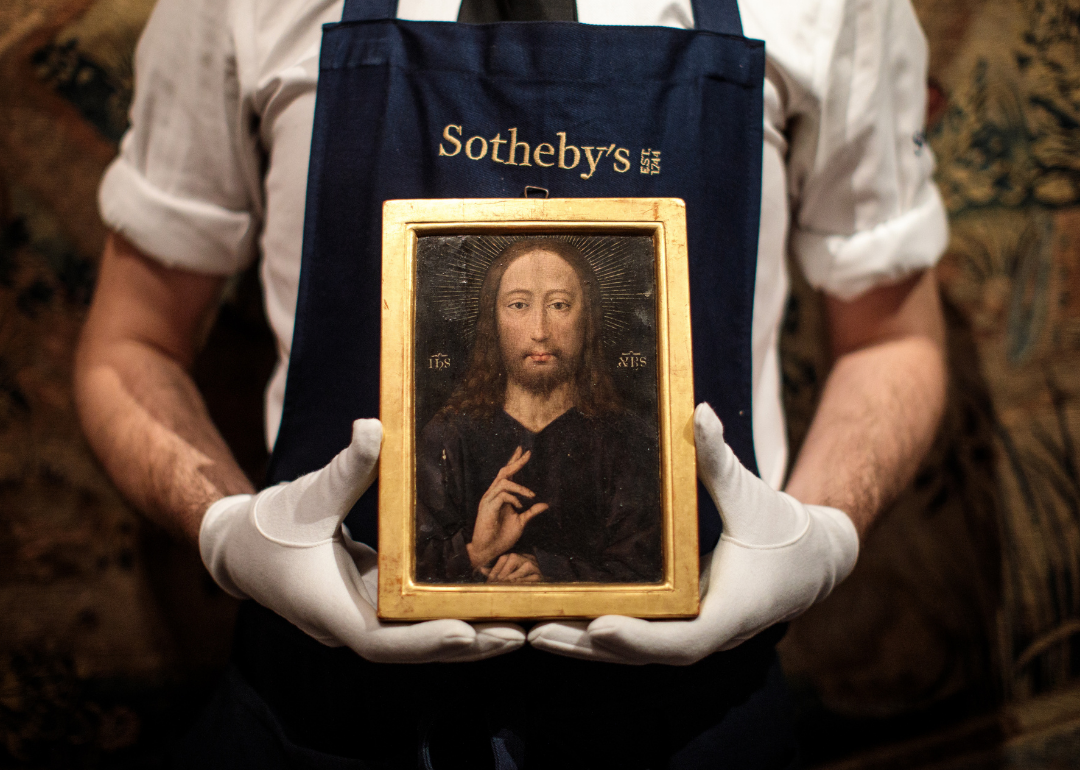
2017: Sale of Leonardo da Vinci’s ‘Salvator Mundi’ shatters records
Believed for years to be the product of his atelier, or even a copy of a lost work by the Renaissance master Leonardo da Vinci, “Salvator Mundi” sold at auction November 2017 for a cool $450.3 million that the painting was, in fact, the work of da Vinci. The diminutive panel disappeared from public view immediately after it was purchased by an anonymous bidder.
2018: Obama portraits unveiled
The long-awaited official portraits of Barack and Michelle Obama were when they debuted at the National Portrait Gallery in 2018. Painted by African American artists Kehinde Whiley and Amy Sherald, respectively, the canvases drew unprecedented crowds of enthusiastic viewers.
2019: Jeff Koons’ 'Rabbit' breaks auction record for a living artist
“Rabbit,” a stainless steel sculpture by art phenomenon Jeff Koons, at Christie's in 2019. The cartoonish image, created in 1986, prefigures the popular “balloon” animals from Koons' 1990s “Celebration” series.
2020: Confederate statues removed from Capitol Hill
Shortly after the killing of George Floyd in 2020 and the ensuing rise of the Black Lives Matter movement, Congress voted to remove statues of Confederate leaders from Capitol Hill. In December of 2020 the last of these—depicting the likeness of Robert E. Lee—was finally .