Famous works of art from 30 countries around the world
Famous works of art from 30 countries around the world
Unlike nations, art knows no boundaries. It can be forged in a vacuum, inspired solely by a burning, inner conflict, or created by wistful expatriates wishing to bridge a long-lost past with an uncertain future. It can emerge organically, in harmony with the natural landscape, or as a carefully crafted response to cultural or political touchstones.
Museums and private collections heave with such works, yet only a select few demonstrate a rare confluence of intent, emotion, and artistic genius. These masterpieces are seared into the collective consciousness, reproduced in varying sizes and shapes on walls, stationary, and coffee mugs the world over.
Traditionally, art history has sought to neatly categorize a multitude of overlapping movements and styles, geography and epochs–Impressionism, Antiquity, Romanticism, Realism, and the Middle Ages, to name just a few. Borders, however, are frequently fluid, artists often itinerant and occasionally anonymous.
With this in mind, Â鶹ԭ´´ took on the task of curating this list of 30 famous works of art from 30 countries around the globe, consulting internet databases and museum websites as well as scholarly books and journals. Residence in a given museum or collection alone was not deemed reason enough for inclusion (in addition to being a source of contention among several nations). Selected works had to express or reflect a direct relationship between the artist and their country of birth, the object and its place of production. Vincent van Gogh may be the Netherlands' most well-known artist, but most of his masterworks depict French rather than Dutch subjects. Ceremonial objects created by Pre-Columbian societies, however, speak volumes about these lost cultures.
Scroll through the list to see which masterworks made the final cut, and find out which images changed the course of Korean painting, depict a dream-like vision of an Eastern European shtetl, or were inspired by a Pagan fertility ritual.
'At the Moulin Rouge, The Dance' by Henri de Toulouse-Lautrec
– France, 1890
Although an aristocrat by birth, Toulouse-Lautrec’s work captures the grit and glamour of working-class nightlife in Belle Époque Paris. Local performers and personalities inhabit his canvases, underscoring the artist’s inimitable brand of post-impressionist realism. Here, “,” a Moulin Rouge veteran, instructs a new dancer in the art of the can-can.
'Bust of Nefertiti' by Thutmose
– Egypt, c. 1345 B.C.
This striking portrait bust of the enigmatic Egyptian queen is believed to have been executed by . Uncovered during the 1912 excavation headed by , the painted limestone sculpture continues to be exhibited in Berlin’s Neues Museum to return the celebrated work to its homeland.
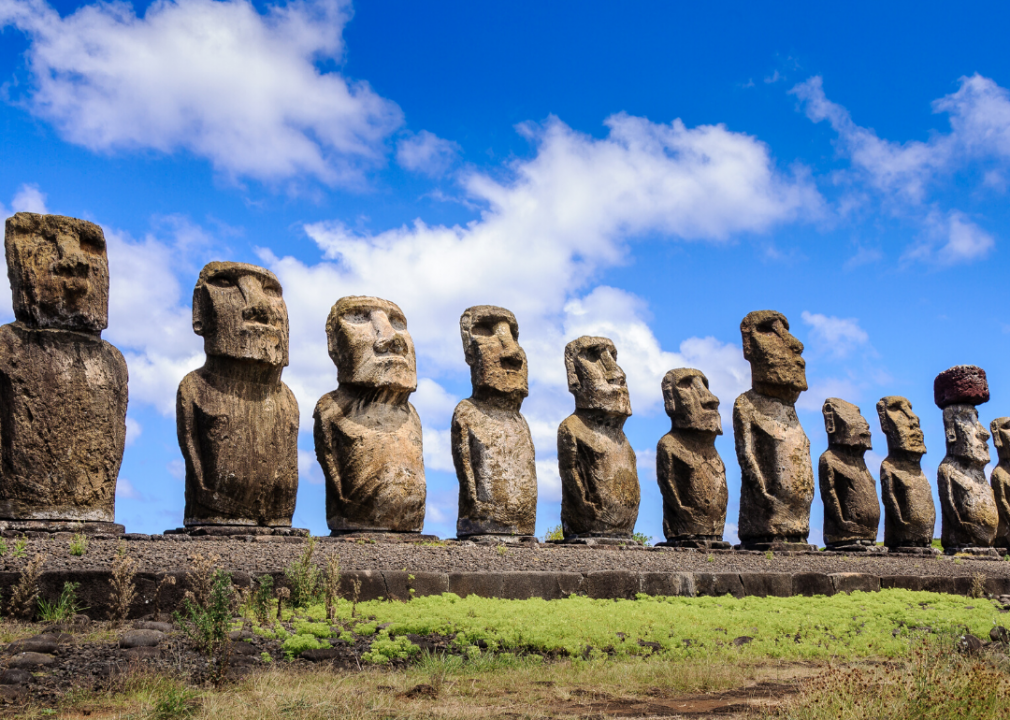
Easter Island Statues
– Easter Island, c.1100–1300 A.D.
Over 300 monumental stone visages hover over the South Pacific Easter Island’s coastline. Characterized by rectangular heads, large eye sockets, and broad noses, the sculptures also have lengthy . Although their original purpose is unknown, it has been suggested that the carvings represent .
'Self Portrait with Thorn Necklace and Hummingbird' by Frida Kahlo
– Mexico, 1940
Frida Kahlo produced during her prolific career, merging a personal iconography of pain and loss with potent symbols of her Mexican heritage. “Self Portrait with Thorn Necklace and Hummingbird” depicts Kahlo in a lush jungle wearing a necklace made of thorns. The artistic process served as a cathartic outlet for Kahlo’s traumatic split from fellow artist Diego Rivera.
'The Great Wave off Kanagawa' by Katsushika Hokusai
– Japan, 1831
One of the most celebrated works in Japanese art, "The Great Wave off Kanagawa" is part of a series of block prints known as the "Thirty-Six Views of Mount Fuji." at the tender age of 6, and is believed to have been in his 70s when he created his masterpiece.
'The Art of Painting' by Jan Vermeer
– The Netherlands, 1666
It’s estimated that a staggering during the 17th century, a period dubbed by art historians as the Dutch Golden Age. No work represents this era more ambitiously than Jan Vermeer’s “The Art of Painting.” The image depicts the painter, his back to the viewer, capturing the likeness of a comely , the muse of history.
'The Lady of Shalott' by John William Waterhouse
– England, 1888
The Pre-Raphaelite Brotherhood, a 19th-century English aesthetic movement, were drawn to religious and literary subjects painted in a highly realistic manner. Waterhouse’s “The Lady of Shalott” based on a medieval Arthurian legend. The landscape was painted by the artist en plein air in the English countryside.
'Karin by the Shore' by Carl Larsson
– Sweden, 1908
Dubbed the Norman Rockwell of Sweden, Carl Larsson is famous for his warm-hearted representations of middle-class Swedes engaged in work and play. This watercolor depicts Larsson’s wife walking pensively along the banks of the Sundborn River. The , dressed in local costume, occupies the rowboat to the right of the scene, together with the family dog.
Nok Sculpture of a Seated Man
– Nigeria, c.500 B.C.–500 A.D.
Some of the most striking examples of Nigerian art were produced by the Nok civilization approximately 2,000 years ago. This terracotta figure, now in the Louvre, exhibits the oversized head and bold, .
'Guernica' by Pablo Picasso
– Spain, 1937
Few paintings pack the political or emotional punch of "Guernica"—an anguished testament to the Nazi bombing of the eponymous Basque town at the request of Spanish Nationalists. Commissioned by the Spanish Republican Government for the 1937 Paris World's Fair, the monumental canvas brought the to international attention.
Clonmacnoise Cross of the Scriptures
– Ireland, c. 900
Distinguished by its circular center and intricate carving, this sandstone cross is one of the most celebrated examples of Celtic iconography in Ireland. An inscription , a medieval Irish king, and Colman, possibly an abbot of Clonmacnoise who commissioned the cross.
'The Slav Epic' by Alphonse Mucha
– The Czech Republic, 1910–1928
Art Nouveau legend Alphonse Mucha was born in Moravia but spent his early career in Paris creating celebrated art posters. In 1910 he returned to what is now the Czech Republic for the express purpose of painting 20 monumental canvases celebrating the history and folklore of the Slavic people. His monumental work was finished in 1928 and to the city of Prague.
Bodhisattva Padmapani, Ajanta Caves
– India, 1st century A.D.
This iconic image of the Bodhisattva Padmapani () is part of an elaborate series of paintings covering the walls of a cave complex in Maharashtra. A former Buddish monastery, the Ajanta Caves are now a UNESCO World Heritage site.
'I and the Village' by Marc Chagall
– Belarus, 1911
Born Moishe Shagal, modernist Marc Chagall received his artistic training in Paris and St. Petersburg, yet never forgot his roots on a Belarussian shtetl. “I and the Village,” a mesmerizing evocation of Chagall’s homeland, employs the artist’s trademark primary hued palette.
'Aphrodite of Milos' by Alexandros of Antioch
– Greece, c. 100 A.D.
Also known as the "Venus de Milo," this graceful marble sculpture was produced during the Hellenistic period. One of the most recognizable images in the canon of Western art, the sinuous sculpture's identity nevertheless remains a mystery. She may represent Aphrodite, the Greek goddess of love, or Amphitrite, a sea goddess worshipped on the island of Melos.
Terra Cotta Army
– China, 3rd century B.C.
In 1974, a group of farmers digging a well stumbled upon a lifesize, clay figure. Subsequent archaeological excavations uncovered a cache of , created to guard Qin Shi Huang, China’s first emperor, in the afterlife.
'The Scream' by Edvard Munch
– Norway, 1893
Popularly known as “The Scream,” Munch’s surrealist icon was originally titled “The Shriek of Nature” and was inspired by a disturbing vision the artist experienced while walking in the Norwegian countryside. Munch executed several versions of “The Scream,” .
'Dancing in Colombia' by Fernando Botero
– Colombia, 1980
Contemporary artist Fernando Botero is famous for his corpulent subjects, including the colorful cast of characters depicted in “Dancing in Colombia.” In addition to scenes of everyday life, Botero is also well known for his zaftig renderings of the "Mona Lisa" and Pablo Escobar. In 2000, —including 123 of his own—to the Banco de la República, which are now housed in the Museo Botero in Bogotá.
'Two Men Contemplating the Moon' by Caspar David Friedrich
– Germany, 1825–30
A titan of German Romanticism, Caspar David Friedrich specialized in allegorical landscapes populated by pensive youths. “Two Men Contemplating the Moon” is a joint portrait of the artist and his friend and disciple, August Heinrich. , twice during Heinrich’s lifetime, and later this work, executed after his death in 1824.
Gold Mask of the Sun God Inti
– Ecuador, 500 B.C.–500 A.D.
This mask represents Inti, the Incan sun god, believed by worshippers to sweat gold. Now in the National Museum of Ecuador, it displays the easily recognizable block-like geometric forms characteristic of Incan art.
'The Last Supper' by Leonardo da Vinci
– Italy, 1498
Aptly located in the dining hall of a Milanese convent, Da Vinci’s “Last Supper” is one of the most famous images in Western art, yet survives only thanks to intense restoration. Art aficionados wishing to get a glimpse of the 15-by-29-foot wall painting in person should book well in advance; admission is limited to small groups with viewings capped at just 15 minutes.
'Illustration from the Khamsah of Nizami' by Sultan Muhammad
– Iran, 1539–43
Persian miniature master Sultan Muhammad is known for his exquisite manuscript illustrations, including this miniature . Although the representation of human and animal forms was prohibited by Islam, exceptions were made for a small number of literary works. This remarkable manuscript was commissioned by Shah Tahmasp, who was also the artist’s pupil.
'The Kiss' by Gustav Klimt
– Austria, 1908
A glittering jewel in the Art Nouveau crown, Secessionist master Gustav Klimt unveiled his celebrated painting of the entwined lovers during the height of his “.” Although prudish Edwardian audiences initially denounced the painting for its unapologetic eroticism, it at the time.
'American Gothic' by Grant Wood
– United States, 1930
, Grant Wood returned to America’s heartland where he completed his Depression era masterpiece. The term “American Gothic” refers not only to the poker-faced couple, but also the arched windows behind the couple, an architectural element popularized in the latter half of the 19th century.
'The Empire of Light II' by Rene Magritte
– Belgium, 1950
painted by Surrealist legend Rene Magritte, "The Empire of Light II" juxtaposes a sleepy row of traditional homes with a blue sky suggestive of midday. It has been suggested that the street scene was modeled on Magritte's own address in Brussels.
'Holy Trinity Icon' by Andrei Rublev
– Russia, 1411–1425
Andrei Rublev’s “Holy Trinity” is, quite literally, the most iconic of all extant Russian icons—a tradition of diminutive, portable religious painting. The Russian Orthodox Church canonized Rublev, a member of the monastic community of St. Sergius outside Moscow, in 1988.
'After Rain at Mt. Inwang' by Jeong Seon
– Korea, 1751
Korea’s most influential “true-view” painter, , capturing local landscapes in ink and watercolor. His breezy, lyrical style rejected the pre-existing stylized aesthetic, influencing Korean artists for generations.
Gunda Gende Gospels
– Ethiopia, 16th century
This elaborate manuscript was illustrated in the scriptorium of the Gunda Gunde Monastery, known for its distinctive palette and stylized figures with large, expressive eyes. The text is written in .
'The Wassail' by Charles Rennie Mackintosh
– Scotland, 1900
This delicate gesso wall panel, designed by Scottish Art Nouveau phenomenon Charles Rennie Mackintosh, depicts the ancient tradition of wassailing—. The frieze originally graced the Ladies’ Luncheon Room in Glasgow’s Miss Cranston’s Ingram Street Tearooms, and was part of a larger remodel of the premises by Mackintosh and his future wife, Margaret Macdonald.
Mosaic Depicting John Komnenos and Irene of Hungary
– Turkey, 1118 A.D.
This mosaic from the south gallery of Istanbul's magnificent Hagia Sophia commemorates an important political alliance between East and West—the . Created from tiny, glittering glass tesserae, the image depicts the imperial couple presenting gifts to the central figures of the Virgin Mary and the infant Christ.