Most men want a return to traditional gender roles, but women aren’t so sure
Bill Jennings, a 69-year-old libertarian who lives in Daytona Beach, Florida, said his mother and wife both worked outside the home, but he has been impressed by the younger generation of women in his family who are homeschooling their children.
“Both parents should participate in raising children, but I’m thinking more that the man is typically the breadwinner and the female is more focused on the home and raising children,” Jennings told . “I know it sounds old-fashioned.”
Half of respondents to a new said they believe, like Jennings, that society would benefit from a return to traditional gender roles. Men were more likely than women to want a return to traditional gender roles, however — nearly 6 in 10 of them agreed with that, compared with 4 in 10 women.
“I’m not taking a hard line that ‘the woman’s place is in the home,’ but I just think the traditional roles are generally better — our traditional cultural, Western cultural roles are better for the family and for children,” Jennings said.
The new data on Americans’ views on gender roles comes amid the high-profile , who often argued to his audience of younger Americans that men should be providers and leaders in their homes, while young women should cherish marriage and children over careers. Erika Kirk, Charlie Kirk’s widow has as the CEO of the company he helped found.
While Gen Z men were less likely than men of older generations to agree at 54 percent, the gap between Gen Z men and women was 19 points, illustrating the ways in which younger Americans are diverging when it comes to culture and politics.
Women of both parties were less likely to support a return to traditional gender roles than men. Support for a return to traditional gender roles was highest among Republican men at 87 percent, followed by Republican women at 79 percent. Democratic women were the least likely to support a return to traditional gender roles — 21 percent do, compared with 26 percent of Democratic men.
Another notable gender divide exists between men and women who are married and who are parenting. Married men support the premise, at 62 percent, compared with fewer than half of married women, at 47 percent. Sixty-seven percent of dads support a return to traditional gender roles, compared with 52 percent of moms.
Divorced men were most likely to think that society would benefit from a return to traditional gender roles, at 67 percent. Women who have never been married were the least likely to agree, at 37 percent.
conducted this poll online from Sept. 8 to 15 among a national sample of 20,807 U.S. adults, with a modeled error estimate of plus or minus 1 percentage point.
Eve Rodsky, a lawyer specializing in organizational management who has become a prominent advocate for fair labor division in the home, said many Americans have long yearned for an idyllic “Leave it to Beaver” lifestyle. The being promoted by Republicans in power — and on full display following the death of Kirk — will only turbocharge those long-standing yearnings, Rodsky said.
“This idea of women being at home is so strong that I would have been shocked if I saw something different in the data,” said Rodsky, the author of “,” a book and card game designed to guide couples through domestic divisions of labor. “It is in our lore.”
The survey showed stark religious divides: More than three-quarters of evangelical Christians — 77 percent — agree with a return to traditional gender roles, compared with 54 percent of non-evangelical Christians, 32 percent of Jewish people, and 15 percent of atheist or agnostic people.
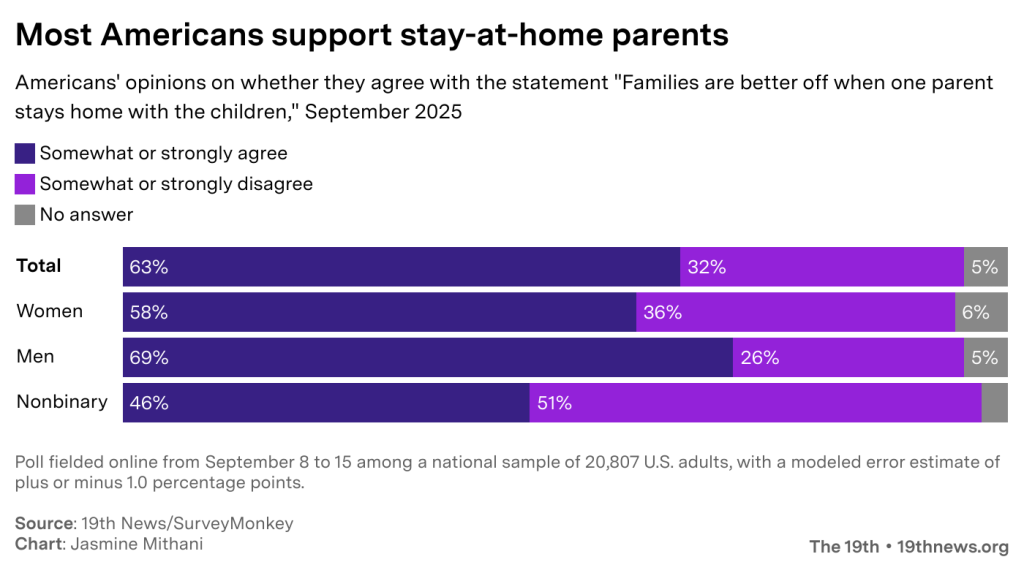
The survey also asked Americans whether or not they agree with the statement, “Families are better off when one parent stays home with the children.” A net 63 percent of Americans agreed, including 69 percent of men and 58 percent of women.
Holly Ann Zuercher, a 71-year-old Republican in Florida, also responded to the survey and said at least one parent should stay home for the sake of the children. She said she and her sister were raised in a home with a dad who worked full-time and a mom who stayed home full-time for about a decade before returning to work part-time.
“A lot of our kids have gone off the rails because they don’t have proper parenting. The parents are too busy and don’t have time to devote to help teach the children all the values and things they should be teaching them,” Zuercher said. “And on the weekends, they’re so tired taking care of things around the house and the kids don’t get the quality time with parents that they should get.”
Zuercher acknowledged that rising costs have made it difficult for many families to make ends meet without both parents working full-time. She herself went back to work when her daughter was less than two years old but was able to leave her with a good friend who was a stay-at-home mom.
“I’m not sure if there’s a policy that would fix the situation or make it better: Things are expensive, housing and child care,” Zuercher said. “There isn’t always a grandparent that can take over and the influence of some teachers doesn’t really go with the ideals of parents. Kids are suffering.”
Both Jennings and Zuercher were among the 66 percent of those who say it’s better for a parent to stay home with children — including majorities of men, women, Republicans and Democrats — who said whichever parent wants to stay home should be the one to stay home.
Those views appear to conflict with the large share of Americans who want a return to traditional gender roles, where the woman is the primary caretaker of children.
“It’s difficult to say in every instance that the mother should be the primary person to stay at home,” Jennings said, adding that “by and large, that’s the case.”
Rodsky said that given the realities of women in the workforce — occupational segregation, lack of paid leave, the pay gap between men and women, for example — Americans who say either parent can stay in the home are likely doing so with the assumption that, more often than not, in heterosexual couples, it will be the woman.
“I think you can say women without having to say women,” Rodsky said. “It’s almost always going to be women.”
Americans’ yearning for a return to traditional gender roles is crucial to understanding why the United States lags behind other wealthy countries in policies like paid parental leave and universal child care. “It’s going to be very, very hard to implement policies that buck that aspirational trend,” she said.
Rodsky said that traditional gender roles, or gender specialization, while an ideal for many Americans, particularly men, is out of reach for more than two-thirds of families because of income inequality, which is only growing.
Kaylia Artis, a 24-year-old from Virginia, said her husband wants her to stay home full-time to watch their children, ages 2 and 6. But she works as a nurse at a hospital and is employed in another part-time retail role, and she said the family cannot afford for her to stop working. Not to mention, she said, she really enjoys it.
“The way things are changing, we both need to be working because we got to be able to pay the rent, the lights, the water, the gas, anything the kids might need, the car,” Artis said. “But my husband’s telling me he’d prefer me to just cook, clean, do everything at home. And I’m like, respectfully, I’m just not that kind of woman.”
Artis believes whichever parent wants to stay home should. But in her specific situation, Artis said she can’t imagine her husband taking over all of the household duties from her.
“Women are being asked to do too much and take on everything,” Artis said. “Us moms are the main ones taking sacrifices for our kids. It’s mainly us women that are leaving or quitting jobs or have to leave work early or have to change our hours a certain way to get the kids or take them to school. We’re making the kids’ appointments, going to the schools and participating in everything.”
was produced by and reviewed and distributed by Â鶹ԭ´´.