These museums are teaching us about how our cities work
These museums are teaching us about how our cities work
When Hurricane Ida hit New York City in 2021, water pipes in Queens were already backed up, and the heavy rain caused severe flooding, killing .
How do these pipes work, and what made them so vulnerable to the floods? What were the engineering, urban planning, and policy decisions that led to these scenes of devastation? digs into these questions and more ahead.
New York Hall of Science’s newest exhibit , located just blocks from where the deadliest flooding from Hurricane Ida occurred, was designed to answer these questions — and help residents understand the urban infrastructure that quietly shapes their lives. It’s one of a growing number of museum exhibits and public education projects working to inform communities about the inner workings of their cities.
Opened just shy of a month, CityWorks explores transportation, water and wastewater, sanitation, construction, and urban development to show how these four main infrastructure systems are imperative to keeping cities like New York City running. Since its opening on May 3, there have been about 20,000 visitors.
“We want this exhibit to be a platform for conversation on how the city could run in the future,” says Katie Culp, New York Hall of Science’s Chief Learning Officer. When infrastructure is working well, it rarely goes noticed, she notes. But this exhibit is helping residents gain insight into the invisible happenings behind the scenes — and understand how they can help improve it.
Culp, who’s been with the science museum for a decade, says this is the largest exhibit she’s worked on so far. The exhibit is hands-on and interaction-first, Culp says, and designed to be accessible to all ages. All audio recordings explaining each interactive piece come in both English and Spanish.
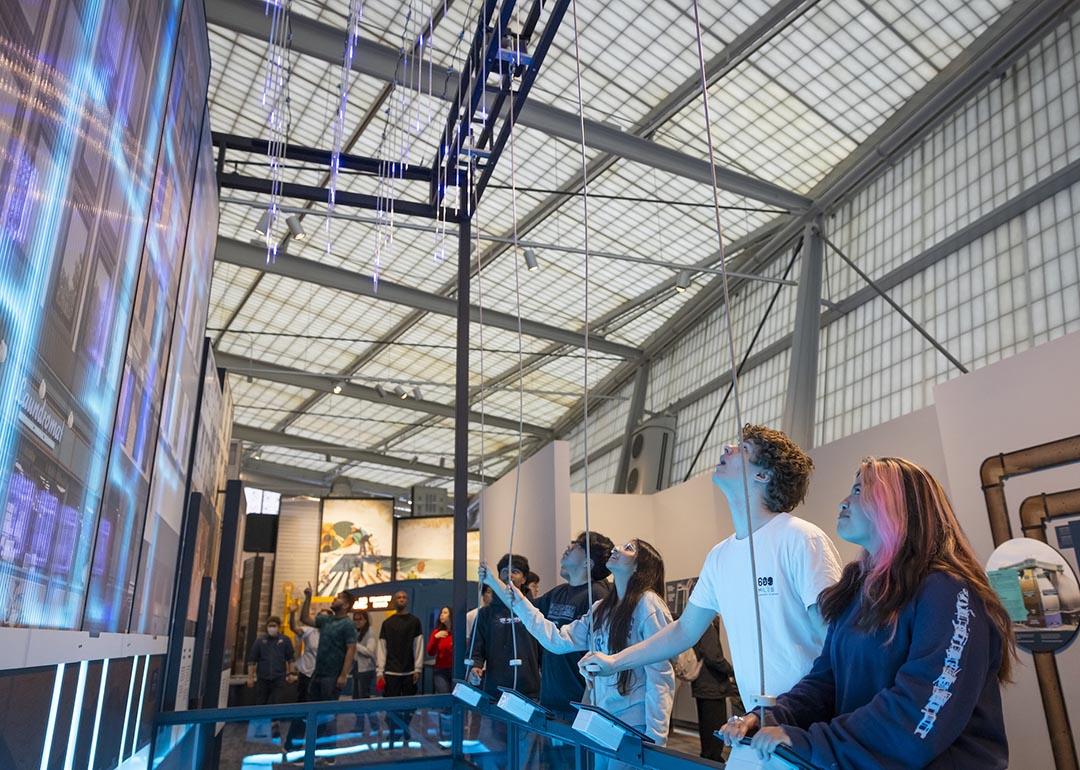
One of the first installations is the interactive flood mapping installation. Hologram pipes flow across a 16-foot-high replica of a block of apartment buildings to show how rainwater and household wastewater can lead to the city’s sewage system overflowing.
The pipes begin on the fifth floor and trickle across each building level, demonstrating the water system’s anatomy. The water is controlled by the participant pulling on the cord in front of them: The harder you pull on the cord, the more water fills the apartment building pipes, allowing the viewer to see firsthand how flooding can occur.
While experimenting with the exhibit’s interactive water piece, Culp explains how New York City’s water system — a combined — is immovable. While the current system can’t be changed, the idea behind this interactive piece is to begin a conversation around what additions could be made to improve the existing water system.
“How do we create change when some decisions that were made in the past have very long-term consequences on our city’s water infrastructure?” Culp says. “The more you understand as a resident, the more you’ll understand as a current citizen, the more you can advocate from a real position of understanding for whatever your goals are for the community.”
Infrastructure isn’t only technical, it’s personal, Culp explains. CityWorks designers aimed to focus on the jobs that real people are doing every day to make New York City function and run, and to spark a conversation about new solutions to improve the infrastructure that keeps New York City running.
“That’s exactly the kind of complexity that we want to represent,” Culp says. “There are examples of incredibly creative, innovative, responsive, powerful development that is actually making the city better, both to live in and for its resilience for the future. And there are things that we haven’t addressed yet.”
New forms of engagement
According to Betsy Loring, who has worked in children’s and science museums for the last two decades, there’s been a notable increase in museums producing exhibitions focused on urban planning.
“We’re an untapped resource,” says Loring, who spent the first 25 years of her career as a waste management planner before pivoting to . “We’re also really good at getting people engaged in these really important topics, like urban heat islands and the impact of design.”
Loring found herself at the intersection of urban planning and museums when designing the permanent at the EcoTarium museum in Worcester, Massachusetts. The interactive exhibit gives participants the chance to build their ideal neighborhood. Participants could even shine a light on their completed neighborhood, learn firsthand how heat can affect a community, and then recreate their neighborhood to account for such factors. The city-building component was a hit, frequently keeping participants engaged for 20 to 30 minutes.
“We normally measure successful engagement in seconds and minutes,” Loring says. “So if somebody stays two minutes, that’s huge … They go to play and have fun and take pictures, but people would design their ideal neighborhood for like 20 minutes and then compare what each family member thought was ideal.”
That makes interactive exhibits a powerful way to get residents who wouldn’t normally attend community board meetings to understand their community and the city’s infrastructure choices – and offer feedback.
In San Francisco, the Exploratorium museum and the city’s planning department and Mayor’s Office for Innovation on interactive science exhibits in public spaces. The Science Museum of Virginia designed a community heat mapping project, , local youth reported a 16-degree Fahrenheit difference in temperature between the coolest and hottest neighborhoods in Richmond, Virginia. City planners incorporated this data into the city’s inaugural .
Loring says exhibits like CityWorks work because museumgoers can help facilitate effective, multigenerational conversations.
“Normally, when people talk about trusted messengers, they’re talking about the hair stylist or the barber. They’re talking about the minister,” Loring says. In fact, she argues, the most trusted messengers for most people are one’s own family and friends. But many people don’t discuss issues such as climate, zoning, and city infrastructure in their social circle.
“People feel like they should be doing something, but they don’t think that everybody else in their circle thinks that they should be doing something,” Loring explains. “When people come to museums, we can get people talking.”
Exhibits like CityWorks “are really good at getting people very engaged in a multi-generational way, on complex topics, and thinking about how it applies to their lives,” Loring says. If residents can understand how city infrastructure has gotten to where it is in a specific community, she suggests, cities may not make the same mistakes in the future.
“Getting people to realize that there have been decisions that have been made and some of those decisions can be undone — like, why don’t we have enough housing? Why are some neighborhoods hotter? Those were all decisions or lack of decisions, and you have a right to have a say in how that goes,” Loring says.
“It’s really about the future pipeline of voters, of community members, and of students and future workers.”
This story was produced through our , which is made possible with funding from the Robert Wood Johnson Foundation.
was produced by , a nonprofit newsroom covering solutions for equitable cities, and reviewed and distributed by Â鶹ԭ´´.