Rethinking anti-aging: The increasing presence of organic products in global beauty markets
Anti-aging is no longer a race to erase; it鈥檚 a strategy for dermal survival. For today鈥檚 consumer, aggressive "correction" is out, and long-term barrier support is in.
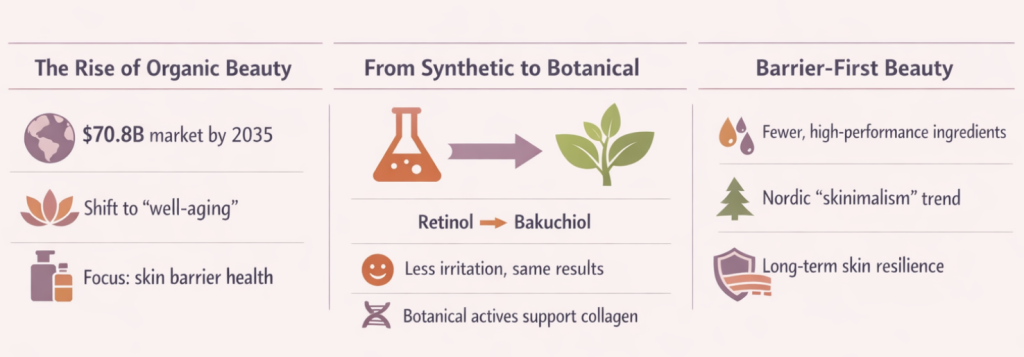
projects the natural beauty sector will reach $70.8 billion by 2035, carving out a significant slice of the $831 billion global cosmetics industry. As users ditch immediate inflammation in favor of cellular health, "well-aging" has emerged as the definitive industry standard, reports.
The Rise of N-Beauty and Minimalist Extraction
The global market is currently dominated by three regional philosophies: K-beauty (Korean), J-beauty (Japanese), and the emerging N-beauty (Nordic). While emphasize multi-step rituals and hydration, Nordic-inspired skincare focuses on skinimalism, or the use of fewer, more potent ingredients designed to withstand environmental stressors.
This shift toward resilience is driving interest in brands that focus on minimalist formulations utilizing ingredients native to the Nordic regions.
These botanicals are harvested for their natural resistance to extreme sub-arctic climates and high UV exposure during summer months, offering a high concentration of antioxidants and fatty acids.
This resilient-ingredient model serves a growing market segment that is moving away from complex routines in favor of streamlined, high-performance products that strengthen the skin鈥檚 self-repair mechanisms.
Defining High-Performance Organics
The modern organic sector has moved beyond simple botanical mixtures to high-performance formulations. These products use certified organic raw materials processed through advanced biotechnology to achieve clinical-grade outcomes.
This involves isolating specific botanical compounds to trigger the same cellular pathways typically targeted by synthetic ingredients, such as collagen synthesis and elastin production, but with higher dermal compatibility. By focusing on bio-active molecules, gadget-free well-aging allows consumers to achieve measurable results without the risk of long-term sensitivity.
The Retinol vs. Bakuchiol Comparison
The most prominent example of this shift is the transition from .
While retinol remains a primary anti-aging treatment, clinical research published in highlighted that Bakuchiol acts as a potent inflammatory modulator, significantly reducing redness-inducing cytokines that synthetic vitamin A can sometimes trigger.
Unlike synthetic retinol, which is synthesized in a laboratory and often causes an initial inflammatory response characterized by scaling and purging, Bakuchiol is a plant-based ingredient obtained from the Psoralea corylifolia plant. Still, the compound used in high-performance skincare undergoes a sophisticated molecular extraction process to achieve 99% purity.
This ensures that the final formulation delivers the same gene-expression patterns as retinol鈥攕timulating the production of Type I, III, and IV collagen鈥攚hile maintaining the skin鈥檚 moisture levels and avoiding the inflammatory markers common in traditional retinoid use.
The Pro-Inflammatory Risk of Synthetic Hyaluronic Acid
While Hyaluronic Acid (HA) is a staple in most moisturizers, the method of production dictates the skin's biological response. Synthetic HA is typically produced via bacterial fermentation. To increase penetration, labs often utilize Low Molecular Weight (LMW) HA.
However, emerging research in dermatological science suggests that LMW HA can act as a pro-inflammatory signaling molecule, essentially "tricking" the skin into a state of low-grade chronic inflammation. Over time, this can actually accelerate collagen degradation.
Conversely, botanical HA offers a distinct biological synergy. Derived from the Tremella fuciformis fungus, this polysaccharide provides a high-performance alternative to lab-grown variants.
Analysis from the confirms the compound can hold 500 times its weight in water, but its structural advantage is equally significant. Because its molecular particles are naturally smaller than synthetic equivalents, it facilitates deeper dermal penetration. This ensures moisture delivery without the pro-inflammatory 鈥榮ignaling鈥� risk typically associated with synthetic low-molecular-weight (LMW) versions.
The Future of Barrier-Centric Beauty
The transition toward organic anti-aging represents a shift in how consumers manage dermal health. By prioritizing the skin鈥檚 long-term integrity over the pursuit of instant fixes, the industry is aligning with a more sustainable and biological approach to aging.
was produced by and reviewed and distributed by 麻豆原创.