12 original companies in the Dow Jones Industrial Average (and what happened to them)
12 original companies in the Dow Jones Industrial Average (and what happened to them)
The Dow Jones Industrial Average, today's primary indicator for the well-being of the stock market in the United States, was created in the 1880s as a daily newsletter put out by financial reporters Charles Dow and Edward Jones. Their company, Dow Jones & Co., produced the Customer's Afternoon Letter, a recap of the day's events on the stock market.
That contained the average stock prices for a grouping of 12 businesses: 10 railroads and two industrial companies. The original index was reconstituted into the (changed to the Dow Jones Transportation Average in the 1970s to be more inclusive of modes of transport), while a new stocks index called the was added in 1896 to cover 12 non-railroad companies. Dow Jones & Co.'s indexes were essential reading for investors at the time, who had trouble finding reliable information about a company's finances without that information being corrupted or hidden by the companies themselves. Today, the Transportation Average is the oldest stock index still in use, second only to the DJIA.
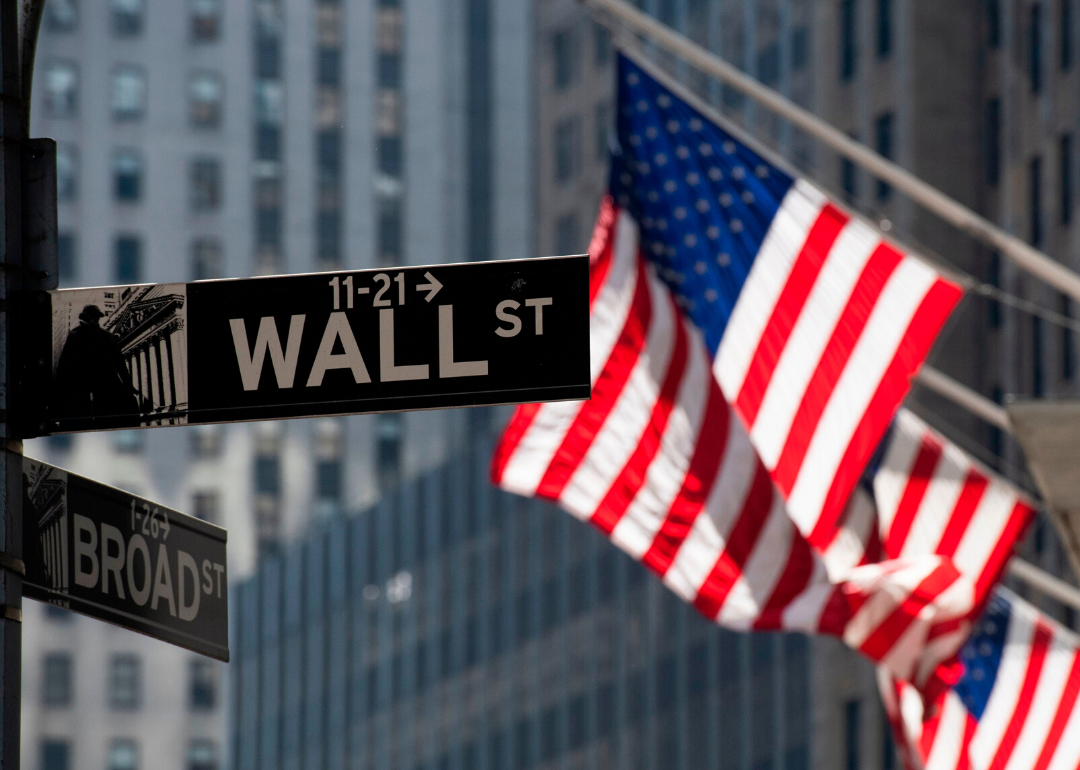
Dow Jones & Co. turned its newsletter into a newspaper in 1889 and called it the Wall Street Journal. The company published its first official Industrial Average May 26, 1896, with a value of 40.94, meaning the average share price of the 12 companies on the index was $40.94. Today, the DJIA contains 30 companies and .
麻豆原创 compiled a list of the 12 original companies that appeared in the Dow Jones Industrial Average (DJIA) from . Along with each slide, you'll find each company's history prior to being added in 1896, and what happened since that day. Some of the original Dow Dozen lasted only a few years, either falling victim to changes in the market or the Sherman Antitrust Act of 1890, which put an end to a couple of these companies.
Only one of those on the following list still exists under the same name today and remains the only company to be included in the Dow for 100 consecutive years. Keep reading to find out the 12 original companies in the Dow Jones Industrial Average and what happened to them.
You may also like:
1896: American Cotton Oil Company
The American Cotton Oil Company traces its roots to a trust established in the 1880s by a group of Texas and Arkansas cotton mill owners looking to regulate the price of seed. An antitrust lawsuit in Louisiana forced the trust to be dissolved, and the American Cotton Oil Company was born. It would remain on the Dow Jones Industrial Average until 1901.
2021: Part of Unilever
American Cotton Oil was absorbed in 1929 and the name Best Foods merged with Corn Products Company in 1958, before split into Ingredion and Bestfoods in 1997. In 2000 , which also includes the Skippy Peanut Butter and Knorr Soups brands, for $24.3 billion.
1896: American Sugar Refining Company
Henry Havemeyer was a third-generation sugar refiner when he founded the in 1891. The company was created when Havemeyer鈥檚 Sugar Trust, a conglomerate of the top refiners, was ordered to be broken up by the New York State Court in 1890. The resulting used the name Domino Sugar beginning in 1900 and remained on the DJIA until 1930.
2021: Domino Foods
and sold in 1988 to Tate & Lyle, which would rename itself the Domino Sugar Corporation. American Sugar Refining purchased the company in 2001, and still operates today as Domino Foods, the The New York City Domino Sugar factory, which was rebuilt following a fire in 1882, continued to refine sugar until it closed and reopened as in 2018.
1896: American Tobacco Company
The American Tobacco Company was who combined five major cigarette producers under one name. Duke had helped revolutionize the tobacco industry in the 1880s by , and the resulting American Tobacco Company controlled nearly 90% of the cigarettes produced in the U.S.
You may also like:
1911: American Tobacco Company broken up by antitrust action
By 1907, American Tobacco had bought up nearly 250 competitors when the federal government filed an action against it under the Sherman Antitrust Act of 1890. In 1911, on the the Supreme Court ordered that the American Tobacco Company be dissolved. The company鈥檚 assets were split among three existing tobacco companies, including R. J. Reynolds, and created a new American Tobacco Co., which rejoined the Dow Jones Industrial Average in 1924, where it remained until 1985.
1896: Chicago Gas Company
The Chicago Gas Company . It spent just two years on the Dow Jones before it was absorbed鈥攁nd replaced on the index鈥攂y regional competitor Peoples Gas Light & Coke Company in 1898. Peoples fell off the Dow Jones in 1915, despite the index expanding from 12 to 20 companies.
2021: Subsidiary of Integrys Energy Group
Peoples Gas that allowed natural gas to be used for industrial purposes for the first time. By 1962, it could heat every home in Chicago and continued expanding with the acquisition of North Shore Natural Gas the following year. Integrys Energy Group purchased Peoples in 2007 and still operates in Illinois today as a subsidiary of Wisconsin-based WEC Energy Group, which bought Integrys in 2015 for $9.1 billion.
1896: Distilling & Cattle Feeding Company
The Distilling & Cattle Feeding Company was organized in Illinois in 1887 as a trust by a group of local distilleries, which would become known as the Whisky Trust. At its peak, the Just a few months after debuting on the Dow, it was reorganized as American Spirits Manufacturing after it was deemed a monopoly by the Illinois Supreme Court in 1895.
2021: Millennium Chemicals
American Spirits Manufacturing would return to the Dow in 1934 as National Distillers following the lifting of Prohibition, where it remained until 1959. The business expanded into chemical and metals manufacturing during that time and . The chemicals aspect of American Spirits would be which would merge with Hanson to create Millennium Chemicals. It remains .
You may also like:
1896: General Electric
A merger in 1892 between Thomas Edison鈥檚 Edison General Electric Company and the competing Thomson-Houston Company produced General Electric. Edison, who had invented the light bulb in the years prior, would step away from the boardroom and return to the laboratory, founding , in 1900. Mergers played significant roles in GE鈥檚 expansion, taking it from an electricity company to one with investments in a wide range of businesses.
2021: General Electric
Since its founding, in the U.S., responsible for introducing the modern train engine, the microwave oven, radio, and television. Branching into financial services in the 1980s would prove profitable until the Great Recession, prompting GE to sell off its financial services arm and return to its industrial roots. GE would bow out of the Dow Jones shortly in 1898 and again in 1901 but would rejoin in 1907 and become the before it was removed again in 2018.
1896: Laclede Gas Company
Laclede Gas Light Company was set up by the Missouri legislature in 1857 with a goal of lighting the streets of St. Louis and providing its residents with access to natural gas. Named for French explorer , who founded the city of St. Louis, Laclede began trading on the New York Stock Exchange in 1889. After debuting in the Dow Dozen, around the city before falling off the Dow Jones index in 1899.
2021: Spire Inc.
The completion of a in the early 1930s and World War II use of coal by-product toluol in TNT, helped the Laclede Gas Company continue to grow. It acquired St. Louis County Gas Company in 1950 and changed the name of the business to Laclede Gas. In 2001, the company became the Laclede Group, followed by a name change to Spire in 2017, and today is
1896: National Lead Company
Founded in Philadelphia in 1772, the conglomeration of smaller lead smelters Twenty-five lead mining companies joined forces to form the National Lead Trust to compete with larger manufacturers while eliminating competition between members. Public concern over trusts saw it
You may also like:
2021: NL Industries
In 1907, the National Lead Company unveiled its most successful brand, Dutch Boy Paint, and while it was removed from the Dow Jones in 1916, the National Lead Company released a corresponding to help ease public concern over lead鈥檚 safety in 1923. On April 15, 1971, the company officially and in 1980 sold the Dutch Boy brand to Sherwin Williams, who still produces the brand.
1896: North American Company
set up North American as a holding company in the 1890s in New Jersey with an eye toward railroads and electric utilities. Villard, a journalist and financier, had previously served as president of both the Northern Pacific Railway (1881-84), and Edison General Electric, the precursor to GE. North American had the lasting just three months on the index.
1946: Broken up by the U.S. Securities and Exchange Commission
The North American Company reentered the Dow Jones in 1928 when it expanded to include 30 businesses but was again replaced in 1930 by The Public Utility Holding Company Act of 1935 banned utility companies from engaging in unregulated activity and gave the Securities and Exchange Commission (SEC) the power to regulate and break up electric holding companies. The in the U.S. Supreme Court but lost its bid to remain solvent on April 1, 1946.
1896: Tennessee Coal, Iron and Railroad Company
The Sewanee Mining Company was formed in 1852 in Tennessee before financial setbacks prompted a series of mergers in 1886 and renaming to the Tennessee Coal, Iron and Railroad Company (TCI). Operations, which had been , where TCI bought up several local coal mines, as well as the , its first step in producing finished steel products.
1907: bought by U.S. Steel
Rapid expansion and changing management brought with it many problems for TCI in the early 20th century: The sent TCI stock tumbling, when U.S. Steel, led by banker J.P. Morgan, agreed to purchase a controlling interest with assurances from President Theodore Roosevelt the deal didn't violate antitrust laws. U.S. Steel, which was the where it remained until 1991,
You may also like:
1896: United States Leather Company
Organized in 1893 in New York City, the United States Leather Company that joined to create one of the largest corporations in the world at the time. Focused on producing tanned leather to be used for the soles of shoes, the Leather Trust, as it would be known, was formed to push back competition from tanneries around Chicago鈥檚 meat-packing district and secure necessary hemlock for the tanning process.
1952: United States Leather Company dissolved
A number of and eventually the dissolution of the United States Leather Company in 1952. Decreased access to hemlock bark, pollution, and advancements in transportation that decreased shipping costs meant tanneries were no longer tethered to nearby bark sources. U.S. Leather was removed from the Dow Jones in 1905 and became the .
1896: United States Rubber Company
The United States Rubber Company was founded in 1892 by nine rubber manufacturers in and around Naugatuck, Conn. One of those companies, the Naugatuck-India Rubber Company, was originally owned by Charles Goodyear, who pioneered the in 1844. United States Rubber Company remained on the Dow Jones Industrial Average until it expanded to 30 business in 1928 and was dropped.
1990: bought by Michelin
The United States Rubber Company would bring the first sneaker to market in 1916, the , which is still available today. It would team up with four other manufacturers in the early 1940s to create after supplies from Southeast Asia had been cut off at the start of World War II. In 1961, the company reorganized under the name Uniroyal, merged with the Goodrich Corporation in 1986, before selling its North American interest to The which doubled as a Ferris Wheel during the 1964-65 New York World鈥檚 Fair, still bears the Uniroyal name in Allen Park, Mich.
You may also like: