
5 hidden causes of workplace slowdowns, and how to fix them
Every company likes to think its operations run smoothly, but even the best-managed teams lose time to hidden workflow issues. shows that two-thirds of executives view their organizations as overly complex and inefficient—a silent drag on productivity and growth.
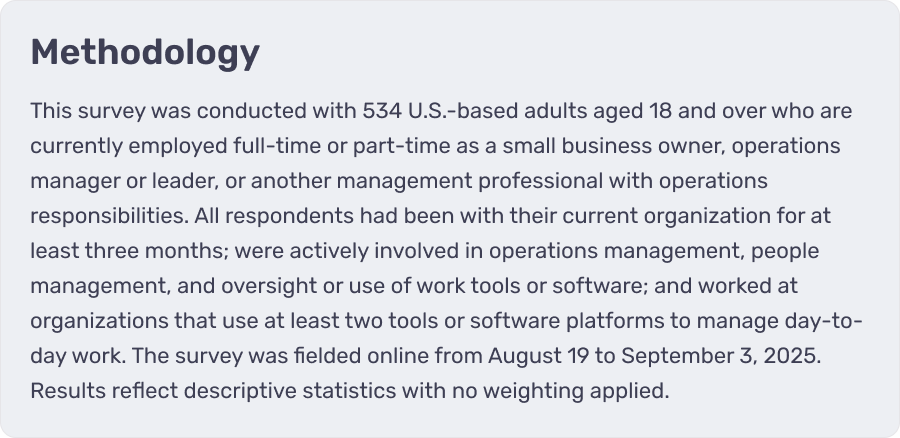
In 2025 survey of more than 500 U.S. operations leaders, 79% said their workflow management is “very” or “extremely” effective. Yet only 4% report that their workflows run without interruptions. For everyone else, everyday breakdowns quietly eat away at productivity, morale, and trust.
Most leaders (80%) say workflow problems have at least a moderate impact on performance. More than half (54%) say they directly hurt productivity, and half say they drag down morale.
So where exactly do things go wrong?
According to the Buddy Punch survey, here are the five biggest workflow problems costing businesses time every week—and how to fix them.
1. Project execution breakdowns derail progress
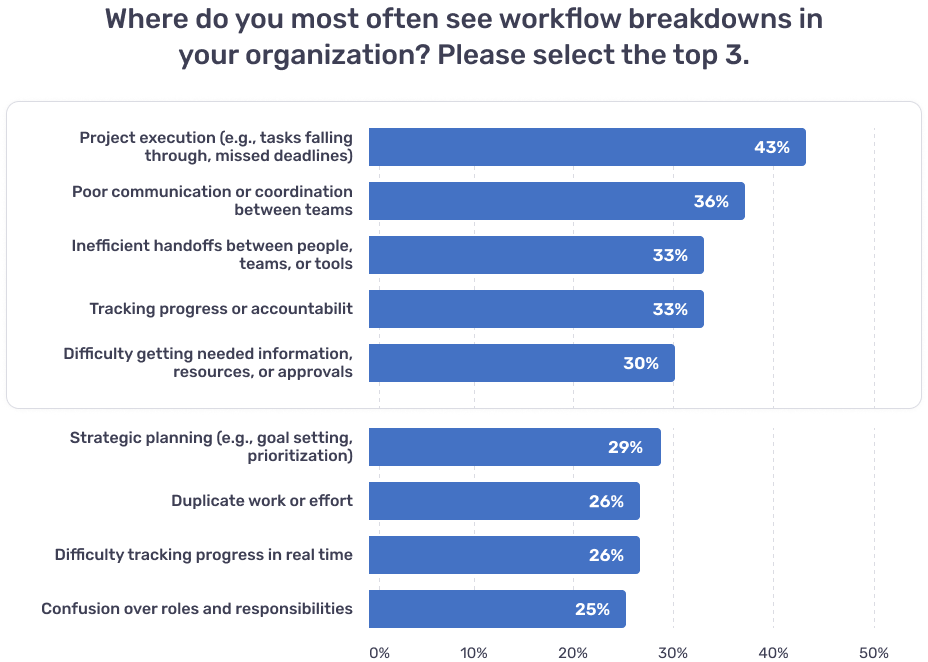
43% of leaders say the biggest workflow breakdowns happen during project execution—when tasks slip through the cracks, deadlines get missed, or no one’s sure who’s responsible for what. These breakdowns can occur in any type of project, from internal initiatives like marketing campaigns or process updates to external client work and product launches. These lapses can ripple through a team, stalling progress and creating unnecessary rework.
Even well-organized businesses often rely on informal task tracking methods—like email threads or spreadsheets—that make it easy for accountability to blur once projects get busy.
With nearly two-thirds of companies (63%) reporting workflow disruptions at least sometimes, it’s clear these breakdowns aren’t one-off mistakes—they’re baked into daily operations.
Fix it: Use clear ownership frameworks to define who’s responsible for each step. Regularly review progress—not to micromanage, but to catch slowdowns early.
2. Communication and coordination chaos
36% point to poor communication between teams as a top workflow killer. Processes may look tidy in a manual or software tool, but in reality, messages get buried, meetings multiply, and coordination falls apart.
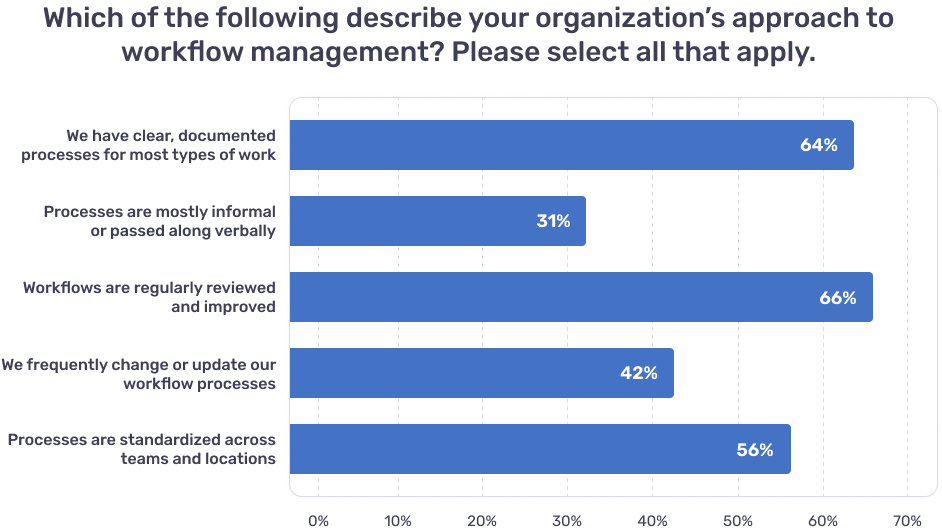
Nearly two-thirds of respondents (64%) say they have documented processes at their businesses, yet nearly one in three (31%) still depend on word-of-mouth communication to get work done. That mix of structure and improvisation creates constant friction and confusion.
Fix it: Pick one central collaboration tool and make it the source of truth. Encourage teams to document decisions in writing rather than rely on verbal updates.
3. Inefficient handoffs stall momentum
A third (33%) of leaders say their biggest pain point is work getting lost during handoffs—the moments when one person finishes a task and another needs to pick it up. These transitions are where small details often slip through, especially when teams use different tools or communicate in separate channels.
For a small business, this might look like a sales lead getting stuck between the person who answers the phone and the one who sends the proposal, or a customer order stalling between production and billing. Even a single missed update or unclear next step can mean rework, delays, or frustrated customers. The challenge is even greater in hybrid or remote setups, where time zones and scattered systems make smooth handoffs harder to manage.
found that only 26% of CEOs have a “future-ready” plan for how work moves between people and systems. For the rest, inefficiency is simply part of the process
Fix it: Create a simple, repeatable process for passing work along. Before anyone hands off a task, make sure the next person knows exactly what’s done, what’s still needed, and who’s responsible for finishing it. For example, a small tech firm might use a shared project board so when a developer finishes a feature, the quality assurance tester automatically gets notified with clear notes and files—preventing delays or confusion about what’s ready for review.
4. Tracking and accountability gaps hide problems until it’s too late
Another 33% of leaders admit their teams lack visibility into progress, making it impossible to spot small issues before they snowball. Limited transparency wastes hours every week. Nearly half (46%) of leaders in our survey estimate their teams lose at least 10% of total work time each week just searching for files, messages, or approvals.
Broader research shows this isn’t unique. A found that employees spend nearly 20% of their working hours searching for internal information or tracking down colleagues for help, underscoring just how much productivity disappears into everyday inefficiency.
Fix it: Consolidate tools where possible and use dashboards to make work visible. The goal isn’t to watch employees, it’s to help everyone see what’s next.
5. Bottlenecks in information and approvals block progress
Three in ten leaders say delays come from waiting on information or sign-offs. The problem often isn’t the tools—it’s outdated or overly complex processes.
When asked about root causes of workflow breakdowns:
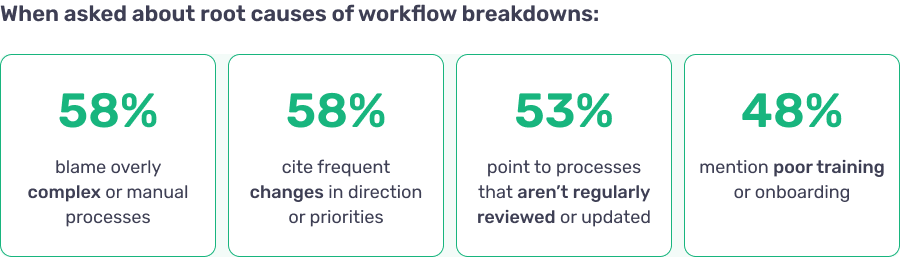
These patterns show that even well-intentioned systems can backfire when they’re hard to follow or constantly changing.
Fix it: Simplify wherever possible. Remove redundant approvals and train teams on updated workflows regularly so no one gets stuck waiting.
The bottom line: Hidden inefficiencies are everywhere.
Most organizations think they’re running smoothly, but the data says otherwise. Eight in ten leaders acknowledge that workflow issues drag down performance, with nearly half tying them to missed deadlines, lower revenue, and stalled innovation.
Technology is helping close the gap, and the demand for better workflow and tracking tools is rising fast.
The global time-tracking software market is reflecting a 16.5% annual growth rate as organizations invest in automation to manage hybrid teams and reduce inefficiencies.
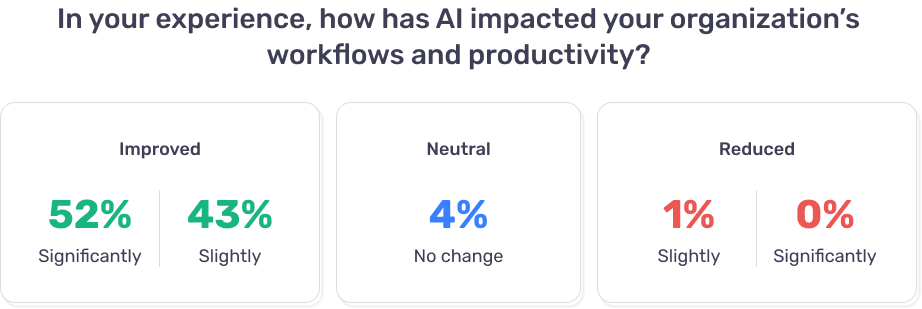
More than eight in ten leaders now use AI-powered tools for workflow or communication management, and 95% say AI has improved productivity, with more than half (52%) calling the improvement significant.
AI is also where leaders see the greatest opportunity for future gains. The focus isn’t just on flashy innovation—it’s on fixing the everyday friction points that quietly drain hours from the workweek. Half of leaders say the biggest promise of AI lies in automating repetitive tasks like data entry and scheduling, while nearly as many (48%) point to improving project management and task tracking. In other words, the same areas where work most often breaks down are the ones leaders most want AI to reinforce.
Beyond basic efficiency, many see AI’s value in helping teams work smarter. Leaders envision tools that can surface insights faster, anticipate bottlenecks, and even personalize employee training based on real-time needs. Some look further ahead, to a future where AI connects multiple systems, streamlines customer interactions, and forecasts workload trends before they become staffing problems.
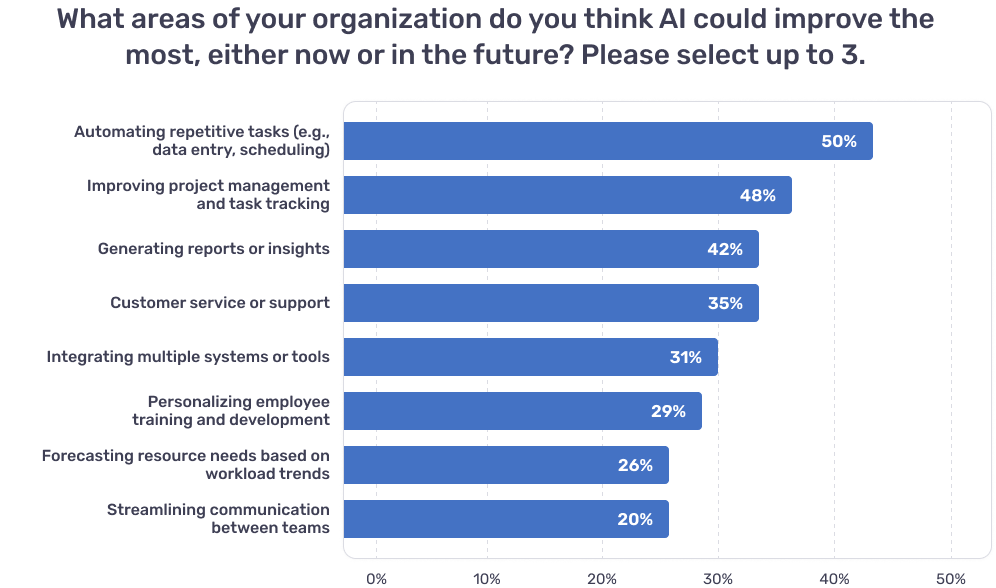
Taken together, these findings suggest that companies are eager to offload manual work while using AI to make smarter, faster decisions. The goal isn’t to replace people—it’s to give them back time for higher-value work and reduce the hidden friction that slows teams down.
Still, tools alone can’t fix process design.
As notes, traditional manual tracking systems often feel “bandwidth-sapping and monotonous,” pulling employees away from higher-value work. Modern AI-powered time-tracking solutions instead automate data collection and deliver real-time visibility—freeing teams to focus on problem-solving rather than paperwork.
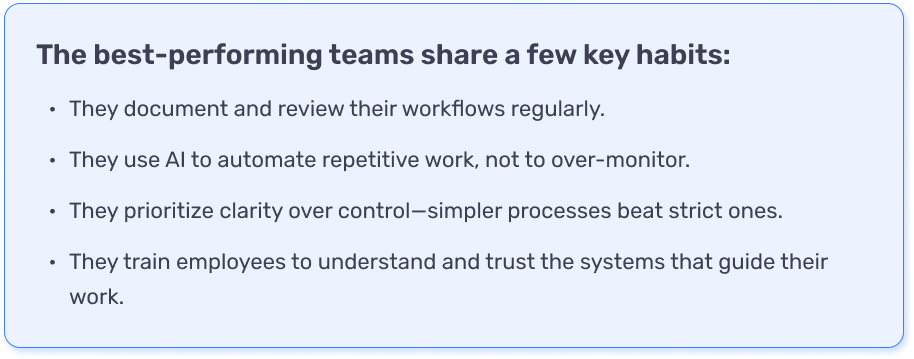
When workflows are clear, consistent, and supported by smart tools, companies waste less time chasing information—and more time getting work done.
was produced by and reviewed and distributed by Â鶹ԭ´´.