94% of global e-commerce leaders agree: In-country enablement is key to future-proofing profits
Global e-commerce is growing fast, but so are the challenges of turning that increased demand into real profit. As tariffs rise, compliance tightens, and customer expectations grow, brands are rethinking how they deliver products across borders. In recent months, these pressures have only intensified, prompting a noticeable trend across the industry.
One strategy in particular is gaining traction: in-country enablement. According to a conducted by in partnership with , 94% said they plan to scale in-country fulfillment within the next five years. This model isn鈥檛 just about faster shipping鈥攊t鈥檚 about gaining control, building resilience, and protecting profitability.
From trade disruptions to evolving logistics demands, local fulfillment is quickly becoming a cornerstone of sustainable global growth. Let鈥檚 take a closer look at what鈥檚 and key factors shaping how brands are fulfilling orders around the world.
Why More Brands Are Investing in In-Country Fulfillment
Decision-makers identified five primary drivers behind their plans to scale over the next five years:
- Supporting business growth (66%)
- Faster shipping times (63%)
- Better customer service and experience (63%)
- Easier returns (53%)
- Gaining a competitive advantage (44%)
These priorities reflect growing complexity on both sides of the global e-commerce equation. Operationally, cross-border shipping is facing new cost and compliance challenges. Rising tariffs, , and tighter customs enforcement are increasing landed costs while heightening the importance of accurate documentation, , and . In fact, over half of the e-commerce leaders in Passport鈥檚 survey said they鈥檝e seen heightened scrutiny from trade authorities in the past year.
At the same time, customer expectations continue to climb. Fast shipping and are no longer differentiators; they鈥檙e the baseline in many major markets.
To meet these demands, brands are turning to fulfillment models that offer greater speed, control, and cost efficiency. In-country fulfillment delivers on all three鈥攈elping brands reduce , improve customer experience at scale, and access high-performing sales channels that often require domestic delivery.
A Smarter Fulfillment Strategy: Blending In-Country and Cross-Border
Every market has different needs, and the most successful e-commerce brands are responding by building hybrid strategies. Instead of relying on a single model, they鈥檙e combining in-country and cross-border fulfillment solutions based on regional demand, operational complexity, and customer expectations.
According to Passport鈥檚 survey, 58% of e-commerce leaders use different fulfillment models depending on the country. It鈥檚 a clear sign that brands are thinking more strategically about where鈥攁nd how鈥攖o invest in logistics infrastructure.
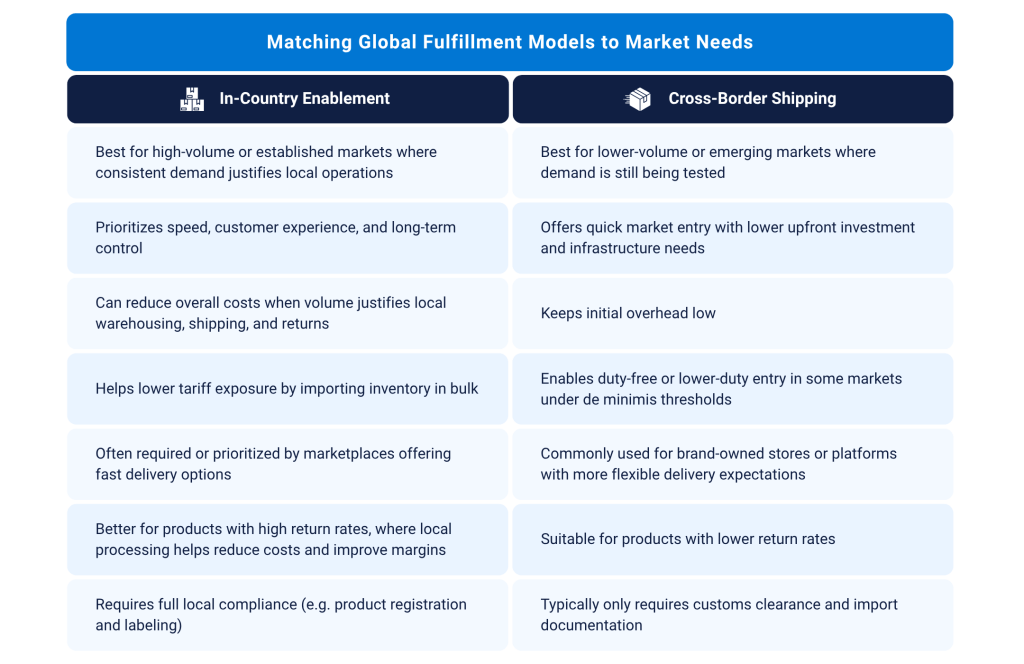
When In-Country Fulfillment Works Best
In high-demand regions like the , , the ., the , , and Mexico, in-country fulfillment offers clear advantages. It gives brands more control, faster delivery, and lower landed costs, making it a smart move when order volume supports local operations.
In-country fulfillment also enables improved inventory planning, speeds up returns, and helps manage tariff exposure by importing in bulk. These efficiencies are especially valuable in high-return categories like fashion and beauty.
For marketplaces like Amazon and Walmart, in-country fulfillment is also often required (or strongly preferred) to qualify for delivery programs and top search placement.
From a standpoint, in-country enablement means meeting local regulations such as registration and labeling. But for many brands, that tradeoff is well worth it to unlock cost savings, deliver a better customer experience, and access new, lucrative sales channels.
When Cross-Border Shipping Makes Sense
continues to play an integral role in many global fulfillment strategies, particularly in lower-volume or emerging markets. It offers a way to reach new customers, test demand, and scale gradually without the upfront investment of local warehousing.
In some countries, businesses can also take advantage of de minimis thresholds to reduce or avoid duties on lower-value shipments鈥攎aking this approach more cost-effective in the right scenarios.
This model is especially useful for companies with broad product catalogs, frequent launches, or those entering a new region for the first time, where flexibility and lower overhead matter most.
New Standards for Evaluating Global E-commerce Partners
As more brands embrace in-country enablement, their expectations for global logistics support are shifting. While cost and speed remain important, flexibility now tops the list.
According to Passport鈥檚 survey, 44% of e-commerce decision-makers ranked flexibility as the most critical factor when evaluating fulfillment solutions鈥攕urpassing cost (26%) and speed (17%). Today鈥檚 merchants are seeking providers that can adapt to changing regulations, scale across regions, and support hybrid models that combine in-country and cross-border fulfillment.
This level of adaptability is no longer a nice-to-have鈥攊t鈥檚 essential. With 75% of companies relying on third-party providers for in-country operations, the demand is growing for solutions that offer more than just shipping. Brands want strategic infrastructure, market-specific expertise, and built-in compliance support.
As international logistics become more complex, success will hinge on having a fulfillment network that鈥檚 flexible, scalable, and aligned with long-term growth.
The Future Is Local: Strengthening International Infrastructure
continues to be a powerful growth engine for today鈥檚 leading e-commerce brands. According to Passport鈥檚 research, 91% of international merchants say cross-border sales are a profitable revenue stream鈥攁nd for half, those sales account for at least 21% of total revenue.
Still, turning this demand into sustainable profit is becoming more challenging. Rising tariffs, shifting regulations, and increasing customer expectations are prompting decision-makers to rethink how they fulfill orders across borders.
That鈥檚 why many are investing in in-country enablement鈥攏ot just as a logistics upgrade, but as a strategic foundation for smarter, more resilient operations. It reflects a broader shift toward infrastructure that supports scale, adapts to trade changes, and helps brands stay competitive.
As businesses reassess how and where they fulfill orders, those with flexible, future-ready strategies will be best positioned to thrive in 2025 and beyond.
was produced by and reviewed and distributed by 麻豆原创.