Countries that spend the most on space exploration
Countries that spend the most on space exploration
With the recent after 15 unprecedented years on the red planet, it's natural to wonder what else is happening and for humans in space.
There are a number of countries committed to and its relevant technologies. 麻豆原创 set out to find out just which countries are investing the most resources to these areas, using , a report produced by The Southern Hemisphere Space Studies Program in Australia. The February 2018 report compares 14 different agencies chosen by a select number of criteria, including an effort to "provide diversity in several areas such as the agency's age, aims, activities, and geographic location."
麻豆原创 has identified key highlights of each agency's spending and size, and also pinpointed some notable efforts and accomplishments in their years of space exploration. Which countries are committed to exploring Mars in the coming years? Which countries are focused on developing on-the-ground infrastructure?
Read on to see the list, ranked by government space budget in U.S. dollars.
You may also like:
#12. Malaysia
- Government space budget (2017): $8 million (0.02% of the national budget)
- Population (2017): 31,187,265
- National space budget per capita: $0.26 per capita
- Government space budget Purchasing Power Parity: $24 million
ANGKASA, , was formed in 2003 and sent their shortly after in 2007. Currently, Malaysia's MEASAT satellite system and its services .
#11. South Africa
- Government space budget (2017): $19 million (0.02% of the national budget)
- Population (2017): 56,015,473
- National space budget per capita: $0.34 per capita
- Government space budget Purchasing Power Parity: $42 million
South Africa formed the South African National Space Agency (SANSA) in 2010. SANSA's first Earth observation satellite, EO-Sat1, is . Other notable SANSA achievements include the launch of the Space Weather Center at Hermanus, which recently became the to all aircrafts in African airspace.
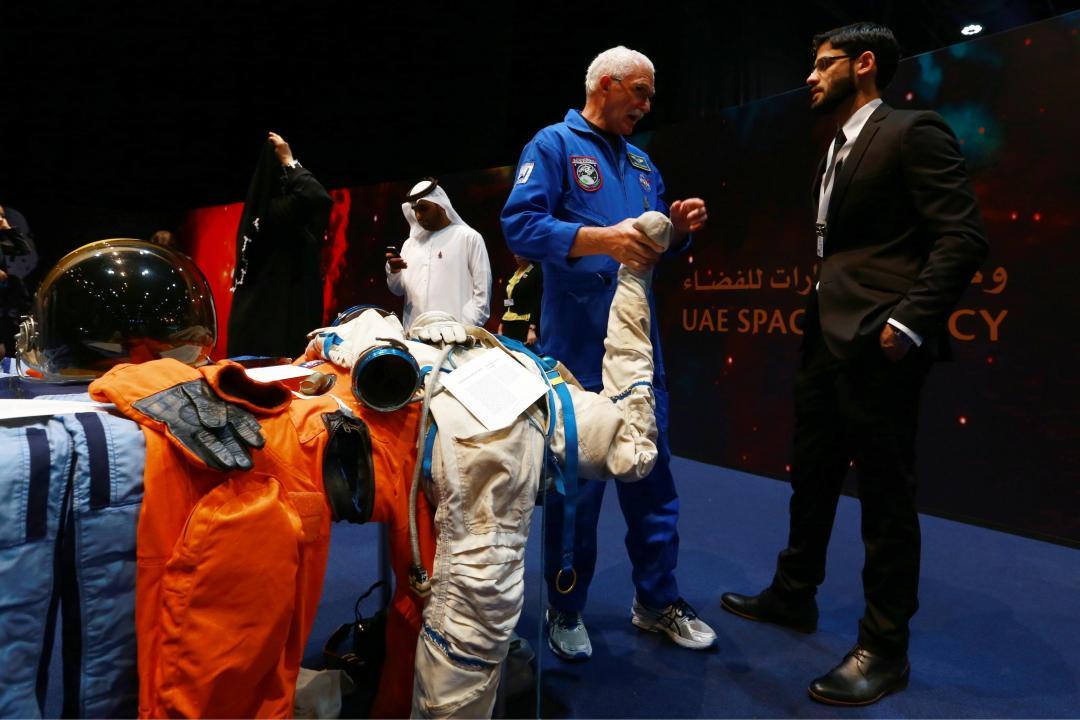
#10. UAE
- Government space budget (2017): $150 million (0.18% of the national budget)
- Population (2017): 9,269,612
- National space budget per capita: $16.18 per capita
- Government space budget Purchasing Power Parity: $275 million
The United Arab Emirates Space Agency is currently preparing to , with an expected launch date planned for July 2020. In October 2018, the newer agency (which was founded in 2014) also signed an agreement with NASA, with plans to collaborate on both .
#9. Spain
- Government space budget (2017): $170 million (0.03% of the national budget)
- Population (2017): 46,347,576
- National space budget per capita: $3.67 per capita
- Government space budget Purchasing Power Parity (PPP): $230 million
Spain has the oldest space agency to make the list; the National Institute of Aerospace Technology (INTA) was . Spain is also active in the European Space Agency. In the fall of 2018, Spanish company GMV secured the by the country's space industry, to maintain and upgrade the , Europe's global navigation satellite system.
#8. Luxembourg
- Government space budget (2017): $223 million (0.8% of the national budget)
- Population (2017): 575,747
- National space budget per capita: $387.32 per capita
- Government space budget Purchasing Power Parity: $227 million
Luxembourg, which is also part of the European Space Agency, entered the space race in 2016. Though the population (at just under 600,000) is the smallest to make this list, the space mining industry is , the highest ratio in the EU.
#7. Brazil
- Government space budget (2017): $260 million (0.04% of the national budget)
- Population (2017): 207,652,865
- National space budget per capita: $1.25 per capita
- Government space budget Purchasing Power Parity: $402 million
The only Latin American country to make this list鈥攁nd with the 鈥擝razil has recently been . Its agency, the Brazilian Space Agency, celebrates its 25th year in 2019.
#6. United Kingdom
- Government space budget (2017): $414 million (0.04% of the national budget)
- Population (2017): 65,788,574
- National space budget per capita: $6.29 per capita
- Government space budget Purchasing Power Parity: $465 million
The U.K. is currently as , a joint effort from ESA and Russian State Space Corporation, Roscosmos. The U.K Space Agency sent Helen Sharman, the , to space in 1991. She was also the first woman to visit the Mir Space Station.
#5. Canada
- Government space budget (2017): $488 million (0.08% of the national budget)
- Population (2017): 36,289,822
- National space budget per capita: $13.45 per capita
- Government space budget Purchasing Power Parity: $525 million
The Canadian Space Agency created the Canadarm, used on , that proved to be a significant achievement. The CSA, which turns 30 this year, also holds a cooperation agreement with the European Space Agency.
#4. India
- Government space budget (2017): $1.11 billion (0.45% of the national budget)
- Population (2017): 1,324,171,354
- National space budget per capita: $0.84 per capita
- Government space budget Purchasing Power Parity: $4.3 billion
In 2017, India broke the record for from one rocket, with 104. It was since the Indian Space Research Organization's 1969 founding. The ISRO is also planning its in 2019.
#3. China
- Government space budget (2017): $4.30 billion (0.16% of the national budget)
- Population (2017): 1,403,500,365
- National space budget per capita: $3.06 per capita
- Government space budget Purchasing Power Parity: $8.33 billion
Earlier this year, China became the first country to . China has since the founding of its space program in 1956 (despite not being included in the International Space Station), and also has additional moon travel and an in the works.
#2. European Space Agency
- Government space budget (2017): $6.43 billion (0.07% of the combined national budgets)
- Population (2017): 511,800,000
- National space budget per capita: $12.55 per capita
- Government space budget Purchasing Power Parity: $7.83 billion
The European Space Agency (ESA) is counted as one country here, but it actually consists of 22 member states countries: Austria, Belgium, Czech Republic, Denmark, Estonia, Finland, France, Germany, Greece, Hungary, Ireland, Italy, Luxembourg, the Netherlands, Norway, Poland, Portugal, Romania, Spain, Sweden, Switzerland, and the U.K. Throughout its more than 40 years, the agency has made many significant achievements, including , development of a , and . An upcoming project to keep an eye out for is the .
#1. USA
- Government space budget (2017): $19.3 billion (0.58% of the national budget)
- Population (2017): 322,179,605
- National space budget per capita: $59.9 per capita
- Government space budget Purchasing Power Parity: $19.3 billion
The U.S., with its space agency NASA (the National Aeronautics and Space Administration) is home to a number of , including the . It's also one of the leading countries , and one of only two countries to .