
Facing a tight budget in 2026? Here’s how to do more with less
Your CFO just sent the email. Budgets will be cut for 2026. Targets won’t be.
You know the drill. Overworked teams. Watching competitors move faster while you’re stuck explaining why you can’t keep up.
But it is possible to “do more with less” when your budget shrinks, but your goals don’t.
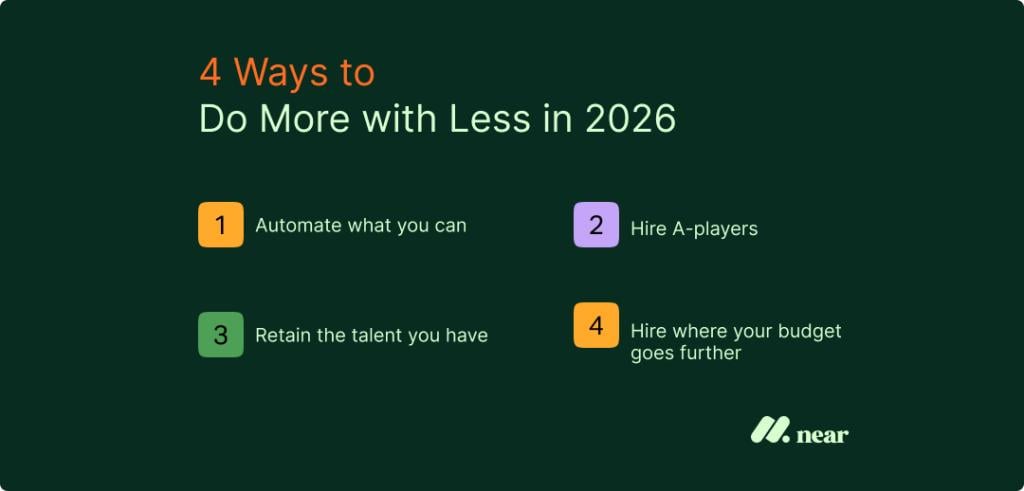
According to the staffing and recruiting firm , four strategies make this possible, and all are within reach:
- Automate the manual work bogging your team down.
- Make every hire count by focusing on top performers.
- Retain the talent you have.
- Get strategic about where you hire.
Each approach is backed by research showing exactly what works and what the returns look like.
Key Takeaways
- Use automation and AI to lift output without a new headcount. Target a handful of repeatable workflows to automate so the same team ships more. Many teams see up to 2.4 times productivity without adding headcount.
- Build and keep a team of A-players. Hire for proven impact, then retain with regular recognition, clear career paths, and flexible remote/hybrid options so top performers stay and lift overall output.
- Make your hiring budget go further. Hire in markets where you can afford top senior talent.
1. Maximize Productivity Through Automation and AI
The fastest way to free up capacity is by automating manual work that doesn’t require human judgment and effectively using AI.
Accenture’s 2024 research, which surveyed 2,000 executives, shows organizations with “fully modernized, AI-led processes” achieve compared to those that haven’t automated.
It’s likely your team is already using some AI. But, according to Gallup, as of Q2 this year. So, most teams have substantial gains to achieve here.
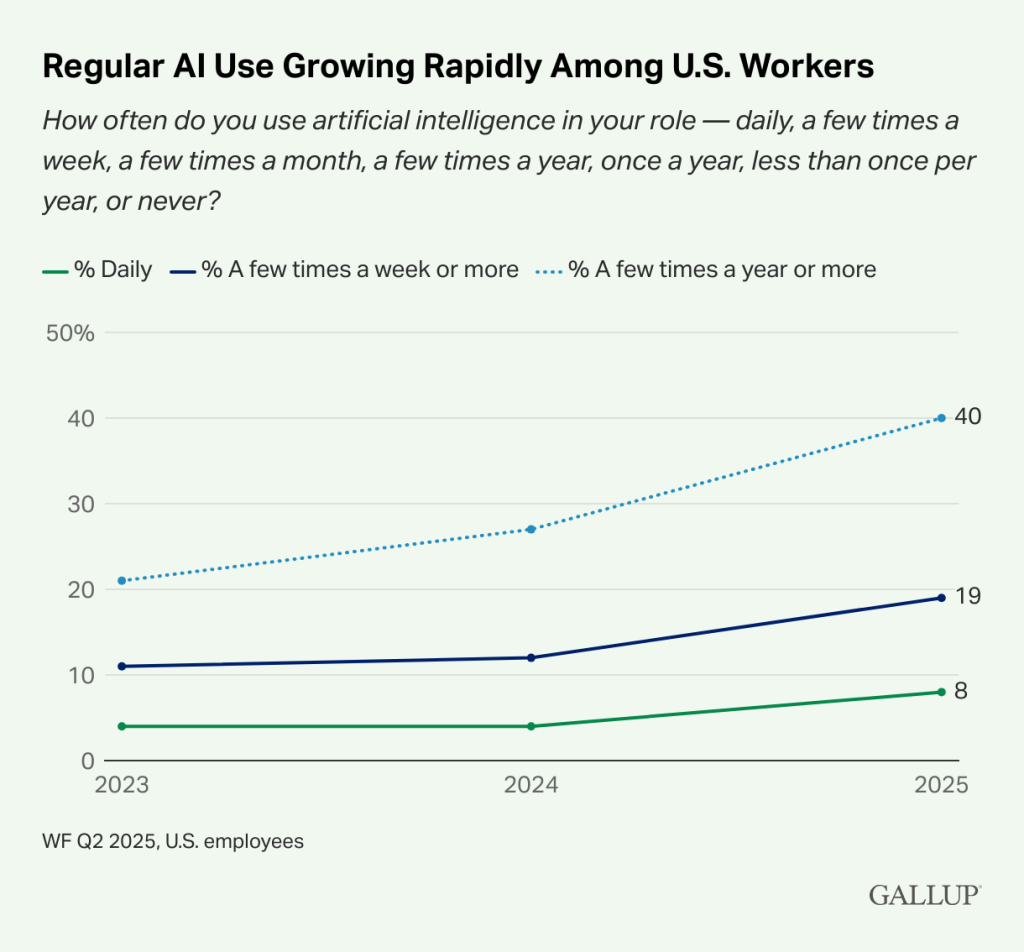
Automation works in two ways: eliminating manual work that doesn’t need human involvement, and accelerating work that does require human judgment.
Think of automation as your way to handle repeatable work the same way every time, and generative AI as your way to speed up thinking, drafting, and analysis. Use automation to move data, route approvals, and prepare routine reports. Use gen AI to get from blank page to workable draft, to summarize long inputs, and to explore options faster while a human keeps judgment and quality.
Start with a few workflows you can describe in a checklist. Map where the data comes from, what triggers the work, and what “done” looks like.
The strategy matters as much as the tools or methods
reveals a critical gap: While 44% of organizations have begun integrating AI, only 22% have communicated a clear plan or strategy for doing so.
This matters because intentional implementation drives results. According to Gallup, “Leaders whose workforces experience the most value have a clear AI strategy and plan in place. When employees strongly agree that their leadership has communicated a clear plan for integrating AI, they are 3 times as likely to feel very prepared to work with AI and 2.6 times as likely to feel comfortable using AI in their role.”
You need to define clear use cases, establish processes, and train your team properly. The organizations achieving 2.5 times revenue growth and 2.4 times productivity gains are deploying automation and AI strategically.
2. Make Every Hire Count by Focusing on A-Players
When you have to be smart with your budget, one exceptional hire beats several average ones. Here’s what the research shows: Top performers produce multiples of what average performers deliver.
in 2013 found that top performers are four times as productive as average performers across all job types. This ratio holds “in every industry, geographical region, and type of organization [they] examined.”
A-players also lift everyone around them. In 2017, tracked over 2,000 workers over two years and found that placing someone within 25 feet of a high performer boosts their performance by 15%. This spillover effect translated to an estimated $1 million in additional annual profits.
If you can hire one exceptional performer who produces four times the average output, that represents better value than three or four average hires—even at a higher salary. When you’re facing budget cuts, focus your limited hiring budget on finding people who can drive more value than multiple average performers.
3. Retain the Talent You Have
When hiring budgets are tight, losing existing talent becomes devastating. In 2024, that replacing talent costs from 40% of salary for frontline staff to up to 200% of salary for leaders and managers.
Plus, you also lose institutional knowledge, team cohesion, and months of productivity while you search for a replacement—if you can even find one.
According to a survey in 2024, 75% of employers reported struggling to find people with the skills they need. You might go through one or two bad hires before finding someone who works out, multiplying both the cost and the lost productivity.
But according to Gallup’s research, 42% of employees who voluntarily left their jobs said their manager or organization could have done something to prevent them from leaving.
When raises aren’t an option, focus on what you can control
If your budget is frozen, you probably can’t offer the salary increases or promotions that would typically retain someone considering an exit. But compensation isn’t the whole story. In 2023, what made them want to stay with an employer. And emotional factors ranked higher than compensation: “job security, being treated fairly and respected, enjoyable work, feeling valued and appreciated, and feeling supported.”
Gallup’s research (referenced above) reinforces this. When they asked people who left what could have prevented their departure, 70% cited actions related to how they were managed daily rather than compensation. These included more “positive personal interactions with their manager (21%), addressing frustrating organizational issues (13%), creating opportunities for career advancement (11%) or improving staffing or workload concerns (9%).”
What you can do to improve retention without budget increases
If you can’t offer raises or promotions right now, you can still address the factors that drive 70% of preventable turnover (many of which also have the knock-on effect of increasing productivity):
- Create clear development paths. Show people they have a future worth working toward. Outline individual development plans that show career progression, even if promotions aren’t immediate. Only , according to Pew Research in 2023. Simply being clear about paths forward sets you apart.
- Address frustrations quickly. As mentioned above in Gallup’s research, a quarter of preventable turnover happens because managers don’t address organizational issues or workload problems. When you identify friction points, discuss how they affect people and clarify your role in fixing them. Left unaddressed, these frustrations lead to burnout.
- Recognize contributions regularly. People want to feel valued. Thank people for specific contributions, acknowledge milestone anniversaries, and share team accomplishments. found that if “a business of 10,000 doubled the number of employees who receive recognition or praise for their work in the last week, they can realize a 9% increase in productivity.”
- Maintain or expand remote and hybrid work options. If you’re considering return-to-office mandates, the data suggests you’ll pay for it in turnover instead. In 2024, that nearly half (46%) of workers currently working from home said they’d be “unlikely to stay at their job” if they could no longer work from home. For jobs that can be done remotely, allowing remote or hybrid work costs nothing while serving as a powerful retention tool.
The organizations that retain talent through budget freezes or cuts aren’t necessarily those offering the highest salaries. They’re the ones making people feel valued, providing clear paths forward, and maintaining regular communication about what matters most to each employee.
4. Get Strategic About Where You Hire
This fourth option lets you achieve more by giving you a way to . It’s geographic arbitrage—accessing the same skill level at different price points based on cost-of-living differences. This works because compensation reflects local economic conditions, not capability.
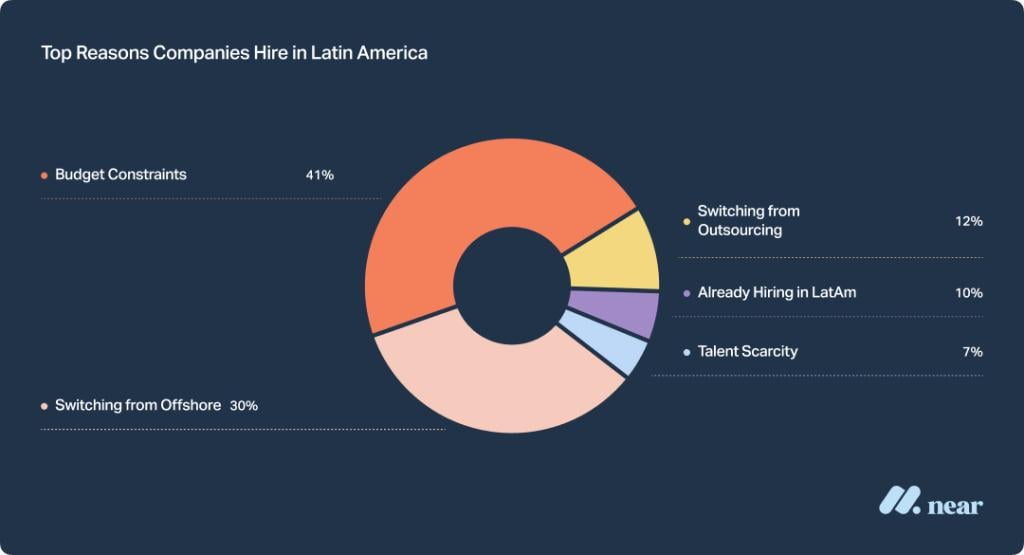
Budget constraints are already driving many U.S. companies to hire offshore. According to Near’s recent report on , 41% of companies cite budget constraints as their primary reason for hiring in the region.
Hire the top senior talent and specialists you need
The A-players discussed earlier, the ones who produce four times more output? You can afford them when you hire in Latin America or other regions.
When you’re competing with big companies for senior developers or experienced finance leaders in the U.S., salary expectations quickly exceed what budget-constrained companies can offer. Geographic arbitrage changes that equation. You can hire:
- Senior-level A-players who drive team productivity. That principal engineer who can architect your entire platform. The senior controller who can transform your financial operations. The experienced product manager who’s shipped multiple products. These aren’t junior hires you’re training up. They’re the experienced professionals who can execute immediately and elevate everyone around them.
- Specialized technical talent to execute your automation strategy. Want to implement those automation processes mentioned earlier? You can who can build and maintain automation workflows. Or who can integrate generative AI tools into your workflows. These specialized roles are exactly what you need to execute strategy one, but they’re often out of reach at U.S. salary rates.
- The full teams you couldn’t otherwise afford. Instead of hiring one midlevel person and hoping they can handle everything, you can or marketing team with the right mix of senior leadership and specialized skills.
As an example, you typically compared to U.S.-based talent for equivalent roles. Senior full-stack developers commanding up to . And similar savings can be achieved across any role that can be done remotely.
But the real value isn’t just in the savings. It’s accessing talent you couldn’t afford otherwise, allowing you to bring in high performers who transform productivity and growth.
Final Thoughts
Budget cuts in 2026 don’t need to lead to sacrificing output or growth. The path forward is about investing in people and managing them wisely—which yields far more output per dollar than traditional cost-cutting approaches.
The data shows what works: Hire ultra-capable, motivated individuals who produce more output than average performers. Enable them with AI and automation tools that handle repetitive work and accelerate their judgment-based tasks. Provide those people with clear progression paths and regular recognition—completely free tools that reduce turnover while boosting productivity.
When budget constraints make it impossible to hire these A-players at U.S. rates, or other regions provides access to the same caliber of talent at price points that fit constrained budgets.
In areas like marketing, sales, and engineering, one creative A-player using advanced tools can now achieve what used to require a whole department.
You can combine these approaches to scale operations while others are contracting. The organizations emerging strongest from budget constraints won’t be those that simply cut costs. They’ll be those who fundamentally rethought how to maximize productivity per dollar invested through smarter automation, better talent, “free” retention strategies that boost performance, and strategic hiring.
was produced by and reviewed and distributed by Â鶹ԭ´´.