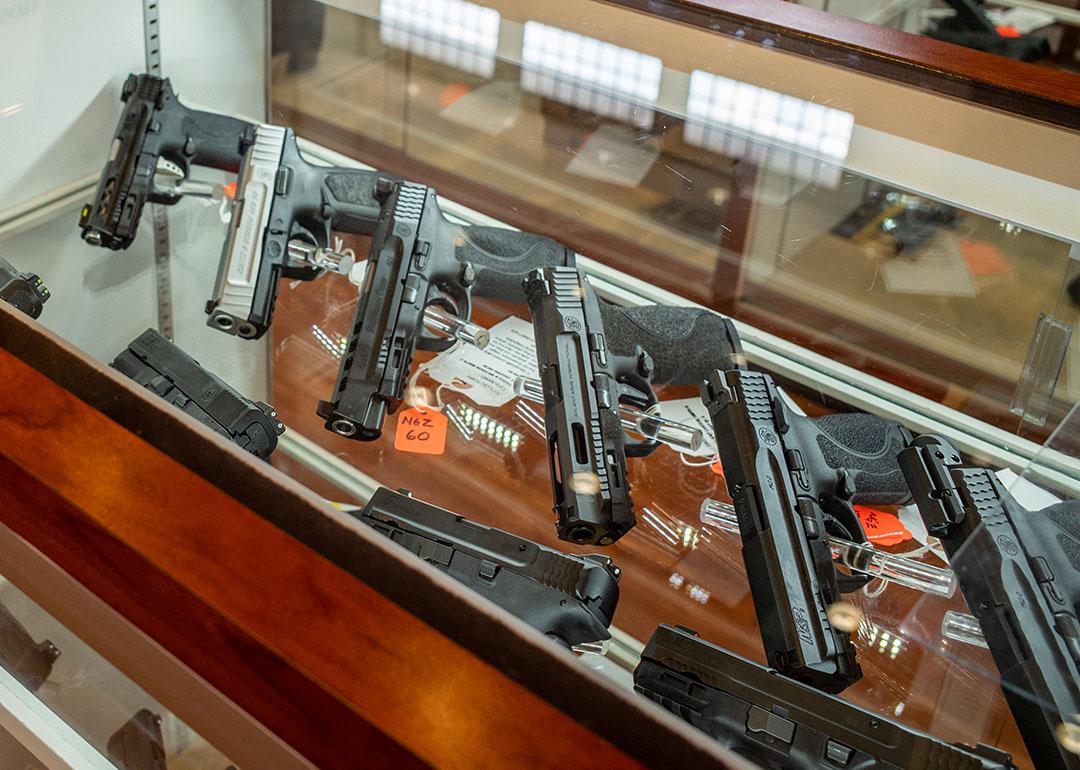
The gun industry makes billions. But how many exactly?
The gun industry makes billions. But how many exactly?
Here at Ask The Trace, we get our fair share of questions about the gun industry, specifically the profits and enjoyed by firearm and ammunition companies. The fewer restrictions on their products, the more money they can make from sales. Supporters of stronger gun laws have sought in recent years to tie the gun debate back to the and revenues reaped by firearms manufacturers, reports.
In that vein, a reader wants to know: How much does the gun industry make each year?
It’s a big ballpark
This information isn’t easy to find. There are publicly traded companies and privately traded. There is the consumer market and the military market. The Trace’s best guess, according to experts, is an estimate.
The market research firm IBISWorld in April that domestic gun and ammunition manufacturing will generate $19.6 billion in revenue in 2025. But that number includes military expenditures, said Greg Lickenbrock, associate director of investigations at the gun reform group Everytown for Gun Safety and runs the watchdog site . (Through its nonpolitical arm, Everytown grants to The Trace. You can find our donor transparency policy , and our editorial independence policy .)
Lickenbrock, a gun expert who in firearms publishing for a decade, was able to that the civilian gun industry raked in an estimated $9 billion in revenue in 2021. But he cautioned that there are limitations on that estimate: It’s derived from market research reports whose sources aren’t totally clear and are often out of date.
That level of opacity, he says, is relatively unique to the U.S. gun industry.
“The majority of gunmakers and dealers are privately held,” Lickenbrock said. “I don’t think there’s another industry that is nearly as occluded. I feel like even pharmaceutical industries report financial figures much more often.”
In lieu of exact or even ballpark figures, Lickenbrock looks to other indicators to measure the economic impact of the gun industry. “It is helpful that the two largest gunmakers in the U.S., Smith & Wesson and Ruger, are publicly traded,” he said. “That’s what we use as a sort of bellwether. We can say whether the industry is doing well based on their earnings.”
Only six of the top 30 gun manufacturers are publicly traded, according to assembled by Orchid Advisors, a firm that works with gun dealers on regulatory compliance. Those companies include Sturm, Ruger & Co.; Smith & Wesson; Colt; Taurus; and Browning Arms. Last year, these companies brought in more than $2 billion combined in net sales, revenue, or income.
The rest of the companies on the list are privately owned. Private companies that don’t trade on the stock market are not required to release their earnings reports, and few gunmakers voluntarily do so. Because only a handful of the biggest gun companies are publicly traded, it’s almost impossible to estimate the industry’s full economic footprint.
But some have tried. The National Shooting Sports Foundation, the gun industry’s lobbying group, paints a rosy picture of the gun industry’s contribution to the economy. The group that the firearm and ammunition industry was “responsible for as much as $91.65 billion in total economic activity” in 2024. Earlier this year, the NSSF that companies “that manufacture, distribute, and sell firearms, ammunition, and hunting equipment employ as many as 150,668 people in the country and generate an additional 232,327 jobs in supplier and ancillary industries.”
Why don’t we know more?
Gun companies keep their financials opaque partly because “they know that it’s not a good look” to boast about earnings when “their guns cause problems,” Lickenbrock said. But mostly it’s to conceal industry secrets from rival gunmakers.
“I think that the gun industry is so extremely competitive and crowded that they don’t want anyone to really have a sense of how well they’re doing,” he said. For example, one of the reasons we don’t have up-to-date production numbers is because, to comply with the Trade Secrets Act, the Bureau of Alcohol, Tobacco, Firearms and Explosives delays the release of its annual firearms manufacturing report. That’s because of the belief that “it can give companies certain advantages if they know how many guns other companies are making,” Lickenbrock said.
Even the research director for the NSSF—the gun industry’s own lobby—has admitted under oath that “it’s very hard to actually get information from gunmakers because of that competitive nature,” Lickenbrock said. In a 2024 deposition in a challenging Illinois’ assault weapons ban, NSSF research director Salam Fatohi testified that manufacturers share data with the group for its industry reports under the condition that it’s destroyed as soon as it’s done being used.
One way Lickenbrock says he can see which companies are having a good year is the size of their booths at SHOT Show, the NSSF’s annual trade show in Las Vegas. “That’s really how they show it off to other companies,” he said. If a gun company has a two-story booth that feels like an apartment building, “you can tell the company’s doing well. If they scale back the next year, they’re not doing so well.”
What we do know is that nearly 15 million firearms were in 2023, according to figures to the ATF by gunmakers. That number can be used as a proxy for annual gun sales. So can background checks: According to our , which analyzes FBI background check data, 15.3 million guns were sold in 2024. It’s not possible to put a dollar amount on that, but at least we have a concrete idea of the industry’s output.
Lickenbrock, who is a gun owner, juxtaposed the opaqueness of the industry with the Second Amendment. “You would think,” he said, “that an industry tied to a fundamental right in that way would be a lot more transparent.”
was produced by and reviewed and distributed by Â鶹ԭ´´.