History of America's meat-processing industry
History of America's meat-processing industry
Virtually every animal on Earth either kills other animals to sustain itself or is unfortunate enough to play the opposite role, being devoured by another animal for the same purpose. Human beings are no exception. In fact, they turned the business of converting animals into food into a multi-billion-dollar industry.
Using news reports, historical accounts, industry timelines, and other sources, chronicled the history of the American meat-processing industry, the largest segment of the United States agriculture sector by far.
The produces 52 billion pounds of meat and 48 billion pounds of poultry every year. That comes from 2.2 million sheep and lambs, 32.2 million cattle and calves, 121 million hogs, 242 million turkeys, and an astonishing 9 billion chickens—again that's the number of animals whose lives are sacrificed for human consumption every single year in the U.S. alone.
The bridge between those living, feeling animals and the shrink-wrapped steaks and drive-thru cheeseburgers that Americans gobble up by the ton is the meat-processing industry. It's as old as the country itself—older, even—and its history is baked into the history of America. Small- and medium-sized family farms tasked with feeding a few thousand colonists transformed over the centuries into a juggernaut of billion-dollar corporations that wring profits out of factory farms that farmers a few generations ago wouldn't even recognize as being farms at all.
Along the way, the meat-processing industry served as a driving force in the rise of the railroad industry, the labor movement, trucking, and transportation. It was responsible for game-changing innovations such as mechanized refrigeration and the assembly line. The realities of the industry have fueled major reforms, public outrage, and activist movements, but mostly the meat-processing industry has been hidden away from the sensitive eyes and minds of an American population that is almost totally disconnected from the origins of the food it consumes.
The work of slaughtering animals and turning their carcasses into food has long been and remains today largely the realm of underpaid immigrant laborers who work for long hours at some of the most physically and psychologically taxing work imaginable. The corporate titans whose fortunes their labor creates are now and have always been among the wealthiest and most politically influential powerbrokers in the country.
Keep reading for 50 key moments in the history of America's meat-processing industry.
1662: The meatpacking industry is born
English colonist and fur trader William Pynchon was the founder of Springfield, Massachusetts. In 1662, he became the when he began packing large quantities of salted pork into barrels for export to the West Indies.
1742: Boston emerges as America’s meatpacking hub
In 1742, , located near Boston, held the first meat auction in the colonies. Cattle farmers and ranchers slaughtered their animals and brought the resulting meat to Brighton for sale. The moment positioned Boston as the new center of colonial America’s meat trade.
1779: First cattle drive
In 1779, the Spanish—eager to drive their British rivals out of the New World—joined the American Revolution. That year, the Spanish governor of Louisiana to send cattle to feed his troops fighting on the front. The Commanding General of New Spain authorized the transfer of 2,000 head of cattle from Texas to the Louisiana territory—it was the first official Texas cattle drive in history.
1813: 'Uncle Sam' feeds the troops
During the war of 1812, a meat packer from Troy, New York, named to supply meat to American troops fighting the British. He stamped his barrels with the initials “U.S.” for “United States,” but playing on Wilson’s first name, soldiers joked that the provisions came from “Uncle Sam.” The name stuck and has forever since been synonymous with the federal government.
1818: The rise of 'Porkopolis'
Elisha Mills in 1818 started the in Cincinnati, where pigs were slaughtered and their meat was preserved in brine-filled barrels to meet the growing demand for salted pork. Because of its advantageous geography and proximity to transportation hubs—not to mention its vast supply of salt and cheap immigrant labor—Cincinnati became the pork-producing capital of the world, with dozens of pork companies emerging there. There were 85,000 pigs being processed there annually by 1833; by 1850, Cincinnati earned the nickname "Porkopolis."
Mid-1800s: Cattle becomes king
Pork was the meat of choice in America from colonial times until the early 1800s when . By the mid-1800s, small family farms could no longer meet the demand. The era of the cattle barons emerged as massive ranches sprung up in the West, where enormous herds could be grazed on endless open prairies before being ushered to market by cowboys on epic cross-country cattle drives.
1861: The Civil War
When war broke out between the North and South in 1861, Texas ranchers left their farms to fight for the Confederacy. Those who lived returned to a land overrun by cattle—left to their own devices, cattle herds multiplied exponentially and by the war’s end in 1865, roughly were roaming wild in Texas. There was no market for beef in the decimated Southern economy, but demand was rampant in the North, where ranchers could get 10 times more for a head of cattle than they could in the South—if only they could get their longhorns to the Yankee markets.
1862: Lincoln forms the USDA
In 1862, President Abraham Lincoln signed into law a Congressional act that created the At a time when half of the American population lived and worked on farms—compared to 2% today—Lincoln called it “the People’s Department.” The USDA is still charged with ensuring that meat is safe, properly inspected, and correctly packaged to this day.
1862: The Homestead Act
The signing of the sent waves of bold and ambitious pioneers and immigrants flooding out of the eastern cities westward in search of land and a new start. The act divvied up the boundless grazing lands of the wealthy, powerful, and often violent cattle barons who saw the land the Homesteaders were settling as the source of their fortunes. Cowboys became hired gunmen as bloody Range Wars raged between cattlemen and the new arrivals—the meatpacking industry was about to be transformed forever.
1865: The rise of the Midwest
Boston, and later Philadelphia, had been the central hubs of the U.S.' meatpacking industry in the country's early years, but in the mid-1860s, to become the core of the industry. It made sense, as Midwestern cities were located strategically between the vast grasslands of the West—where huge herds of cattle were raised—and the hungry cities in the East that generated an unquenchable demand for meat. In 1865, the Chicago stockyards became the U.S.' biggest livestock market, and Cincinnati Omaha, Nebraska, and Kansas City, Kansas emerged as major meatpacking hubs.
1867: The Real McCoy
Chicago livestock trader Joseph McCoy wanted to position himself as the dominant middleman in the American meat industry and worked to bring cattle from Texas to his operation in Chicago for processing and distribution to the East. With hordes of Homesteaders and bloody range wars making traditional cattle drives more difficult, McCoy turned to the burgeoning railroad industry and built a town called Abilene in a strategically centralized spot in Kansas—it was America’s first cowtown. He advertised heavily and offered a good price to ranchers who would deliver their cattle to his railyard in Abilene—and he delivered on his promise, entering the phrase “the real McCoy” into the American lexicon.
1867: The railroad revolution
In 1867 in Abilene, McCoy transported —and his ambitious and expensive gamble paid off. It dramatically shortened the time it took to bring meat to market; old-school cattle drives took months to complete and often resulted in huge losses of herds. It was the beginning of a new era in the meat industry and the dawn of the “Wild West,” as rugged, lawless, prosperous, and violent cowtowns began coalescing around major railroad shipping points where thousands of cattle were herded onto train cars for transport as thousands of dollars were changing hands.
1867: Barbed wire
The fate of the Western open range, the cattle barons whose fortunes were built on it, and the iconic cowboys who did the hard work of driving cattle for endless miles was sealed in 1867 with the arrival of one of history’s most low-tech but consequential inventions: . Thousands of miles of cheap but highly effective barbed wire soon cordoned off small farms and homesteads across the West, making large scale open cattle grazing impossible. Between the Homestead Act, the arrival of the railroads, and an endless crisscrossing of impenetrable barbed wire, the open range was doomed and the meatpacking industry entered into the modern era.
1870s: Dis-assembly lines
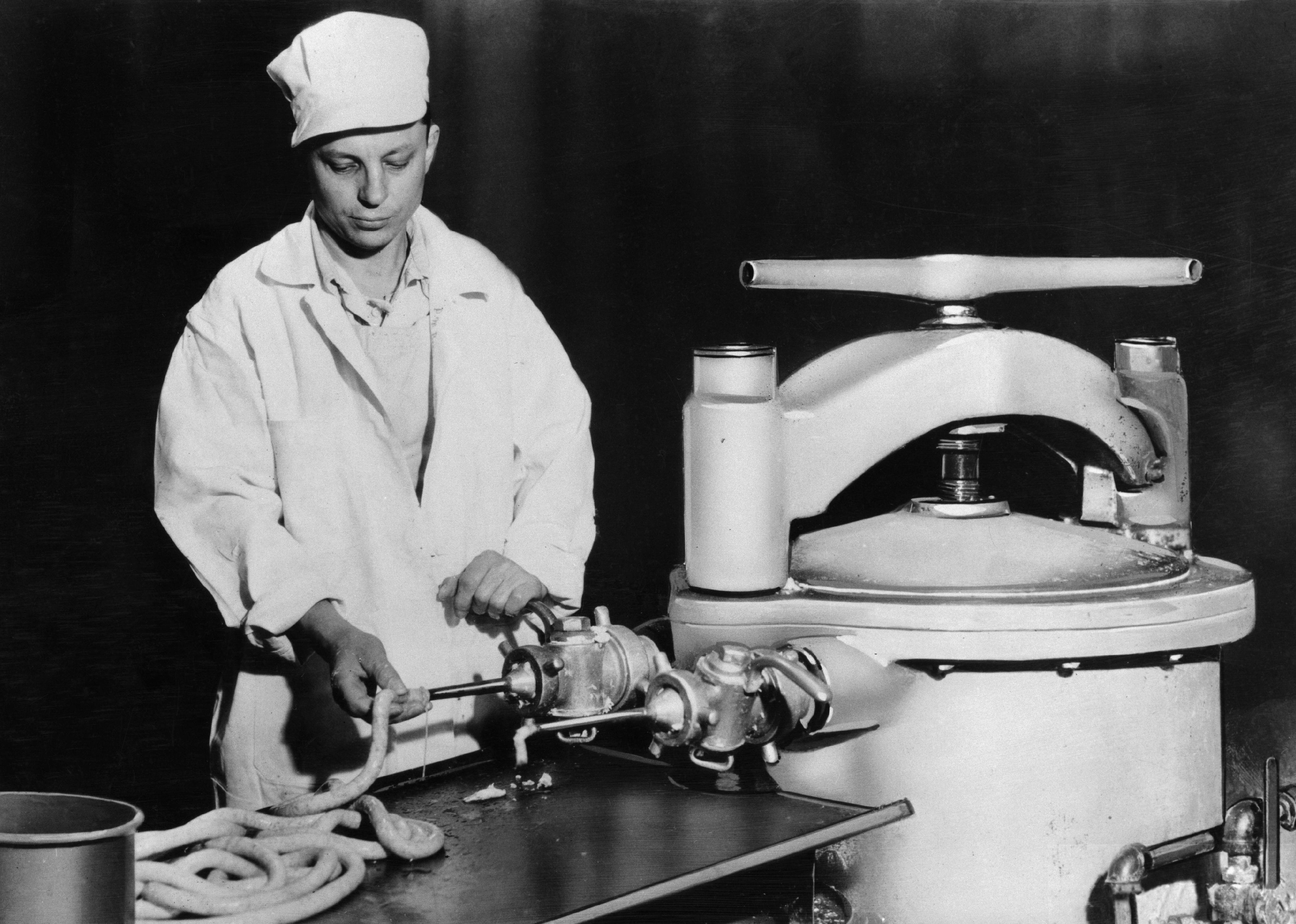
By the 1870s, meatpacking plants were using technology like steam power, monorail trolleys, and mechanical mixers, choppers, and stuffers in factory settings where stationary workers doing individual jobs broke down and processed animal carcasses that continuously passed by them. These so-called allowed for fast, consistent, and efficient processing. A young entrepreneur named Henry Ford was so inspired by the process when he visited a meat plant that he used the concept for the basis of his automobile assembly lines.
1877: The refrigerated railcar
Many people and companies experimented with dating back to the mid-19th century, but all attempts had flaws that made them impractical and unreliable. It was much cheaper and more efficient to slaughter cattle in Chicago and then ship their carcasses East instead of transporting the animals while they were still alive, but that could only be done in the winter months. Then, in 1877, two men named Joel Tiffany and Andrew Chase secured patents that made the dream of a refrigerated railroad car a reality—cattle could now be transported live to Chicago, slaughtered, and processed into meat, before being shipped to Eastern cities without spoiling at any time of year.
1880: US beef reigns supreme
Before the refrigerated railcar, ranchers bred cattle for endurance to survive long, grueling cattle drives, but the invention of the cold car allowed ranchers to breed cattle for the quality of their meat. , American ranchers were exporting their beef to England, which had long been considered the home of the finest beef in the world; now, that title was now squarely in the hands of the American rancher.
1883: The birth of a giant
In 1883, Bavarian immigrant and butcher opened his first meat market in Chicago. On the very first day, sales totaled $59—not bad for a time when cuts of pork sold for between eight and 12 cents per pound. Today, the Oscar Mayer company does more than $5 billion in annual sales and represents one of the most famous names in American meat.
1884: Arthur forms the Bureau of Animal Industry (BAI)
In 1884, President Chester Arthur signed a law that . As part of the USDA, the BAI was tasked with preventing sick animals from entering the U.S. food supply. Quarantine stations were set up across several cities to screen and separate diseased imported animals to prevent their meat from going to market.
1890: Harrison signs first meat inspection law
As foreign countries began scrutinizing U.S. exports of meat more strictly, American meat producers found it harder to compete in overseas markets. President Benjamin Harrison that mandated a final inspection of all meat products before they left for markets on foreign shores.
1893: Meat goes to college
In 1893, a University of Minnesota instructor named called "Instruction in Killing, Dressing, Cutting, and Curing Meat"—it is the first known higher education course that provided instruction and education related to meatpacking. The moment spawned a revolution in which academia and agriculture would merge. The University of Minnesota unveiled the first meat laboratory around 1900, and in the first two decades of the 20th century, dozens of major colleges and universities across the country began adding courses dealing with livestock and meat.
1897: Meat processors unionize
The rise of the meat-processing industry coincided with the rise of the American labor movement, and just as coal miners, steelworkers, and railroad workers sought power through collective bargaining, so, too, did meat workers. In 1897, the was chartered by the American Federation of Labor. They organized to demand higher pay, better working conditions, and job security.
1898: National Live Stock Growers Association
By 1898, even wealthy and influential cattle ranchers were under the thumbs of powerful interests like banks, insurance companies, railroad corporations, and stockyard groups, many of which were monopolies that enforced their will through price-fixing. That year, cattle ranchers countered by forming the , which would later become the National Cattlemen’s Beef Association (NCBA). More than 120 years later, the NCBA is still the most prominent organization representing America’s cattle ranchers.
1900: Meatpacking dominates America
By the turn of the 20th century, meatpacking was America’s biggest industry by far. Its $1 billion in annual sales was more than the annual budget of the U.S. government. With demand soaring in America’s ever-expanding cities, enormous slaughterhouses and meatpacking plants emerged in Midwestern hubs like Chicago, Milwaukee, and Kansas City that were situated between the vast cattle ranches in the West and the densely populated cities that generated demand in the East. They were built and operated to process as much meat as quickly as possible, which led to ghastly conditions that were unsanitary and unsafe for animals and workers alike.
1906: Upton Sinclair publishes 'The Jungle'
One of the most prolific and important writers in American history, in 1906. In graphic detail, the book chronicled the dangerous, cruel, and filthy world where America’s meat was processed, shedding light on the plight of the impoverished and largely immigrant workers who toiled in them for what Sinclair called “wage slavery.” The book did for the meatpacking industry what “Uncle Tom’s Cabin” did for abolitionism a half-century before. An appalled and outraged public demanded action.
1906: The Neill-Reynolds report
In response to the public outcry in the wake of "The Jungle," President Theodore Roosevelt commissioned Charles P. Neill and James Bronson Reynolds to investigate the claims made by Sinclair, which Roosevelt suspected the author might have embellished to advance his socialist agenda. After making surprise inspections to major plants across the country, the confirmed Sinclair's assessment of the horrors of the American meat industry. One passage read, "In a word, we saw meat shoveled from filthy wooden floors, piled on tables rarely washed, pushed from room to room in rotten box carts, in all of which processes it was in the way of gathering dirt, splinters, floor filth, and the expectoration of tuberculosis, and other diseased workers."
1906: The Federal Meat Inspection Act
Roosevelt had seen enough, and in 1906, he muscled Congress into passing the , which he signed the very same year that Sinclair published “The Jungle.” It mandated strictly regulated sanitary conditions for before, during, and after the slaughter of animals, made it a crime to sell misbranded or adulterated cattle, and charged the USDA with conducting meticulous inspections. It also mandated strict inspections for all imported meat.
1906: The Pure Food and Drug Act
On the very same day that Roosevelt signed FMIA, he also signed the , a series of significant consumer protections that banned the sale or transport of any goods—including meat—that were mislabeled or impure. It represented the first time that companies had to list active ingredients on labels for things like drugs and cosmetics, and that meatpacking companies were forced to list any preservatives or other chemical agents used in production. Before that, apples were commonly treated with poisonous red dyes and meat was treated with poisons like borax and formaldehyde to kill mold or disguise rot.
1919: The Green Bay Packers
On Aug. 11, 1919, two former high school football rivals named Earl Lambeau and George Whitney Calhoun of their own. Strapped for cash, Lambeau—a worker at a meatpacking plant—asked his employer, the Indian Packing Company, for funds to pay for equipment and uniforms. His boss agreed and gave the pair $500 on the condition that the team would be named for the sponsor—the result was the Green Bay Packers, one of the oldest, most storied, and most successful NFL franchises in football history.
1919 FTC meatpacking report
With World War I in the history books, President Woodrow Wilson in 1919 ordered the FTC to conduct a thorough investigation of the meatpacking industry. The stating that five companies—Wilson, Swift, Morris, Cudahy, and Armour—controlled virtually the entire industry and acted as a monopoly. The “Big Five” were shown to make competition essentially impossible for smaller companies and to systematically defraud consumers and producers alike by fixing prices, restricting the flow of food, and manipulating markets.
1921: Packers and Stockyards Act
The 1919 FTC report led to the , anti-trust legislation designed to regulate the industry and dilute the enormous power wielded by the Big Five. Among the most important reforms was that the act made stockyards function as public utilities and forbade companies that owned stockyards from dealing in the animals they maintained. It provided oversight, prohibited unlawful practices, made pricing structures more transparent, and stoked competition.
1924: Introduction of meat grading
Congress in 1916 passed a law mandating a grading system to classify different types, cuts, and qualities of meat that consumers could use to make educated purchasing decisions. A tentative beef-grading system was established and in 1924, those . Today, the USDA recognizes eight grades of meat, with the three most common and highest quality being U.S. Prime, U.S. Choice, and U.S. Select.
1920s: The mass production of chickens begins
Originally founded as an agrarian society, the early U.S. was made up largely of small- and medium-sized farms where animals roamed freely—that all changed when farmers and ranchers began fencing in their animals with barbed wire in the late 19th century. In the 1920s, a new era of industrial-scale farming began when . Chickens and hens were the first animals to be raised indoors in enormous quantities for egg production and slaughter.
1930s: The Depression and Dust Bowl
The one-two punch of the Great Depression and the Dust Bowl brought the country—including —to its knees. Bank failures, foreclosures, and the obliteration of millions of acres of grazing and ranching lands led to widespread herd liquidations as a quarter-million farmers and ranchers went under.
1931: Food and Drug Administration (FDA)
A federal agency called the Bureau of Chemistry was charged with enforcing the sweeping reforms that came with the landmark 1906 Federal Meat Inspection Act and Pure Food and Drug Act. In 1927, that agency was reorganized into the Food, Drug, and Insecticide Administration, which in 1931 became the .
1939: Food, Drug, and Cosmetic Act
More than 30 years after the major 1906 reforms, countless loopholes and disorganized enforcement meant that American consumers were still inundated with substandard food and drugs that were improperly produced and deceptively advertised. The 1939 finally gave teeth to those reforms by giving the FDA the authority to regulate, monitor, and enforce safety and quality standards for food and drugs produced, sold, and consumed in the U.S.
1940: The refrigerated truck
In the 1930s, an engineer for the Werner Transportation Company in Minneapolis named Frederick McKinley Jones began developing trucks cooled by mechanical refrigeration. Before that, meat bound for market in trucks was cooled with ice—but ice was expensive, drivers had to stop frequently to refresh it, and if the ice melted, the meat spoiled and the shipment was lost. In 1940, Jones perfected his design, Werner began building his trucks, and meat could now be reliably transported over the road for long distances any time of year.
1940s: World War II
as the government regulated virtually every aspect of the industry. Meat was a critical component of the food-supply chain, which was under enormous strain as the government struggled to feed its military, civilian population, and starving allies overseas. Rationing, price controls, and new production standards were implemented—and for the first time in history, women dominated the meat-processing labor force.
Fast food
Although White Castle has a history dating back to 1921, America’s fast-food culture was born in earnest in 1948 when sibling restaurateurs developed the Speedee Service System at their California burger stands. Today, fast-food is a $223 billion industry—McDonald’s alone sells 75 hamburgers every second at more than 37,000 locations—and the incredible demand for inexpensive and instant meals can only be met with mountains of cheap meat. The rise of fast-food culture would forever change the way animals were raised, killed, and processed, giving rise to the modern factory farm.
1957: Poultry Products Inspection Act
Poultry was always a minor player in the animal agricultural industry, and chickens, turkeys, and other birds were left out of major reforms targeting the meat production and processing industries—to this day, there’s not a single regulation protecting chickens from abuse. The rise of industrialized poultry farming in the 1920s, however, was linked to several major outbreaks of disease, as disease is a natural byproduct of unnatural factory farming conditions. In 1957, the required the USDA’s inspection arm to inspect birds before, during, and after slaughter and to prevent mislabeled poultry products from going to market.
1958: Humane Methods of Slaughter Act
In 1958, President Dwight D. Eisenhower signed the , which set the first standards for reducing pain and suffering during the process of transforming living, feeling animals into food. It called for animals to be quickly and effectively stunned through mechanical, chemical, or electrical means before they were killed. While groundbreaking, the act did not include birds or fish and made no provisions for how animals should be treated before slaughter.
1967: Wholesome Meat Act
The 1960s were a decade of reform—and also a decade when America’s food-supply chain became vastly more sprawling and complex. The 1967 attempted to create uniform standards by compelling the states to create inspection programs that were equal to federal USDA procedures.
1971: Chicago stockyards close
Since they first opened nearly a century earlier in 1865, the 475 acres of land known as the Chicago stockyards helped give birth to one of America’s great cities and positioned Chicago as the meat-processing capital of the world. Animals were shipped there from all over the country, leaving as meat products that fed people across the globe. 1971 signaled the end of one of the greatest eras in meatpacking history when the
1970s: Rise of factory farming
In the 1970s, the pork and beef industries finally followed the lead of the poultry industry in adopting as the preferred business model for meat production. Designed to maximize production and profits while minimizing expenses without regard to animal welfare, factory farms breed, raise, kill, and process hundreds of thousands of animals in enclosed, unclean, dark, poorly ventilated, and horribly overcrowded indoor industrial settings without fresh air, grass, or sunlight. Not only are disease and infections rampant, but animals—often from birth—undergo tortuously cruel procedures like tail docking, beak-burning, and castration without any pain mitigation, all of which is performed by poorly paid, overworked, mostly-immigrant employees who are frequently subject both to physical injury and psychological trauma.
1978: Slaughter Act updated
In 1978, the Humane Methods of Slaughter Act was expanded to include imported meat. The update required meat producers overseas to meet or exceed USDA standards in how their animals were killed to be eligible for import to the U.S.
1980: Mass consolidation begins
In 2010, the USDA and U.S. Justice Department about a massive and widespread consolidation in the meat industry—detractors called it a conspiratorial monopolization—that witnessed countless small farms and ranches gobbled up by just a few industry giants. In the three decades between 1980 and 2010, the number of hog farms dropped from 660,000 to 71,000 for an incredible decline of 89%—cattle ranches decreased by 40%. During that time, the portion of supermarket prices that ranchers and farmers received was cut in half—in 1980, a hog farmer took a 50% cut from pork sold at market but by 2010, the same farmer received just 25%.
1980: PETA
In 1980, (PETA) was formed and quickly grew into the country’s premier animal rights organization. One of its most effective tactics was undercover investigations—often conducted by moles who sought jobs in slaughterhouses to serve as spies—that dramatically increased public awareness of horrifying and systematic cruelty to animals at slaughterhouses, meat-processing facilities, and factory farms. Their work also exposed horrible abuses at animal laboratories, fur and leather producing facilities, government labs, and animal-based entertainment operations such as circuses.
1990: ‘Ag-gag’ laws emerge
In 1990, Kansas passed the , which made it a crime to trespass on animal-processing plants for the purpose of recording or otherwise documenting animal abuse and other violations. States across the country soon followed suit, passing their own laws and expanding on banned behavior, like getting a job at a meat plant for the purpose of exposing animal cruelty. Today many big agriculture states enforce strict ag-gag laws, many of which come with severe penalties and are even considered “eco-terrorism” under the law.
2001: ‘They Die Piece by Piece’
On April 10, 2001, the Washington Post printed a front-page story with the headline Harkening back to Sinclair’s “The Jungle,” the article chronicled in graphic detail appalling and widespread instances of animals commonly and regularly being chopped apart at the joints, bled to death, skinned, disemboweled, dunked in tanks of boiling water, and strung up by a single leg while alive and fully conscious, after being improperly stunned or not stunned at all. Also like “The Jungle,” the article sparked widespread outrage, raised mainstream awareness of animal cruelty at factory farms, and sparked boycotts of fast-food companies driving much of the demand.
2020: COVID-19 hotspots
In the spring of 2020, as the coronavirus began spreading out of control across the country, meatpacking facilities quickly emerged as major COVID-19 hotspots, even in places where virus infections were otherwise low. Meatpacking is physical, hands-on work conducted indoors in close quarters, conditions that put meat processing workers—who are mostly immigrants and African-Americans—at risk more than virtually any population other than nursing home residents and prisoners. and other organizations revealed a concerted campaign from the highest levels of the industry to downplay the crisis, stymie testing efforts, resist reforms and safety measures, and misreport infection rates.
2020: Modern monopolies
The coronavirus crisis revealed just how vulnerable America's food supply chain is to disruption and just how dangerously consolidated the meat industry has become. Unlike at the turn of the 20th century when the Big Five controlled virtually the entire industry, today, just four companies dominate America's meat production—Tyson, Cargill, National Beef, and JBS control more than 85% of America's beef supply. In April 2020, the joined a growing chorus of industry watchers who called on Congress to finally live up to the promise of the Packers and Stockyards Act a century before and break up the meat-processing monopolies once and for all.