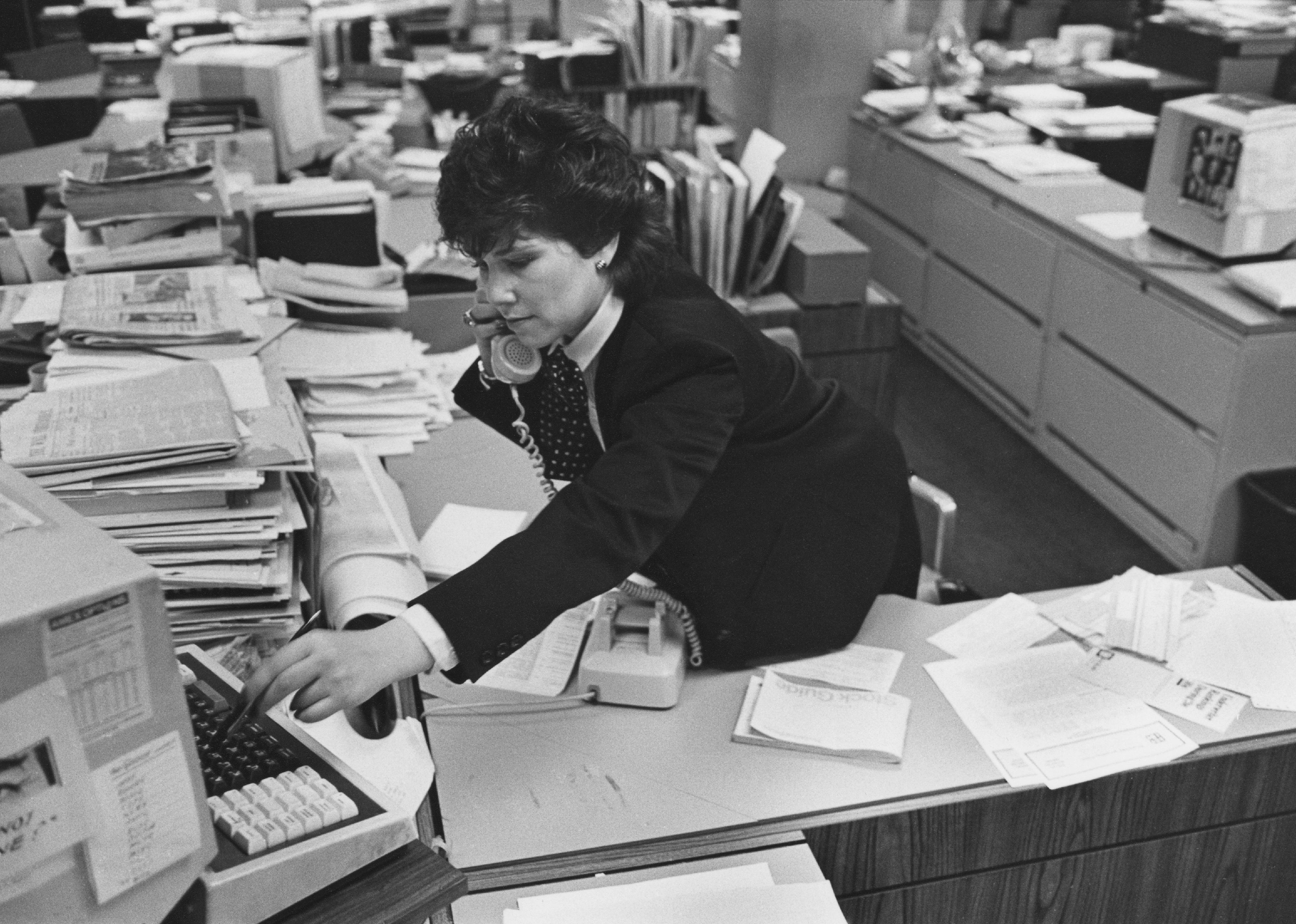
History of women in the workplace
Mark the year 2059 on your calendar—that's when data shows that women will to their male counterparts. It's hard to believe that closing the gender wage gap will take nearly a century after the Equal Pay Act was passed in 1963. In 1960, women only earned about 61 cents for every $1 that a man took home, a number that ticked up —but that still leaves another 18 cents to go overall. The wage gap is : Among women working full-time jobs in the U.S., Black women are paid 62 cents, Native American women 57 cents, and Latinas 54 cents for every dollar paid to white men, according to the National Partnership for Women & Families.
Researchers on a variety of reasons, ranging from differences in the industries women and men work in, racist hiring and discriminatory promotion practices, discrepancies in hours worked, job segregation, and years of experience. The government also does little to create policies making workplaces and institutions like schools more supportive of women. Systemic discrimination against working women in the U.S. has put them at a severe disadvantage since before the founding of the country. The colonies enacted laws that prevented women workers from as far back as 1769. A lack of suffrage prevented women from voting for politicians who could bring forth more equitable policies until 1920. Wage codes from the National Recovery Administration, established in 1933, set lower minimum wages for women than for men, even though they were performing the same work. To top it off, women continue to endure sexual harassment and assault in the workplace and take on the "second shift" of being both workers and mothers, just as they have throughout American history.
Despite these struggles, women have managed to achieve plenty of success in their careers, becoming Fortune 500 CEOs and going to space. Â鶹ԭ´´ looked at research from news outlets (Time, The New York Times, U.S. News & World Report, Entrepreneur), think tanks (McKinsey, the Brookings Institution), government agencies (the U.S. Census Bureau, Department of Labor, Equal Employment Opportunity Commission, National Park Service), and organizations that focus on women's rights (Time's Up, Planned Parenthood) to learn about the history of women in the workplace. The resulting timeline shows both the challenges and triumphs of women climbing the corporate ladder and fighting for equity along the way.
Click through to learn more about American women in the workplace, from 1765 to today.
1765: Women workers establish the Daughters of Liberty
The Daughters of Liberty, the country’s earliest , was formed in 1765. They went on to demonstrate against the Stamp and Townshend acts.
1769: Colonies ban women workers from keeping their earnings
The 13 colonies adopted English laws that from keeping the income they earned in 1769. The system also banned women from owning property.
1776: Abigail Adams promotes gender equality
Abigail Adams brought issues of gender equality to the White House in 1797. She emphasized the importance of educating girls and appealed for .
1809: US woman earns patent for the first time
Mary Kies of Connecticut became the first woman in the nation to be in 1809. She received the patent for an innovative straw and silk braiding technique that advanced hat-making.
1824: Women stage first factory strike in US
More than blocked entry to a Rhode Island textile mill in 1824, protesting their employer's plan to cut wages and increase the length of the workday for women between 15 and 30 years old. The demonstration is considered the country's first factory strike.
1825: Workers form first all-women union
The was formed in 1825. It was the country’s first union comprised entirely of women. In 1831, the union went on strike . After a bitter struggle, during which male trade unions their female counterparts, the women returned to work without higher wages—But they did set the stage for future union work in the textile industry.
1844: Workers form Lowell Female Labor Reform Association
In response to an extension in the workday, women workers formed the Lowell Female Labor Reform Association in 1844. It is considered one of the first successful organizations of women workers in the country. The group helped reduce the workday at (down from 12 or 13 hours) and make their mills safer and more sanitary.
1847: Maria Mitchell opens doors for women in STEM
was the country’s first professional woman astronomer. She was also the first American to discover a comet in 1847. She helped pave the way for women in STEM (science, technology, engineering, and math) careers.
[Pictured: Astronomer Maria Mitchell with her astronomy class outside the observatory at Vassar College, Poughkeepsie, New York.]
1869: Women enter the legal field
The year 1869 marked for women in the legal profession. That year, Arabella Mansfield became the first female lawyer, and Ada Kepley graduated from law school, making her the first woman to do so in the country.
[Pictured: Belva Ann Lockwood, the first female lawyer to practice before the United States Supreme Court.]
1867: Cigarmakers union welcomes women members
The Cigar Makers' International Union began adding women to its ranks in 1867. It was the first national union to ditch its males-only mandate.
1869: Workers form first national union for women
Women shoe workers established the country’s first , the Daughters of St. Crispin, in 1869. It aimed to represent the diversity of skills in the stitcher workforce.
1872: Congress guarantees equal pay for women federal employees
Congress passed a law granting to their male counterparts in 1872. Unfortunately, it did not extend to the state or local level, nor did it apply to the private sector, so many women workers did not receive this protection.
[Pictured: Victoria Woodhull, the candidate in 1872 from the Equal Rights Party, supporting women's suffrage and equal rights.]
1872: Patent Office hires first woman patent examiner
Anne Freeman became the at the U.S. Patent Office in 1872. The milestone may have encouraged more women to apply for patents for their inventions, according to the National Women’s History Museum.
1873: Ruling allows state to exclude women from practicing law
The Supreme Court ruled that from practicing law in 1873. One Justice on the case reasoned that practicing law could disrupt “the respective spheres of man and woman” and her duties as a mother and wife.
1881: Washerwomen strike in Atlanta
A group of more than 3,000 washerwomen, the majority of whom were Black, staged a large-scale strike in Atlanta, Georgia, in 1881, demanding fair pay for their strenuous jobs. While the threat of a costly business license requirement and arrests of strikers mitigated their efforts to set a standard wage for laundry, the of "the power of low-wage, African American, female workers to disrupt the status quo," according to Rosalind Bentley of The Atlanta-Journal Constitution.
1892: American Federation of Labor appoints first woman organizer
The American Federation of Labor appointed as the first woman to serve as a national general organizer in 1892. During her time in that role, she organized workers in the garment industry, along with shoe workers, carpet weavers, binders, and printers.
1889: Anna Bissell becomes first woman CEO
When ’s husband died, she took over the Bissell sweeper company in 1889 and became America’s first female CEO. She helped promote workers’ compensation policies and employee pension plans.
[Pictured: The Bissell carpet sweeper invented by Melville and Anna Bissell in 1876.]
1898: Charlotte Perkins Gilman pushes for women’s financial independence
In 1898, Charlotte Perkins Gilman published “Women and Economics.” She argued that women must become economically independent from men.
1899: Social reformers found the National Consumers League
Two women social reformers—Jane Addams and Josephine Lowell—founded the National Consumers League in 1899. The organization leveraged the power of consumers to push for minimum wage for women and other workers’ rights.
[Pictured: Jane Addams, American social reformer and feminist.]
1900: Women get some control over income
New York state passed the Married Women's Property Act in 1848, which gave married women a degree of control over their own income and property. By 1900, had enacted similar legislation, according to the National Women's History Alliance.
1905: Women entrepreneur earns more than $1M
Madam C.J. Walker created her hair care product company in 1905. The business, which was focused on the needs of African American women, would help Walker become America’s first self-made female millionaire.
[Pictured: A photograph of Madam C.J. Walker driving, 1911.]
1909: 20k women workers go on strike
Around 20,000 shirtwaist industry workers, most of whom were Yiddish-speaking women who immigrated to the U.S., went on strike on Nov. 23, 1909. The largest demonstration by women up until that point, the forced the largely male leaders of the industry to “revise their entrenched prejudices against organizing women,” according to Tony Michels of the Jewish Women’s Archive.
1911: Triangle Shirtwaist Factory fire kills 123 women workers
A fire at the Triangle Shirtwaist Factory in New York City , the majority of whom were women, in 1911. Considered one of the worst industrial disasters in the nation’s history, it led to stricter fire codes at workplaces. It also helped spark the empowerment of women in the workforce.
1912: Massachusetts sets first minimum wage for women
Massachusetts adopted a in 1912—the first state in the country to do so. The law only applied to women and children.
1917: First woman serves in Congress
Women saw political career opportunities open up to them in 1917 when Jeannette Rankin was elected to Congress. Since then, the U.S. House of Representatives has had a total of join its ranks.
1918: Women take on factory jobs during World War I
Women filled factory jobs left vacant by men during World War I. By 1918, munitions factories became the .
1918: New York court broadens acceptable contraceptive use
The New York State Court of Appeals ruled that physicians were allowed to for health reasons in 1918. Expansion of access to contraceptives has helped women and advance in the workplace, according to Planned Parenthood.
1918: Women in Industry Service publishes employment standards
The Women in Industry Service released the first edition of the in 1918, using input from both employers and women laborers. They were updated and republished multiple times and eventually helped form labor laws at the national and state level.
1919: International Congress of Working Women founded
Female laborers from the U.S. and abroad formed the International Congress of Working Women in 1919. That year, they met in Washingtond D.C., for 10 days to discuss labor standards and benefits, such as maternity insurance.
1920: Women get right to vote
The passage of the 19th Amendment in 1920 gave women the right to vote. With a stake in politics, women could now vote for leaders who could help them achieve equality at work.
1920: Department of Labor adds Women’s Bureau
The Department of Labor established a . The bureau was responsible for creating standards and policies focused on the welfare of women workers, improving their working conditions, and fostering more career opportunities for women.
[Pictured: Mary Anderson, head of Women's Bureau of the U.S. Department of Labor, at her desk, Washington D.C.]
1923: Activists introduce Equal Rights Amendment
The first version of the was drafted in 1923. With support from the National Women’s Party, Amelia Earhart, and professional women workers, the amendment aimed to grant men and women equal rights, including in the workplace.
1932: Women lose government jobs
The Economy Act of 1932 prohibited the government from per family. Many women workers were ultimately let go.
[Pictured: President Hoover with the New York Young Republicans after signing the Economy Act of 1932.]
1933: 2 million women lose jobs in the Great Depression
The Great Depression left more than 2 million women out of work at the start of 1933. The struggles of women and Black workers during this time went unrecognized by the government and much of the public, who thought of workers as solely white men.
1933: National Recovery Administration codifies pay discrepancies
Established in 1933, the National Recovery Administration made pay discrepancy between men and women an official policy. Around 25% of its codes established lower minimum wages for women workers compared to their male counterparts.
[Pictured: President Roosevelt affixes his signature to the Industrial Control-Public Works bill, otherwise known as the National Recovery Act.]
1933: Frances Perkins becomes first female Secretary of Labor
Frances Perkins took on the role of Secretary of Labor in 1933. The first woman to hold that position, Perkins was instrumental in the , as well as the New Deal.
1935: National Council for Negro Women is established
Mary McLeod Bethune founded the in 1935. The organization helped push for an end to job discrimination, sexism, and racist policies, according to the Labor Heritage Foundation.
1936: Only 18% of people believe wives should work
In 1936, a Gallup poll asked people whether married women should work full-time outside of the home. Just of the notion, with the majority of both men and women signaling disapproval. Those numbers would all but flip when the same question was asked in the 1990s.
1938: Fair Labor Standards Act sets minimum wage
Congress passed the Fair Labor Standards Act in 1938. It established a minimum wage for all workers—regardless of gender.
1943: Rosie the Riveter inspires women workers
The Saturday Evening Post published the now-iconic Norman Rockwell cover image of Rosie the Riveter on May 29, 1943. The concept of the character, which had been around for at least a year, helped inspire women to take on traditionally masculine jobs to help with the war effort.
1945: Congress introduces Women’s Equal Pay Act
Members of Congress proposed the in 1945. While the bill failed, it did establish the concept and the language for “comparable work” in regards to pay equity, which means that people of different genders working similar jobs at the same place of employment should be paid equally.
1945: Women labor force grows 50%
World War II saw large numbers of women enter the labor force to fill jobs while men served in the military. The female labor force expanded by .
1948: Court allows bans on women in certain industries
The Supreme Court backed up a Michigan law that in certain industries in 1948. It was deemed that keeping women out of some jobs, such as bartending, would help protect their morals.
1961: President Kennedy founds Commission on the Status of Women
In 1961, President John F. Kennedy created a , chaired by Eleanor Roosevelt. It issued a report two years later that documented substantial discrimination against female workers and offered guidance on fair hiring practices and other policies to help women, according to the Labor Heritage Foundation.
1962: Women's labor force participation swells
Beginning in 1962, women's participation in the labor force started to increase dramatically. It would climb from , creating around $2 trillion in economic gains, according to Alison Burke of the Brookings Institution.
1963: Equal Pay Act gets passed
President John F. Kennedy signed the into law on June 10, 1963. It was among the earliest federal laws that aimed to end wage differences between men and women performing the same work in the same place of employment.
1964: Civil Rights Act strengthens gender equality
Women gained even more protection against discrimination when the Civil Rights Act was passed in 1964. It prohibited employers from discriminating workers on the basis of sex, along with race, religion, and national origin.
1965: Supreme Court rules that married couples can use contraception
A landmark Supreme Court decision in 1965 ruled that married people have the right to use birth control. According to Planned Parenthood, since the 1960s can be credited to access to oral contraceptives.
1966: Feminists form the National Organization for Women
Betty Friedan and other feminists formed the National Organization for Women (NOW) in 1966. The country’s largest group of feminist grassroots activists, NOW is and establishing gender equality in the workplace.
1967: Executive order implements affirmative action plans
President Lyndon B. Johnson that required federal contractors to implement an affirmative action plan to provide equal opportunities to minority and women workers in 1967. All federal contractors that have more than 50 workers and over $50,000 in federal contracts must comply with these regulations by creating written affirmative action plans and developing placement goals for these protected workers.
1968: Government bans sex-segregated help-wanted ads
The Equal Employment Opportunity Commission that specified gender in newspapers in 1968. While the ruling was challenged, the Supreme Court upheld the original decision in 1973, giving women a path to more lucrative jobs that were once only available to men.
1969: Court rules against gender-based job classification systems
A U.S. Circuit Court of Appeals ruled against a company policy that segregated jobs based on gender in 1969. The company, Colgate-Palmolive, had previously for roles requiring strenuous work.
1970: Court reinforces equal pay for women and men
The U.S. Court of Appeals for the Third Circuit ruled that employers can’t change a job title or description to avoid paying women equal to their male counterparts in 1970. The ruling stemmed from a case against Wheaton Glass, which gave men the job title of “selector-packer-stackers” and women the title of “selector-packers” in order to pay them substantially different amounts for similar work.
1970: Women workers participate in nationwide demonstrations
Gender equality activists across the country participated in the Women’s Strike for Equality on August 26, 1970. The series of demonstrations, which included a march of tens of thousands of people in New York City, were aimed at and other issues affecting women.
1971: Working mothers get more protections
The Supreme Court made a ruling that outlawed employer policies against the with preschool-age children in 1971. The decision gave women greater opportunities to secure employment after having children.
1972: Ruling establishes right to contraception for single women
A Supreme Court ruling in 1972 gave unmarried people the same access to birth control as married couples. According to Planned Parenthood, birth control was responsible for around a third “of the increase in the proportion of from 1970 to 1990.”
1972: Title IX establishes gender equality in education
The government enacted Title IX of the Education Amendments in 1972. The measure banned gender discrimination in education programs that are funded with federal dollars, giving women greater opportunities.
[Pictured: Representative Patsy Mink of Hawaii, Title IX co-author, for whom the law was renamed in 2002.]
1972: America gets first female CEO of Fortune 500 company
of The Washington Post in 1972, making her the country’s first woman CEO of a Fortune 500 company. Under her leadership, the newspaper broke stories on the Watergate scandal.
1972: Congress expands equal pay policies
When Congress passed the Educational Amendment of 1972, it of the Equal Pay Act to professional, administrative, and executive positions. Those types of jobs had previously been exempt from the law.
1974: Supreme Court deems mandatory maternity leave unconstitutional
The Supreme Court ruled in 1974 that employers cannot force workers to take maternity leave. The decision helped women to remain at work and advance in their careers while becoming mothers.
1974: Congress extends fair labor standards to domestic workers
In 1974, Congress extended the protections of the Fair Labor Standards Act to domestic service workers, the majority of whom were women. However, the amendments included limited exemptions from requirements to pay a minimum wage and overtime for certain workers in this category.
1977: Louise Kapp Howe coins the term pink-collar worker
Social critic Louise Kapp Howe published “Pink Collar Workers: Inside the World of Women’s Work” in 1977, coining the term “pink-collar workers” for the first time. The book drew attention to gender segregation in the workforce.
1978: Congress passes the Pregnancy Discrimination Act
Congress enacted the in 1978. The law bans employers from discriminating against workers for reasons related to pregnancy and childbirth.
1981: Sandra Day O’Connor becomes first woman on Supreme Court
Sandra Day O’Connor broke the judicial glass ceiling in 1981 when she became the first woman Supreme Court justice. The Washington Post would go on to call her
1982: States fail to ratify Equal Rights Amendment
Gender equality in the workplace took a blow in 1982 when states failed to ratify the Equal Rights Amendment before the deadline. The amendment needed an to sign on in order to receive full ratification.
1982: Women earn more college degrees than men
The year 1982 marked the first time in U.S. history that of bachelor’s degrees than men, according to the American Enterprise Institute. The education helped make women more competitive for higher paying jobs.
1983: First woman astronaut goes to space
Sally Ride became the first American woman astronaut to go to space in 1983. She helped pave the way for other women at NASA.
1984: Law firms no longer allowed to discriminate against women
The Supreme Court in 1984 ruled that law firms were no longer allowed to use gender as a discriminating factor when promoting lawyers to partners. The decision would help women continue to climb the ladder in legal fields.
1984: New law helps women workers collect retirement benefits
Congress enacted the Retirement Equity Act in 1984. It permitted workers to without giving up future retirement benefits and made it easier for widows to collect their spouse’s retirement pay.
1986: Sexual harassment at work made illegal
A Supreme Court ruling in 1986 deemed that sexual harassment from a supervisor against an employee was a violation of a federal law prohibiting sex discrimination at work. The court said sexual harassment could create a problem that especially affected women workers.
1986: Lawsuit ends forced resignation of married flight attendants
A sex-discrimination lawsuit against United Airlines ended in a for women flight attendants in 1986. The flight attendants had been forced to quit if they got married—a policy that was deemed a civil rights violation.
1987: Supreme Court affirms gender-based affirmative action
In Johnson v. Transportation Agency, Santa Clara City, a female employee received a promotion over a similarly qualified male employee at the local transportation agency that was taking affirmative action. The Supreme Court ruled in 1987 that employers are allowed to take gender into consideration when deciding who gets a promotion as part of affirmative action and correcting imbalances in the workplace.
1988: Congress enacts Women’s Business Ownership Act
Congress passed the Women’s Business Ownership Act in 1988. The law eliminated a requirement for women to on business loans, thus helping female entrepreneurs get financing for new companies.
1989: Woman becomes leader of Small Business Administration
President George H.W. Bush put Susan Engeleiter in the of the Small Business Administration in 1989. She was the first woman to hold that position.
1993: Congress passes Family and Medical Leave Act
The Family and Medical Leave Act helped make it easier for and family needs. Passed in 1993, the law grants eligible workers up to 12 weeks of unpaid time off each year for pregnancy, care of a newborn, adoption or foster care, and other caretaking duties.
1994: Congress passes Gender Equity in Education Act
Congress passed the in 1994 in an effort to promote equality between men and women in the workplace and beyond. The law gave teachers training in gender equity, preventing sexual harassment, and increasing math and science education for girls, according to the National Women’s History Alliance.
1995: Women become breadwinners
In the mid-1990s, women played a greater role in bringing in income for their families. A 1995 survey found that nearly half of married women earned at least .
1996: Equal Pay Day gets added to the calendar
The National Committee on Pay Equity declared the first in 1996. It has been commemorated every year since then in order to draw awareness to the gender pay gap.
1998: Employers now liable for sexual harassment from supervisors
A Supreme Court ruling in 1998 deemed that employers are still liable for sexual harassment from supervisors against employees, even if they did not know about the issue. The decision included which may let employers off the hook if they take certain steps to stop sexual harassment or if the employee did not complain through the right procedures.
2000: Women's workforce participation hits peak
The share of women age 16 and up in the labor force hit It was a historical peak in participation.
2001: Casino workers campaign against high heels
Through their “Kiss My Foot” campaign, workers’ rights activists successfully persuaded casinos in Nevada to end the in uniform requirements in 2001. Tom Stoneburner, director of the Alliance for Workers’ Rights, told Martin Griffith of the Associated Press that his group wants “women to become valued employees rather than sexual lures used to bring people into casinos.”
2009: President Obama creates Council on Women and Girls
President Barack Obama created the in 2009. The council was given the mission to help government agencies promote gender equality and eliminate pay disparities.
[Pictured: President Barack Obama and Senior Advisor Valerie Jarrett (who chaired the council) chat outside the Oval Office in the White House.]
2009: Congress passes Lilly Ledbetter Fair Pay Act
The overturned a Supreme Court decision that restricted the time period workers had to file complaints of wage discrimination against their employers, giving them 180 days from the date of their last paycheck to make a claim. It also had explicit details on retroactive pay, helping women (and other workers) who received unfair compensation get paid what they should have on previous paychecks.
2010: Women’s Bureau hosts National Dialogue on Workplace Flexibility
In an effort to encourage employers to adopt flexible policies that could particularly benefit women workers, the Women’s Bureau hosted the in 2010. Organizers say policies like and compensated family and medical leave could help workers better balance the needs of their employers and their families, according to the National Partnership for Women & Families.
[Pictured: President Barack Obama addresses the closing session of the White House Council on Women and Girls’ Forum on Workplace Flexibility.]
2010: Break time for breastfeeding becomes mandatory
Congress amended the Fair Labor Standards Act to include a provision for in 2010. The law requires employers to provide reasonable break times during the workday for nursing mothers to express milk in a private area that's not a bathroom.
2010: Affordable Care Act increases access to birth control
The Affordable Care Act, which was signed into law in 2010, mandated that private health insurance companies cover birth control without any additional payment (like co-pays or deductibles) from members. Planned Parenthood has found that has helped advance economic and career opportunities for women.
2011: Woman takes over top 20 bank
Beth Mooney became CEO of KeyCorp in 2011. It was the first time a had a woman in its highest role.
2013: Combat roles open to women
The Pentagon lifted a ban that had prohibited women in the military from serving in combat roles in 2013. Realities of war had frequently in combat prior to the overturning of the gender-based ban.
2013: General Motors gets woman CEO
Mary Barra became the in 2013. It was the first time in U.S. history that a major automaker had a woman at its helm.
2014: President Obama opens door for salary discussions
In April 2014, President Obama signed an executive order that prevents federal contractors from penalizing workers for discussing their salaries with colleagues. The measure was an effort to help reduce gender-based wage disparities.
2015: Pay gap closes for New York City millennials
A found that the pay gap between men and women closed among millennials in New York City. The research found that female millennials earned $1.02 for every $1 in income received by young men.
2016: Hillary Rodham Clinton scores Democratic nomination
Hillary Rodham Clinton broke one of the highest glass ceilings in the country when she became the first woman to earn the presidential nomination from a major party in 2016.
2017: 42% of women face gender discrimination at work
A 2017 report from the Pew Research Center found that at least have dealt with gender discrimination at their workplace. The research also revealed that 22% of men felt they had faced similar discrimination.
2017: #MeToo movement hits Twitter
Activist Tarana Burke started the “Me Too” movement when she coined the term in 2006 to raise awareness of the pervasiveness of sexual assault and harassment. The movement exploded on Twitter in 2017 when actress Alyssa Milano encouraged people to reveal their stories of sexual harassment using the hashtag . It created a larger movement of countless women sharing the misconduct they’ve experienced at the workplace and beyond, and sparked discussion and action to end hostile work environments.
2018: Women in Hollywood launch Time's Up
Hundreds of women in the entertainment industry banded together in 2018 to form . The organization works to tackle gender equity issues in the workplace.
2019: Report predicts automation will displace women workers
A McKinsey report from 2019 predicted that up to 160 million women workers worldwide from their current jobs. Women will need to learn new skills and get more education in order to transition to other careers, the report added.
2020: Government removes deadline on Equal Rights Amendment
The U.S. House of Representatives passed a measure that to pass the Equal Rights Amendment on February 13, 2020. States now have no specified time limit for ratifying the amendment, which guarantees equal rights (including in matters of employment) to Americans of all genders.
2059: Women achieve equal pay to men?
As of 2018, women earned 81.6 cents for every dollar their male counterparts made, according to the U.S. Census Bureau. At the current rate of wage increases, women won’t achieve .