
How the nursing workforce has changed over time
This story originally appeared on Incredible Health and was produced and distributed in partnership with 麻豆原创 Studio.
How the nursing workforce has changed over time
Even as the population of the United States becomes more diverse鈥攚ith as of 2020鈥攖he nursing workforce isn't following suit.
analyzed 2023 data from and 2020 data from the and found that nurse demographics have remained relatively consistent over the past two decades.
Bureau of Labor Statistics data shows that there were about in May 2021, earning a median $37.31 per hour. Nurses' work is undoubtedly crucial, especially in the wake of the which was exacerbated by the COVID-19 pandemic.
Still, the last few years have seen a push for a more diverse medical field that better represents the population it serves. In the United States, across a wide range of health measures鈥攁 trend at least partly attributed to disparities in access to health care.
Receiving medical care from someone with a similar cultural background or ethnicity can help patients feel more comfortable. And research has . A 2022 Columbia University study even found that reported fewer health complications for moms during childbirth.
Keep reading to see demographic snapshot of the nursing workforce today鈥攁nd perhaps discover opportunities to increase diversity within the field.

Nursing remains a female-dominated field
Revelio data shows that about 84% of nurses are female. This figure has remained nearly the same over the past decade, with the share of female nurses having changed by less than 1 percentage point since 2008. (Note: Only binary gender data was available.)
The reason that nursing remains so dominated by women likely comes down to societal gender norms.
Historically, people have viewed nursing as a woman's profession, from early wet nurses and midwives to Florence Nightingale's pioneering nurse training programs in the 19th century, which favored women over men.
Society sees nurses as caretakers, and ascribes to the profession. Although the , these occupational stereotypes often dissuades men from entering the field.
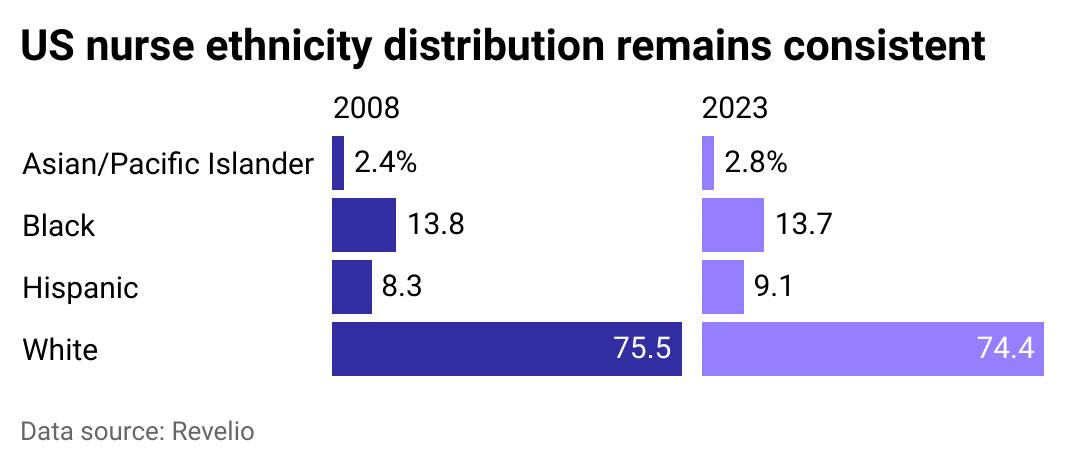
Nurses are still predominantly white
Despite the need for diversity and inclusion in the medical field, about three-quarters of nurses are white鈥攁 percentage that has barely shifted in the last 15 years. As of 2020, , indicating that the nursing field isn't representative of its patient population.
A diverse workforce leads to , and greater health equity for marginalized groups. 2019 research published in the American Economic Review journal found that patients are more likely to take advantage of preventative care and have when their provider is of a similar race or background.
Many nursing schools have made changes to increase the number of diverse nurses entering the field. Some are reducing their reliance on standardized testing and switching to . Some are reevaluating how institutions recruit students and faculty to . And others are introducing more to raise awareness of nursing as a potential career.
These efforts are paying off: The number of has steadily increased at the undergraduate and graduate levels over the past several years.

The 2020 median age for RNs was 52
In 2020, the median age for registered nurses was 52鈥攁 year older than what determined in 2017. Data Revelio sourced from LinkedIn also supports this observation, revealing that nurses have gotten older on average over the past 15 years. The higher average age in nursing can be partially attributed to the aging baby boomer population, which represents .
As baby boomer nurses retire, millennial nurses are taking their place: Millennials are . However, that still might not be enough to combat the worsening nursing shortage. Nursing school enrollment , and a lack of nursing school faculty makes it challenging to increase admissions.

Bachelor's degrees growing among nurses
Prospective nurses have several choices for their education. To become a registered nurse, you must first complete either an associate degree in nursing over two years or a bachelor's degree over four years. Then, you need to pass the NCLEX-RN licensure exam.
Though you can get your nursing license with either an associate or bachelor's degree, many hospitals consider a the gold standard. Still, some nurses complete a more affordable associate's degree first to start working sooner and then save up to pursue their bachelor's degree.
Some nurses return to school to complete a Master of Science in Nursing program or a Doctor of Nursing Practice degree. After completing coursework, prospective nurse practitioners must pass a national board certification exam.
In 2020, as their highest level of education. This statistic has steadily increased over the past decade. Forty-two percent of registered nurses also said their bachelor's degree qualified them for their first U.S. nursing license.