
Nearshoring: A smart way to cut costs and scale your business in 2025
You鈥檝e probably heard the term 鈥渘earshoring鈥� tossed around at conferences or seen it in your LinkedIn feed lately. It seems everyone鈥檚 talking about it, but what鈥檚 the real story? Is it just another buzzword, or is there something useful here?
Some see it as a way to cut costs. Others see it as the only way to actually hire the people they need. Either way, it鈥檚 catching on fast.
covers what nearshoring is, why so many U.S. companies are embracing it, and how to do it right, without creating a second set of problems around communication, compliance, or team cohesion.
Key Takeaways
- Nearshoring is the practice of hiring remote professionals in nearby countries to build distributed teams that work in sync with U.S.-based teams.
- U.S. companies are using nearshoring to access the specialized talent they need in areas like software development, finance, marketing, sales, and support roles.
- Successful nearshoring requires fair compensation, structured onboarding, and inclusive management practices to build long-term, high-performing teams.
What Is Nearshoring? A Simple Definition
Nearshoring is having business operations performed by teams or individuals based in geographically close countries with similar time zones.
It鈥檚 about building part of your workforce in nearby countries, where professionals work remotely with your U.S.-based team. For U.S. businesses, this typically means establishing teams in countries like Mexico, Argentina, Colombia, and Brazil.
Unlike traditional or India, nearshoring focuses on the benefits of geographic proximity, like real-time collaboration and cultural alignment.
This article focuses specifically on nearshore hiring: directly hiring remote professionals to work as part of your team.
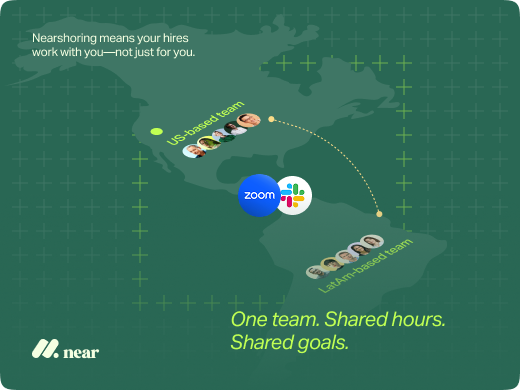
Unlike outsourcing, where work is contracted out to a third-party firm, nearshore hires are integrated into your company structure. They follow your processes, attend your meetings, and contribute to your culture, just like any other employee.
Here鈥檚 what it looks like in practice: A U.S.-based startup needs to build out its development team but can鈥檛 match big-tech salaries.
They expand their search and end up hiring senior developers in Colombia who work U.S. hours, attend the same virtual meetings as U.S.-based staff, and contribute like any other team member. Their , sure鈥攂ut more importantly, the company gets the experienced talent it needs to grow. Talent they wouldn鈥檛 have been able to afford in the U.S.
Why US Companies Are Turning to Nearshore Hiring
People often assume nearshore hiring is just about cutting costs, but that鈥檚 only part of the story. Smart companies are embracing nearshoring as a strategic growth move. They鈥檙e hiring smarter, not cheaper.
Here鈥檚 what鈥檚 driving this shift.
Access to specialized talent
because hiring in the U.S. has become increasingly challenging.
That perfect candidate either costs a fortune or gets snatched up by a competitor before you can even schedule a second interview.
When you can鈥檛 find the talent you need locally or can鈥檛 afford the A-players in the U.S. market, nearshoring lets you .
For example, Propensity, a SaaS company, was struggling to scale its marketing team with the right talent. By expanding their search to include remote professionals in Latin America, they were able to assemble a high-performing marketing team with key hires: a head of marketing and a product marketing manager.
Nearshoring opens up access to a much wider talent pool. Instead of competing for scarce local talent, you can tap into markets where highly skilled professionals are more available.
Significant cost savings
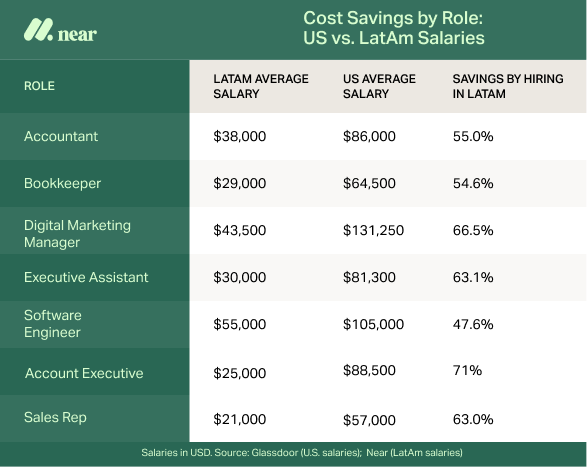
U.S. companies typically save 30%-70% when nearshoring to Latin America compared to hiring U.S.-based talent. These savings come from lower costs of living in the region, not from compromising on quality or short-changing hires.
Hiring in LatAm is a genuine win-win. While you save on costs, your Latin American team members often earn more than they would make locally, creating strong motivation and loyalty.
An analysis of 2,000 placements of LatAm professionals with 500 U.S. companies in the revealed that LatAm hires saw their salaries grow by up to 87.5% when switching to an equivalent role with a U.S. company.
And that increase鈥攃ombined with benefits and growth opportunities鈥攎ade those placements 66.29% more likely to stay than their U.S.-based counterparts.
Sure, some companies try to squeeze every last dollar of savings, but that鈥檚 shortsighted.
The most successful nearshoring relationships are built on finding the sweet spot: paying competitive rates for Latin America while still making savings compared to U.S. salaries.
Companies that pay too little find their hires jumping ship as soon as someone comes along with a better offer. Pay fairly, and you build a stable, committed team while still realizing significant cost benefits.
The table below shows average savings for a few roles, or have a look at the to get figures for dozens of roles.
Real-time collaboration
Here鈥檚 where nearshoring really shines compared to traditional offshoring: Your team works during your hours.
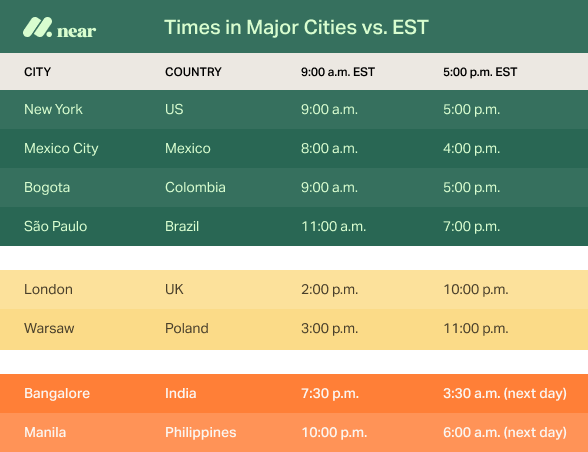
Wherever you're based in the mainland U.S., there are LatAm countries in the same time zone or within a one- to two-hour difference.
This means, compared to offshoring to Eastern Europe or Asia, you get:
- The ability to have actual conversations and solve problems in real time
- Team members who are available for customer calls during U.S. business hours
- Simplified scheduling for meetings and collaborative work
This time zone alignment makes nearshoring feel much more like having a remote U.S.-based team than a traditional offshore operation.
For example, for Stull CPA, a Texas-based accounting firm, the time zone alignment was a game-changer. Their team was swamped during tax season and couldn't afford the delays that came with the offshore talent they had been working with in India and the Philippines.
They needed people who could jump on calls, answer client questions, and collaborate in real time. By switching their talent search to Latin America, they quickly found experienced accountants with US GAAP knowledge who could work during US business hours.
Time zone alignment isn鈥檛 just a convenience鈥攊t鈥檚 often the difference between a team that runs smoothly and one that constantly feels out of sync.
Cultural compatibility
Latin American professionals often have strong cultural alignment with U.S. business practices. Many have previous experience working with U.S. companies and understand American workplace norms, communication styles, and expectations.
Plus, you鈥檒l find excellent English proficiency, especially among the top-tier professionals that nearshoring allows you to hire. This eliminates one of the biggest friction points of traditional offshoring: miscommunication due to language or cultural gaps.
The Challenges of Nearshoring (And How to Overcome Them)
No business strategy comes without challenges, and nearshoring is no exception.
But here鈥檚 the thing: None of these nearshoring challenges are deal-breakers. They鈥檙e just hurdles you need to plan for.
Finding and vetting talent
Without an established presence in Latin America, it can be challenging to know where to look for top talent and how to assess candidates鈥� skills and experience effectively. Quick鈥攏ame the top three universities in Argentina or which LatAm companies are the equivalent of working at a Big Tech company. Not so easy, right? Not to mention that resumes often look completely different from what you鈥檙e used to seeing.
Solution: Partner with a recruiting or .
Specialized firms have established networks, understand local job markets, and can pre-vet candidates to ensure you鈥檙e only interviewing high-quality prospects.
Legal and compliance considerations
Hiring internationally involves navigating different legal systems, tax implications, and compliance requirements, which can be complex without specialized knowledge.
Solution: Use an service, hire contractors rather than employees, work with a staffing and recruiting agency that handles these complexities for you, or utilize global HR platforms like Deel or Oyster.
And, of course, always consult your legal or HR team.
These approaches simplify the legal aspects and ensure compliance while still giving you all the benefits of working with nearshore talent.
Communication and management adjustments
Even with cultural similarity and time zone alignment, remote teams require intentional communication strategies to ensure everyone stays connected and aligned. This is true whether your team is all in the U.S. or distributed globally.
Solution: Implement clear communication protocols from day one. Use collaboration tools like Slack and Zoom and project management platforms like Asana or ClickUp to keep workflows efficient. Regular video meetings help build relationships and maintain team cohesion.
It鈥檚 also important to . Small things like including them in casual (virtual) conversations (maybe on a 鈥渨ater-cooler鈥� Slack channel) and celebrating their accomplishments can make a big difference in engagement and retention.
Which Roles Are Best Suited for Nearshoring?
If the job is already being done from a laptop and managed over Zoom and Slack, it can likely be done just as effectively from Latin America.
Here are some of the most common roles companies successfully nearshore:
- Tech: Developers, QA engineers, DevOps, AI engineers
- 鈥岲补迟补: Data scientists, data engineers鈥�
- Finance: Accountants, bookkeepers, analysts
- Support: Customer support reps, technical support, executive assistants
- Marketing and sales: Sales development representatives, digital marketers, copywriters
- Creative: Designers, video editors, content creators
Many U.S. businesses build entire teams in LatAm, including data operations, customer support, and product design roles. Others use nearshoring to extend their U.S. teams, adding a few key people who work the same hours and collaborate daily.
Best Practices for Successful Nearshoring
Here are the key practices that make the biggest difference for U.S. companies building successful nearshore teams:
- Start with clearly defined roles and expectations. Document exactly what you need before starting your search, including required skills, experience level, and performance expectations.
- Prioritize communication skills. While technical skills are important, strong communication abilities are crucial for remote collaboration. Look for candidates who can express themselves clearly in both written and verbal formats.
- Use video interviews extensively. Video recordings and calls give you a better sense of a candidate鈥檚 communication style, English proficiency, and cultural fit than phone or text-based screening.
- Implement a structured onboarding process. Create a that familiarizes new team members with your systems, processes, and company culture. This investment pays significant dividends in productivity and retention.
- Foster inclusion across borders. Make a conscious effort to include nearshore team members in company communications, celebrations, and decision-making processes. The more integrated they feel, the more they鈥檒l contribute.
- Provide fair compensation and growth opportunities. While cost savings are important, don鈥檛 focus solely on paying the lowest possible rates. Fair compensation and clear growth paths lead to higher retention and performance. Before making an offer, validate your salary ranges against real-time local data, not just U.S. benchmarks.
Final Thoughts
The domestic talent shortage isn鈥檛 going away anytime soon. Traditional hiring approaches are leaving companies understaffed, losing their competitive edge, and wasting resources on lengthy recruitment cycles.
offers a strategic solution by providing access to a larger talent pool of qualified professionals while maintaining the quality and communication you need to build high-performing teams.
The time zone alignment, cultural compatibility, and cost efficiency create a powerful combination that鈥檚 hard to match with any other hiring approach.
Whether you鈥檙e looking to build a development or sales team, staff accounting positions, or expand your customer support capabilities, nearshore hiring can help you achieve your goals faster and more efficiently.
was produced by and reviewed and distributed by 麻豆原创.