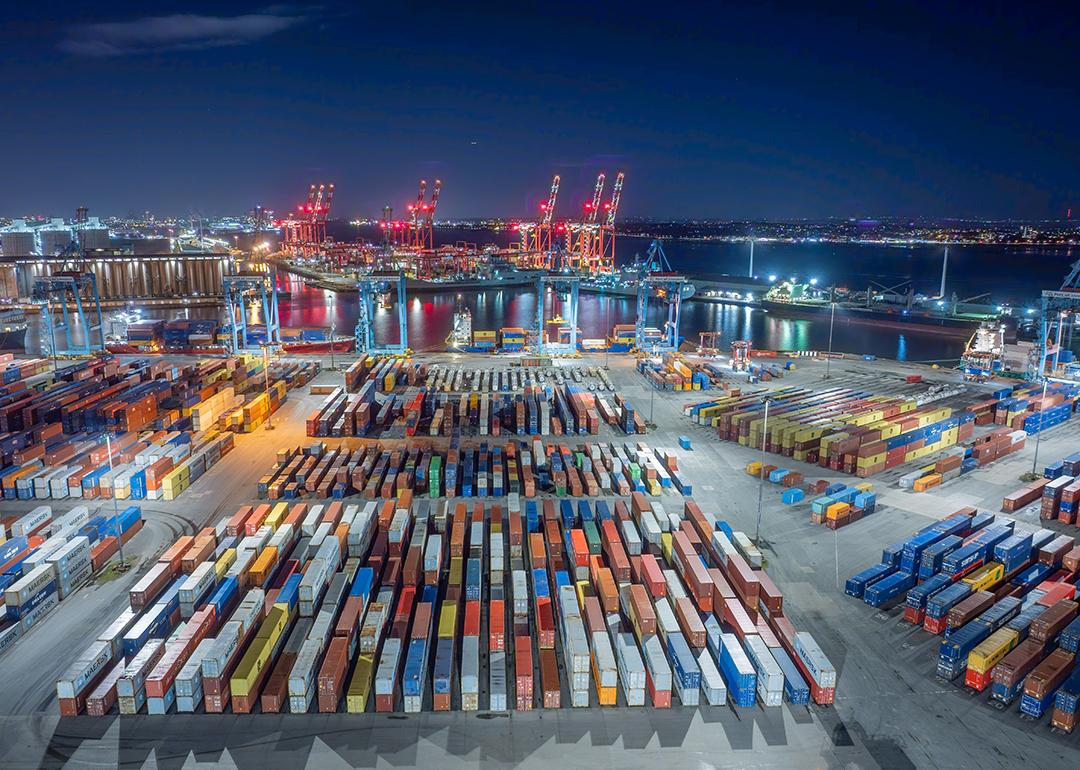
The quiet tech powering the world’s most resilient supply chains
The quiet tech powering the world’s most resilient supply chains
Global supply chains are showing signs of fatigue, and the consequences are more than logistical headaches. Over the past 50 years, extreme weather events have increased fivefold, according to the . As the climate becomes more volatile, so do the economic disruptions that follow, reports.
For example, when Hurricane Helene hit, it didn’t just disrupt the Gulf; it shut down the country’s , triggering hospital shortages nationwide.
In China, torrential flooding brought Nissan’s production facilities to a standstill. Meanwhile, blistering heat in Greece sidelined port equipment and sent workers home, grounding shipments across the Mediterranean to a halt.
But these climate disruptions are just the surface layer. Beneath them lies a growing digital threat. Between 2021 and 2023, . Something as routine as a software update now carries the risk of paralyzing entire operations.
The made that clear. With one system failure, freight operations across continents came to an abrupt stop. These kinds of digital threats aren’t isolated; they’re unfolding alongside rising geopolitical tensions that are redrawing global trade routes in real time.
Ships that once crossed the Red Sea in days now navigate weekslong detours around the Cape of Good Hope. Each additional mile adds cost, delays, and unpredictability to already strained logistics.
And those costs don’t just hit companies. In small island states, volatile freight prices are driving inflation at a rate .
At the same time, global tariffs introduced in 2025 have prompted a major strategic reset. According to the Pew Research Center, of operations leaders are now rethinking how their supply chains are structured, top to bottom.
Labor shortages continue to limit throughput, while new sustainability mandates are forcing companies to overhaul how they source materials and move goods. It’s no longer just a matter of shipping products; it’s about re-engineering the systems that support them.
These converging forces have exposed a foundational weakness. For decades, supply chains were built around a single doctrine: efficiency. The goal was speed and cost reduction, with networks trimmed lean for just-in-time delivery. It worked, so long as the world stayed stable.
But that stability has fractured.
Now, only one in five companies reports having enough resilience to weather disruption. The game has changed. The new competitive advantage isn’t speed. It’s adaptability. It’s the ability to absorb shocks, pivot in real time, and keep the wheels turning when legacy systems falter.
“The defining weakness of traditional supply chains isn’t cost or speed…it’s fragility,” says Michelle Jacob, marketing specialist at Trackonomy. “Resilience is no longer a contingency plan; it’s becoming an engineered capability.”
The ‘Quiet Tech’ Revolution
The solution to today’s supply chain strain isn’t flashy. It doesn’t come with a product launch, a keynote, or a viral moment. Instead, it’s unfolding quietly, through foundational technologies that do their work behind the curtain of global commerce.
This category, often referred to by insiders as “quiet tech,” isn’t about grabbing headlines. They’re purpose-built systems designed to tackle specific operational challenges. Things like transparency, forecasting, and adaptability. And while they don’t make much noise, they’re becoming essential to how the modern supply chain stays alive.
This marks a shift in how companies think about infrastructure. For years, supply chains ran in a reactive mode. A disruption would hit, and teams would scramble to respond. But with AI-powered predictive analytics, that model is fast becoming outdated.
Algorithms now comb through years of procurement data, weather trends, and shipping patterns, not just to explain what happened, but to predict what’s coming next.
In large manufacturing networks, these systems are even more advanced. They can simulate alternate supplier options or flag inventory gaps weeks in advance. A decade ago, this level of foresight would have sounded like science fiction.
And with each data cycle, these platforms get smarter. They refine their forecasts, adapt to new conditions, and catch anomalies that human analysts might never see. But predictive analytics is only one layer of the architecture.
Internet of Things (IoT) monitoring systems are expanding this intelligence across the physical world, but the newest generation has moved beyond simple “tracking.”
Smart devices now ride alongside cargo, acting less like passive recorders and more like active agents. Instead of just measuring temperature or shock and sending an alert to a dashboard no one is watching, these systems are capable of local decision-making. For example, a pharmaceutical shipment can now autonomously flag itself as “compromised” and lock its own digital manifest, preventing a spoiled product from ever reaching a patient.
The International Data Corporation reports that 70 percent of edge deployments now use this kind of local decision-making. The shift is profound: Technology is no longer just “seeing” the problem; it is starting to solve it.
Alongside that, advanced simulation technology is giving companies a way to rehearse disasters before they happen. Rather than relying on static models, leaders can now run “war games” on their supply chains, stress-testing how their networks would react to a port strike in Rotterdam or a freeze in Texas.
Edge computing makes these simulations even more powerful by feeding them with “Ground Truth” data from the physical world. This ensures that the model reflects reality, not just theory, allowing decisions to happen instantly while goods are in motion.
Finally, cryptographic verification adds the necessary layer of trust. In a fragmented supply chain, “he said, she said” disputes cost millions. New verification technologies create an immutable audit trail generated directly by the device itself.
This means companies can prove exactly where a product has been, who handled it, and whether it stayed within compliance, not because a form was signed, but because the physical asset itself generated the proof. call this convergence a way to turn data into something measurable, verifiable, and intelligent. In other words, it transforms transparency into resilience.
But these systems can’t function in silos. Their power lies in integration. As , the combination of advanced robotics, predictive analytics, and IoT has the potential to reshape supply chain performance and dramatically improve customer satisfaction.
Together, these systems don’t replace human oversight; they extend it. And as uncertainty becomes the default setting of global trade, the companies leaning into these invisible upgrades are quietly setting the new standard for what resilience actually looks like.
Real-World Impact
Theory means little without execution, and quiet tech has already proven itself on factory floors, distribution networks, and field operations around the world. The data now emerging from early adopters confirms what industry analysts predicted: These technologies deliver returns substantial enough to reshape competitive dynamics.
A 2024 found that 20 percent of global organizations have already rolled out industrial AI for energy optimization and predictive maintenance. That figure rises steeply when you factor in planned adoption.
More than say they’re either deploying or preparing to deploy these tools in the next three years. Their focus: streamlining supply chains, improving real-time decisions, and tightening production efficiency.
And the financial performance tracks the enthusiasm. A showed supply chain management delivered the highest cost savings of any AI application.
Companies at the front of the curve are trimming logistics costs by 15 percent, tightening inventory by 35 percent, and boosting service performance by 65 percent. In that same survey, said their AI investments were paying off strongly.
What sets these results apart is the type of work being transformed. , chief product officer at enterprise software company IFS, puts it plainly.
Industrial AI isn’t trying to write emails or mimic conversation. It’s built for companies dealing with hard assets and physical complexity. “You have 30 percent of the workforce behind a desk,” he says, “while 70 percent out there getting their hands dirty.” That, he explains, is what separates industrial AI from the buzzier tools grabbing headlines.
And that orientation toward physical operations and frontline workers shapes where these technologies create value.
in Lewisville, Texas, is a case in point. Opened in 2020, the 300,000-square-foot facility produces 5G gear and advanced antennas for the North American market.
Since opening, worker productivity has more than doubled compared to traditional setups. Energy use is down nearly 24 percent. Water consumption has dropped by 75 percent. And the entire site runs on renewable energy.
These results challenge a long-held assumption: that the best way to lower costs is to offshore production to wherever labor is cheapest. But when robots and intelligent systems handle the repetitive work, location starts to matter less for wages and more for proximity to customers.
As automation scales, reshoring and nearshoring no longer look like premium options. They look like a smart strategy.
The steel industry offers another snapshot of how quickly entire industries can pivot. After Russia invaded Ukraine, were forced to rethink their dependence on unstable supply routes.
Many were already modernizing, but the crisis kicked plans into high gear. , the world’s second-largest steelmaker, has rolled out Industry 4.0 systems and 5G infrastructure across its plants to improve safety, consistency, and performance.
Newer players are going even further. in Sweden plans to deliver Europe’s first commercial green steel by the end of 2025 using hydro and wind power. In France, GravitHy is building a hydrogen-powered facility set to open in 2027.
Meanwhile, has committed to carbon-neutral production across all locations by 2045. Each of these efforts hinges on tech that can juggle efficiency, complexity, and environmental accountability at once.
But this revolution isn’t confined to factories. It’s also rewriting the playbook for field operations, especially in sectors where labor constraints and logistical complexity have long limited output.
One global facilities management firm, responsible for more than a year, was falling behind on client commitments. The culprit: a shortage of technicians.
To fix it, leadership deployed AI algorithms that analyzed technician schedules, customer profiles, travel routes, and even electric vehicle charging patterns. The result: Field productivity jumped 40 percent.
offers another look at how quiet tech sharpens performance. The company continuously collects data from recycling machines installed at customer locations, then runs anomaly detection models to guide maintenance decisions.
Before implementation, field engineers resolved issues correctly on their first visit 84 percent of the time. After deploying industrial AI, the success rate reached 97 percent.
, who leads field operations for TOMRA in North America, says simulation capabilities have transformed planning. “It essentially offers you a test environment right within production, which saves weeks, if not months, in assessing the impact of different potential changes,” he explains.
The company has also used AI to compress training timelines, cutting onboarding duration by half. Basile points to knowledge capture as a key benefit: “Rather than an employee needing 30 minutes or an hour to sift through the information of an 800-page manual, they can ask a question and in seconds the AI will return the answer.“
Still, no amount of optimization matters if companies can’t see their own supply chains. And most can’t. A found that only 2 percent of organizations could trace suppliers beyond the second tier. That means most businesses are flying blind beyond their direct vendors, leaving them vulnerable to surprises they can’t predict or prevent.
AI-powered mapping tools are starting to close this gap. , a startup focused on supply chain intelligence, has built a generative AI platform that synthesizes public records and proprietary data to chart supplier relationships across multiple levels.
Its language model interface lets users ask plain-language questions and get precise answers from complex network data.
Amazon is testing a similar approach through . The platform draws real-time data from fragmented sources and uses machine learning to help businesses forecast demand and manage inventory more accurately.
Of course, it’s not just digital blind spots that threaten operations. The physical world is just as volatile. In 2021 alone, the . Hurricanes, wildfires, and floods forced plant shutdowns and clogged supply routes. To stay ahead, companies are turning to geographic intelligence.
With 5G and edge computing, companies can now overlay their supply networks onto live risk maps. They can track port congestion, monitor warehouse conditions, and get real-time alerts as transit disruptions unfold.
And the payoff is becoming clear. A found that 91 percent of U.K. companies using industrial AI reported improved profitability. Ninety-five percent said they expected stronger environmental outcomes. These aren’t projections; they’re operational metrics from companies already running at scale.
, AI program manager at techUK, summarizes the pattern this way: “Organizations are seeing tangible results by implementing robust cybersecurity measures, enforcing strong data governance, investing in workforce upskilling, and aligning AI initiatives with strategic business objectives.”
That alignment between technology and business strategy, as Ikhlaq describes, is no longer optional. It’s becoming the core competency for the next generation of supply chain leadership.
Future Outlook
As quiet tech matures and scales, its reach is expanding well beyond factory floors and freight corridors. The next era of supply chain architecture is taking shape around systems built not only to withstand volatility, but to see it coming and shift course before the impact hits.
This isn’t a matter of layering tech onto old infrastructure. It’s a complete structural rethink, driven by the growing recognition that resilience, flexibility, and foresight are now prerequisites for global competitiveness. For the first time, operational agility is being treated not as an advantage but as an obligation.
Saudi Arabia’s Minister of Transport and Logistics Services, , framed the stakes bluntly at a recent UN roundtable. “These challenges are not the exception,” he said. “They are here to stay. We have to be ready to live with them and overcome them as they arise.“
His message echoed across regions and industries: Resilience must be engineered into the system, not stapled on after the fact.
That system is being built, piece by piece, through unlikely partnerships. Engineers, data scientists, warehouse supervisors, and government ministers now share a common blueprint. They’re connecting risk models to sensor networks. They’re turning procurement data into a predictive strategy. And they’re investing in infrastructures that can bend without breaking.
said it plainly: “We are willing to pay that extra buck to be able to have resilience in our supply chains.” That willingness is no longer a trade-off. It’s the entry point for a new kind of supply chain; one powered quietly, but decisively, by the technologies making resilience possible.
was produced by and reviewed and distributed by Â鶹ԭ´´.