Recognizing the faces on the world's most-traded currencies
Recognizing the faces on the world's most traded currencies
From shells and livestock to Venmo and Bitcoin, the dates back to 9,000 B.C. Before that, people used the barter system. The problem with the barter system was that if one person had a chicken to trade for a pound of flour, they had to find a person who not only had a pound of flour but also needed a chicken. Money became a medium of exchange that simplified the process by assigning value to objects that could be used to purchase any number of goods. Livestock like camels, cows, and sheep were the earliest living dollars, but they soon gave way to shells and later to coins and precious metals like gold and silver, and finally to paper bills. Today, people buy things by moving numbers around on a computer screen, but the concept of money remains the same鈥攜ou work for it to get it then trade it for the things you need and want.
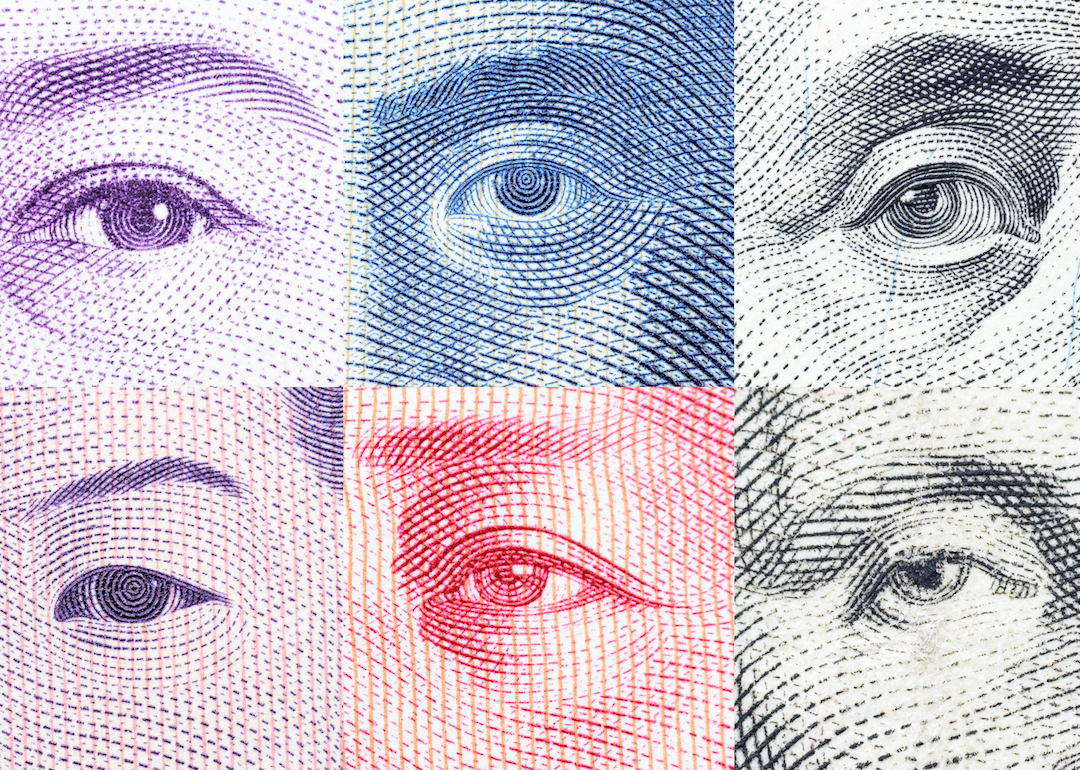
The was minted around 600 B.C. by Lydia's King Alyattes, who stamped his coins with pictures to indicate value and denomination. Soon, powerful leaders began stamping images of their own faces both to showcase their clout and to prevent counterfeiting. Throughout history, money has contained images of powerful people, national heroes, military leaders, founding fathers, and conquerors鈥攁nd that tradition continues today.
Using data from , 麻豆原创 developed a list of 20 of the most commonly traded currencies in the world, starting with the U.S. dollar. It's important to note that some countries or unions are omitted because their currencies don't include an image of a person. The list examines the people whose faces are on the currency and what they did to earn the honor. In some cases, the currency is in coin form; in other cases, it's in paper banknotes. Either way, the list profiles the people who grace each currency's most common or most frequently used denominations. Keep reading to learn about the people who are so famous that their countrymen and women see their faces every time they buy something.
You may also like:
U.S. dollar
The is the most heavily traded currency in the world and probably the most famous鈥攂ut it wasn鈥檛 always a green paper rectangle emblazoned with George Washington鈥檚 portrait. Congress created the U.S. Mint and the concept of the national dollar with the Coinage Act of 1792, but dollars were silver coins until paper bills, called 鈥渄emand notes,鈥� were created to pay for the Civil War. The U.S. Department of the Treasury was tasked with designing the first paper dollar bill in 1862, and then-Treasury Secretary Salmon P. Chase slapped his own face on it. Washington, known as the father of our country, replaced Chase鈥檚 mug in 1869.
Japanese yen
The is the #3 most commonly traded currency in the world, behind only the U.S. dollar and the euro. Its entry-level bill is the 1,000 yen note, which is emblazoned with the image of famed but controversial bacteriologist Noguchi Hideyo, who discovered syphilis as the cause of the progressive disease now associated with it. A novelist named Soseki Natsume graced the 1,000 yen note from 1984 to 2004, when Hideyo replaced him.
British pound
Great Britain issued the one-pound paper note for nearly 200 years starting at the end of the 18th century until 1988 when it was replaced with the more practical . Although it鈥檚 gone through several changes in shape and design, one thing has remained the same in the more than 30 years that have followed: The pound coin is printed with the image of Queen Elizabeth II. Her majesty is the oldest and longest-serving monarch in the history of Great Britain, as well as the oldest and longest-serving head of state in the world.
Australian dollar
Like Great Britain, Australia axed its one-dollar note in the 1980s in preference of a one-dollar coin, although Australia had introduced other coins in 1966 to replace the pence, shilling, and pound it had been using before. Also like Great Britain, the features the image of Queen Elizabeth II鈥攊n fact, her majesty graces every currently issued Australian coin. The British colonized much of Australia until it gained independence, but the two countries share deep cultural bonds and remain strong and longtime allies.
Canadian dollar
Just like Australia, Canada has a deep cultural connection to, and a long historical alliance with, Great Britain, whose sweeping empire once included much of the North American nation. It, too, abandoned the paper one-dollar note in favor of a coin, called , in the 1980s. And Queen Elizabeth II's image also graces the loonie.
Swiss franc
The unified and standardized a collection of currencies starting in 1850, and thanks to Switzerland鈥檚 pledge of non-inflation, it鈥檚 one of the most stable currencies in the world. The one-franc coin bears the image of Helvetica, who is not a real person, but the personification of Switzerland. The franc is also known as CHF, for its Latin name "Confoederatio Helvetica."
Chinese yuan renminbi
The is the official currency of China, and since 1999, all denominations feature a portrait of Mao Zedong, although Chairman Mao was briefly sidelined in favor of an Olympic theme on six million bills for the 2008 Beijing Games. The year 1999 was the 50th anniversary of the communist takeover of China, which was led by Mao, a revolutionary who established the People鈥檚 Republic of China in 1949.
Swedish krona
All Swedish krona coins feature the image of the . Since 1973, that鈥檚 been King Carl XVI Gustaf, who became crown prince when his father, King Gustaf VI Adolf, ascended the throne in 1950. The current king took the throne when he was just 27 and has remained in power for 46 years.
Mexican peso
Peso coins don鈥檛 feature portraits of people, but instead feature the state title and coat of arms on the obverse side. The most commonly traded and lowest denomination paper currency is the 20 peso note, which features a portrait of , a lawyer who became president of Mexico during the period of national unification. As of August 2018, Ju谩rez also was honored with a portrait on the 500 peso bill (pictured here).
New Zealand dollar
All are graced with a portrait of Queen Elizabeth II, and they have been since the South Pacific island nation switched from the New Zealand pound to the decimal-based dollar in 1967. Her majesty also appears on the obverse side of the 20-dollar bill and the watermarks found on all paper currency in New Zealand. The country was a colony of the British Empire into the 20th century and the British monarch remained the head of state even after New Zealand gained independence.
Singapore dollar
The emerged in 1967, and its coins feature a coat of arms, not a portrait of a person. All notes in the fourth, or Portrait Series of paper notes, however, are emblazoned with an image of President Yusof bin Ishak. Ishak died in 1970, but as the first president of Singapore, his memory and legacy loom large over the country to this day.
Norwegian krone
No Norwegian krone banknotes and only two of the currency鈥檚 coins feature an image of a person. Both of those coins, the 10 and 20 kroner, portray , who ascended the throne in 1991 when his father, King Olav V, passed away. All Norwegian 10 and 20 krone coins always feature the current monarch.
South Korean won
The 1,000 bill is the smallest denomination banknotes of currently circulating . Even when it wasn鈥檛, it featured a portrait of Yi Huang, a Confucian scholar who remains one of the most important and celebrated writers and thinkers in Korean history.
Turkish lira
was born in what is now Turkey in the late 19th century at the twilight of the Ottoman Empire, which dissolved during World War I. Atat眉rk was a nationalist leader who became the founder and first president of the Republic of Turkey. His image adorns all Turkish lira鈥攂oth coins and banknotes鈥攖o this day.
Indian rupee
Mohandas Gandhi appears on all denominations of currently circulating . Gandhi is famous worldwide as the spiritual leader of India's successful movement for freedom and independence from the oppression of the colonial British Empire. His methods of peaceful and nonviolent protest and civil disobedience were the inspiration for the Rev. Dr. Martin Luther King Jr.'s civil rights movement in the United States.
Brazilian real
Much like the Swiss franc, the features an image not of an actual person, but of a personification of the nation, sort of like the Statue of Liberty is for the United States. In Brazil, it鈥檚 the Ef铆gie da Rep煤blica, or Head of Republic. She graces every currently circulating paper real banknote, as well as every coin from a previous real coin series that is still in circulation but is no longer minted.
South African rand
For generations, coins and notes featured a portrait of Jan van Riebeeck. Riebeeck was a Dutch navigator who arrived in Cape Town, became a colonial administrator, and helped to found the Dutch East India Co. But that currency was from the time of Apartheid. Today, South African rand coins and banknotes display images of Nelson Mandela, the civil rights leader and anti-Apartheid revolutionary who was instrumental in liberating South Africa.
Danish krone
Danish currency has roots dating back to the ninth century, but modern Danish krone coins feature a monogram of Margrethe II Alexandrine 脼贸rhildur Ingrid, known as ; paper krone banknotes have pictures of landscapes. Anointed as queen in 1972, Margrethe II is widely beloved in Denmark, where she serves as head of state, commander in chief of the military, and supreme authority of the Church of Denmark.
New Taiwan dollar
An image of Sun Yat-sen adorns the New Taiwan dollar鈥檚 100 banknote denomination. According to National Interest, 鈥淗e is , whose government was transplanted to Taiwan in 1949 following Chiang Kai-shek鈥檚 retreat during the war with the communists,鈥� according to National Interest. The publication notes that 鈥淪un Yat-sen鈥檚 presence in Taiwan is ubiquitous鈥� and that 鈥渞oads and schools are named after him.鈥�
Malaysian ringgit
The name would likely be hard to print in a readable font on Malaysian ringgit currency, but lucky for the country's mint, he's so famous that a portrait of his face will do. The country's first supreme head of state, his image has appeared on all paper Malaysian ringgit banknotes since they were first issued in 1967 through the series currently in circulation.
You may also like: