
What smart companies in America are doing to overcome the accounting talent shortage
Accounting is the function you only notice when it breaks. Right now, it鈥檚 breaking for many U.S. companies. Roles sit open for months. Salaries keep climbing.
The work doesn鈥檛 go away, though. Closings, audits, and tax deadlines still hit every month.
And finance leaders are left carrying the risk when reports don鈥檛 get filed on time.
That鈥檚 why more companies are filling these roles in Latin America, where GAAP-trained accountants work U.S. hours and bring the same experience you鈥檇 expect from domestic hires, reports.
Key Takeaways
- The U.S. faces a severe accounting shortage: fewer graduates, CPA exam declines, and a large portion of the existing talent pool retiring have made qualified accountants harder and more expensive to hire.
- Hiring accountants in Latin America helps U.S. companies overcome the shortage. Companies can access GAAP-trained talent who work U.S. hours, enabling faster closes, real-time collaboration, and reliable compliance.
- Latin American accounting salaries are 30鈥�70% lower than U.S. rates, allowing companies to hire skilled accountants and controllers within budget.
Understanding the shortage in U.S. accounting talent
Fewer students are choosing accounting, universities are downsizing programs, and the profession鈥檚 age curve is tilting toward retirement.
Between 2016 and 2022, the number of graduates fell by 17% and 鈥渢he number of candidates sitting for the CPA exam has decreased by 27% over the past decade,鈥� according to .
The Bureau of Labor Statistics projects more than each year through 2032. Many of them are replacement roles for people exiting the field. Filling those jobs locally is getting harder, not easier.
That leaves finance leaders competing in a shallow talent pool where salaries keep climbing.
The impact has been widely reported. , for example, highlighted how the shortage is showing up in financial statements, with more than 600 US-listed companies disclosing 鈥渕aterial weaknesses鈥� tied to personnel shortfalls. Some firms have even had to explain delays in completing reports because they lacked the staff to finish them on time.
For CFOs and controllers, the downstream effects are clear. Closing the books takes longer. Tax season creates bottlenecks that internal teams can鈥檛 absorb. Managers burn out as they pick up the slack. And the cost of waiting months to land a single qualified hire shows up in delayed audits, missed filings, and eroded confidence from boards and investors.
The shortage is so acute that even the Big Four are scrambling. announced plans to invest $1 billion over three years to 鈥渋mprove the attractiveness of the profession.鈥� They plan to 鈥渋ncrease early career compensation as part of a total rewards package that recognizes the value of a certified public accountant (CPA) career path.鈥�
This massive investment proves the shortage is real, but also shows why most companies need a different approach, as they can't outspend the Big Four for talent.
From Big Four-trained professionals to aligned time zones: why LatAm is the place to fill accounting roles
The accountant shortage is forcing leaders to widen the search. Increasingly, that search points south.
Latin America has become the clear choice for many U.S. accounting teams, and here鈥檚 why:
- World-class accounting education. Top universities in the region, such as the University of Buenos Aires and the University of S茫o Paulo, have long-established accounting programs with rigorous standards. Graduates enter the workforce with strong technical foundations and a solid grounding in IFRS, giving them the skills to adapt quickly to U.S. company needs.
- Time zone alignment. S茫o Paulo, Bogot谩, and Mexico City share most or all of the U.S. workday. That means reconciliations, reviews, and sign-offs can happen live, not overnight.
- Experience with global firms. Many professionals launch their careers in the Latin American offices of Big Four firms (PwC, Deloitte, etc.) or at multinationals. That means U.S. companies can hire accountants who already know how to operate at global and U.S. standards.
For companies that can鈥檛 match Ernst & Young鈥檚 billion-dollar bet on salaries, Latin America also provides a practical answer to cost pressures.
Salary expectations for top accounting staff in the region are typically because of differences in cost of living.
That makes it feasible for mid-market firms, regional CPA practices, and growth companies to hire the talent they wouldn't otherwise be able to find or afford in the U.S.
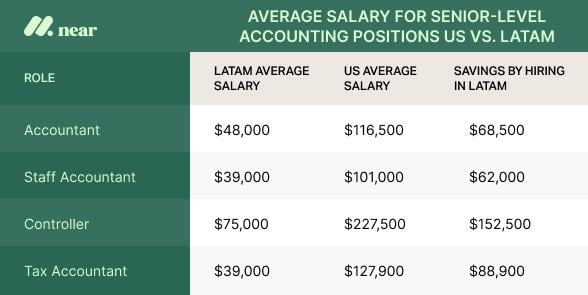
And it鈥檚 not only about covering entry-level or mid-tier gaps. In Latin America, budgets can stretch to senior-level hires鈥攃ontrollers, tax accountants, and experienced staff accountants 鈥攚ho would be out of reach in the U.S. market.
Here鈥檚 what those salary differences look like in practice for senior-level hires:
Why not look farther afield?
There are more distant options for finding skilled accountants, like the Philippines and India, of course. And many U.S. accounting firms have hired there to compensate for the shortage. It鈥檚 that accounting firms are even 鈥渉iring direct from Indian campuses and even offering to sponsor CPA courses.鈥�
But for many companies, working with talent in such distant time zones creates its own problems. As one CFO noted, 鈥淲e looked at the Philippines, but my team pushed back. With a 15-hour difference, they knew it wouldn鈥檛 work. The controller-level staff already had huge workloads. What they needed wasn鈥檛 just another body. It was someone they could work with in real time, side by side, to get through it. That鈥檚 why we moved the search to LatAm.鈥�
Latin America allows finance leaders to keep reviews, approvals, and team discussions within the same business day.
What this looks like in practice
The companies making this shift aren't chasing theoretical cost reductions. They're solving concrete operational problems: scaling finance and accounting teams during growth, handling seasonal capacity crunches, and accessing senior-level expertise they can't afford or find locally.
Here's how three different companies used Latin American talent to remove real bottlenecks:
A cybersecurity company based in Texas was experiencing the classic scaling challenge: growth was outpacing its ability to hire senior finance talent locally. They needed leadership-level expertise that could handle complex reporting and compliance. Within weeks of looking in LatAm, they hired a Director of Accounting and Financial Reporting, a Director of Global Tax (with Big Four experience), and an Accounting Team Lead, along with 17 other accounting professionals. Month-end close times dropped from 15 days to 10, and they had the senior expertise in place to keep up with growth.
A CPA firm faced its annual tax-season crunch. Historically, they spent months scrambling for temporary staff and still came up short. By looking beyond the U.S., the firm hired senior accountants and an operations manager in less than 30 days. The result was simple: the work got done on time, with fewer overnights and less burnout for the partners.
And when a CFO services company needed senior bookkeepers, accounting managers, and financial analysts, their hiring timeline decreased to just 7 days by looking to LatAm.
That kind of speed is unheard of in the U.S. market today, where weeks can pass before interviews even begin. But through specialist recruiters with established Latin American networks, these timelines become routine rather than exceptional. Near鈥檚 , which analyzed 2000 placements, found that the typical number of days to hire an accountant was 7 to 14, with Argentina being the most common country to hire in.
These stories share a common theme: companies didn鈥檛 lower the bar on skill or experience. They hired professionals with the same qualifications they had struggled to find locally.
Accounting鈥檚 new reality
The U.S. accountant shortage has been dissected and debated for the last few years. Universities aren鈥檛 producing enough graduates, retirements are accelerating, and companies are feeling the strain in everything from financial reporting to compliance. That much is clear.
The smartest companies aren鈥檛 waiting for the pipeline to fix itself. where the talent exists, salaries fit within reasonable budgets, and collaboration is seamless with U.S. operations.
was produced by and reviewed and distributed by 麻豆原创.