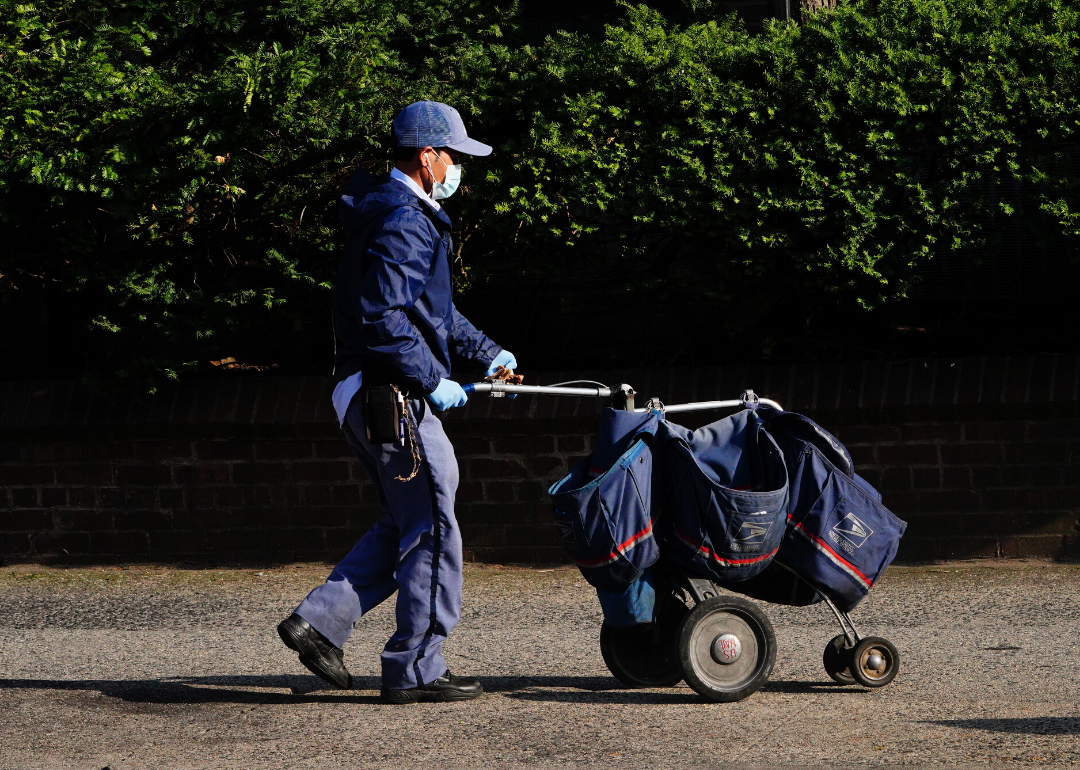
Employment during COVID-19 by the numbers
When the COVID-19 outbreak hit the U.S. in force, many states implemented their own mandatory closures of nonessential businesses and social distancing orders to reduce the spread of the coronavirus. But while many countries around the world unveiled nationwide measures that reduced infection rates enough to safely reopen, the varied responses among U.S. states meant many reopened without getting the virus firmly under control with proper social-distancing measures or enough tests to track COVID-19's spread. The result? Major losses both in terms of the economy as well as human life.
Â鶹ԭ´´ looked at news articles, research from government agencies, industry reports, and information from think tanks to learn more about how COVID-19 is affecting employment. And while there have been a few bright spots, like some and , employment overall has been experiencing steady serious consequences from the pandemic.
With businesses forced to close or operate at limited capacity—and with little help from the government to staunch the losses—many employers have had to lay off or furlough entire swaths of their workforce. The unemployment rate surged to a record-breaking , with a total of 23 million unemployed. While those rates have decreased in subsequent months, September reports showed a .
And the layoffs keep coming. After the unsteady return of students to colleges in September and college sports dissipating, with budget shortfalls and cuts. Tens of thousands of Oct. 1, just two days after Disney announced it was. These massive layoffs reflect the catastrophic effect of the COVID-19 pandemic on the travel and tourism industry. But virtually every sector of the economy has been hit, with restaurants, retail, banks, museums, manufacturing, and media companies furloughing and laying off workers and sometimes filing for bankruptcy.
The newly jobless join the millions of other out-of-work Americans struggling to keep up with bills and medical treatments, facing down looming evictions and , and navigating complicated state systems for unemployment compensation. A and additional $600 a week supplement to unemployment benefits was a lifeline that expired in July; when Congress failed to pass another stimulus bill, President Trump halved the payment to and left it up to individual states to distribute money, creating a lag in dispersement. That stimulus is already over in most states. America's stimulus stands in stark relief , which have prevented the kind of joblessness and financial woes through heavily subsidized wages, with some governments taking over payrolls.
With more than because of COVID-19 and millions more affected, the human toll of the virus is staggering. It's going to be a long time before we truly understand the overall toll the coronavirus has taken on employment in the U.S., but some recent statistics related to workers paint a grim picture. Read on to see some staggering numbers about employment during COVID-19.
International Labour Organization predicts millions of global job losses
After initially predicting that the coronavirus would threaten 25 million jobs, the chief of the International Labour Organization (ILO) revised its forecast in April 2020 to predict that full or partial lockdown orders would impact the equivalent of . The ILO's report from Sept. 23, 2020, shows how conservative that estimate was: The equivalent of 495 million full-time jobs have been , with more expected. The job losses are contributing to an increase in the inequality between richer and poorer countries.
227 hospitals furlough or lay off health care workers
When elective procedures were suspended to reserve services for COVID-19 patients in the early months of the pandemic, many U.S. hospitals and health care systems experienced a revenue crunch. Layoffs and furloughs affected workers at in April, May, and June, according to Becker’s Hospital CFO Report. The back half of the summer saw some states allow elective procedures; but some have still to return to to work. Twenty-two hospitals in September.
Working remotely becomes a reality for millions of Americans
As concern about COVID-19 began growing in early March, companies took measures to protect their employees. A survey of 158 national and multinational firms in North America found that had implemented a remote work policy as of early March. By June around 35% of American workers had moved to remote working, . Some companies, , made remote working permanent. But many others had their workers return to offices, prompting and the to publish guidelines and best practices to mitigate the risk of COVID-19 transmission in the workplace.
Unemployment claims eclipse 30 million in U.S.
The coronavirus pandemic has caused record layoffs in the U.S. In March and April 2020, for unemployment benefits. unemployment rate shattered records. After steady improvements, figures in July showed the economy was backsliding, and the latest numbers from September show and a sluggish economy.
Government boosted weekly unemployment benefits by $600—but failed to renew payments
Workers who've lost their jobs could receive an in their unemployment benefits as part of the Federal Pandemic Unemployment Compensation program. The program ended in July, eventually replaced with a $300/week supplement after Congress failed to pass another stimulus bill. The $300 payments have ended in most states.
26.7 million workers exposed to infection monthly in March
Using federal employment data, researchers at the University of Washington estimated in early March that are exposed to COVID-19 or other infections at least once a month. What’s more, 14.4 million workers may be exposed to infection once a week.
With $600 supplement, unemployment paid more than wages in 38 states
Unemployment benefits usually provide workers with about 40% of lost wages—but that changed with the $600 supplement. Unemployment benefits during the time the federal government added $600/week were equal to or higher than typical wages for the lost jobs in , according to Ernie Tedeschi, an economist at Evercore ISI.
Senate doesn't pass 'Heroes Act'
In May the House of Representatives passed a that would have included hazard pay for essential workers. The Senate did not take it up and President Trump promised to veto the bill if they did.
Education Department garnishes wages of 285,000 workers
From March 13–26, 2020, around who fell behind on their student loan payments had their wages garnished by the Department of Education. They’ve proposed a that alleges the garnished wages are .
Amazon hikes minimum wage by $2 per hour, for a limited time
Amid surging online orders during the pandemic, Amazon increased the minimum hourly pay for associates from through May. Despite offering a small pay bump, the online retailer has been criticized for" and tell its employees about confirmed cases of coronavirus, a problem .
Hundreds of health care workers have died from COVID-19
As of Oct. 28, 2020, 1,336 health care workers have died from COVID-19, from Kaiser Health News and the Guardian US. Many of the deaths—122—were in April, after the initial surge of the virus on the East Coast.
52% of essential workers are women
deemed essential during the pandemic are women, according to an analysis from The New York Times, whose Campbell Robertson and Robert Gebeloff write that “one in three jobs held by women has been designated as essential.”
Many furloughed workers will not return to work
When millions of workers were furloughed in the early months of the pandemic, they assumed it would only be a month or two before they were back at work. But many temporary furloughs became permanent and are predicted to become permanent if they're not already: By some estimates, as many as half of the workers experiencing temporary layoffs and furloughs won't return to their jobs, .
Walt Disney World lays off 28,000
Walt Disney World laid off 28,000 workers at the end of September, mostly in its Florida theme park. The company furloughed around in April.
71% of top earners are working from home
The option to work from home during the pandemic can vary widely depending on the income level of workers, according to the . It found in April that 71% of workers in the top income quintile were working remotely, but only 42% of workers in the bottom income level were telecommuting.
50% of American households lost hours or jobs in April
Half of American households say that they or someone in their household have lost their job or had their hours cut as a result of the coronavirus, according to conducted by NPR, PBS NewsHour, and Marist. That number was up from 18% of Americans who said they or someone else at home had been let go or lost hours from the coronavirus in March.
Wage recovery expected to take 5 years
Recovering from the financial hit of the coronavirus pandemic may take for blue-collar workers and small-business employees, according to an analysis by PayScale. Experts warn that the financial devastation many workers have experienced will “exacerbate inequality” in the U.S.
Only 71% of unemployed workers receive benefits
in some states collapsed from the influx of applicants who lost their job during the pandemic. As a result, only, according to the Economic Policy Institute.
Pay for transportation workers grows 3.2%
Workers in the transportation sector saw wages increase 3.2% over the past year, with the majority of growth occurring during the pandemic, according to the . The increased wages are attributed to a higher demand for delivered goods for Americans staying at home.
7.5 million hotel workers are out of a job
The COVID-19 pandemic has severely impacted the travel industry. About in the hospitality and leisure industry, according to the American Hotel & Lodging Association.
More than 35,000 airline workers furloughed and laid off
A $25 billion bailout staved off mass airline layoffs in March, keeping employees paid through September. But Congress didn't extend the lifeline, resulting in 35,000 airline on Oct. 1, 2020.
Women's advances in the workplace unravel
Women make up 47% of the global labor force, but accounted for 54% of the early coronavirus-related job losses, according to a . Another 2020 show the dire consequences of the unequal burden women face with childcare: About one in five working mothers in the U.S. are considering leaving the workforce temporarily (compared with 11% of working fathers). Another 15% reported "dialing back" their careers. Nearly a quarter of women with young children may leave their jobs permanently.
86% of at-risk jobs pay low wages
Low-wage workers face a disproportionately high risk of job loss due to COVID-19, according to research from McKinsey & Company. The report found that offered annual wages of less than $40,000.
Restaurant industry loses 417,000 jobs
The in March amid mandatory closures to prevent the spread of coronavirus. Restaurant Business’ Jonathan Maze states that the number is and does not reflect the full brunt the restaurant industry has taken during the crisis.
73% of U.S. workers report mental health issues
Nearly have been experiencing mental stress systems, like trouble focusing, nightmares, depression, and rage during the pandemic, according to a Monster report. Around 27% of workers have had physical health problems, like back pain, insomnia, and weight fluctuation.
Colleges cut majors, furlough faculty
The pandemic has caused a budget crisis for colleges and universities across the country as schools are spending millions on virus control measures while their student enrollment numbers drop. In late October, The New York Times reported that schools such as Ohio Wesleyan University and the University of California at Berkeley are to some humanities programs, while other schools are furloughing faculty and staff. Ithaca College in New York has planned to cut 131 full-time jobs, and has already furloughed 167 nonfaculty staff members, according to the Times.