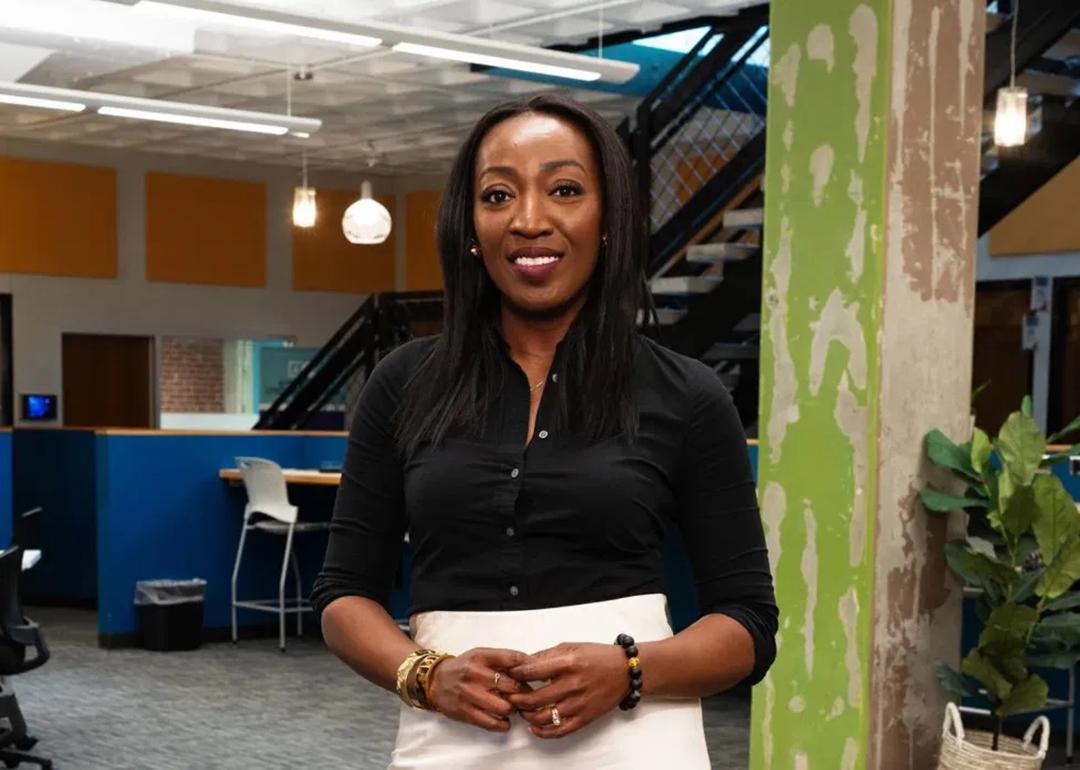
How a mom who had been out of the workforce for a decade talked her way into a career opportunity
How a mom who had been out of the workforce for a decade talked her way into a career opportunity
In early 2015, Daisy Magnus-Aryitey was 32 years old and had been out of the workforce for a decade raising two young children. She had attended law school more than seven years prior but never graduated. She had no idea how to reenter the workforce—let alone find a job she loved that supported her family and covered the outrageous cost of daycare and after-school programs. She felt overwhelmed and discouraged, with an outdated résumé listing her last full-time job as a child advocate on a Native American reservation in 2004.
Meanwhile, Ramiro Rodriguez and Dan Rearick, two friends who had met at a college alumni event, recently had the idea for Code the Dream, a nonprofit in Durham, North Carolina, to train people from diverse low-income backgrounds to become software developers. They assumed they’d bring in young, enthusiastic people who had faced barriers to traditional paths and wanted to learn how to code. Thus, they focused on people who had never been to college and were mostly in their early 20s. They didn’t think to look for anyone over the age of 25. The initial class was 14 people ages 18 to 25, most of whom were first- or second-generation immigrants. Rodriguez, a software developer himself, focused on teaching the classes while Rearick took on fundraising, outreach, and interviewing prospective students.
So, when 32-year-old Daisy Magnus-Aryitey’s application ended up on Rearick’s desk for their second cohort, he could’ve easily tossed it aside, as she was out of the typical age range for the program, and explain.
Luckily, he didn’t. He decided to call her in for an interview anyway.
‘I will take this opportunity and run with it’
Magnus-Aryitey came to the U.S. from Ghana when she was four years old. Her family resettled in New Mexico, and her parents, who were high school teachers in Ghana, struggled to restart their careers. Her mom worked odd jobs in food service and as a hotel cleaner, then enrolled in nursing school. When her mom couldn’t find childcare, Magnus-Aryitey, at five, remembers attending class with her mom, quietly coloring with her sister in the back of the classroom. Her dad had returned to school to study chemistry, and eventually found work at Pfizer, but separated from her mom when Magnus-Aryitey was 13.
When it came time for college applications, as the first in her family to attend college in the U.S., Magnus-Aryitey had to navigate the complex application process without the guidance of her parents. “When I saw other students prepping for the PSATs, I did, too,” she says. “When I heard them talk about an application due date, I thought, oh, I guess I should put something together.” She was thrilled to be accepted into Rutgers University in New Jersey. She studied criminal justice, helping to pay tuition with summer retail jobs at Gap or Macy’s, and planned to attend law school.
Then, in 2007, after her second year in law school, she saw two lines on a pregnancy test. She had recently gotten married, but she didn’t expect pregnancy to happen this quickly. She was excited to become a mom, and figured she’d take a short break from law school. But then she was diagnosed with hyperemesis, severe nausea and vomiting during pregnancy, which left her so physically drained she could barely get out of bed, let alone attend class. She submitted a leave of absence, and welcomed her daughter in July 2008.
Six and a half years later, with her daughter and now a three-year-old son, Magnus-Aryitey had long given up on returning to law school. She was living in Hillsborough, North Carolina, with her husband and found herself staring at an email advertising Code the Dream’s pilot program. It called for people ages 15 to 25 to apply, yet it seemed perfect for her. Her priorities had changed since law school: She wanted a job that was fulfilling and allowed her to be present with her family, but she didn’t want to incur significant financial hardship by returning to school.
So, when she saw that Code the Dream’s program was free and only two months, she submitted an application, even though she had no experience and was well out of the age range. “I was nervous because I had been out of the workforce for so long, and so much had changed,” she says. “My résumé was obsolete and, beyond college classes, I didn’t have any form of certifications. I also knew that at over 30, the whole world was not open to me.”
In her application, she wrote: “Please don’t let my age preclude me from being a part of Code the Dream. I’m disciplined, hard-working, ambitious, and, most importantly, I don’t give up. I will take this opportunity and absolutely run with it.” She was shocked when Rearick asked her to come in for an interview. She prepped as much as possible, watching online tutorials and reading books from the library to familiarize herself with coding language. The interview took place at a Durham coworking space, and she could sense it was a make-or-break moment. “I was nervous, but I tried to show how serious I was about learning to code—that it wasn’t a hobby, and I wanted to make a career out of it,” she says.
Rearick had already done 30 to 40 interviews for the 14 spots, and had plenty of impressive applicants to choose from, but he decided to squeeze in another interview after he received Magnus-Aryitey’s application. As soon as he met Magnus-Aryitey, he knew the spot was hers. “One thing we had learned from the first cohort was that the single biggest determiner of success was not someone’s previous education background,” he says. “Is this something they have thought about and really want to do? Daisy was very convincing of that.”
‘Rules are not always bent in favor of people from marginalized backgrounds’
One week after the interview, as Magnus-Aryitey was sitting in a parking lot waiting to pick up her son from daycare, she received an email accepting her into the program. Rearick said yes.
“I cried,” she recalled after seeing the email. “I had no background in computer science, but I asked for this, and someone took a chance on me. In some way, I knew this opportunity was going to change my life.”
Eight months later, Magnus-Aryitey was hired as a software engineer at Duke University’s Office of Information Technology and became the first graduate to work as a full time developer. In 2017, she returned to Code the Dream as the director of partnerships and, in November 2021, Rearick asked if she would join him as co-executive director. Today, she shares her story with employers and organizations, as well as the stories of other Code the Dream graduates, as powerful examples of how Code the Dream changes lives. “To be able to show that after nine months, a person’s entire economic future is different—that kind of impact is deeply meaningful,” she says.
Code the Dream has adjusted the application process to include all ages, now knowing that career paths can vary widely. “We quickly learned that, even for those who went to college, they faced barriers that are still very real,” Rearick says. Magnus-Aryitey is grateful they bent the rules for her back then—and the organization continues to give people a chance.
“Rules are not always bent in favor of people from marginalized backgrounds,” she says. “It’s meaningful that Code the Dream was willing to do that. And I feel blessed to be in a position where I can now say yes to others.”
was produced by the and , and reviewed and distributed by Â鶹ԭ´´.