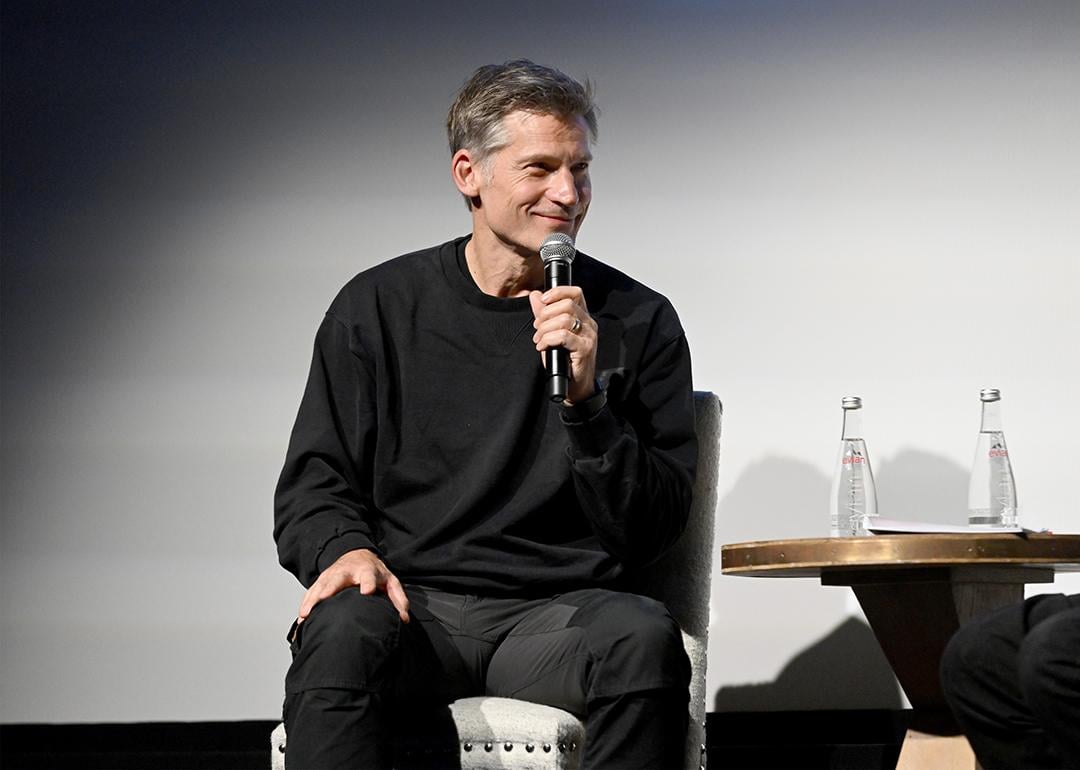
This 'Game of Thrones' star is taking his search for climate solutions global
This ‘Game of Thrones’ star is taking his search for climate solutions global
In the opening episode of the latest season of “An Optimist’s Guide to the Planet,” travels deep into the Ecuadorian Amazon to meet the Indigenous community of Achuar.
There, in an act of collective self-determination, residents are resisting the construction of a road through their territory. They’ve seen what roads have brought elsewhere in the Amazon—deforestation, illegal mining, and spikes in violent crime—and decided that supposed “progress” cannot come at the expense of their autonomy or land. Instead, people here are choosing their own path, connecting their villages by river, converting diesel engines to battery power, and using solar energy to sustain themselves. “Technology is a tool that we can use; that we decide to use,” Coster-Waldau told . “It cannot be the other way around.”
The second season of “An Optimist’s Guide to the Planet,” which premiered Oct. 23 on Bloomberg TV alongside major streaming platforms, expands its global scope on small and large-scale climate solutions while sharpening its focus on agency and hope. Filmed across Europe, Asia, and the Americas, the series explores how communities are tackling challenges in water, waste management, and energy in deeply local and unexpectedly innovative ways.
Below, Coster-Waldau speaks with Atmos about filming “” in a time of climate doomism—and why optimism is a choice, renewed every time someone decides to act for the Earth.
Daphne Chouliaraki Milner: The world has changed a lot since Season 1 of “An Optimist’s Guide to the Planet” premiered in 2024. Season 2 starts in your native Denmark, and then takes you to many other countries the world over. What feels different this time around in the stories you’re telling and the way you’re approaching them?
Nikolaj Coster-Waldau: It really does feel different this time. What I love about the show being global is that it gives you perspective. It’s so easy to get caught up in where you are. From Denmark, for example, the presence of war in Europe feels like it’s expanding, and other issues like climate have slipped down the ladder of interest, which is understandable but worrying.
When we started this season, I was questioning the optimism in “An Optimist’s Guide to the Planet.” So much seemed to be pulling in the wrong direction. But doing the show again has reminded me how much the human spirit—and our thirst for innovation, finding solutions, helping each other—is still very much an integral part of who we are. That gives me real reason for optimism and hope. It’s easy to lose sight of that because we’re caught in these social media echo chambers, especially with the conflicts in Ukraine and Gaza. People are constantly being fed information that confirms their bias, yet they are very adamant they’re seeing the full truth.
What’s changed for me is also how I think about climate communication. There’s been a tendency to scare people into caring, to create doomsday narratives that say if we don’t act now, the world will end. But that doesn’t work in the long term. These issues won’t be solved in our lifetime or in our kids’ lifetime; they take generations. You can’t keep saying the wolf is coming every other day.
A good example is how we sometimes misuse science, saying the poles are melting and sea levels will rise by 7.5 meters [24.6 feet], which is true only if the ice caps melt completely, thousands of years from now. That kind of exaggeration backfires. It makes it easy for people to dismiss the real crisis as a hoax. The reality is already bad enough. Just look at the extreme weather we’re seeing now, or the loss of biodiversity and pollution. It’s already completely out of whack, and it’s only going to get worse. That should be scary enough.
Daphne: I think that’s also where our responsibility comes in as storytellers, whether as writers or filmmakers. And I want to return to what you said earlier about hope and the intergenerational aspect of it. But before that, I have a more logistical question about the second season. You travel through so many different environments, from coastal cities to farmlands to innovation hubs. How did you decide where to film?
Nikolaj: It was really based on lessons from Season 1 and on going to places we hadn’t been before. In the first season, we wanted to film in India, but didn’t want to travel all that way for just one story. It needed to be part of a full block. So for Season 2, we planned three main shooting blocks: one in the Americas, one in India, and one in Europe.
We combed through all these incredible stories happening around the world. That’s the fun part because it shows there’s so much innovation everywhere. And then, of course, there’s the logistical side: How do we actually make it work? What helped was looking at the themes we wanted to explore this season—water, waste management, and energy were big ones—and choosing stories that felt distinct but connected through those threads. And while we always include a stop in Canada because our production company is based there, the rest really comes down to curiosity and logistics.
Daphne: You met such a big range of people, researchers, activists, entrepreneurs, and land defenders, all of whom are working on sustainability. What stands out to you about the people behind these solutions?
Nikolaj: For me, it’s the realization that we share so much, no matter where you are in the world. Everyone wants the same basic things. Everyone wants to do something meaningful, to have a sense of purpose, and to feel agency over their own destiny. And everywhere we’ve been, there’s this real belief that action matters and that you can make a positive impact in your own life and in others’ by doing something, however small.
What’s interesting is that once you move outside Europe and the wealthiest parts of the world, optimism actually grows. Belief in tomorrow grows. I won’t try to analyze why, but it’s fascinating and it gives me hope. Humans are just incredible. The solutions we’ve seen range from high-tech innovations to the simplest, low-tech ideas that are pure genius. In many places, people are solving very basic problems, like access to water, sewage issues, and waste management challenges, with almost no resources, and doing it in ways that avoid creating more pollution or harm.
What I love about this season is that it connects those stories. The point is that while circumstances differ worldwide, we already have the solutions we need. It now comes down to resources and political will. Hopefully, the show inspires someone to think, “Why don’t we do that?”
Daphne: As you say, you cover a huge range of different solutions, large-scale, small-scale, tech-focused, grassroots. Is there one from Season 2 that really surprised you, or that made you think, why doesn’t the rest of the world already know about this?
Nikolaj: Yes, one that really stayed with me was a story about fungi. We filmed with a company in Chicago called Mycocycle. One of the founders came from construction, which is one of the world’s biggest sources of CO2 emissions and waste. They realized that nature already knows how to break this material down, in that fungi are doing it all the time.
That, to me, is one of the big ideas of this season: There’s no such thing as waste. In nature, everything is reused; a leaf falls, it decomposes, and becomes fuel for new life. We’ve somehow forgotten that everything we create can also be part of that cycle if we find the right processes. Seeing how this company used fungi to break down and reuse construction waste was incredibly inspiring.
Then, in India, we filmed another story that also began with waste, specifically cleaning up the Ganges. A company there collects around 30 tons of discarded flowers a day from temples. One of the scientists noticed a white growth on the flowers, fungi again, and started experimenting. That curiosity led to the creation of flether, a leather-like material made from floral waste. It’s brilliant because it uses nature’s own mechanisms to solve problems we think are uniquely human.
It reminded me of something from Season 1, when we visited the . A man there told me he’d looked up the English word “waste,” and realized there’s no direct equivalent in Japanese. It’s always “waste of time,” “waste of energy.” That stayed with me. There really is no waste; it’s all energy and resources. We just have to learn how to use them differently.
Daphne: You’ve seen how differently people experience climate change, and how similarly they respond with care and ingenuity. What do you think connects us most in this shared effort to build a livable future?
Nikolaj: I think the problem is that we’re always looking for a bad guy and a good guy. But we’re in this together. Not many people actually want to destroy the world. Sure, there are a few horrible people out there, but 99.99999% of us want the same things.
I always use this example: If you think about your week—all the people you’ve interacted with—how many were truly awful? Maybe one or two, out of hundreds or even thousands. Most people are decent. It’s the same with these global issues. We all basically want the same outcomes, but we’re living in a world of constant noise and division.
That’s why I find it so inspiring to meet people who actually do something. Once you take action, things start to feel more manageable. If we keep focusing on fear or the idea that someone’s out to get us, we’ll get stuck. No one’s out to get us. Everyone just wants a better life. And if we put more of our energy into doing instead of talking, we’d get much further.
Editor’s Note: This interview has been condensed and edited for purposes of length and clarity.
“An Optimist’s Guide to the Planet” airs on Wednesdays at 8 p.m. Eastern time on Bloomberg Originals and is available on major streaming platforms such as Samsung TV+, Amazon Prime Video, and LG channels. Episodes will also air on Bloomberg TV and be available on demand on and YouTube.
was produced by and reviewed and distributed by Â鶹ԭ´´.