As college enrollment declines, apprenticeships are on the rise
This story originally appeared on Best Universities and was produced and distributed in partnership with 麻豆原创 Studio.
As college enrollment declines, apprenticeships are on the rise
The high cost of higher education, long believed to be the pathway to success for young Americans, is yielding ground to an older, more traditional form of education: apprenticeships. The country's numerous historical and economic developments are driving factors behind this trend. The technological advances that emerged from World War II, and in the years following鈥攁s well as the 鈥攔apidly increased public demand for college education. In just seven years, from 1939 to 1946, total college enrollment .
Until recently, the so-called ""鈥攖he difference in income that college graduates earn compared to those without a bachelor's degree鈥攈ad been steadily rising, reaching its peak in the mid-2010s. But since then, the premium has flattened and now is in decline.
A 2019 Federal Reserve Bank of St. Louis study found that the attributable to college education is now at a historic low for white households and virtually nonexistent for racial minorities. This trend, coupled with the , has made an undergraduate education a less attractive financial investment for many. Consequently, the overall college enrollment rate has fallen鈥攅specially for men, who are now in the nation's colleges by a 3-to-2 ratio. One reason is that young men have that don't require a college degree but are no less lucrative.
In this context, apprenticeships have become much more popular options for young people eyeing career opportunities. In 2021, 37.7% of active apprentices were aged 24 and under, and 39.7% were 25 to 34, . The annual number of new apprentices has risen by nearly 70% in less than a decade, and apprenticeship programs across the country have added over 2 million participants since 2012.
The nationwide shortages of electricians, construction workers, and other occupations that usually require an apprenticeship have played a major role in this boom. Additionally, apprentices are usually paid while learning, .
Apprenticeships can be more flexible than college course schedules, too鈥攁nd can typically be completed during military service. In fact, service members are in the , which requires no off-duty hours and provides a nationally recognized credential upon completion.
cited data from the and the to explore why apprenticeship participation is increasing as .
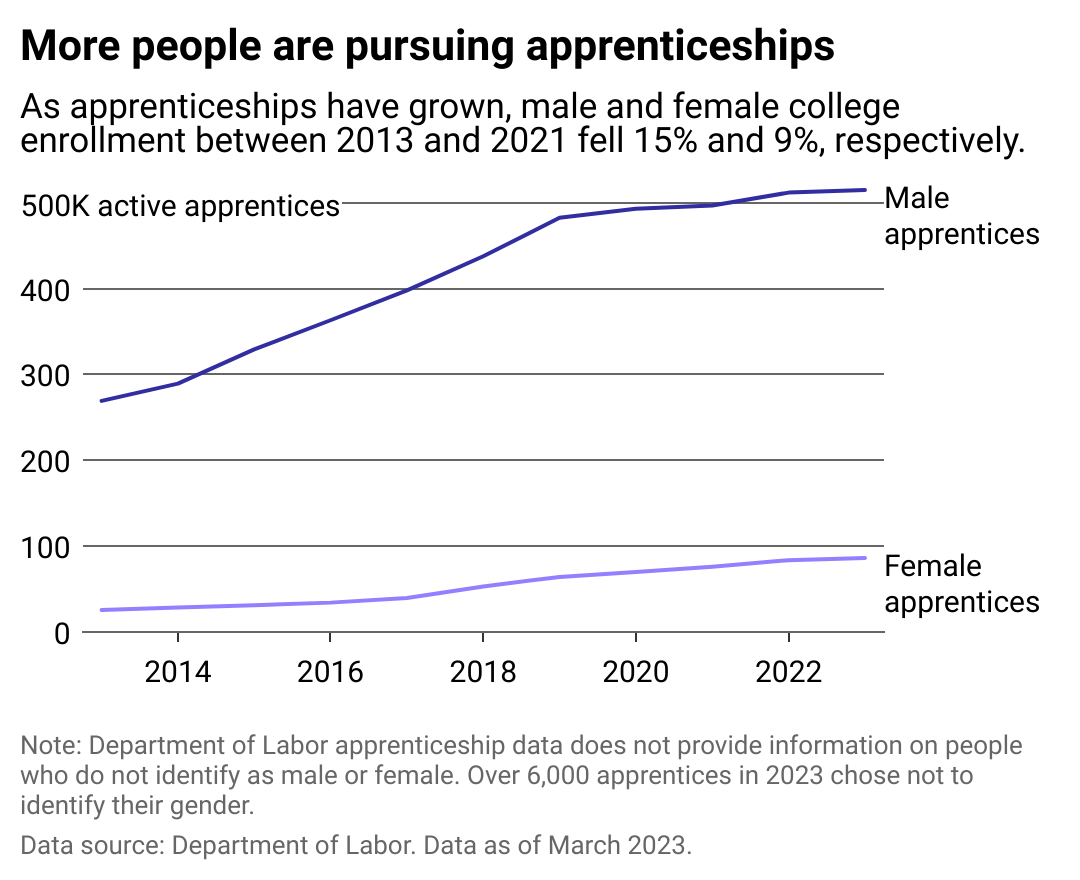
Number of active apprentices experienced steady growth over the past decade
A bump in between 2017 and 2020 has contributed to the growth in active apprentices, especially among men. At the same time, college enrollment among men has been falling faster than among women.
Most of the occupations requiring an apprenticeship have been historically male-dominated. In the United States, for example, and are women, per a New York Times report and Zippia research. The gender imbalances in the blue-collar industries may have contributed to the low number of women apprentices.
However, 6,000 apprentices did not identify their gender in 2023, and the Labor Department data does not provide information on people who did not identify as male or female.
Story editing by Jeff Inglis. Copy editing by Paris Close. Photo selection by Ania Antecka.