Is interest in a 4-year college degree drying up? Not really.
American colleges are under siege.
The Trump administration has waged a legal and rhetorical battle against the country鈥檚 elite universities. Voters have grown of higher education. Some high school students are questioning the value of a college diploma. In turn, there鈥檚 been a veritable of stories about a generational pivot away from college due to some combination of ruinous costs, close-minded campus cultures, and appealing .
It is a disorienting experience, then, to examine the cold, hard data of higher education.
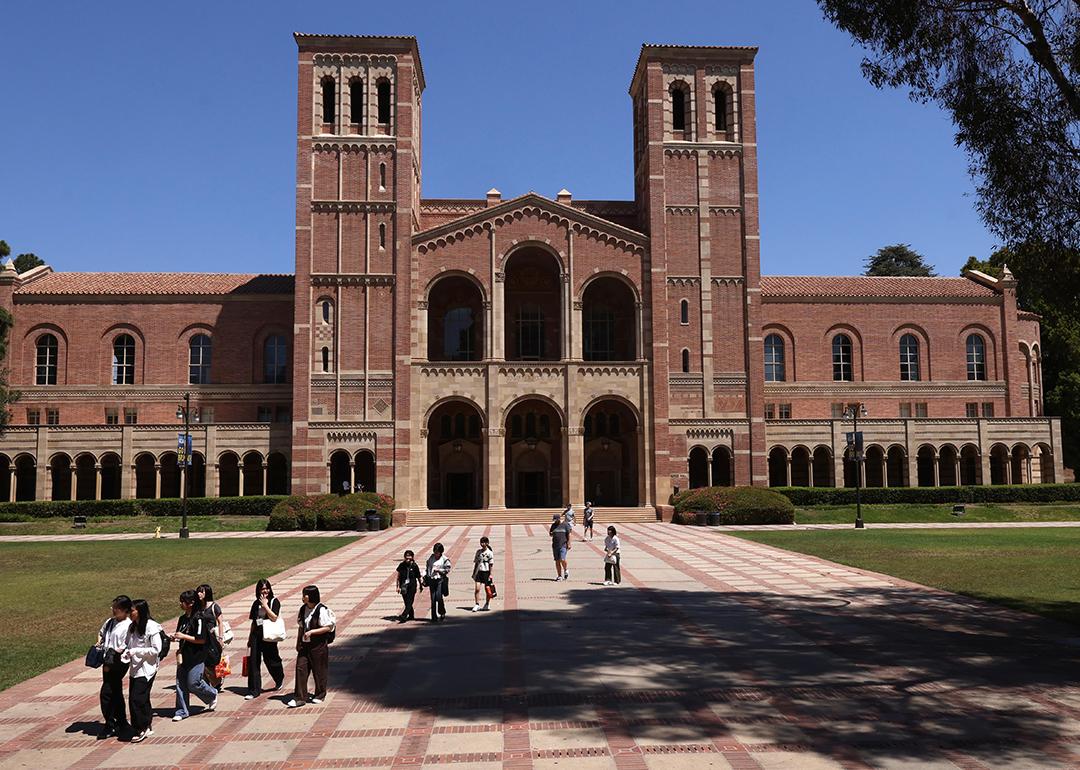
College tuition has become more affordable in recent years. The economic return on a bachelor鈥檚 degree has stopped growing but remains near historic highs. After a post-pandemic dip, four-year college enrollment has almost fully recovered to near-record levels. Students are to flagship public universities like UCLA and the University of Michigan.
Whatever the problems of higher education, the narrative has raced far ahead of the reality.
Much of this mistaken story stems from a simple confusion: conflating enrollment in two-year and four-year colleges. While it鈥檚 true that fewer people are in community colleges, the number of students seeking bachelor鈥檚 degrees hasn鈥檛 changed much. 鈥淚t鈥檚 been roughly flat for the last 10 years,鈥� says Joshua Goodman, an education economist at Boston University. 鈥淭hat鈥檚 very much not the narrative.鈥�
unpacks the disconnect between the data and the vibes.
The costs vs. benefits of college
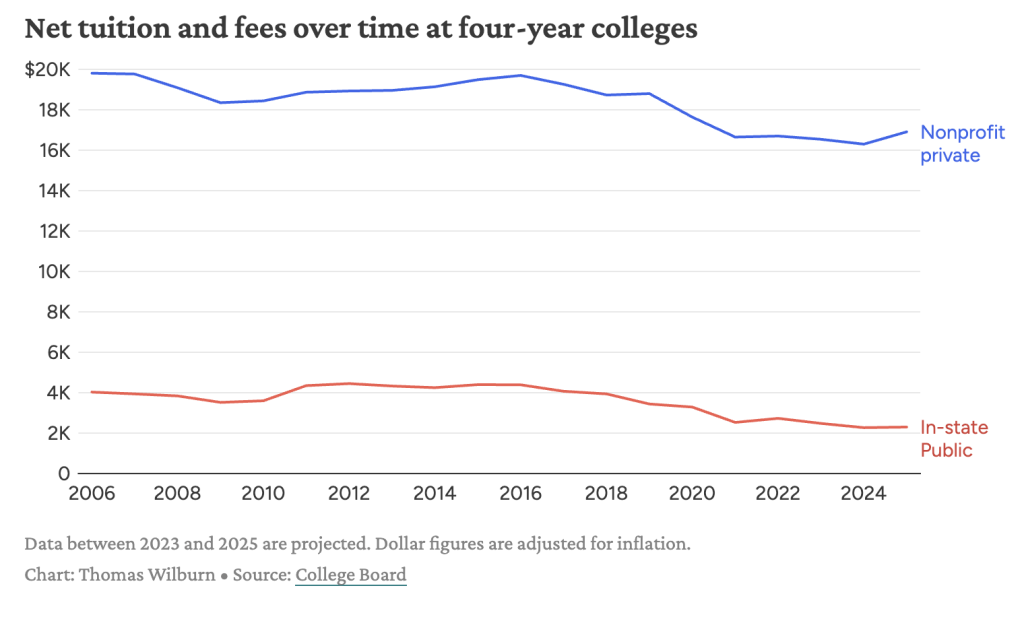
It is often treated as a well-established fact that the price of college is soaring. That is no longer the case. For the last couple of decades, net tuition has, if anything, trended down at private and in-state public universities, according to by the College Board. Since household earnings have during this period, college tuition appears to have become somewhat more affordable in recent years, not less.
鈥淲hen I talk to members of the public this has not penetrated at all,鈥� says Dominique Baker, a higher education professor at the University of Delaware.
The reality has been underappreciated because colleges鈥� sticker prices have been rising at an almost linear rate. But list price has become increasingly disconnected from the real price thanks to growing financial aid.
What about the economic benefits of a four-year college education?
On average, those with a bachelor鈥檚 degree still earn far more than those without. The 鈥渃ollege-wage premium,鈥� as economists call it, about 75%. This figure has stagnated since the early 2000s, but it remains at or point in a century.
You may have about careers that don鈥檛 require a degree but that come with lucrative salaries. Such examples certainly exist, but they are exceptions to the average. The Bureau of Labor Statistics projects that the non-degreed with the most new positions all earn under $40,000 annually. Those include home health aides, order stockers, and fast-food workers.
This does not mean that every student who attends college will see a return. The wage premium is a simple correlation and refers to those with a degree, which about of college enrollees do not obtain. The decision for any individual student about whether to go to college depends on their chances of completion, the careers they鈥檙e interested in, and the cost.
Still, have found , on average, students benefit economically from seeking a four-year degree.
鈥淭here鈥檚 not a case to be made that it鈥檚 a worse deal now than it was 10 or 15 years ago,鈥� says Jeff Denning, a higher education researcher at the University of Texas at Austin. 鈥淚鈥檓 not aware of any data that would suggest that.鈥�
Four-year college enrollment has held steady, though two-year enrollment has fallen dramatically
For the last few decades, a little more than 40% of recent high school graduates in a four-year college. These numbers have been fairly stable, even as high school graduation rates have risen.
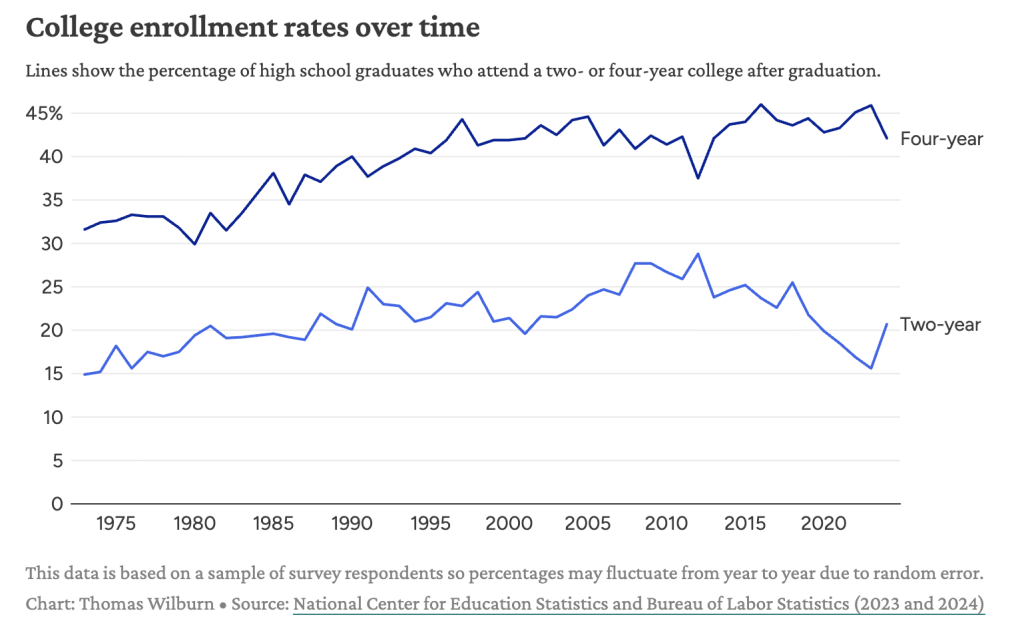
Other data shows a dip in four-year enrollment in the wake of the pandemic, followed by a bounce-back in recent years. The number of people pursuing bachelor鈥檚 degrees is now just 1% below pre-pandemic levels, according to .
While flagship state universities have generally seen enrollments rise, colleges with worse student outcomes, like the University of Phoenix, an online for-profit college, have seen drops, notes Preston Cooper in a for the American Enterprise Institute.
The biggest decline in college enrollment has been at two-year schools, which are largely open-enrollment public institutions that most students attend part-time. Until a recent upturn, attendance at these schools has been falling consistently since 2010.
Here鈥檚 where the conventional narrative about the college decline falls apart: Community colleges鈥� costs are very low and they have not been at the center of the cultural and political backlash to higher education. The prevailing narrative has focused on bachelor鈥檚 degrees, which community colleges typically don鈥檛 issue.
What explains the two-year college decline, then? A coauthored by Goodman of Boston University shows that much of this is driven by economic trends. When job options are plentiful, community college is less appealing. Recently, as unemployment has ticked up, so has two-year enrollment. Another explanation is that more potential students have become wary of the value of two-year programs since the completion rates are .
Reality may soon mirror perception
We may one day look back at this particular moment as a golden age of four-year colleges, even though it doesn鈥檛 feel like one.
There that real tuition is going up as schools face new cost pressures. The perception of higher education has in fact , which eventually limit public funding and depress enrollment. (Or perhaps not: Enrollment has been rising over the last couple years at the height of the college collapse narrative.)
Another imminent challenge: At least for a while, each year鈥檚 high school graduating class is likely to than the last due to lower birth rates. Generative AI is an , as some suspect it will devalue and, in turn, a college education.
The irony is that the colleges likely to bear the brunt of these challenges are the country鈥檚 less-selective, less-known schools, not the elite institutions that have come to embody higher education in the public mind.
was produced by and reviewed and distributed by 麻豆原创.