Many young adults are barely literate despite earning a high school diploma
One in 4 young adults across the U.S. is functionally illiterate — yet more than half earned high school diplomas, according to recently released data analyzed by .
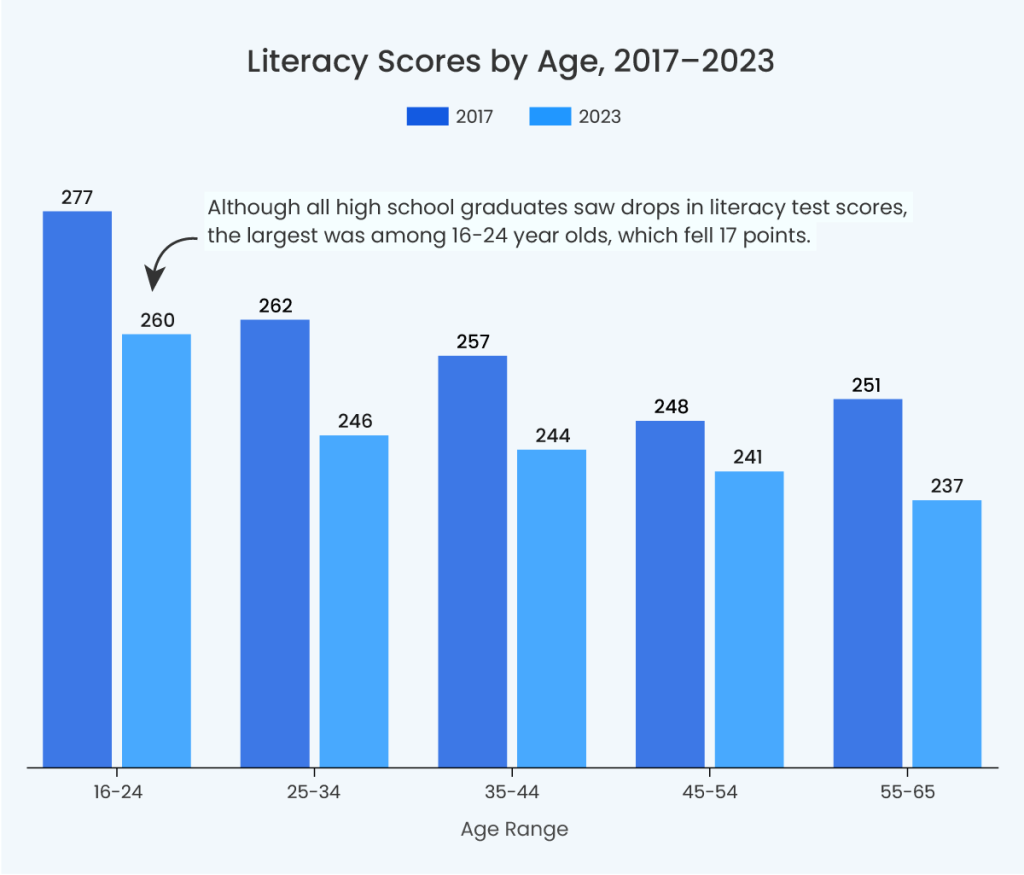
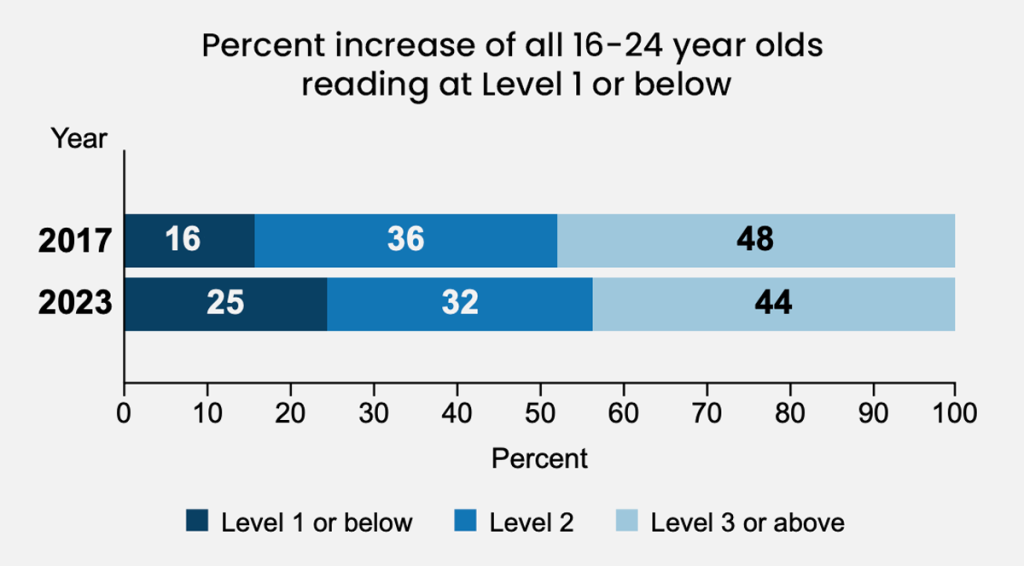
The number of 16-to-24-year-olds reading at the lowest literacy levels increased from 16% in 2017 to 25% in 2023, according to from the National Center for Education Statistics in partnership with the Program for the International Assessment of Adult Competencies.
In 2023, a total of about 5 million young adults, equivalent to the population of Alabama, could understand the basic meaning of short texts but could not analyze long reading materials, according to further analysis by the American Institute of Research.
The is in line with an unprecedented decline in the literacy rate among all adults in the same six-year period.
But even more troubling is the AIR researchers’ finding that while the percentage of young adults with high school diplomas increased from 50% to 55% between 2017 and 2023, that group also saw the largest decrease in scores on tests measuring literacy skills compared to older adults with diplomas.
“We know that over 20% of [young adults] that get their high school diploma do not have the skills commensurate with that,” said Sharon Bonney, chief executive officer of the Coalition on Adult Basic Education, a national adult education nonprofit. “So, when we have this ‘’ agenda, but people can’t read, write, speak the language or do math, they can’t get good jobs and better jobs. They can’t be skilled up.”
Education experts in functional illiteracy in part on poverty and housing instability, a growing population of students with high needs, and the pandemic shutdown of schools, which affected some of those in the 16-to-24-year-old group. Many adult education programs were also shuttered during the pandemic.
But researchers also believe the data may point to more troubling trends among young adults: Students increasingly without acquiring needed skills, a — and a changing standard of what level of literacy is needed now that technology can provide information without most people having to think twice about it.
“When you talk about literacy, what are we talking about? Is it reading, writing, filling out forms? Or really understanding and critically questioning what it is we’re consuming?” said Limor Pinhasi-Vittorio, professor and department chair of counseling, leadership, literacy and special education at Lehman College in the Bronx. Because the latter “for sure is gone for the majority of the adult population.”
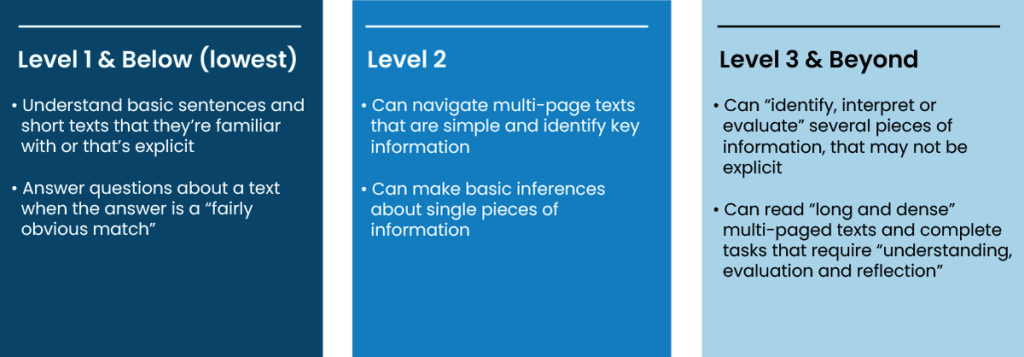
Adult literacy levels are measured through a test where individuals score on a 0-to-500-point system. The scores are then grouped on a scale of one to five. Readers at Level 1 and below only understand basic and explicit short texts, such as reading a menu at a restaurant. At the highest literacy level, it includes the ability to critically evaluate, infer and dissect complex ideas in written material.
‘They’re pushed through’
Most efforts to improve literacy have centered on early intervention before third grade, as a student’s reading level at that age is viewed as of their future success.
have implemented legislation for evidence-based reading instruction. Initial K-3 efforts , including in Indiana, where test scores show and bouncing back from the pandemic. But there’s still concern about older students who were in the early grades during the pandemic and may not have gotten help and are still struggling.
“The most effective literacy instruction is still one-on-one or small group instruction, and that’s very difficult to do at scale in the K-12 system,” said Andrew Roberts, president of the Barbara Bush Foundation for Family Literacy. “So if you have some of those background skills, you’re able to get where you need to get, but if you’re struggling, … that’s where we see people really fall off that cliff.”
Curriculum changes from a “learning to read” model after third grade to “reading to learn” through high school, many experts said, and if a student is behind from the beginning, it’s almost impossible to catch up.
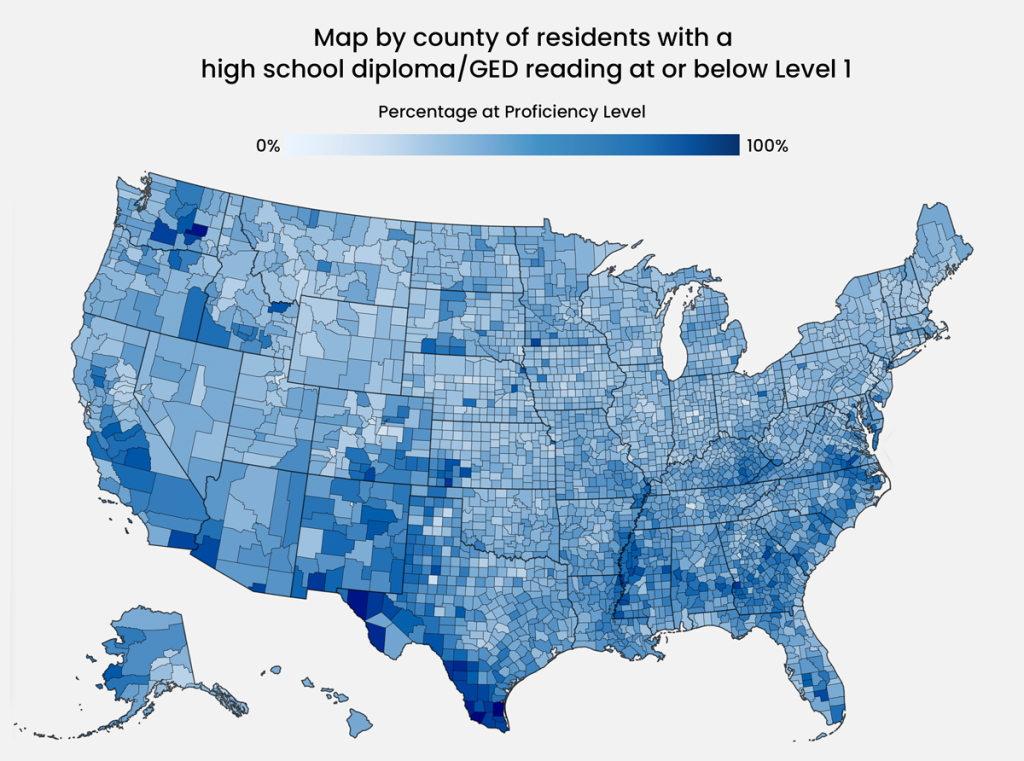
The numbers by show the results can be devastating.
For example, in Star County in southern Texas and Adams County in central Washington state, more than 80% of high school graduates are reading at Level 1 or below. In countless other counties across the country, the Level 1 literacy rate for high school graduates is higher than 60%.
“In high schools, oftentimes [students] do get pushed along,” Bonney said. “If we’re seeing in one county that [functional illiteracy is] super high, then to me, that says that the school system has a real issue — like why are they pushing students along that don’t have skills?”
Some literacy advocates believe that passing a student through grades can be part of a more intentional effort to , but there’s also a belief that it’s a product of strained classrooms and a student’s ability to fly under the radar.
“Every couple decades, we’re changing the style of teaching, but the problem is the same,” Pinhasi-Vittorio said. “I’m not only talking about money, but populations that have the resources … to help the students, they will be able to. But, in areas that they don’t, they’re falling between the cracks.”
When students fall between the cracks, they also get resourceful, Roberts added.
“They find ways to hide the fact that they don’t read that strongly. … We find adults who have gotten into their 30s and struggle with reading, and people close to them don’t even fully know,” Roberts said. “There’s a lot of coping mechanisms that allow people to get by, maybe not getting by with As on their report card, but getting by enough that they’re passing through the system — friends doing homework for them — all these types of things.”
How literacy is changing
Researchers view literacy as a spectrum that goes beyond knowing the basic skills of reading and writing. After students grasp foundational reading skills, the next levels of literacy develop through practice — which some kids aren’t getting because they don’t connect to their lessons. Easy access to online sources and AI also means they don’t really have to engage with the written word deeply anymore.
Pinhasi-Vittorio recalls that when she was in school, she had to read through a set of Britannica Encyclopedias for research papers. Now, however, “you don’t even need to read and write.”
“You can just read it to the computer or the phone, and the phone will write it down,” Pinhasi-Vittorio said, adding that technology has changed the way students process information.
Students take what they get from internet searches at a surface level without disseminating it. “My concern is that we are skipping one step,” Pinhasi-Vittorio said. “The teaching needs to be different. … We need to build attention with students, which we didn’t have to do before.”
Rebuilding student interest into their lessons is part of the issue.
“A lot of the low-functioning literacy is stemming from connectivity,” she said. Students don’t deep dive into topics they don’t care about. They stop paying attention and don’t connect to their reading when they think what they’re learning in the classroom doesn’t have any “relevancy to their lives.”
Literacy skills can often be concentrated in topics that a student cares about or areas that play a role outside of school. For example, a student could be “very literate” in a church environment and able to dissect the Bible but struggle when it’s a text in the classroom, said Rachael Gabriel, a literacy professor at the University of Connecticut.
“For kids graduating from high school, I think there are some texts that they have trouble with, and I think there are a lot of texts that they can read that we don’t care about,” Gabriel said. “Their literacy is very likely to extend far beyond what is tested, and it may or may not show up well on the way that we’ve been testing literacy for a long time.”
So by better adapting curricula and testing in a way that mirrors a student’s background and interests, measured literacy levels will improve, Gabriel argued.
“I think the goal is just awareness and flexibility of how texts are changing across all the different contexts, where they want to be powerfully literate, where they want to be able to create and critique and participate,” she said. “It is important to teach skills explicitly, and if we teach them in a context that is relevant and engaging and has a real purpose in the world, kids learn faster and better.”
Researchers acknowledge the importance of having a baseline for literacy skills that all students should have, but how it is measured can continue to improve.
“Literacy skills are really foundational building blocks for learning everything more complex,” said Marco Paccagnella, an analyst at Organisation for Economic Co-Operation and Development, which manages the Program for the International Assessment of Adult Competencies. But many assessments were “designed and conceptualized 10 years ago.”
“The tasks that are part of the assessments mostly reflect the demands on people back in the days. There’s always a tension between adapting the assessment based on what is required of people at a particular moment in time,” Paccagnella said. “So, yes, you can say people are less able to engage with longer texts and difficult texts, but that’s maybe also because they don’t really need to now because the way we consume written information has fundamentally changed.”
The push is already being put into action as the National Assessment of Educational Progress (NAEP), which was last changed in 2004, is expected to roll out to better measure literacy in different subject areas and disaggregate data further based on student background.
A belief that the worst is yet to come
The growth in low-literate adults wasn’t a surprise to many who have tracked reading levels throughout the years or who have worked with adult education programs. In fact, they expect the problem to get worse in the upcoming years.
Federal funding for adult education, which had already been stagnant for over two decades, has played a major role in the fact that less than 3% of those who need the programs actually received services, ProPublica in 2022. Many programs have monthslong waitlists.
“From 23-24, we saw 415,000 people-plus who could demonstrate additional achievement gains in literacy through outside programming. We saw over 80,000 people get their high school equivalency degree through adult programming,” Roberts said. “There are paths, but the funding level is just really low, and you’re not able to meet up the demand. It’s like a big spigot coming in and you’re kind of a small spigot going out with the people you’re able to serve.”
The programs are in further jeopardy after a recent proposal from the Trump administration all federal funding for adult education programs with a $0 line item in the .
“If kids are coming or graduating from high school with low reading skills and they don’t have access to educational opportunities as an adult to address those low skills,” said Todd Evans, senior director of programs at advocacy and literacy training nonprofit ProLiteracy, “that number will just keep growing and growing and growing.”
was produced by and reviewed and distributed by Â鶹ԭ´´.