Vouchers are booming, but lack of rural private schools that accept them means students miss out
Sitting on the Kentucky border, the Christian Academy of Indiana draws students from 56 different ZIP codes in southern Indiana. Some come from as far as 30 miles away and live in counties without private schools.
Families in those distant communities make the drive every day — sometimes carpooling — because they’re drawn to the school’s environment and extracurriculars, and especially its Christian teaching, said Lorrie Baechtel, director of admissions for the school, which is part of a three-school network in Indiana and Kentucky.
“There are lots of good public school options in Indiana. Families come to our Indiana campus more for that mission,” Baechtel said.
The school’s enrollment has boomed in the last four years, driven in part by the expansion of the Choice Scholarship, Indiana’s signature voucher program. That’s made tuition more affordable, Baechtel said. More than 1,200 students attended in 2024-2025, up from around 700 in 2021-22.
That reflects a statewide trend: Voucher use has surged in recent years as Indiana lawmakers loosened eligibility requirements. In 2026, the program will open to all families, regardless of income, reports.
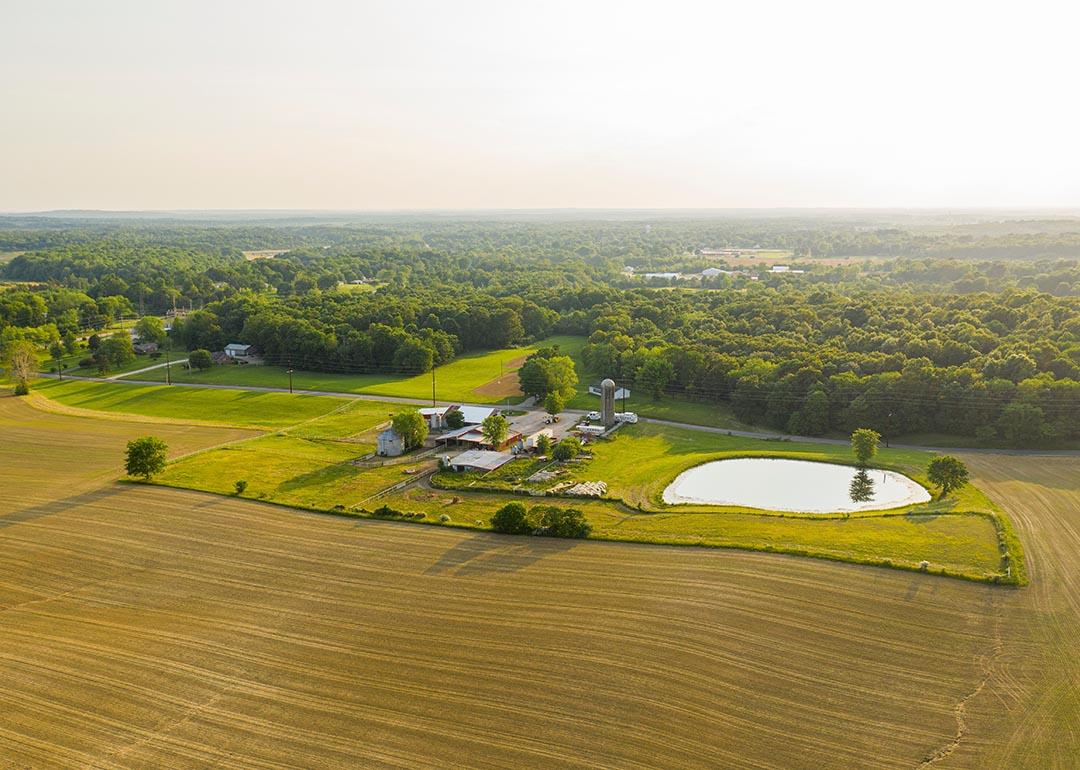
But the Christian Academy’s ability to attract students from far away tells another story too. Even as vouchers have become more accessible, Indiana’s rural students aren’t using them at the same rate as their urban and suburban peers. That’s in part because one-third of counties don’t have a private school that accepts vouchers within their borders, and distance is a factor in parents’ decisions on school choice.
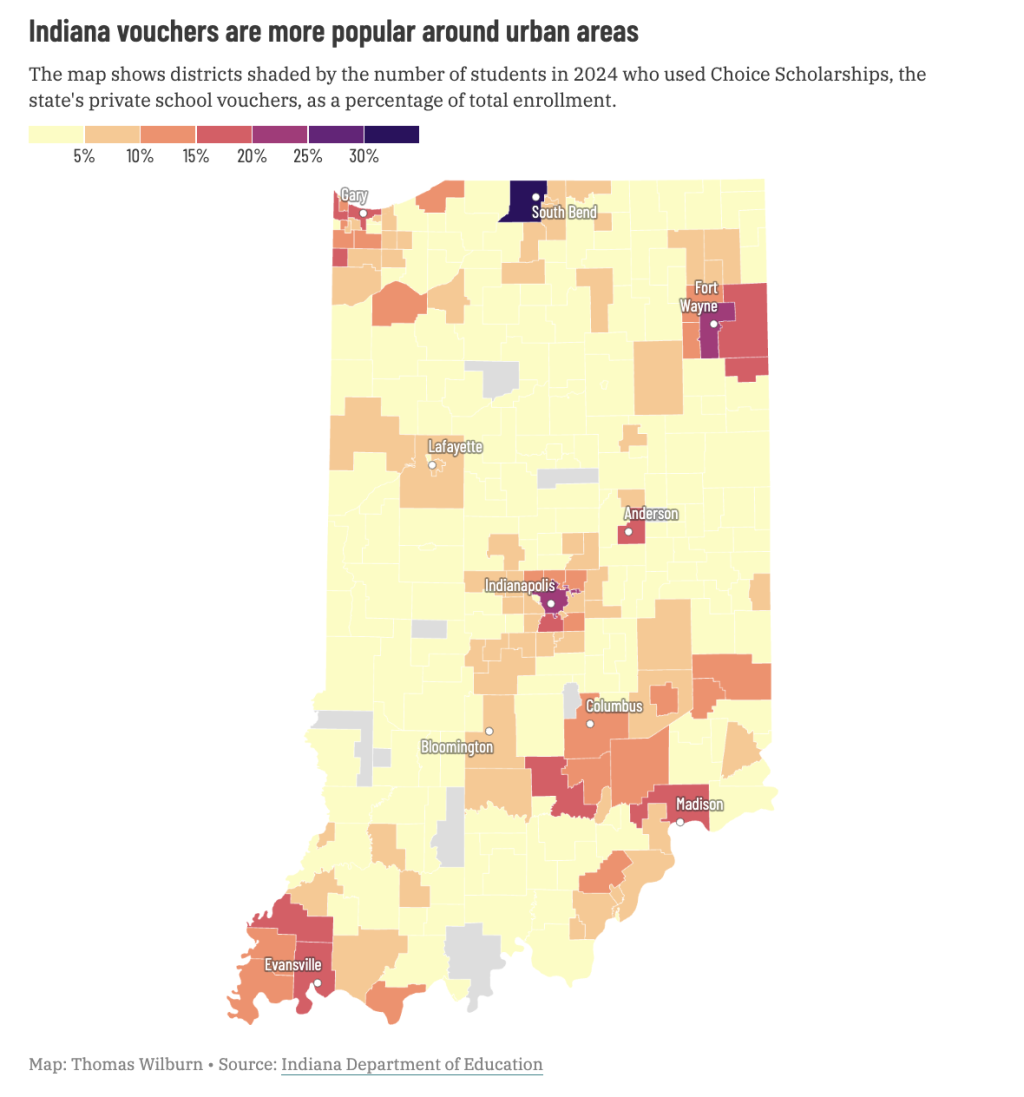
The result is that students who live closer to an urban center — which typically has one or more voucher-accepting private schools — may use vouchers at rates up to 30 percentage points higher than those for students who live in a neighboring district.
That also means rural families may be at a significant disadvantage when the state opens the Choice Scholarship to all, and when also begin to roll out in 2027.
“If there are no schools there for you to attend it’s unlikely it’s going to be all that useful for you,” said Jon Valant, director of the Brown Center on Education Policy at the Brookings Institution.
More than that, public education advocates say splitting state school funding with vouchers leaves less for the rural public schools these students do attend.
“We’re making the policy choice to fund a lot more choices than we used to,” said Chris Lagoni, executive director of the Indiana Small and Rural Schools Association, which represents public schools. “We’re inviting more and more folks to Sunday dinner. It’s a little bit of a bigger meal, but a lot more guests.”
But the state’s Republican lawmakers have dismissed the fears of a hit to public rural schools as a result of vouchers, saying that rural voters support choice and parents want educational options — whether that’s private, charter, or traditional public schools.
Meanwhile, school choice advocates say the latest expansion of the Choice Scholarship, along with a growing preference for smaller learning environments and the rise of voucher-accepting online schools, could mean more private school access for rural areas in the near future.
“I think we’re best when we have a robust ecosystem of private and public options,” said Eric Oglesbee of the Drexel Fund, a nonprofit venture philanthropy organization that funds new private schools in Indiana and throughout the U.S.
Location matters in accessing a private school
Across the state, for the 2024-25 school year — an increase of about 6,000 students from the year before. The program cost the state $497 million last year, and the average voucher recipient came from a household with just over $100,000 in income.
But around one-third of Indiana counties don’t have voucher-accepting private schools within their borders, according to a Chalkbeat analysis of state data, which also shows that voucher use is lower in rural areas than urban ones.
Voucher use can shift dramatically even between nearby areas. For example, around 16% of students who reside in the Madison school district in southern Indiana use vouchers, but that rate drops to as low as 1% in nearby districts that are more rural. Similar trends hold in other areas of the state, like Indianapolis, Evansville, Fort Wayne, and South Bend.
Location matters because driving distance has been shown to be a factor in how parents choose a school.
In a 2024 survey of parent preferences by EdChoice, an Indianapolis-based group that supports vouchers, around half of parents said they would drive a max of 15 minutes for their children “to attend a better school.” Just over a quarter said they would drive no more than 20 minutes, and the final quarter said 30 minutes would be their max.
Concerns about this issue have persisted in the state for years. Alli Aldis of the advocacy group EdChoice pointed to a 2018 report from her organization that called .” It estimated that in the 2017-18 school year, around 3% of Indiana students, many in rural counties, lived more than 30 minutes from a charter, magnet, or voucher-accepting private school.
Starting a new school anywhere, but particularly in a rural area, comes with challenges like finding a building, said Oglesbee of the Drexel Fund.
A 2023 Drexel Fund report found that facilities in the state are “inadequate to meet the needs of new entrants to the market.” Though the report notes that real estate is both affordable and available, there are no public sources of facilities funding, and surplus facilities are not available to private schools.
But new laws in Indiana have the potential to change that. House Enrolled Act 1515 established voluntary school facility pilot programs open to both public and private schools to “allow for additional flexibility and creativity in terms of what is considered a school facility,” like colocating with schools, government entities, and community organizations.
Oglesbee said the organization is fielding an explosion of interest from potential new private schools in Indiana, possibly as a latent result of the 2023 expansion to voucher eligibility, which made the program nearly universal.
School succeeds ‘if the community asks for it’
Other challenges to opening a private school include hiring staff and recruiting students, which can be a particular issue in rural areas with both fewer children and licensed teachers, advocates said.
Opening a school also requires a team of people with both education and business experience, Oglesbee said. And they’re more likely to succeed if they have roots in the community they hope to serve.
“I see less of the ‘if you build it, they will come’ idea,” Oglesbee said. “A school is successful if the community asks for it.”
At a recent , Indiana House Speaker Todd Huston said rural Indiana communities were “super excited” for school choice, and noted that no Republican lawmaker had been beaten in a primary for supporting the policy.
But Indiana voters haven’t voted on school vouchers, and don’t have a legal avenue to overturn the policy, said Chris Lubienski of the Center for Evaluation and Education Policy at Indiana University. Last year, voters in Kentucky and Colorado ballot measures in favor of school choice, while Nebraska voters partially repealed a state-funded scholarship program.
“There’s resistance: ‘Why do I want to have my taxes fund a program I can’t use?’” Lubienski said.
In rural areas, support for school choice may actually mean support for transfers between public school districts, said Lagoni.
Ultimately, the Rural Schools Association believes any school receiving state dollars should be subject to the same expectations of transparency and accountability, Lagoni said.
Asked about concerns that rural students often have difficulty using vouchers, Huston said he expects voucher usage to continue to grow once the program becomes universal in 2026-27.
“We want to make sure our policies align with what works best for families,” Huston said.
Vouchers add to financial stress for rural schools
With more school options in Indiana, , and declining population, rural public schools feel pressure to compete. Sometimes that means closing and consolidating schools.
Vigo County schools recently announced plans to close two rural elementary schools as part of a plan to renovate facilities and offer more programming. The school corporation’s enrollment has declined slightly, due in part to an overall decline in the county’s total population, said spokesperson Katie Shane.
More students who reside in the district are using vouchers, although they’re not the biggest reason for the district’s falling enrollment. While 429 students used vouchers to attend private schools last school year, an increase from 252 the year before, around 870 Vigo students transferred to another public school district in the fall of the 2024-25 school year. That reflects .
Without their nearest public elementary schools, students may have to travel by bus for half an hour or more to the nearest school, according to community members who have started a petition to save one of the two schools marked for closure, Hoosier Prairie Elementary School.
“Hoosier Prairie isn’t just about going to school,” said Shyann Koziatek, an educational assistant at the school who also signed the petition to stop its closure. “Kids love to learn and love the routine we have.”
Rural schools also often function as large area employers and drivers of the economy.
“Schools are often the center and identity of the community, how people view who they are,” Lubienski said. “You go and cheer on your football team, it’s where you put on your school play.”
But private schools can serve the same role, choice advocates say.
“If people have stronger educational options, more choices, that only strengthens the community,” said Aldis of EdChoice.
Reporters from the Arnolt Center for Investigative Journalism at Indiana University Jon Eckert, Charlie Herman, Char Jones, Mitchell Lierman, Mackenzie Lionberger, Eva Remijan-Toba, Maddie Slepski and Jasmine Wright contributed to this story.
was produced by and reviewed and distributed by Â鶹ԭ´´.