Winners and losers in public school funding: How does your state compare?
was produced by and reviewed and distributed by 麻豆原创.
Winners and losers in public school funding: How does your state compare?
National Education Month is not only a great time to honor the important work of teachers and school staff but also to assess how states invest in public education. Research from the Public Policy Institute of California shows that
In this article, explores to examine how states allocate resources to public schools and the variations in funding priorities across states. Some states are missing from this analysis due to unavailable data.
2022 to 2023 Funding Shifts
Many states have been working to increase public education budgets to bolster student outcomes and close resource gaps. Nationally, that has added up to the biggest boost of educational expenditure in 20 years with the U.S. Census Bureau reporting that in 2022.
States can decide how to allocate funds for education, which has resulted in a different landscape for public education in each state. For example, in Michigan, the 2023 with funds going toward special education, at-risk students, rural bus transportation, and free breakfast and lunch. grew by $2.3 billion from the previous year, allocating more funds directly to local school districts and including new funds to help support early childhood education. In states like and, budgets included the expansion of school choice and voucher programs.
Many states face the struggle of keeping pace with inflation鈥攐ne example is Wisconsin, where opponents of the education budget argue that despite a, the high rate of inflation all but nullifies it. Another is Colorado, which bases school funding on student enrollment and inflation. Because enrollment in Colorado public schools has dropped,, leveling out any funding gains, some argue.
How Pandemic Impacted Funding
The COVID-19 pandemic brought substantial changes to U.S. schools, including an increase in federal funding. One part of the Coronavirus Aid, Relief, and Economic Security (CARES) Act was the Elementary and Secondary School Emergency Relief (ESSER) program that to K-12 schools.
In the early days of the pandemic, money went to expanding and supporting hybrid and remote learning, including providing students with laptops and even WiFi access. In response, the EdTech market saw a, with states continuing to invest in technology.
ESSER dollars were also spent on addressing critical needs, such as. Many schools invested the funds in teachers and staff, earmarking money for hiring and increasing teacher pay. Grappling with the student mental health crisis during the pandemic, schools used federal funds to sustain and build mental health services. For example, Florida put toward reducing the mental health professional-to-student ratio in rural school districts and expanding access to mental health services.
Shifting Priorities Post-COVID-19鈥�&苍产蝉辫;
The deadline for spending ESSER funds was Sept. 30, 2024; however, some states have been granted extensions that run through 2026. With this boost of federal funding phasing out, states will need to return to their pre-pandemic funding models and make hard decisions about which ESSER-funded programs and supports will continue.
Post-pandemic, priorities have shifted with a sharper focus on academic recovery, student mental health, and teacher retention. A found that districts were planning to put the last of their ESSER funds toward addressing chronic absenteeism and offering more counseling services鈥擨llinois planned to use its funds to boost social-emotional learning (SEL) support by creating SEL hubs throughout the state.
With teacher shortages still plaguing most districts and teacher retention rates dropping, states have focused on shoring up their own teacher pipelines. While some states have updated their, which recruit future teachers from the ranks of support staff and aides.
Regional Disparities in Education Spending鈥�&苍产蝉辫;
Every state has a unique process or formula for determining its education budget, and usually, funds come from federal, state, and local levels. Most states calculate funding on a per-student basis (either based on enrollment or attendance) with more weight given to certain student populations like low-income students and special education students. Other states have a resource-based model, allocating money for services and staffing, or use a guaranteed tax base model that pulls from local and state taxes.
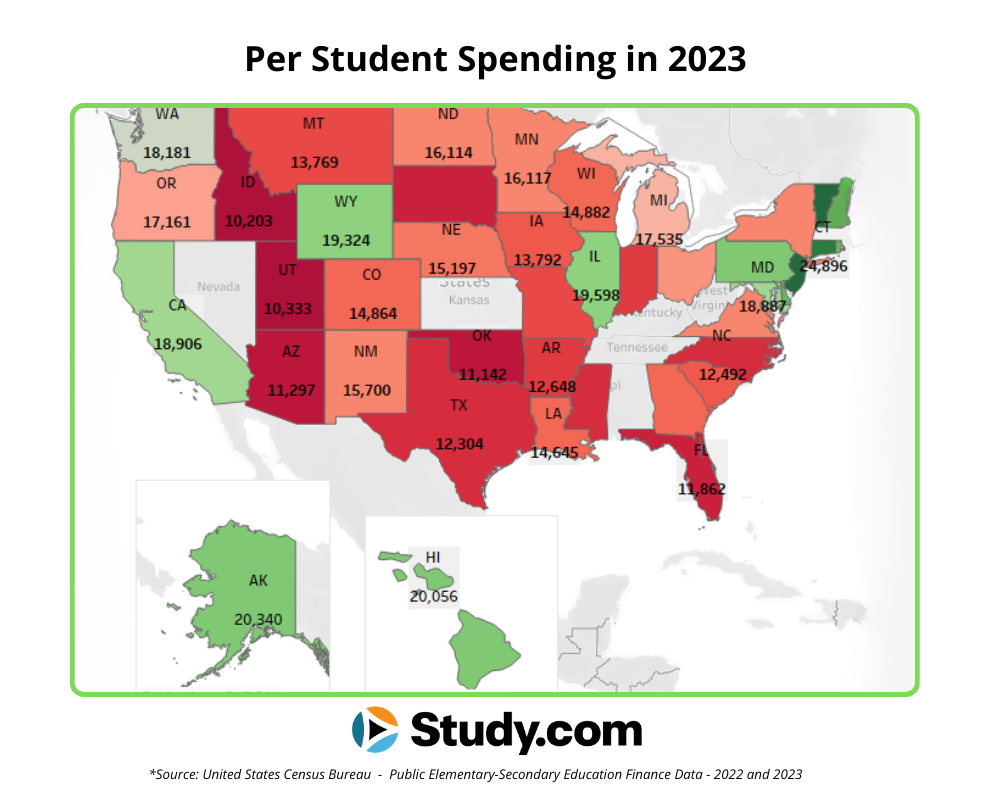
Top 10 States by Per-Pupil Spending in 2023鈥�
Because of the varied formulas that determine state education budgets, per-pupil spending varies greatly across the country. The states below, however, had the highest per-pupil spending in 2023:
- Vermont: $26,345鈥�&苍产蝉辫;
- New Jersey: $26,280鈥�&苍产蝉辫;
- Connecticut: $24,896鈥�&苍产蝉辫;
- New Hampshire: $21,731鈥�&苍产蝉辫;
- Delaware: $21,340鈥�&苍产蝉辫;
- Rhode Island: $21,182鈥�&苍产蝉辫;
- Alaska: $20,340鈥�&苍产蝉辫;
- Hawaii: $20,056鈥�&苍产蝉辫;
- Pennsylvania: $20,056鈥�&苍产蝉辫;
- Illinois: $19,598
education finance system emphasizes local control with school boards setting their budgets and then turning them over to voters to approve鈥攖hat state also relies on property taxes and other taxes to fund schools. Jersey's School Funding Reform Act of 2008 was put in place to ensure that lower-income school districts had equitable access to state resources, and like Vermont, local tax revenue is also put toward funding schools.
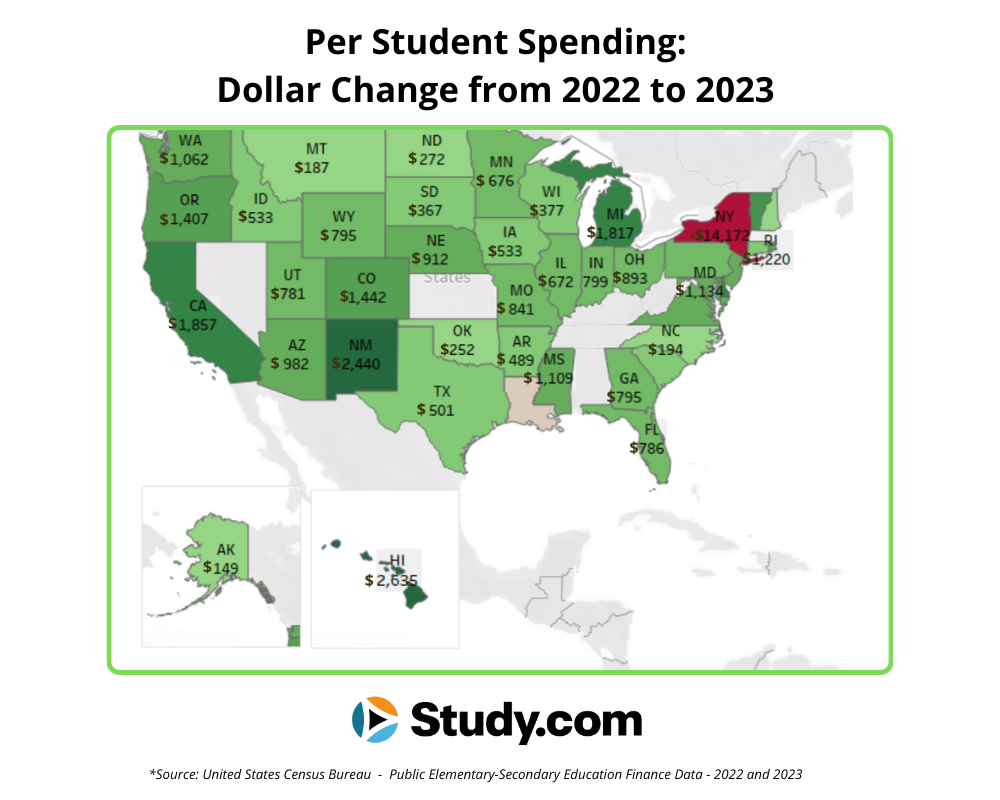
Top 10 States with the Largest Increases in Per-Pupil Spending
A handful of states had large increases in their per-pupil spending with the largest being:
- Hawaii: +$2,635.22鈥�&苍产蝉辫;
- New Mexico: +$2,440.45鈥�&苍产蝉辫;
- Delaware: +$1,983.43鈥�&苍产蝉辫;
- California: +$1,856.56鈥�&苍产蝉辫;
- Michigan: +$1,816.55鈥�&苍产蝉辫;
- Vermont: +$1,736.62鈥�&苍产蝉辫;
- Colorado: +$1,441.53鈥�&苍产蝉辫;
- Oregon: +$1,407.32鈥�&苍产蝉辫;
- Rhode Island: +$1,219.74鈥�&苍产蝉辫;
- New Jersey: +$1,180.90
Hawaii's per-pupil spending benefited from almost that were aimed at helping Title I schools, which are schools with a high number of low-income students. With this money, schools could invest in technology, hire teachers, and provide professional development.
I California, the Learning Recovery Emergency Block was part of the 2022-2023 budget but these funds are still being used for pandemic recovery, focusing on learning loss. had a big cost-of-living adjustment (COLA) to help with funding and included $20 million to help develop more bilingual teachers.
States with the Lowest Per-Pupil Spending in 2023鈥�&苍产蝉辫;
Budget limitations and fiscally conservative spending policies are often the hallmarks of states with low per-pupil spending. In 2023, these were the states with the smallest amounts of per-pupil spending:
- Idaho: $10,203鈥�&苍产蝉辫;
- Utah: $10,333鈥�&苍产蝉辫;
- Oklahoma: $11,142鈥�&苍产蝉辫;
- Arizona: $11,297鈥�&苍产蝉辫;
- Florida: $11,862鈥�&苍产蝉辫;
- South Dakota: $11,932鈥�&苍产蝉辫;
- Mississippi: $12,093鈥�&苍产蝉辫;
- Texas: $12,304鈥�&苍产蝉辫;
- North Carolina: $12,492鈥�&苍产蝉辫;
- Arkansas: $12,648鈥�&苍产蝉辫;
I spending, partly due to state funding that relies on local levies and local grants. During the pandemic, Idaho altered the way the state education budget was formulated, basing funding on enrollment and not attendance; however, that change has been reversed, which could lead to less money for schools. With pandemic funds also expiring and despite a in 2023, schools are bracing for steep cuts.
Although Utah's education budget has grown from, like Idaho, Utah also lags in local and state funding because it depends on state income tax and property tax revenue, and with smaller populations, that means less funding. What's more, funding is adjusted for enrollment and inflation, but Utah is expected to see a, which can lead to even lower per-pupil spending.
States Decreasing Per-Pupil Spending from 2022 to 2023鈥�&苍产蝉辫;
Two states in particular saw decreases in their per-pupil spending:
- Louisiana: -$283.71鈥�&苍产蝉辫;
- New York: -$14,172.37鈥�&苍产蝉辫;
Louisiana determines its education spending based on its formula, and state budget deficits in past years meant little, if any, money was left to put toward increasing the education budget. Although teachers received in 2023, early childhood education dollars were cut and the state is projected to see almost in 2025 due to a state sales tax reduction.
As for New York, last year Mayor Eric Adams announced a sizable. The biggest impact will be felt by the city's free preschool program and other community programs. A teacher hiring freeze and the elimination of vacant non-classroom positions is expected, too. Mayor Adams argued the cuts were necessary due to an influx of asylum seekers creating a financial strain for the city in addition to COVID-19 funds running out.