50 of the greatest archaeological discoveries of all time
50 of the greatest archaeological discoveries of all time
More than a century ago, Albert Einstein developed his famous theory of relativity. The idea that space and time are linked together means that time travel might be possible 鈥� one day, once physicists figure out how it works.
However, travelers and archeologists have known for centuries that the opportunity to step back in time already exists. Yes, really. By visiting archeological sites around the world, you can see how the city of Pompeii worked right before it was covered in volcanic ash, the lost Inca citadel of Machu Picchu, incredible cave drawings in Brazil and Spain, and even the wealthy trading hub of Petra鈥攏o flux capacitor required. Even just learning about archeological findings from home, like the Rosetta Stone and its captivating code or a 44,000-year-old pictorial story from Sulawesi, Indonesia, offers a deeper appreciation for collective ancestors and a humbling reminder of our place in the universe.
When it comes to archeological discoveries, you've got a seemingly infinite array of options to read and learn about. So which ones have made the biggest impact on scientists' understanding of humankind? To find out, 麻豆原创 took a look at 50 of the greatest archeological findings of all time, based on reports in news outlets (like National Geographic, Smithsonian Magazine, BBC News, and The Guardian), UNESCO World Heritage site listings, articles from archeology magazines, and other publications. The list includes important discoveries from around the world, ranging from the Americas to Asia, and even Antarctica.
While we're all stuck at home, there's no better way to transport yourself to a different time and place than by learning about fascinating archeological sites and discoveries across the globe. Click through to see 50 of the greatest archeological discoveries made throughout history鈥攁nd don't be surprised if they inspire future travel plans, once it's safe to explore the world again.
Oldest-known human footprints in North America
In 2021, researchers reported a remarkable discovery in White Sands National Park, New Mexico: human footprints dating between 21,000 and 23,000 years old. This finding was confirmed in 2023 using multiple dating techniques and reconfirmed in 2025, making these the oldest-known human footprints in North America.
The discovery pushes back the timeline of human presence in the Americas by thousands of years, challenging the long-held theory that people first arrived around 13,000-14,000 years ago at the end of the last Ice Age.
Tutankhamun's tomb
Egyptologist Howard Carter unearthed the tomb of the pharaoh Tutankhamun as he was working on the excavation of the Valley of the Kings in 1922. The densely packed archeological find took eight years to document and empty due to it being left in disarray after multiple robberies.
Borobudur
Locals in Indonesia led the British ruler of Java, Sir Thomas Stamford Raffles, to the site of Borobudur, the world's largest Buddhist temple, in 1814. The roughly 1,200-year-old temple features 72 openwork stupas, each of which holds a statue of the Buddha. Still a place for Buddhist pilgrimage, the archeological site reflects a combination of indigenous Indonesian scenes with an Indian influence.
The Lost City of Tenea
Greek archeologist Eleni Korka finally found the in 2018, marking the end of a 34-year search for the Trojan-founded city, per Artnet. Archeologists have since found a whopping 200 coins on the site, demonstrating the city's incredible wealth, which had been discussed in ancient texts.
Pompeii
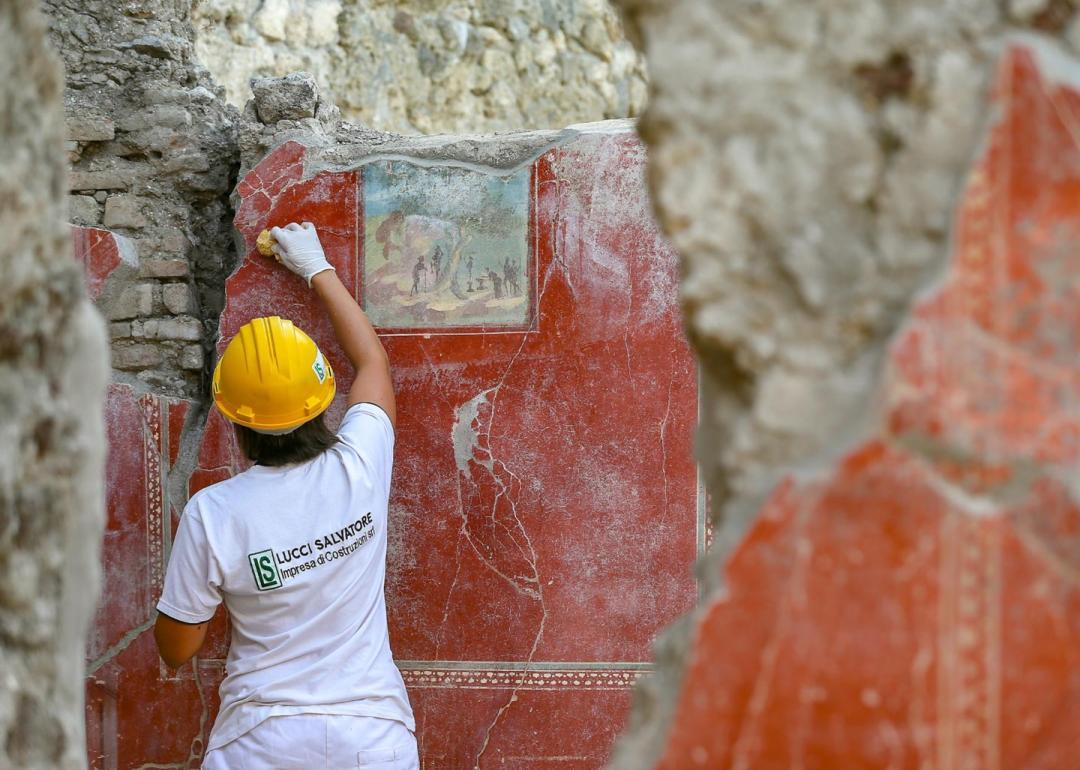
When Mount Vesuvius erupted in A.D. 79, it preserved the Roman city of Pompeii (along with the final moments of its fated residents) under a roughly 20-foot layer of pumice stone and ash. The archeological site, which includes fresco-covered homes, was discovered more than 1,400 years later by architect Domenico Fontana. Now a popular tourist site, the archeological site of Pompeii offers an understanding of cultural, religious, and political life in this ancient city.
Terracotta warriors
China's first emperor, Qin Shi Huang, was buried in a tomb protected by an army of 8,000 life-size clay soldiers鈥攅ach with unique hairstyles, postures, and facial features鈥攚hen he died in 210 B.C. Farmers discovered the terracotta warriors in 1974, and since then, investigations have led archeologists to believe that the emperor's tomb is a massive replica of the city of Xi'an.
Rosetta Stone
Soldiers in Napoleon Bonaparte's army accidentally discovered the remarkable while working on a fort in the Nile Delta, according to the British Museum. The artifact, which dates back to 196 B.C., is inscribed with "a royal decree issued by priests on behalf of Ptolemy V, then ruler of the Ptolemaic Empire in Egypt," in three distinct scripts: Egyptian demotic script and hieroglyphs, along with ancient Greek. The message was deciphered by Egyptologist Jean-Fran莽ois Champollion in 1822, which allowed other ancient texts to be translated.
Knossos
Dubbed Europe's oldest city, Knossos is an archeological site on Crete that dates back to the Bronze Age. It was discovered by amateur archeologist Minos Kalokairinos in 1878. The palace complex contains around 1,300 intricately decorated rooms, along with baked clay slabs with inscriptions in an unknown language.
Sutton Hoo
Archeologists got a vivid glimpse at the medieval world when the excavation of Sutton Hoo, in Suffolk, England, began in 1939. The largely in-tact ship burial held Anglo-Saxon grave goods, including Byzantine artifacts, weaponry, and a now-famous helmet.
Homo luzonensis
In 2019, researchers in the Philippines discovered evidence of an ancient human species that scientists were previously unaware of. Dubbed , the small hominin is believed to have lived on Luzon Island between 50,000 and 67,000 years ago, National Geographic reported. It was identified after archeologists found seven teeth and half a dozen small bones.
Petra
The "lost city" of Petra had been referenced in historical documents for quite some time, but it wasn't until 1812 that the site had finally been found by Swiss explorer Jean-Louis Burckhardt. The impeccably intact Nabataean Aramaic archeological site, which was first inhabited in 7000 B.C., showcases what life was like in a trading city focused on wealth.
Machu Picchu
Explorer Hiram Bingham rediscovered the "lost" Inca citadel of Machu Picchu in Peru in 1911. The well-preserved archeological site, which was constructed in the mid-1400s, gives historians a sense of the technological capabilities held by the Inca Empire when it was at its most powerful. The cave cemeteries and terraced platforms also offer a glimpse at how everyday people lived in this area.
Cave of Altamira
The Cave of Altamira, a Paleolithic cave in Northern Spain, contains particularly well-preserved polychrome paintings and charcoal drawings of human hands and animals. The amazing archeological site was found by Modesto Cubillas in 1868. UNESCO said the artwork showcases "outstanding illustrations of a significant stage in human history."
Staffordshire Hoard
A man named Terry Herbert was using a metal detector over farmland in Staffordshire, England, in 2009 when he stumbled across a substantial archeological finding: gold artifacts. He reported the treasure to the Portable Antiquities Scheme, which scheduled a weeks-long archeological dig. They uncovered thousands of other items鈥攖he "largest collection of Anglo-Saxon gold and silver treasure ever found"鈥攅arning the haul the name Staffordshire Hoard.
Spanish Stonehenge
A drought in Spain's Extremadura region allowed archeologists to see the long-submerged Dolmen de Guadalperal in 2019. Also known as Spanish Stonehenge, the 7,000-year-old site contains 150 monolithic stones, some of which are 6 feet tall. Locals believe it may have been a trading hub with a religious element.
The Lost Leaders of Jamestown
In 2015, a team of researchers identified four skeletons found in the historic 1608 church of Jamestown (where John Rolfe and Pocahontas were wed) as the remains of the "founders of the first permanent British settlement in America," National Geographic reported. The forensic researchers used the teeth of the skeletons to figure out how long the "Lost Leaders of Jamestown" spent at the settlement.
Dead Sea Scrolls
While tending to his flock in 1947, a young Bedouin shepherd in the Judean Desert made one of the greatest archeological discoveries ever: the Dead Sea Scrolls. Held in large clay jars, the old scrolls contained Hebrew manuscripts written more than 1,000 years earlier than any existing Biblical text, according to the Israel Antiquities Authority.
Nazca Lines
Fly above Peru's Nazca Desert, and you'll see huge geoglyphs that resemble animals and plants. Dubbed the Nazca Lines, the archeological finding dates back to between 1,500 and 2,500 years old. American historian Paul Kosok is credited as the first researcher to conduct an in-depth study of the Nazca Lines, the purpose of which is still a mystery.
Ayahuasca from the Bolivian Andes
In 2019, researchers discovered that a millennium-old leather bundle found in a cave in the Andes of Bolivia contained the active compounds for ayahuasca, a hallucinogenic tea, the University of California Berkeley reported. The artifact is the first evidence that South Americans have been using hallucinogenic substances for at least 1,000 years.
Pre-Hispanic skeleton
As they were building a water tank foundation in 2020, people in Tamaulipas, Mexico, found one of the first complete skeletons of a pre-Hispanic man. Researchers believe the remains, which had been untouched for more than a millennium, belonged to a man who was between 21 and 35 years old at the time of death.
299,000-year-old skull
In 2020, a research team from Australia's Griffith University and London's Natural History Museum took a closer look at a skull discovered in modern-day Zambia nearly 100 years earlier. They discovered that it was 299,000 years old, not 500,000 years old, as previously speculated. However, the more accurate dating suggests that multiple human species lived in the area at the same time, per Nature.
Tombs of pyramid builders in Egypt
It's been long speculated that the Great Pyramids of Giza were built by slaves. However, a 2010 discovery of ancient tombs, reported to be more than 4,000 years old, with skeletons of pyramid-builders indicates that they were paid laborers, according to The Guardian.
Painted shell from Neanderthals
Researchers unearthed a from a cave in Northern Italy that was collected by Neanderthals, according to a 2013 article in PLOS ONE. While Neanderthals are often thought of as primitive cavemen, the decorated artifact suggests that they may have collected artwork and thus been more sophisticated than once believed.
1.8-milion-year-old skull
Starting in 2005, scientists spent eight years researching the features of a 1.8-million-year-old . Their research suggests that the early Homo species (a predecessor to humans) may have had a much simpler evolution than previously thought, per The New York Times.
The earliest story told in pictures
A 2024 report in Nature found that a panel of , is the world's oldest figurative artwork and "oldest pictorial record of storytelling."
The cave painting depicts a hunting scene with dwarf bovids and wild pigs and is now estimated to be at least 51,200 years old鈥攐ver 7,000 years older than previously thought. This makes it the earliest known example of humans creating narrative art.
Library of Alexandria
A team of researchers from Poland and Egypt excavated what appeared to be the in 2004. The library contained "works by the greatest thinkers and writers of the ancient world," including Plato and Socrates. The excavation was the first time that a complex of Greco-Roman lecture halls was found in the Mediterranean.
Hidden Japanese settlement in British Columbia
Archeology professor Robert Muckle heard about a site tucked deep in the forest of the North Shore Mountains of British Columbia in 2004. While he thought it might be a historic logging camp, he spent the next 14 years excavating the area and finding signs of a , Smithsonian Magazine reported. Researchers have since dug up more than 1,000 artifacts, as well as evidence of a Japanese bathhouse at the site.
Karahan Tepe
Discovered in 1997 but not extensively excavated until 2020, Karahan Tepe in southeastern Turkey may be the earliest known human village, predating even the construction of G枚bekli Tepe by several centuries. Dating to between 10,000 and 9,500 BCE, the site is part of the "Ta艧 Tepeler" (Stone Hills) project, which now encompasses 12 related Pre-Pottery Neolithic sites in the 艦anl谋urfa region.
Like its more famous neighbor, Karahan Tepe features distinctive T-shaped pillars carved with intricate animal figures and symbolic imagery. In 2023, Turkish and German archaeologists uncovered a remarkable 2.3-meter-high statue of a seated human figure, along with a statue of a vulture, providing unprecedented insight into Neolithic artistic expression.
In 2025, excavators found a 1.3-meter T-shaped pillar bearing a human face鈥攖he first of its kind among Neolithic monumental stones鈥攁nd a set of miniature figurines artfully arranged in stone rings, interpreted as possibly the oldest known three-dimensional narrative in the world.
These discoveries are reshaping our understanding of how early humans transitioned from mobile hunter-gatherers to settled agricultural communities and developed complex symbolic and ritual practices.
Chich茅n Itz谩
Chich茅n Itz谩, a massive pre-Columbian city created by the Maya in Yucat谩n State, Mexico, garnered worldwide attention after explorer John Lloyd Stephens wrote about it in 1843, but it wasn't until the early 20th century that archeologists from the Carnegie Institution would begin conducting archeological research. The site is considered to be among the mythical great cities and offers researchers the chance to study a myriad of architectural styles.
Tikal
Excavations of Tikal, the ruins of an ancient pre-Columbian Maya city in modern-day Guatemala, were started by the University of Pennsylvania in 1956. Since then, it has become one of the best sources of understanding of the lowland Maya cities and features a range of temples, monuments, and palaces.
Helmets made from children's skulls
In 2019, archeologists working on an excavation site in Salango, Ecuador, published their discovery of two infants who were buried wearing helmets made from the skulls of other children in Latin American Antiquity. The burial mounds are believed to have been created in the year 100 B.C. The findings offer clues about the unique infant mortuary rituals of the Guangala culture.
Stonehenge
The of Stonehenge, a prehistoric monument consisting of a ring of 13-foot-high stones in Wiltshire, England, was started by the Duke of Buckingham in the 1620s. The monument, which dates back about 5,000 years, has helped researchers learn more about the ceremonial practices of the Neolithic and Bronze Ages.
Oldest alphabetic writing
In 2024, archaeologists from Johns Hopkins University announced the discovery of what appears to be the . The writing is etched onto finger-length clay cylinders excavated from a tomb at Tell Umm-el Marra in Syria and dates to around 2400 BCE.
This discovery precedes other known alphabetic scripts by roughly 500 years, fundamentally upending what scholars know about the origins of the alphabet. Previously, researchers believed the alphabet was invented in or around Egypt sometime after 1900 BCE. The Syrian artifacts suggest an entirely different origin story, indicating that people were experimenting with alphabetic communication technologies much earlier and in a different location than previously imagined.
The perforated cylinders may have been labels attached to vessels, possibly detailing their contents, origin, or ownership. While the writing cannot yet be translated, the discovery revolutionizes our understanding of how alphabets鈥攚hich democratized writing by making it accessible beyond royalty and social elites鈥攆irst emerged and spread across ancient civilizations.
摩al Saflieni Hypogeum
Construction workers accidentally discovered a Neolithic subterranean structure in Paola, Malta, when they were cutting cisterns in 1902. Now known as the 摩al Saflieni Hypogeum, the finding contained grave goods, human remains, and a multilevel structure with interconnected chambers. It has given researchers more insight into the Maltese culture of building temples.
G枚bekli Tepe
G枚bekli Tepe in Turkey contains the oldest-known megaliths in the world. The ancient site, thought to be of ritual or social importance between the 10th and 8th millennium B.C.E., features more than 200 pillars. The archeological site was first surveyed in 1963 by a research team from Istanbul University and the University of Chicago.
Hidden Palace of Ramesses II
While researching a royal temple, archeologists from New York found an that's connected to the Temple of Ramses II in Abydos, reported Newsweek in 2019. The discovery gives researchers more clues about temples of the period and even prompted the first change to the temple's floor plan in around 160 years.
Lucy, the first Australopithecus afarensis skeleton
Paleontologist Donald C. Johanson discovered the first Australopithecus afarensis skeleton ever unearthed in Hadar, Ethiopia, in 1974. "Lucy," as the 3.2-million-year-old ape has come to be called, was thought to be the earliest-known ancestor species to humans for the next 20 years, according to National Geographic.
Frozen bodies of children sacrificed by Inca
Researchers learned more about Inca child sacrifice from the frozen bodies of two boys (age 4鈥�5 years old) and a 13-year-old girl, found in a according to a 2013 paper published by the Proceedings of the National Academy of Sciences. Data extracted from the scalp hair of the remains implies that the children ingested coca and alcohol, and may have been overall treated differently than other children before they were sacrificed.
Medieval female scribe
In 2019, a multidisciplinary research team discovered "an abundance of ultramarine particles" in the dental remains of a woman who was laid to rest at a German monastery in the 11th or 12th century, according to Archaeology magazine. Because the brilliant blue pigment was extremely expensive and rare at the time, researchers believe that the woman served as a scribe who used ultramarine when creating sacred manuscripts. It may eventually lead to the discovery of more female scribes from the early medieval period.
Ancient human jawbone outside of Africa
A fossil found on Israel's Mount Carmel by a university freshman in 2002 would later be determined to be the unearthed outside of Africa nearly two decades later, per Artnet. It was evidence that humans traveled outside of Africa around 50,000 years sooner than what experts previously believed.
Angkor Wat
The writings of French naturalist Henri Mouhot in the mid-19th century prompted waves of archeologists to visit Cambodia and learn more about the once-sprawling city of , per the BBC. The massive Buddhist temple complex is considered to be one of the world's largest religious monuments and is a source of Cambodian national pride.
Frozen Siberian mummies
Archeologists found the remains of more than 40 people, including a , in southern Siberia in 2003. The mummified bodies belonged to a class of warrior-nomads known as the Scythians. The findings have given researchers more details about the lives of ancient people in the region, including some of the earliest-known battlefield surgeries, Discover magazine reported in 2008.
Skara Brae
A severe storm in Scotland stripped the earth of a knoll and revealed the outline of the long-abandoned in 1850. Some 5,000 years old, Skara Brae is considered to be among the best-preserved Neolithic sites on the continent. Researchers are still trying to figure out why the residents abandoned the area, reported National Geographic in 2019.
臓gantija megalithic temple complex
While travelers and explorers had long known about the megalithic temple complex of 臓gantija in Malta, excavations didn't begin until 1827, with more extensive digs occurring in the mid-20th century. Believed to have been erected as early as 3600 B.C., the 臓gantija temples are one of the oldest existing religious structures created by humans and have since earned designation as a UNESCO World Heritage Site.
The Acropolis of Athens
While Greece brims with fascinating archeological sites, none are quite as famous as the Acropolis of Athens. The site was constructed over thousands of years, starting as early as the Bronze Age. Researchers began restoring and preserving the site around the turn of the 20th century. The is now considered to be a universal symbol "of the classical spirit and civilization," notes UNESCO.
Senegambian stone circles
Built over a period of 1,500 years, the Senegambian stone circles are part of a sacred landscape spanning more than 11,500 square miles in The Gambia and Senegal. Excavations on the megalithic circles occurred in 1964 and 1965. The concentration of the 1,000-plus monuments offers insight into a "," UNESCO says.
Lalibela churches
Among the most famous archeological findings in Ethiopia are the country's monolithic churches, believed to have been built as early as the seventh century. They are of significant religious importance for Ethiopian Orthodox Christians and feature an extensive drainage system and ceremonial passageways.
Medieval cities in Cambodia
Laser-scanning technology helped researchers uncover several in 2015, The Guardian said. The never-before-seen cities are believed to have comprised "the world's largest empire in the 12th century."
Serra da Capivara National Park
Scattered throughout the rock shelters of Brazil's Serra da Capivara National Park are cave paintings, some of which date back more than 25,000 years. They were created by one of , per UNESCO.
Thingvellir
Thingvellir, established by the Vikings in the year 930 A.D., is the site of the world's oldest parliament, in regular use until the 19th century. Not only did it play an important role in antiquity, but it also served as a symbol in the Icelandic independence movement. It's now considered one of the , according to Iceland magazine.