Atlanta is embracing a cheap, effective way to beat urban heat: ‘cool roofs’
Atlanta is embracing a cheap, effective way to beat urban heat: ‘cool roofs’
Walk outside into 100-degree heat wearing a black shirt, and you’ll feel a whole lot hotter than if you were wearing white. Now think about your roof: If it’s also dark, it’s soaking up more of the sun’s energy and radiating that heat indoors. If it were a lighter color, it’d be like your home was wearing a giant white shirt all the time.
This is the idea behind the “cool roof.” In June, Atlanta joined a growing number of American cities be more reflective, reports. That significantly reduces temperatures not just in a building, but in the surrounding urban environment. “I really wanted to be able to approach climate change in the city of Atlanta with a diversity of tactics,” said City Council member Liliana Bakhtiari, who authored the bill, “because it’s far easier to change a local climate than it is a global one.”
Because set their own building codes, they can regulate roofs regardless of the whims of the Trump administration, which is climate policies. Experts say cool roofs are a simple, relatively cheap, and effective way to save people from extreme heat. “I like to say that reflective materials transform rooftops from problem to power,” said Daniel J. Metzger, a senior fellow at Columbia Law School’s Sabin Center for Climate Change Law. “Cool roofs give homeowners the power to improve health outcomes and air quality while saving money on their own energy bills.”
Other cities, including Chicago, Los Angeles, and New York, have also passed cool-roof ordinances, but they often only cover flat roofs, like you’d see on a commercial building. Atlanta’s ordinance covers all roofs, though it only mandates that new ones be made cool — it’s not forcing anyone to rip theirs off if it’s not time to replace. So it’ll take some time for every roof in the city to change, but Atlanta is also rapidly growing with new construction. “It’s going to be kind of a gradual, ongoing, but ideally a permanent response to rising temperatures,” said Brian Stone, director of the Urban Climate Lab at Georgia Tech. “This is pushing Atlanta into one of the more forward-looking cities.”
The Smart Surfaces Coalition — a nonprofit that works with cities to enact cool roof ordinances — estimates that Atlanta’s new building code will cool the city overall by 2.4 degrees Fahrenheit during peak summer temperatures, and by as much as 6.3 degrees in the city’s hottest neighborhoods. It further calculates that over a 35-year period, the ordinance will result in $310 million in energy savings, due to residents having to run their air conditioners less. “It’s a super cost-effective way to make the city healthier, more competitive, cut energy bills, and protect jobs,” said Greg Kats, founder and CEO of the Smart Surfaces Coalition.
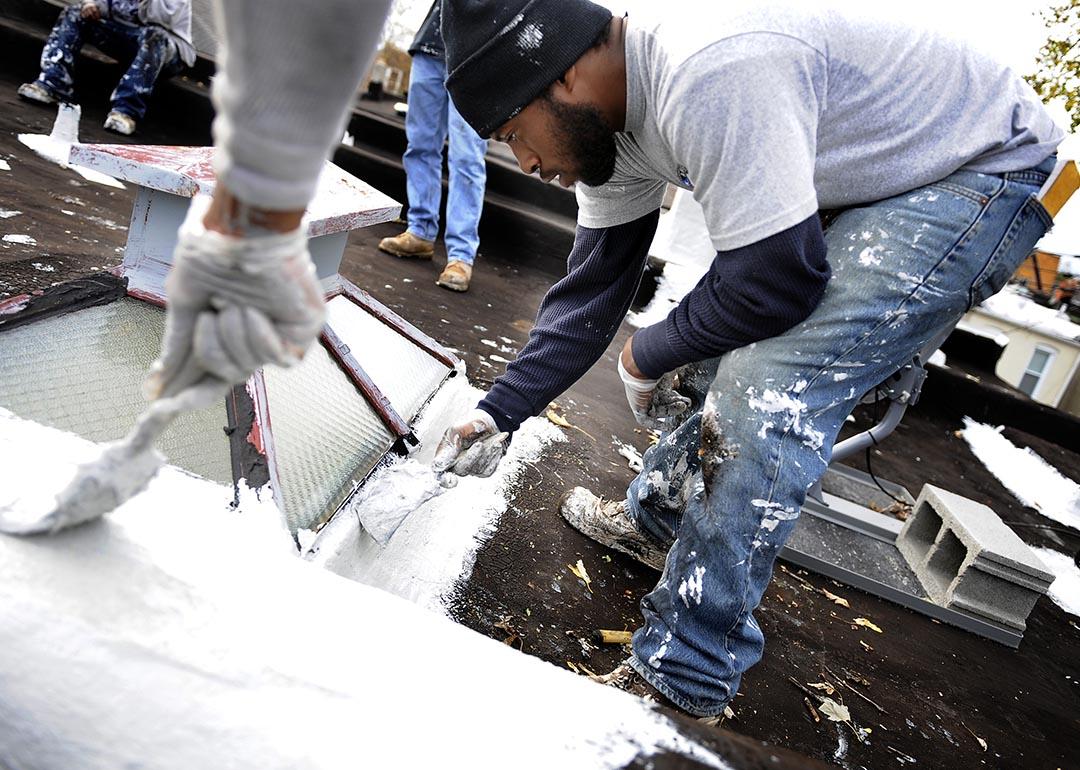
A cool roof is a passive technology that keeps working on its own. For the flat roof of a commercial building, a simple coat of white paint will do. Manufacturers also make that reflect more sunlight. Whatever the strategy, cool roofs are no more expensive to install than traditional ones, and can even be cheaper. They also extend the life of a roof because there’s less wear and tear of the material expanding in the heat, then contracting when it cools down.
Like any other city, Atlanta is struggling with the urban heat island effect: As a summer day wears on, the built environment of asphalt, brick, and concrete absorbs more of the sun’s warmth. This raises temperatures perhaps 20 degrees Fahrenheit above the surrounding countryside, where there’s more vegetation releasing water vapor to cool the air. At night, that stored heat slowly releases from a city, keeping temperatures abnormally high into the morning.
The urban heat island effect gets especially bad in lower-income neighborhoods, where there’s typically less tree cover than in richer areas. “These folks are getting the triple whammy,” said Mark Conway, a council member who sponsored Baltimore’s . “Not only is it hotter in those areas of the city, but then also, they don’t have the trees and the shade to help them, nor can they pay for the AC.”
The urban heat island effect gets extra dangerous during heat waves that stretch several days, because human bodies can’t get a break from relentlessly high temperatures. The stress builds and builds, in particular imperiling those with asthma and heart conditions, as the body tries to pump more blood to cool itself off. Infants and the elderly are also at higher risk because their bodies don’t cool as efficiently as other people. Accordingly, extreme heat kills each year as hurricanes and tornadoes combined.
While getting more air conditioners into more homes will help save lives as cities get hotter, it’s not a cure-all. For one, the units use a lot of energy, and Atlanta’s residents already deal with , meaning a significant proportion of their income goes to electric bills. Two, air conditioners actually make urban heat worse: They work by extracting heat from indoor air and pumping it outside — that’s why you feel a blast of hot air if you walk by one of them. And if the grid goes down because too many people are running their AC and other appliances at once, everyone’s now at much higher risk. “When a house loses power, if its only intervention to stay cool is air conditioning, it’s very likely that people inside of that home are going to quickly overheat,” said Grace Wickerson, senior manager of climate and health at the Federation of American Scientists, a nonprofit think tank.
At the same time, American cities are complementing cool roofs with more trees — Cleveland, for example, has set a goal of getting all its residents within a . Trees provide shade and also release cooling water vapor, like rural vegetation does. Parks and gardens also soak up rainwater, preventing flooding. “There’s just a long litany of good reasons to plant as many trees as possible, and cool roofs don’t take away from that,” Metzger said. “They work together to overall cool the city.”
was produced by and reviewed and distributed by Â鶹ԭ´´.