Can a sneaker brand help counter Amazon deforestation?
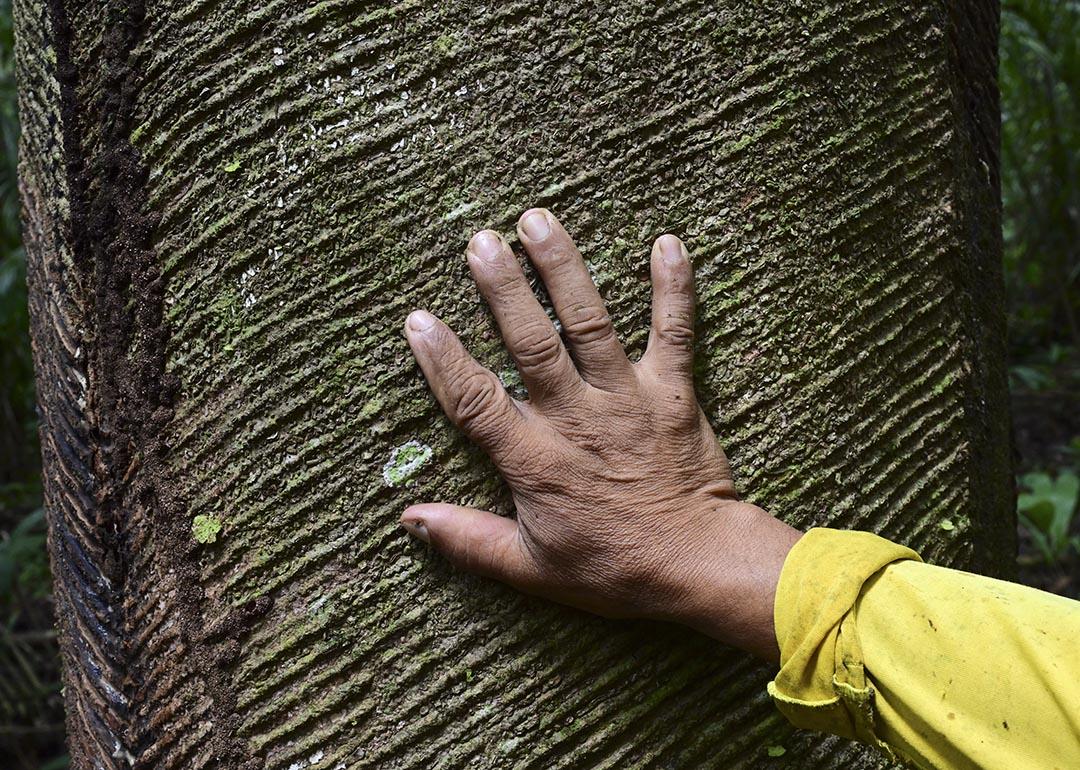
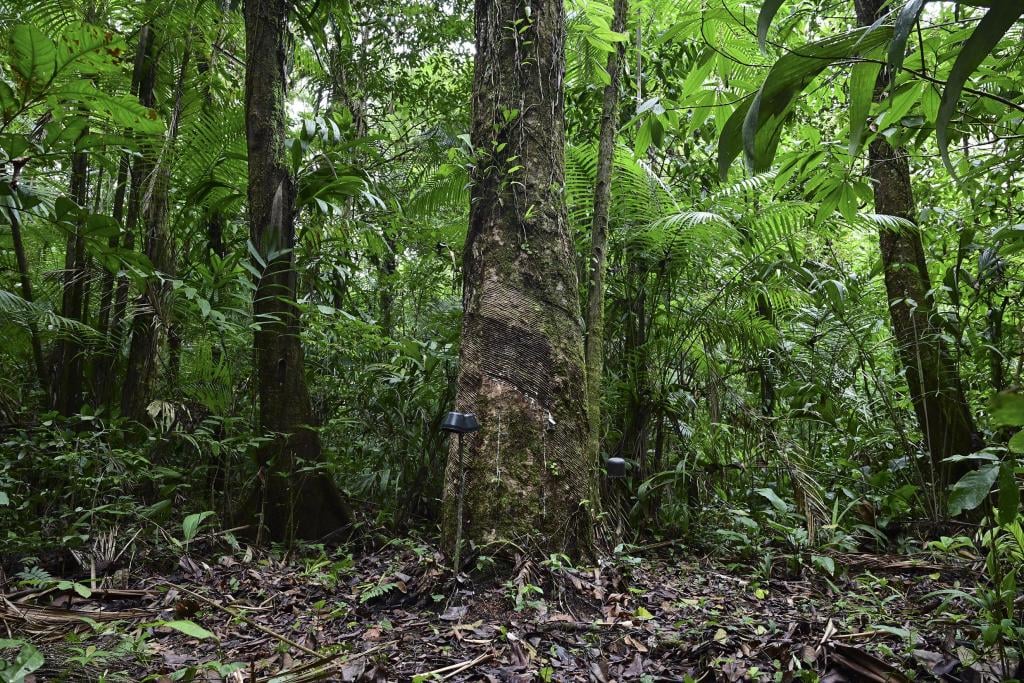
This was no ordinary tree. Tidy diagonal scars ran up and down its trunk in tightly organized chevrons. The lines were as parallel as the black, red, and white stripes of the S茫o Paolo FC jersey that Sebasti膩o da Silva Lima wore as he led us through the thick Amazon foliage one hot May morning.
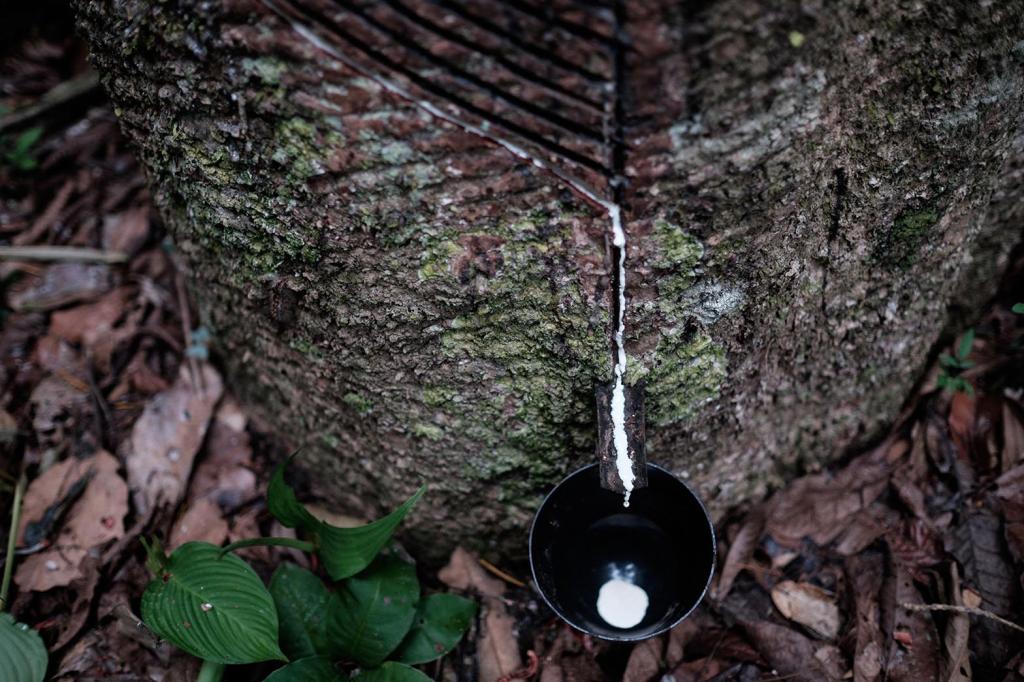
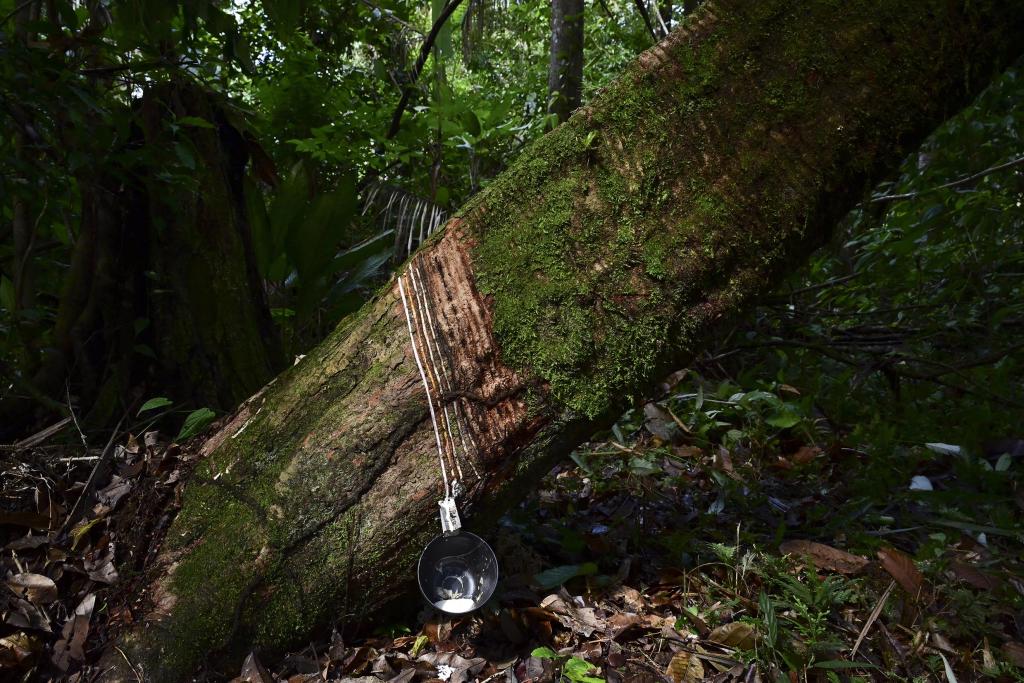
Da Silva Lima, 37, approached the 100-foot-tall tree wielding a bladed wooden tool called a cabrita. With several smooth strokes, he carved another scar beneath the others. White fluid oozed out of the trunk like blood from a wound, coursed through the new channel, and flowed into a small cup on the ground. That鈥檚 raw latex, da Silva Lima explained to , and this was a seringueira rubber tree.
Da Silva Lima is a seringueiro, or rubber tapper. He harvests latex Monday to Thursday, starting at 5:30 a.m.鈥攁 late start, as he describes it, to avoid on莽as, or jaguars. A Portuguese interpreter translated the harvesting practice as 鈥渃utting,鈥� but explained that seringueiros use a less violent word: riscada, which describes how one would cross out a word with a pencil.
Rubber tapping runs in da Silva Lima鈥檚 family. His father, who died three years ago, was a seringueiro, da Silva Lima explained with tears in his eyes. His kids鈥擯edro, 7, and Eric Davi, 12鈥攁re learning, too. They joined, and each took a practice turn at a rubber tree. But the family tradition faces an existential threat: Deforestation, climate change, and exploitative market forces endanger their way of life.
While most rubber in the early 20th century came from the Amazon, most companies now source rubber from monoculture plantations in Southeast Asia. Out of work, many Amazonian locals have turned to cattle ranching, which in Brazil accounts for . Felled trees leak stored carbon dioxide into the atmosphere, and reduced tree cover limits the forest鈥檚 carbon-capturing abilities to accelerate the climate crisis. The forest鈥攁nd the rest of the world, especially the Global South鈥攑ays the price.
But there are inklings of a resurgence for wild rubber. The shoe company, Veja, sources 20% to 40% of the rubber in their sneaker soles from Amazonian seringueiros like da Silva Lima. They pay them up to five times market value, so the ancestral practice is competitive with cattle ranching, and to compensate rubber tappers for the environmental benefits of an intact forest.
Beyond Chico Mendes reserve, 叠谤补锄颈濒鈥檚 government promotes a bioeconomy, which involves selling forest products like rubber, a莽a铆, and Brazil nuts traditionally harvested from the Amazon. Some scientists argue that the bioeconomy is critical to meeting . Indeed, President Luiz In谩cio Lula da Silva spearheaded bioeconomy negotiations when the nation hosted the 2024 G20 Summit, and it鈥檚 on the docket of in.
But can capitalism, even a fettered form of it, really save the rainforest? The idea is controversial. Still, the seringueiros need it to work. Even 79-year-old Raimund茫o Mendes de Barro, a seringueiro and union leader who laments the concentration of wealth in the global elite (鈥淗ere in the forest, thank God nobody is rich,鈥� he said), has bought into his community鈥檚 partnership with Veja. With the Amazon and climate at stake, failure isn鈥檛 an option.
Twelve-year-old Eric Davi pointed out the abundant wildlife while hiking through the forest. The precocious preteen held out a husk of a seringueira seed and pointed to a sapling that would sprout from it鈥攁 seringueirinha. He spotted a caterpillar covered in spike-like hairs, chimney-shaped mushrooms emerging from fallen branches, and a thick mat of moss, which he photographed and posted on his Instagram story. 鈥淐uidado,鈥� he warned of the caterpillar. 鈥淣茫o,鈥� he answered when asked if the mushrooms posed a threat, too.
Such a connection with the rainforest is the norm here in the Chico Mendes Extractive Reserve, which makes up 2.3 million acres and is home to over 10,000 residents. Established in 1990, it鈥檚 the largest extractive reserve in Brazil, a system of publicly owned lands that permits sustainable natural resource extraction by traditional populations like seringueiros.
The well-being of the forest and its people here are intertwined. That鈥檚 been clear since the reserve was founded. Its namesake, Chico Mendes, was a renowned conservationist and human rights activist during the late 1900s. At the time, many seringueiros were mistreated and trapped in debt bondage by monopolizing rubber barons. 鈥淲e were very exploited by the landlords of rubber,鈥� said Mendes de Barro, who is Chico Mendes鈥� cousin and vice president of the Rural Workers鈥� Union of Xapuri. 鈥淪eringueiros were slaves to their landlords.鈥�
When cattle ranchers arrived in the mid-1970s and threatened to tear down the forest, Mendes led seringueiros in resistance. They staged nonviolent empates, or standoffs, putting their bodies between chainsaws and trees to prevent deforestation. To them, the labor movement and environmental movement were inseparable. Mendes鈥� activism earned him international recognition, but it cost him his life; on Dec. 22, 1988, a local cattle rancher murdered the 44-year-old Mendes with a 20-gauge shotgun at the back door of his home in Xapuri.
Mendes鈥� impact has outlived him. 鈥淲e have better living standards,鈥� said Mendes de Barro, citing the way people dress, their education, and their access to technologies like cell phones. 鈥淧eople [from cities] used to call us idiots, donkeys鈥� but today our children are equal.鈥�
But the battle is far from over. The ever-worsening climate crisis threatens the forest and its denizens. In 2024, the Amazon had its biggest fire in two decades and its worst drought in half a century, fueled by climate change.
Rising temperatures and erratic rainfall patterns , said Sebasti膩o Aquino, 46, president of the agroforestry cooperative, Cooperxapuri. Fluctuating river levels can also complicate product transport, he said.
Seringueiro鈥檚 livelihoods are impacted, too. Mendes de Barro recently dug a well to maintain access to water at his home. 鈥淭his could be complete collapse. We鈥檙e going into June now. Just look how hot it is,鈥� said Mendes de Barro. 鈥淲hatever happens here will reflect on the country you come from.鈥�
With the forest more at risk now than ever, the struggle for the dignity of the Amazon鈥檚 people has ramped to fever pitch, said Maria Ara煤jo de Aquino, a leader of Black and women鈥檚 social movements in the Chico Mendes community. 鈥淔orest preservation goes beyond planting trees,鈥� she said. 鈥淚t鈥檚 about the cultural rescue of this population.鈥�
Pastures sprawl outside the Chico Mendes reserve. Slashed and burned trees smolder on the ground, the smell of smoke inescapable. Brazil nut trees tower above cows and grazed grass鈥攊llegal to fell, but often unable to fruit without beetle pollinators and their natural habitat.
Harrowing as the visual is, it鈥檚 hard to blame cattle ranchers for taking up their line of work. The government makes the business easy鈥攁nd lucrative.
叠谤补锄颈濒鈥檚 with 123 billion reis ($2.2 billion today) per year in tax incentives, credit, and debt relief. About a quarter of the nation鈥檚 beef gets exported, , though this year, the . This is all for a product that produces 50 times more greenhouse gases pound-for-pound than coal鈥攂y some estimates, the .
Seringueiros don鈥檛 wish to end cattle ranching altogether. Many of them, including Aquino, have cows, which they hold as savings. Instead, they want to see an agricultural model that works with the forest, not against it. But it鈥檚 hard when the economics favor clear-cutting.
Veja is seeking to flip that script, first by creating a market that makes rubber tapping economically viable again. Several seringueiros told me the work would be impossible without the company. 鈥淏ut this investment alone is not enough,鈥� Ara煤jo de Aquino said, partly because rubber is a six-month business, and Veja is only one buyer.
鈥淭he dream we have as a company is for other companies to be inspired by us,鈥� said Sebasti茫o Pereira, production chain manager at Veja. In addition to rubber, families can earn a living from harvesting other natural forest products like a莽a铆, Brazil nuts, wild bee honey, or medicinal products like vinho de jatob谩. A robust portfolio would provide 鈥渢rue transformation for these families,鈥� he said.
It鈥檚 not easy for companies to pay the premium Veja does, though. Compared to the market price of 64 cents per kilogram of rubber, seringueiros who produce for Veja receive up to $3.27鈥攁 more-than-five-fold difference鈥攄epending on how well the rubber tappers care for the forest, rubber trees, rubber quality, and community cooperative. Additionally, Veja contributes up to an additional $2.54 per kilogram of rubber toward community development, with projects including community centers, solar panels, and water pump kits.
鈥淚t鈥檚 a natural tendency to go to cost reduction,鈥� said Fran莽ois-Ghislain Morillion, co-founder of Veja. 鈥淪ometimes we have to say: No, this is a non-negotiable.鈥�
But even with money on its side, the revival of wild rubber tapping may face an impasse in the Brazilian zeitgeist. 鈥淲hat is difficult to compete with is the culture, because if you talk to any kid,鈥� Morillion said, 鈥渉is dream is to be a cattle rancher.鈥�
Even Aquino鈥檚 child, 11-year-old Maison, and Eric Davi鈥攂oth sons of seringueiros鈥攑layed YouTube videos of Brazilian bull-riding rodeos as they walked through the forest.
鈥淚t鈥檚 a bit like country music, let鈥檚 say, but the Brazilian version,鈥� Morillion said. 鈥淎t least economically, now we are really competing.鈥�
The idea that companies can preserve a forest might reek of greenwashing鈥攁nd the bioeconomy certainly has its critics.
Some products may be considered niche. For example, , just 0.07% of 叠谤补锄颈濒鈥檚 GDP. Can the market really help support the 30 million people living in the Amazon?
If niche markets grow, cheaper monocultures might proliferate and further devastate biodiversity, according to Dr. Ricardo Hausmann, an economist at Harvard University. Development of , too, he wrote in a plainly titled op-ed, 鈥�.鈥�
Even Morillon is uncomfortable with the idea that companies can save the rainforest. 鈥淲e are never claiming that if you buy a pair [of Vejas], you are going to contribute to preservation鈥� that the company can be the savior of the forest,鈥� he said. However, Veja that 鈥渙ur goal is to enhance the economic value of the forest in order to protect it鈥� and that it 鈥�.鈥嬧赌�
While Veja is often cited as a case study in its bioeconomy negotiations, Morillion is ambivalent about how talks play out. Brazil, he said, emphasizes an 鈥渁gribusiness framework鈥� that overlooks fair trade and compensation for workers.
But current extractive models need to change, and Morillion insisted that politics, companies, and public interest all play a role in shifting the status quo.
Indeed, Brazilian President Lula is at the forefront of the conversation. 叠谤补锄颈濒鈥檚 G20 summit last year saw the development of 鈥溾�� on bioeconomy, which were . These include, among others, sustainable socioeconomic development, climate mitigation, and biodiversity conservation. His government seems keen on advancing the conversation at .
Although there are plenty of avenues for error, it鈥檚 hard to discount the benefits to the environment and economy when things go right. Since Veja began monitoring deforestation in the Chico Mendes reserve four years ago, compliance with deforestation laws has increased from 60% to 86%, Morillion said, though he emphasized that much of that might be credited to rather than Veja.
Rubber-tapping families have benefited from between 2018 and 2021. They also have better access to education, clean water, and more. Starlink even provides internet connection in the deepest neck of the woods. (鈥淭hanks, Elon,鈥� Morillion joked.)
Still, not every seringueira tree in the rainforest was thriving. One had been overharvested, the cuts too deep and frequent. It would probably die, da Silva Lima said. Another rubber tree had a vine wrapping endless loops around its trunk. It looked harmless, said Pereira of Veja, but it鈥檚 actually suffocating the seringueira.
In his truck, Aquino drives past endless pastures. The treeline in the distance marked the front line of deforestation. Those in the bed of the truck had to watch their heads for branches as they drove through the forest. But in the pastures, you don鈥檛 have to worry, Aquino said. The forest is largely dead and gone.
Much like the rubber tree being suffocated by the parasitic vine, each year, like a tightening belt, the joint fires of climate change and agribusiness cinch one notch closer to seringueiro communities. What happens here will be reflected in your country, Mendes de Barron had warned.
鈥淎t first I thought I was fighting to save rubber trees, then I thought I was fighting to save the Amazon rainforest,鈥� the conservationist Mendes once said. 鈥淣ow I realize I am fighting for humanity.鈥�
Veja hosted Jason P. Dinh on a trip to Brazil in May 2025.
was produced by and reviewed and distributed by 麻豆原创.