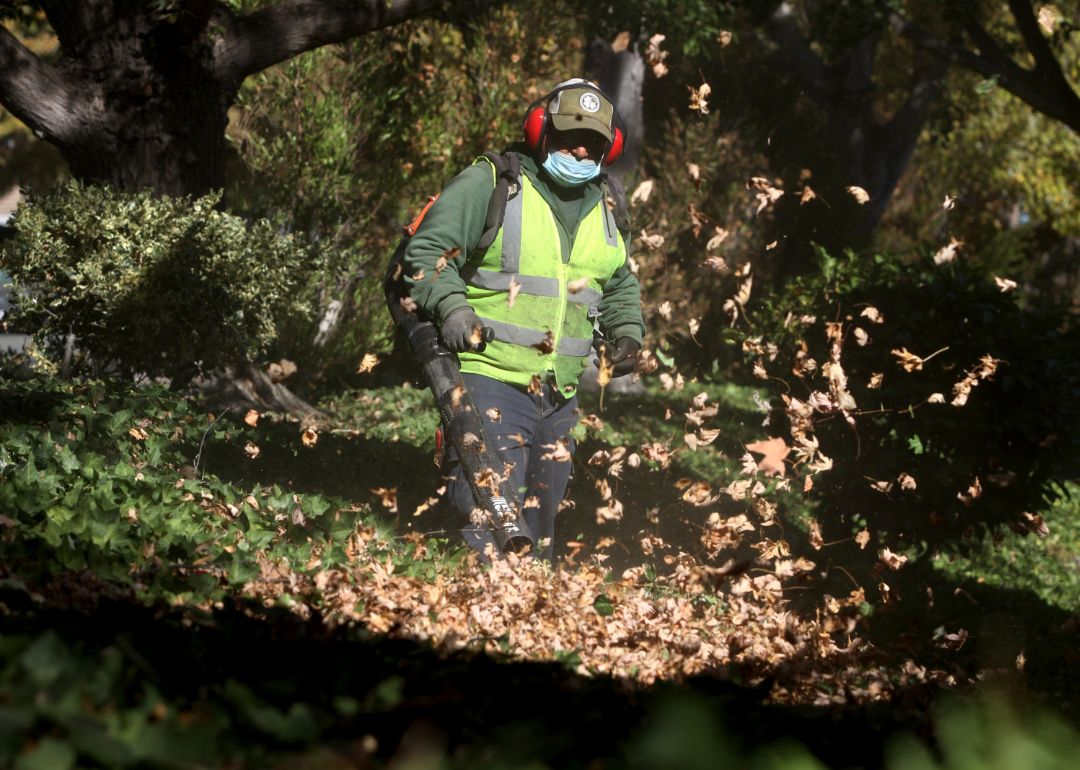
Everyone hates gas-powered leaf blowers. So why is it so hard to ban them?
Everyone hates gas-powered leaf blowers. So why is it so hard to ban them?
The push to ban gas-powered leaf blowers has gained an unlikely figurehead: Cate Blanchett, the Australian actress. “Leaf blowers need to be eradicated from the face of the Earth,” she said in in March. Her complaints have . “It’s a metaphor for what’s wrong with us as a species,” Blanchett said. “We blow s--- from one side of our lawn to the other side, and then the wind is just going to blow it back!”
Her complaints about leaf blowers — equal parts entertaining and earnest — stretch back , and now the mood has caught up with her. Today, more than 200 local governments in the U.S. have to switch to quieter, less polluting electric tools. The first bans , but the trend picked up after the COVID-19 pandemic lockdowns in 2020, when newly homebound workers discovered just how inescapable the whine of their neighbor’s leaf blower could be.
In this article, examines why local governments struggle to implement and enforce bans on gas-powered leaf blowers, despite widespread support.
“With every year that passes, more and more communities across the country are taking action to address the shocking amount of pollution and noise from gas lawn equipment,” said Kirsten Schatz, clean air advocate at the Colorado Public Interest Research Group, called CoPIRG.
Gas-powered leaf blowers aren’t just annoying; they’re bad for public health. Closing the windows can’t shut out their low-frequency roar, which can be louder than the World Health Organization’s recommended limit of 55 decibels . The unwanted sound can , along with disturbing people’s sleep and potentially damaging hearing over time.
Leaf blowers’ two-stroke engines also churn out : fine particulate matter, , and . By , running a gas-powered leaf blower for an hour emits as much smog-forming pollution as driving a car from Los Angeles to Denver.
And while lawn and garden equipment is only a small slice of global carbon emissions, leaf blowers and other gas-powered tools “pack a big punch for the amount that they create based on the size of their engines,” said Dan Mabe, the founder of the American Green Zone Alliance, a group that works with cities and landscapers to shift to electric equipment. In 2020, fossil-fueled lawn and garden equipment in the U.S. released , more than the emissions of the city of L.A.
Cities and states across the country have taken different approaches to dealing with the problem. California’s law banning the sale of new gas-powered blowers took effect last January, while cities like Portland and Baltimore are phasing out their use. Some places, like Wilmette, Illinois, , either permanently or until a full ban takes effect. Others, like Colorado, attempt to sweeten the deal of buying electric lawn care equipment, offering .
But implementing the bans is proving more challenging than many expected. Many communities are frustrated that the new rules are not being properly enforced, said Jamie Banks, the founder and president of Quiet Communities, a nonprofit working to reduce noise pollution.
Westport, Connecticut, fought for years to get , only to find that local officials were not enforcing it, Banks said. Noise complaints are not exactly at the top of police officers’ priority lists, and sometimes ordinances are written in a way that’s hard to carry out — police aren’t usually expected to go around town taking noise readings, for example. Some communities are taking a deliberate approach to the problem: Banks pointed to a group of towns in the greater Chicago area, including Wilmette, that are and working with the local police.
Then there’s the matter that swapping gas blowers for ones powered by electricity isn’t as straightforward as it sounds. While the costs are comparable for homeowners — you can get electric blowers at a big-box store like The Home Depot for around $200 or less, cheaper than most gas ones — electric blowers are more expensive for commercial landscapers. They require multiple batteries for workers to get through the day. While a typical professional gas-powered blower runs for $550, a comparable electric one costs $700 and requires thousands of dollars' worth of batteries. Landscapers also have to buy hundreds of dollars' worth of charging equipment and find ways to charge safely on the go.
Plus, it can be difficult to meet the standards customers expect from electric leaf blowers, which are less powerful than gas ones. “If you have customers that are demanding that you get everything off the ground, and you better do it quickly, and you’d better not charge me too much money, it’s really tough,” Banks said.
Bans have already generated a political backlash in some Republican-led states. and have passed laws prohibiting local governments from regulating gas-powered leaf blowers. The Western States Petroleum Association, an oil industry group, launched that pushes back against laws to electrify vehicles and leaf blowers. But leaf blowers aren’t just a culture-war lightning rod; in some places, they’re leading to personal conflict. In Evanston, Illinois, a suburb north of Chicago, several landscape workers by people reporting violations of the local ban.
The American Green Zone Alliance noted in a recent statement that “heavy-handed bans on gas-powered leaf blowers can unintentionally create stress and hardship for workers who often labor for low wages, with limited benefits or control over their working conditions.”
Although there are many details to work out, the organization is still pushing lawn care to go electric. “We are trying to convince our industry, ‘Look, we need to accelerate this,’” Mabe said.
The alliance is advocating for incentives that are sufficient to make the new equipment affordable for landscaping businesses operating on razor-thin margins. (In the end, lower fuel and maintenance costs for electric blowers can save companies money if the equipment is properly cared for, Mabe said.) Seasonal bans on gas-powered leaf blowers may be more feasible in some places than year-round ones, because they leave short windows for using the fossil-fueled devices in the spring and fall to take care of heavy cleanup jobs.
Another solution: Customers could loosen their expectations and accept a scattering of leaves, instead of demanding a perfectly manicured lawn. “Now, if that aesthetic was more relaxed, that could help change things,” Banks said. “Maybe they wouldn’t need to carry so many batteries.” Leaving some leaves on the ground is, at least ecologically speaking, a good thing — decaying leaves and form that provides shelter for snails, bees, and butterflies.
And of course, in many cases, a leaf blower isn’t needed at all: You can do as Blanchett advises and take matters into your own hands .
was produced by and reviewed and distributed by Â鶹ԭ´´.