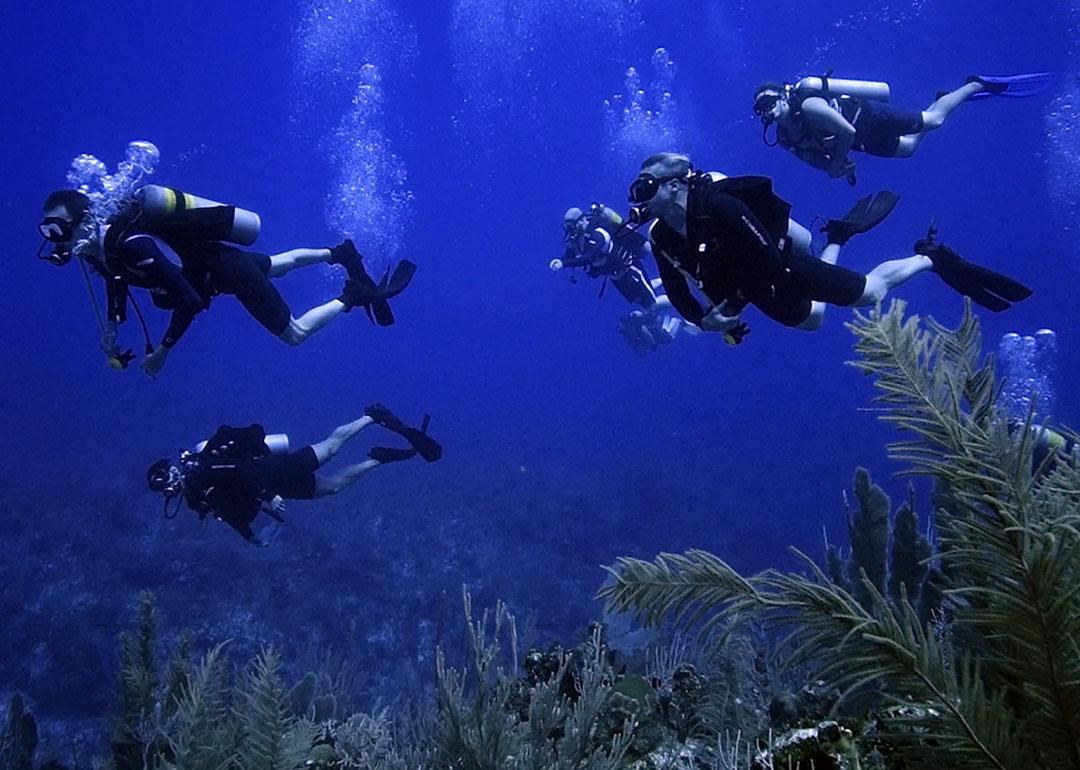
Former Navy SEALs are diving to save the ocean
When went diving in the Cayman Islands in 2015, the experience changed his life. The highly decorated veteran had logged thousands of dives as a Special Ops Force Recon Marine in 18 years of service. But, as Reyes recalls, “As combat divers we operate at night, pushing 200 pounds of equipment, carrying massive weapons. It’s very stressful, and we focus on the mission — taking on the enemy.”
In the Caribbean, Reyes dove for the first time during daytime at his own pace, guided by his friend Jim Ritterhoff, who worked with the Central Caribbean Marine Institute. Ritterhoff remembers the moment vividly: “Here’s this trained combat diver, one of the best, most highly skilled individuals you’ll ever encounter underwater — yet he’s never seen a fish.”
At the time, Reyes was struggling with depression, post-traumatic stress, and substance abuse. “I had a really hard drug habit after all these intense combat tours,” he admits, but diving in the Caymans, surrounded by vibrant marine life, reignited a sense of wonder. “It brought me back to life.”
When Ritterhoff told him the underwater world was in danger, Reyes found a new mission: “It inspired the same kind of protective spirit and willingness to go fight in the battlefield that I used in the Marine Corps, but now I wanted to use that passion to fight for ocean conservation.”
In 2016, Reyes, Ritterhoff, and Keith Sahm co-founded , a nonprofit that recruits veterans — especially Navy SEALs and Special Operations divers with military dive training — to channel their skills into marine conservation. “We’re learning to transfer combat diving expertise into protecting and providing refuge for this incredible aquatic environment,” Reyes explains. “We do freshwater work. We do brackish water work. We’ve installed artificial reefs with buoys and sensors for early hurricane detection. There’s really nothing we can’t do.”
The organization’s impact has been profound, reports. Force Blue now works with more than 40 veterans and runs eight to 10 missions annually, tackling everything from shoreline restoration and coral planting to turtle surveys and shipwreck assessments. The nonprofit collaborates with NOAA, marine scientists and conservationists to educate recruits about identifying marine species, combating invasive threats and preserving vital habitats like mangroves and seagrass beds.
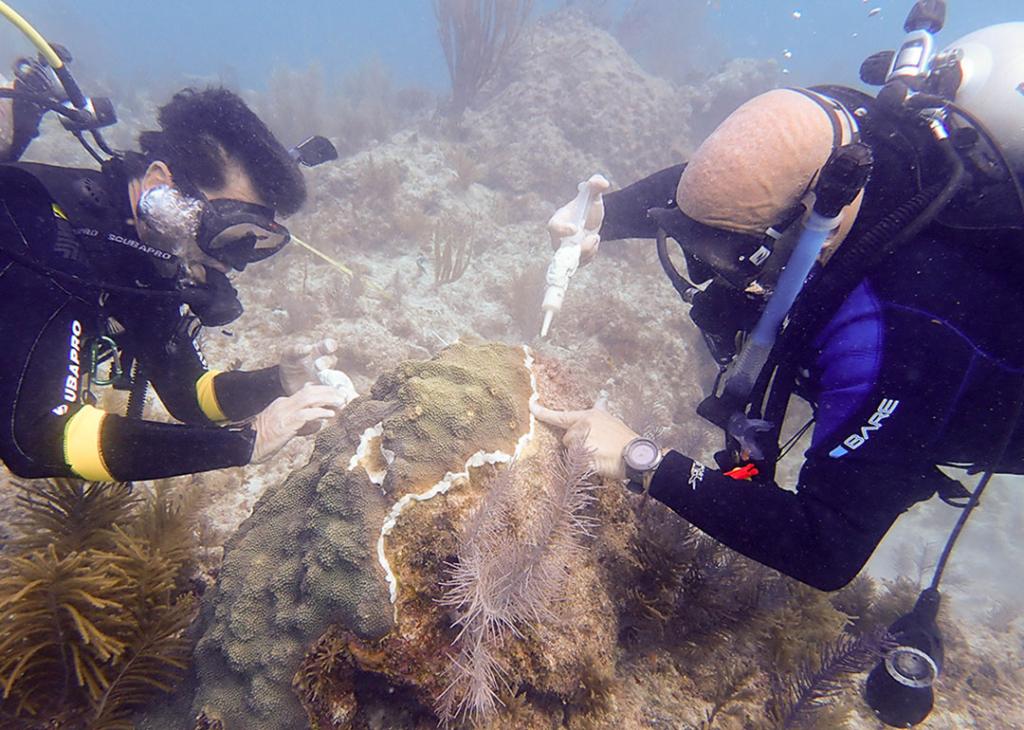
For instance, in 2017, Force Blue deployed to Puerto Rico after Hurricane Maria and to Florida after Hurricane Irma to assist with emergency coral reef recovery and efforts in damaged reefs. In 2018, the Florida Department of Environmental Protection approached Force Blue to monitor and curb the spread of . The disease, which affects half of the coral species in the Florida Keys, completely destroys the soft tissue of infected corals, resulting in their death, often within a matter of weeks. The organization was tasked with studying an 80-mile stretch of reefs along the Florida Keys treating the afflicted corals with antibiotics. “I hadn’t quite realized how important corals are for the marine life and life in general,” says Force Blue volunteer Duncan Baillie, who spent 25 years in the British military and now lives in Florida. He helped replant coral from nurseries.
The ecowarriors are currently on “” with a five-year-mission to work in and around each of the country’s 15 National Marine Sanctuaries.
Force Blue volunteers also rebuilt a shoreline in Choctawhatchee Bay, Florida, by moving 40 tons of rock. “They thought we needed two days, but we got it done in one,” Baillie says about the task of constructing 50-foot rubble barriers underwater. “Give veterans a task, and it turns into a competition. Stop for lunch? No, we just get it done.”
For many, the work is therapeutic.
“Force Blue’s mission statement — ‘Giving warriors a cause and giving a cause its warriors’ — really resonates,” says Baillie, who especially enjoys rescuing and surveying sea turtles.
“They’re such sweet animals. They need protection — not from predators, but from boats, plastic waste, and abandoned fishing gear.”
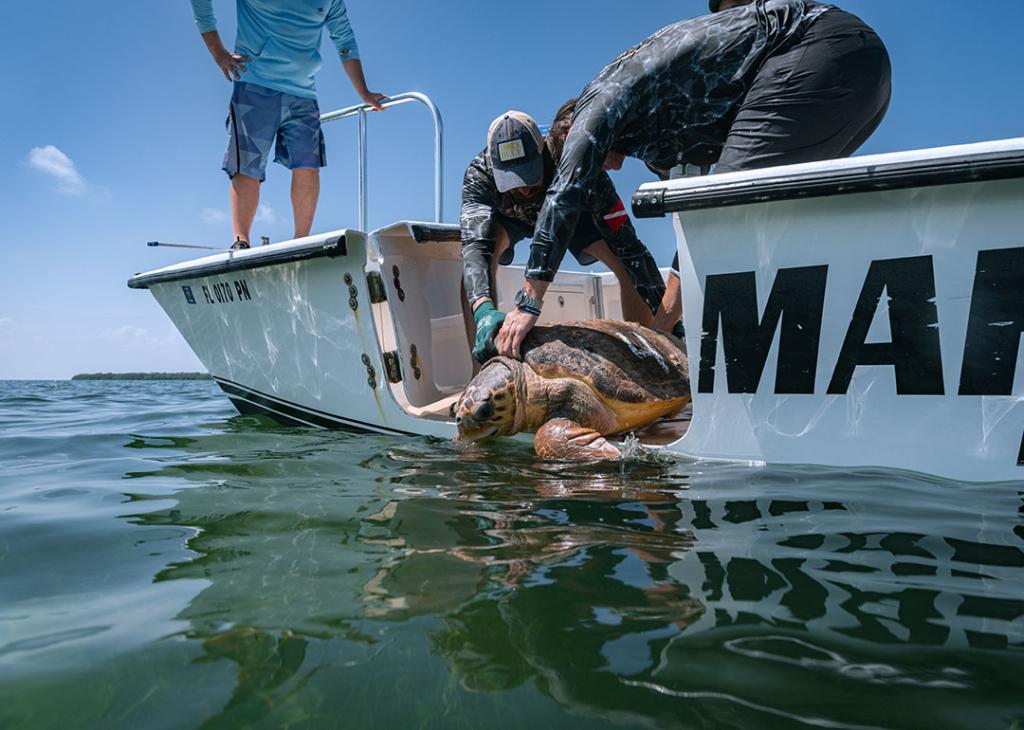
Force Blue partners with organizations in Florida including the Turtle Hospital, the Loggerhead Marine Life Center, and Florida Atlantic University to study and combat fibropapillomatosis, a disease that affects sea turtles worldwide. The disease, particularly prevalent in Florida, can blind turtles, leaving them vulnerable. Force Blue warriors tag and scan the turtles before either releasing them or taking them to the Turtle Hospital in Marathon, Florida.
Adam Wright, a former Navy SEAL, finds the work exhilarating. “You get the thrill of the hunt but you don’t have to kill anything,” he says from his home office near Washington D.C. Wright does about two week-long missions a year with Force Blue. After 10 years in the Navy, he despised the water. “Being a SEAL turns men into cats, because you’re always cold and wet, so you start to hate it.” But Force Blue brought his passion for the oceans back, and he sees the organization as a platform for education and outreach. “We’re all connected to the ocean, even if we don’t realize it,” he emphasizes. “Part of Force Blue’s mission is outreach because, as veterans, we can reach a demographic that scientists can’t.”
As much as the work benefits the ocean and coastline, Force Blue clearly also gives the veterans a much-needed way to serve again. “It recreates some of the camaraderie that we experience in the military,” says Wright. “We’re like sled dogs, we want to do the hard work. If we don’t have a bone to chew or an ambulance to chase, we’re just not happy dogs.”
Wright calls the Force Blue experience “therapeutic, like a soul shower.”
Some veterans also experience physical relief.
“I have a buddy who shattered his lower leg multiple times skydiving, and just standing up is painful,” Wright says.
“When he gets in the water, in the zero gravity environment, it doesn’t hurt, and he can be active down there and feel good about himself.”
Co-founder Rudy Reyes credits Force Blue with his survival: Beyond getting clean and going through therapy, “it was really Force Blue that brought me to a place of joy in my life,” Reyes says from the ice rink in St. Louis where his son plays hockey. “I got my son back!” he exclaims, beaming as his child skates over for a hug.
One of his favorite initiatives is the , a program Force Blue runs with NAUI (National Association of Underwater Instructors) Worldwide for families — those who have lost a loved one in military service. “It’s about reconnecting with our sense of purpose,” Reyes says. “Healing veterans’ souls and healing the ecosystem — it’s all connected.”
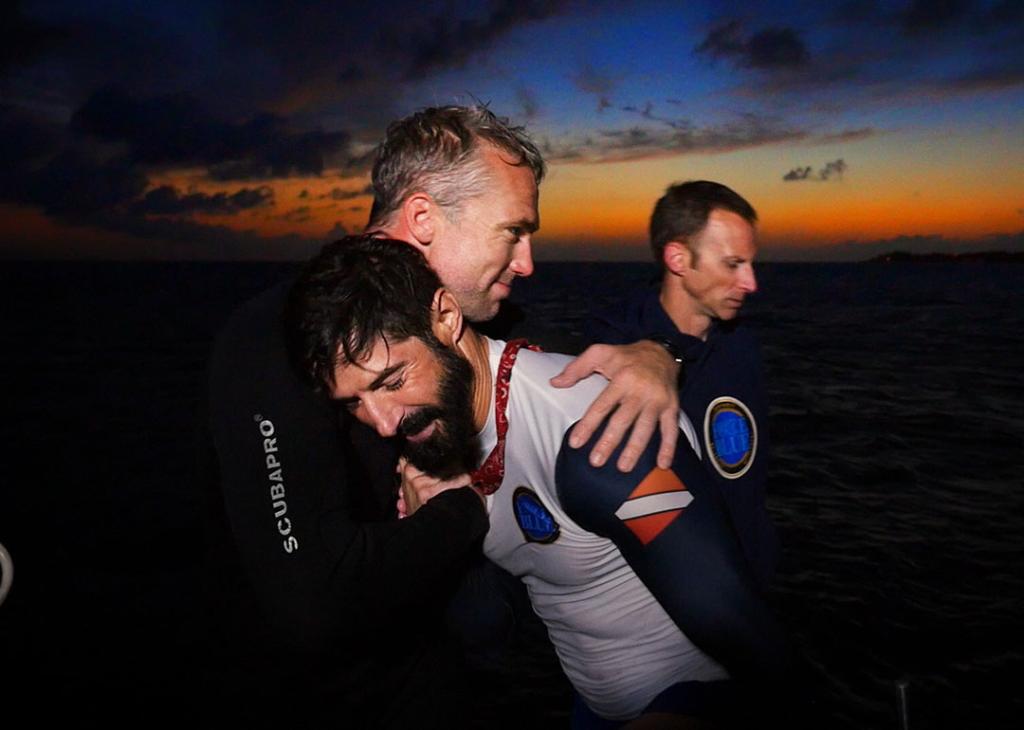
Reyes likens the personal reverberations of Force Blue to the interconnectedness of the ocean’s ecosystem. “From charismatic megafauna down to the tiniest plankton, every layer must be healthy for the whole environment to thrive,” he explains. “Force Blue does the same thing for veterans. We’re stronger in our families, overcoming substance abuse and learning emotional resilience. We’re restoring our own lives while restoring the ocean. That’s why Force Blue is so successful.”
The message Reyes wants to leave people with is simple: “Find a way to contribute. Show up to community cleanup events. Get involved. The ripple effect is real — it changes lives, both above and below the water.”
was produced by and reviewed and distributed by Â鶹ԭ´´.