Support for renewables shrinks as fossil fuel interest grows
Republicans and Democrats alike are than they were five years ago, according to a survey released June 5 by the Pew Research Center. examines the survey results, which mirror growing pockets of opposition to , reignited political support for and moves by President Donald Trump and congressional Republicans to kill projects.
This shift in opinion dates back to when Democratic President Joe Biden took office, said Brian Kennedy, Pew senior researcher and one of the study’s authors. “This isn’t a new trend,” he said.
Still, Kenneth Gillingham, professor of environmental and energy economics at the Yale School of the Environment, was surprised.
“I see this shift … as a successful effort to link climate change and renewable energy to broader culture war issues,” Gillingham said. He added that in the past, “prominent” Republicans supported renewables and sought solutions to climate change, but those stances could now be seen as “disloyal” to Trump.
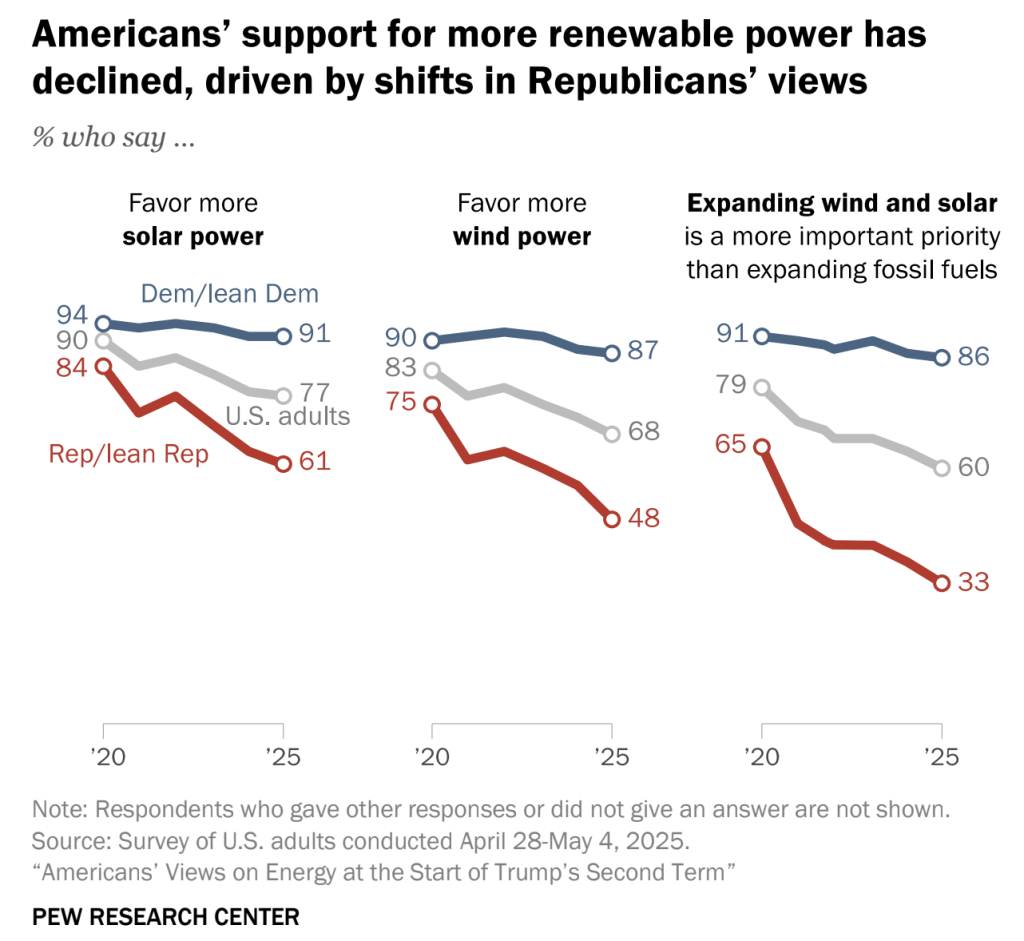
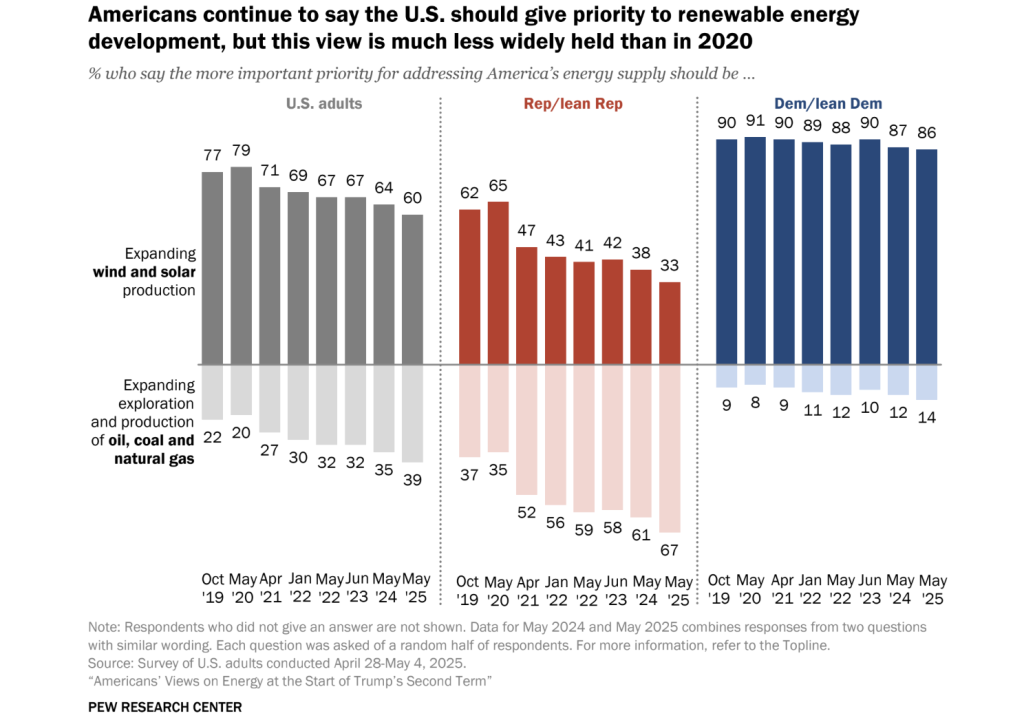
The survey of 5,085 U.S. adults taken April 28 to May 4 revealed that while 79% of Americans favored expanding wind and solar production in 2020, that number has dropped to 60%. And 39% of Americans today support expansion of oil, coal and natural gas — almost double the 20% that supported it in 2020.
Combustion of fossil fuels — in transportation, energy generation and industrial production — is the No. 1 cause of climate change.
Much of the change in opinion is driven by Republicans, whose support of oil and gas grew from 35% in 2020 to 67% today. But Democrats also indicated less support for renewable energy and more for fossil fuels than five years ago.
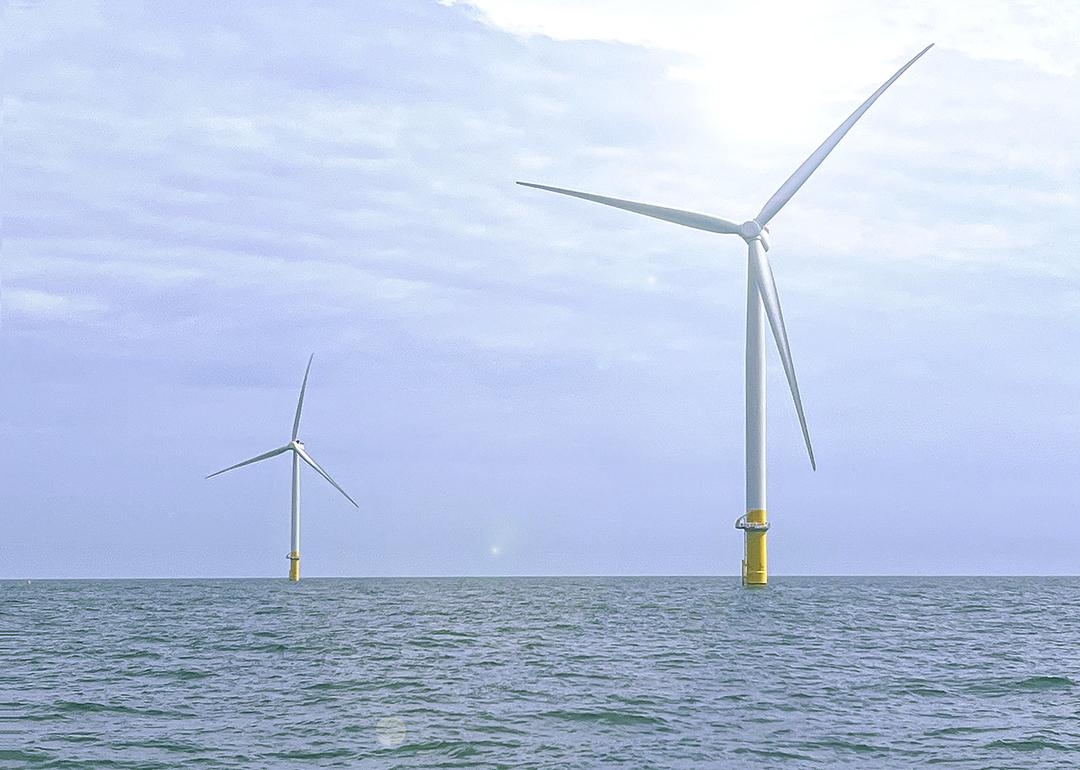
While many results reflect Trump’s policies opposing most renewables and boosting fossil fuels, Pew found a few notable exceptions: 69% of all respondents favor offshore wind — a technology .
Both Democrats and Republicans indicated stronger support for nuclear power, with Republicans’ favorable opinions increasing from 53% in 2020 to 69% in 2025. Democrats’ support rose from 37% to 52%. The Trump administration has signaled , despite its high cost.
There were wide partisan splits on several topics. In March, the U.S. Environmental Protection Agency . Pew asked whether it was possible to do that and still protect air and water quality: 77% of Republicans said yes and 67% of Democrats said no.
Pew didn’t ask the respondents why their attitudes have shifted. But Kennedy said in Pew’s past surveys, Republicans have expressed concern about the economic impacts of climate change policies and transition from fossil fuels to renewable energy sources.
Mike Murphy, a Republican consultant and electric vehicle backer, said when the environmental benefits of clean technologies are touted, it polarizes Republicans. Instead, Murphy said messages should be about pocketbook issues — like lower fuel costs — and jobs.
“It's hard for pro-climate people to understand,” said Murphy, who has advised dozens of state and national GOP campaigns including John McCain’s 2008 presidential bid. “(They think) we just need to shout louder and hit people over the head about climate, climate, climate. The key is you want to talk about jobs and national security and other events that naturally resonate a lot more with right-of-center people.”
That’s what Murphy’s groups, the and the , are trying to do to depoliticize electric vehicles. “Whenever electric cars are seen through a climate lens,” Murphy said, “their appeal narrows.”
It’s a strategy also being used by the , a left-of-center pro-EV group. Ben Prochazka, the coalition’s executive director, echoed Murphy’s strategy, adding that EVs have “become overly politicized and caught in the culture wars, impacting markets and ultimately hurting our ability to realize their many benefits for all Americans.”
Prochazka noted that once introduced to EVs, consumers support them: "EV drivers love their vehicles, with more than eight out of ten reporting that their next car will also be electric."
Perhaps those practical messages are getting through. In the Pew survey, electric vehicles were the one item that saw an uptick in support — 4 percentage points in the past year.
But popular support might not be enough to stop Congress from killing a $7,500 electric vehicle credit, which Murphy said would be “policy disaster.”
Republicans, he said, are in a “real squeeze,” because “they don’t have enough money for the tax cuts the president has promised.”
Murphy said: “It’s easier for Republicans to cut Biden electric cars … than it is for them to cut more Medicaid.”
Gillingham is still optimistic that solar, wind and other greenhouse gas-reducing technologies will move forward — because they are the cheapest.
“The continued decline in the price of renewable energy and battery technologies, as well as other new technologies, is a reason to continue to have hope that the worst impacts of climate change can be addressed,” he said.
Published by ,
is a nonprofit newsroom that investigates the powers stalling climate action.
was produced by and reviewed and distributed by Â鶹ԭ´´.