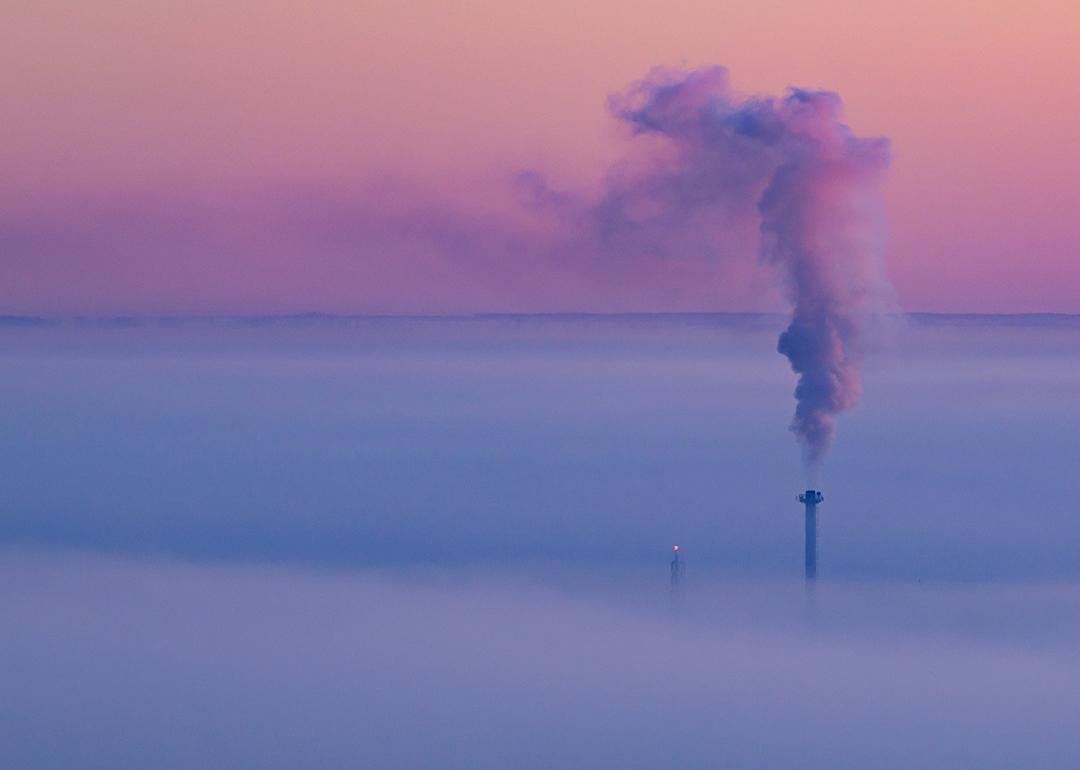
The world turns to energy pragmatism on the path to a new climate consensus
The world turns to energy pragmatism on the path to a new climate consensus
As Dispatch Energy contributor Alex Trembath , talk of emissions reductions at any cost is out, and political and economic realism is in. The only surprise is how long the shift took.
Take Canadian Prime Minister Mark Carney, for example. A decade ago, while governor of the Bank of England, Carney that remaining fossil fuel reserves may become “unburnable” if the world wants to avoid a climate catastrophe. In stark contrast, Carney has in recent months fast-tracked approval of a new liquified natural gas export terminal in British Columbia, to “transform our country into an energy superpower.”
Carney is far from alone. In the United Kingdom, Prime Minister Keir Starmer must soon decide whether to relax aggressive climate targets—including Britain’s effort to rid its energy supply of fossil fuels by 2030—in the face of energy costs. “There is a choice about what price you’re willing to pay for the next [renewables] auction round, which is key to hitting 2030,” a government insider . “If it comes to a choice between hitting the target and overpaying, or missing it and keeping costs down, we will miss it.”
Even in Europe, which has promoted climate policy more than any other bloc, economic realities have crashed the climate party. German Chancellor Friedrich Merz recently the competing economic objectives that accompany an ambitious climate agenda: “None of us are questioning the goal of climate protection. All of us are of the opinion that we must combine this with the competitiveness of European industry.”
But Chancellor Merz is incorrect about the unanimity of European leaders. Earlier this month, Greek Prime Minister Kyriakos Mitsotakis, writing for the , argued in favor of a more pragmatic energy transition. “If we must accept some emissions for a bit longer to save our industries or to maintain social cohesion, so be it,” he wrote. “We must have these debates honestly. We cannot begin with climate neutrality and hope everything else falls into place.”
Mitsotakis walked the talk last week when a European Union proposal to place a carbon fee on shipping emissions. Explaining his opposition to the levy, the prime minister said, “We want to be ambitious about the energy transition, but we must be realistic, not undermine the competitiveness of European industry, and certainly not cause social unrest by imposing unbearable costs on our households and businesses.”
In the United States, much attention has been rightly paid to the Trump administration’s hostility to climate science and outright opposition to solar and wind energy. But the climate conversation has changed among Democrats as well.
For instance, Sen. Chris Coons of Delaware recently that climate is “not a top three issue right now.” Sen. Brian Schatz of Hawai‘i went even further, at a New York Times event last month that costs need to be front and center when talking about energy: “You could talk about the planetary emergency and mitigation and adaptation, and you could throw in some environmental justice rhetoric, and by the time you’re done talking, people think you don’t care about them.” Instead, he added, “The way to victory is to talk about price.”
China reached such clarity on energy and climate years ago. Since 2021, President Xi Jinping has often explained that China should “establish the new before destroying the old,” invoking , who cautioned to “build before breaking.” China’s logic of developing alternative energy technologies before shutting down the energy sources that power our economies has taken hold around the world. Since then, China has to lead the world in many energy technologies.
For decades, conventional wisdom among climate policy elites was that deep decarbonization would be achieved by making fossil energy substantially more expensive—through policies such as taxes, tradable emissions permits, regulation, litigation, and supply-side constraints—thus providing fossil fuel alternatives with an economic advantage.
But there is little evidence that such efforts have accelerated the decarbonization of global or national economies. To the extent that efforts to make fossil energy more expensive have succeeded, when people notice higher priced energy, goods, and services, they do indeed respond—not by becoming champions of wind and solar projects, but by putting on yellow vests to protest, as happened in 2018 following a small increase in a fuel tax, and more generally by voting into office populist candidates who promise lower prices (recent examples include and Italy’s ).
While some people have the means and interest to pay a bit more in support of an energy transition, that willingness is limited, even among the wealthy.
Before the 2024 election, the American Enterprise Institute conducted of how Americans viewed energy and climate issues. It asked if people would support a $40 monthly fee on their energy bills to support climate policies. Large majorities across demographics opposed such a fee; even those making more than $100,000 opposed it by almost three to one. Less than half of respondents favored even a $1-per-month fee.
The economics behind making fossil energy more expensive to motivate energy system transformation works in theory. However, theory fails when it encounters political reality.
The sweetener that was supposed to help citizens swallow the costs of higher-priced energy has always been promises of the avoidance of the “” of climate change. As United Nations Secretary-General António Guterres last year, “The world must pay up, or humanity will pay the price.”
However, science does not always conform to political expectations. Over the past 20 years, projections of massive future carbon dioxide emissions from a world powered increasingly and mainly by coal have , as the world turns toward other sources of energy. Natural gas, solar, wind, and even nuclear energy are . Apart from India and China, global coal consumption peaked almost 20 years ago.
About a decade ago, climate policy advocates adopted increases in global average temperatures as the central metric of climate policy. A 2°C increase above 1850-1900 global average temperatures by 2100 constituted a “dangerous” increase under of the U.N. Framework Convention on Climate Change. Much higher temperature increases by 2100—warming of 4-5°C—were viewed to be both plausible and apocalyptic.
The projections of a global that have underpinned global climate projections for the past several decades have proven unfounded, as coal has fallen out of favor in most places around the world due to its high costs and environmental impacts. As a result, the most extreme temperature increases in modeled futures have become increasingly implausible with every additional year of unfolding reality.
Today, a consensus exists in the scientific community that on our current policy trajectory, the world is headed for less than a 3°C warming by 2100, and such estimates have been revised downward each year. For instance, the Norwegian group that net-zero emissions by 2050 is impossible, but hitting that target later this century is “most likely” with an associated warming of 2.2°C—certainly disruptive, but not civilization-threatening.
Century-scale predictions are always highly uncertain and often wrong, especially when it comes to energy futures. However, the momentum of the global energy economy is such that if most nations were indeed to return to carbon-intensive coal over natural gas, petroleum, nuclear, wind, solar, electrification, and other lower-carbon energy sources, we would have plenty of advance warning. At present, massive carbon dioxide emissions from a coal-dominated future are not remotely plausible.
Rather than welcome the optimistic turn in the scenarios that underlie climate science, climate advocates have chosen to double down on the promised apocalypse. Not long ago, 4°C or 5°C were the thresholds of doom. Today, climate advocates hoping to sustain projected apocalyptic futures have repeatedly lowered the threshold of catastrophe as projected futures have become less extreme. We now see claims that 3°C, 2°C, 1.5°C, and even are the new demarcations of existential threat.
Human-caused climate change is, of course, real and poses risks worth mitigating. However, in a world that has already warmed by 1.5°C without apocalyptic consequences, extreme scare tactics have lost their potency. The rising costs of energy further erode support for expensive emergency measures to reduce emissions.
Climate change is not going to go away, and concerted action to continue or improve upon historical rates of the decarbonization of the economy makes good sense—so long as policies can be implemented in a way that enhances energy security, access, and reliability, and of course in a manner that contributes to growing wealth for people around the world, particularly those who have yet to reach a level of energy services enjoyed by the wealthy.
Effective climate policy is a marathon, not a sprint. The ongoing reset of expectations about energy and climate is an opportunity to reject apocalyptic fatalism and to embrace realism and pragmatism.
was produced by and reviewed and distributed by Â鶹ԭ´´.