Cicadas 脿 la carte? Here's why it's so hard to get Americans to eat bugs
was produced by and reviewed and distributed by 麻豆原创 Media.
Cicadas 脿 la carte? Here's why it's so hard to get Americans to eat bugs
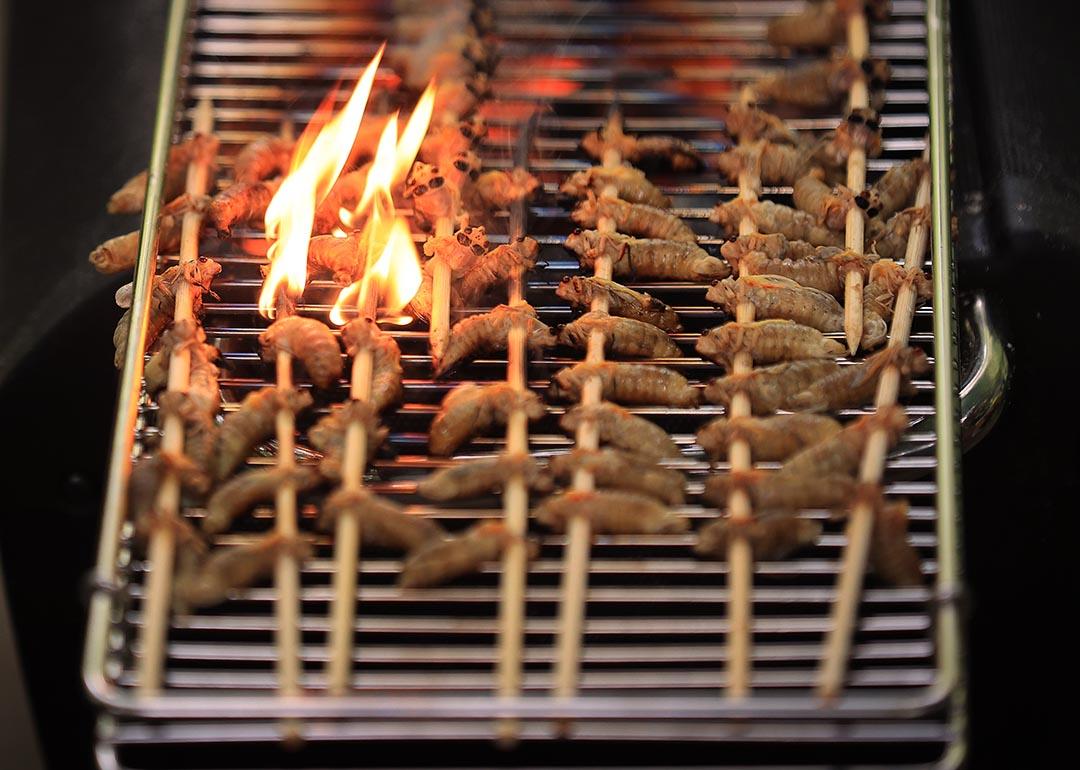
When Cortni Borgerson thinks about the emerging from underground, she sees more than clumsily flying insects flitting from tree to tree in search of a mate. She sees lunch.
Some may find that idea revolting, a belief often, if unknowingly, steeped in colonialism and the notion that eating insects is "." But Borgerson, an anthropologist at Montclair State University, is among those eager to change that perception. She's a big fan of dining on bugs of all kinds, but finds cicadas particularly appetizing. "It's one of the best American insects," she said.
Their texture, she said, is something like peeled shrimp, and their taste akin to what you'd experience "if a chicken nugget and a sunflower seed had a baby." She recommends first-timers cook them like any other meat and try them in tacos.
As reports, Borgerson's not alone in her fascination with edible insects. In the lead-up to this spring's dual-brood emergence, a flurry of cicada , , and have sung the bulky bugs' praises. The interest is part of a growing social movement in favor of alternative proteins among consumers increasingly a more sustainable food system.
"They're this magical-looking insect that crawls up, that people are excited and interested in," she said. "People are more excited about eating it than they might be about other types of insects."
The buzz around this cicada emergence provides an opportunity to break down , Borgerson said. If you ask her, the creatures are more than tasty. They're a sustainable alternative to like beef and an effective way of addressing .
"Some insects have an incredible opportunity, and a potential, to reduce our carbon footprint in a delicious, but sustainable, way," she said.
Roughly 30 percent of the world's population considers insects a delicacy or dietary staple, a practice that goes back millennia. A published earlier this year found that over 3,000 ethnic groups across 128 countries eat 2,205 species of Insecta, with everything from caterpillars to locusts appearing in dishes of every description. These invertebrates are a rich source of , , and . The creatures are most commonly eaten by consumers in Asia, North America 鈥� predominantly Mexico, where people enjoy 450 varieties 鈥� and Africa.
The idea remains a novelty in the United States, where are regularly consumed ( being the most popular). Consumer attitudes, based on old stigmas, remain a hurdle to broader acceptance.
Julie Lesnik, an anthropologist at Wayne State University who beetles, called the "ick" response many Americans have toward the idea a cultural byproduct of .
"Disgust is felt very viscerally and biologically," she said. "So to tell somebody their aversion to insects is cultural and not physiologically programmed is a difficult thing to wrap your head around, because you can feel your stomach turn, you can feel the gag reflex come up if you are disgusted by the idea of eating insects. But disgust is one of the few learned emotions. So we are disgusted by the things our culture tells us to be disgusted by."
Such a reaction also can be a sign of internalized prejudice, she said. Indigenous peoples throughout North America once , a practice European colonists deemed "uncivilized" 鈥� a way to "other" non-white communities and cultural practices. "Is it racist? Yes, simply put," Lesnik said.
The racialized foundation of that ideology has garnered in the wake of viral right wing claims that a . Politicized conspiracy theories 鈥� like the suggestion that Bill Gates will 鈥� are insidious misinformation that Joseph Yoon fights daily.
"The very notion of edible insects, I believe, has people think about the lowest denominator," said Yoon, the founder of Brooklyn Bugs and a chef advocate for the United Nations International Fund for Agricultural Development. "It's for the apocalypse. It's for poor people. It's for marginalized communities in developing nations. And so the very notion of this creates a sense of fear, anger, resentment. Instead of putting insects in a silo because you don't understand 鈥� we can work together to provide solutions for our global food systems."
Eleven years ago, the U.N. Food and Agriculture Organization a promising alternative to conventional meat production. In the decade since, a surge of North American startups have launched to make insects into a primary food source for humans, ( is common), or a feedstock for cattle and . The market for such things in the United States is expected to hit by 2033; globally, the figure is .
Still, for an industry in its infancy, the viability of scaling insect protein into a legitimate climate solution remains a burning question, one Rachel Mazac has studied intently. Mazac, a sustainability researcher at the Stockholm Resilience Centre, is among the scientists who have attempted to quantify the carbon footprint of producing things like crickets, mealworms, and black soldier flies on an industrial scale. So far, she's use of land and water compared to conventional livestock. Although she acknowledges the dearth of data on the subject, Mazac thinks insects warrant further consideration as a feasible alternative to more common 鈥� and carbon-intensive 鈥� meats.
Not everyone sees insects as a climate solution, however. Matthew Hayek, an environmental researcher and assistant professor at New York University, co-authored a 2024 of more than 200 climate and agricultural scientists that showed widespread support for greater efforts by governments and the private sector to incentivize to meat and dairy. But he doesn't believe insects belong on the slate of urgent solutions. Among other things, he questions the environmental impact of feeding them to livestock, and whether the creatures can be raised and harvested humanely.
"It's a worthwhile area of investigation for fundamental science and research and development," he said. "It is not worthwhile as an actual climate solution at a market level for somebody to invest in a climate solution."
Jeffery Tomberlin, an entomologist at Texas A&M University and director of the Center for Environmental Sustainability through Insect Farming, doesn't buy that. He believes every possible alternative protein needs to be on the table because meeting the climate crisis requires reforming the global food system. "We should be looking at all options when we talk about how to be better stewards of our planet," he said. "We need to diversify as much as possible."
Doing that, however, will require consumers and policymakers to put aside old ideas and consider new possibilities. That, Tomberlin said, would prompt the kind of research and funding needed to "safely and efficiently" develop the processing and production practices needed to make insect protein a viable, scalable alternative to other meats. Only then will the idea of eating insects be more than a flurry of trendy headlines, and cicada tacos more than a fleeting novelty.