Hawaiian taro takes root in Oregon
was produced by and , and reviewed and distributed by Â鶹ԭ´´.
Hawaiian taro takes root in Oregon
In the the Hawaiian creation story, the goddess Ho'ohōkūkalani gives birth to a stillborn son, who is buried in the fertile soil. In her grief, she waters the soil with her tears, and a sprout emerges, becoming the first kalo plant. This plant nourishes her second-born son, Hāloa, the first Native Hawaiian.
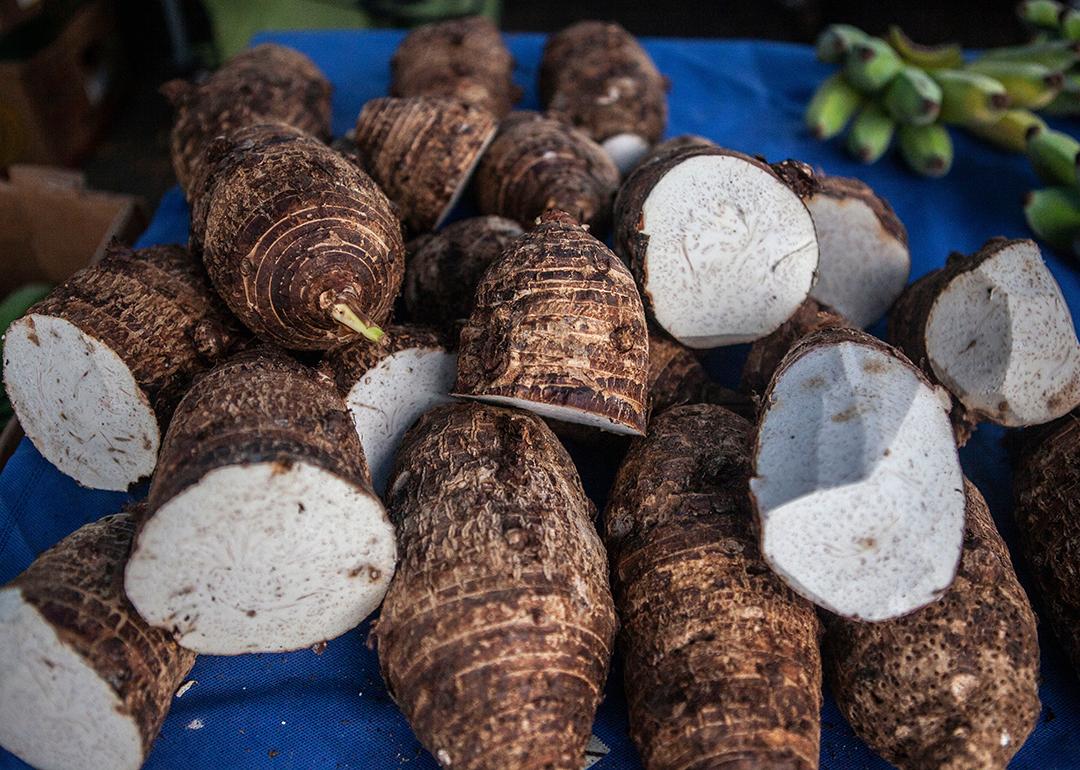
For Native Hawaiians, kalo, also known as taro—a tropical plant prized for its starchy, nutritious, rootlike as well as its leaves—is but an ancestor, symbolizing a lasting and reciprocal connection to land. As a staple crop, kalo has sustained Pacific Islander cultures for generations.
Now kalo has sprouted thousands of miles from its ancestral home in the Portland, Oregon, metropolitan area, where a growing Native Hawaiian population resides. The land for the garden—or māla, in Hawaiian—started with just 6 square feet but has expanded exponentially, with multiple locations. What these gardens produce is more than just food and a bond with Indigenous culture; it is a thriving community, the and report.
"We give a safe space for our Hawaiian families," said Leialoha Ka'ula, one of the garden project's founders, describing its greater purpose. "It [is] also food sovereignty, that relationship to ʻāina, or land. It's a place of healing."
Ka'ula, like many Native Hawaiians and Pacific Islanders (NHPI), left the islands due to the high cost of living there, combined with low wages and lack of jobs and housing. It's part of a that followed the of the Hawaiian Kingdom in 1893 and declaration of statehood by the U.S. in 1959. Then as now, emigration is fueled by unaffordable living costs, low-wage jobs, and a housing crisis , luxury development, and an influx of mainlanders.
In 2020, the U.S. Census reported that, for the first time, more Native Hawaiians live in the continental U.S. than they do in Hawaiʻi, with Oregon having nearly . Many in the diaspora long for stronger ties to their home and cultural identity.
According to , the relationship with kalo is binding, and without it, Native Hawaiians lose vital connections to their culture and mana, a Hawaiian term for spiritual and healing power. But growing kalo is not as easy as just planting it in the ground. Cultivation took years of effort and help from multiple hands.
Land Access and Indigenous Blessings
Born on Oʻahu and raised on Hawaiʻi Island, Kaʻula was steeped in Hawaiian culture through her family. Her grandmother introduced her to the Hawaiian language when she was little. Wanting to continue those studies, she attended a Hawaiian immersion charter school, where she also learned cultural practices like hula, chanting, and the traditional farming methods of her ancestors, including how to grow kalo.
Kaʻula came to the Pacific Northwest in the early 2000s to study psychology at Washington State University and eventually settled in Beaverton, Oregon. From her first days in Washington, Kaʻula dreamed of growing kalo there, but accessing land was a challenge.
Meanwhile, she started a in Beaverton to help carry on the traditions of her elders. She also helped found , one of several such clubs across Hawaiʻi and the continental U.S. promoting Native Hawaiian culture, advocacy, and community welfare after the .
Kaʻula envisioned growing kalo through the Civic Club as a part of a new youth program, but it wasn't until she met Donna Ching, an elder at the hula academy, that plans began to take shape. Ching, also Native Hawaiian, served on the board of the (OFB), which has gardens where immigrant communities can grow culturally important foods. Ching helped secure a modest plot for the youth program in the Eastside Learning Garden, in Portland—and the kalo project was born.
The next step was to ensure a blessing for the māla. KALO HCC invited Portland-area Indigenous community organizations like the and to request permission to grow native Hawaiian plants on local land.
The ceremony and took place in August of 2021. After chanting and prayers, NHPI youth from the club tossed in handfuls of rich, black soil and planted dozens of baby kalo, already sporting several tender, heart-shaped leaves. The elders in the community watered the bed. Especially for those who had left the island many decades earlier, it was monumental to see kalo being planted in Oregon.
The First Harvest
In the first season, KALO HCC harvested 25 pounds of kalo leaves, called lau, which are used for food, medicinal purposes, and ceremonies.
For her role in procuring the land, Ching was given the first harvest to make lau lau—a traditional Hawaiian dish of fatty pork or butterfish along with vegetables, all wrapped in kalo leaves and steamed. The kalo leaf softens in the process, adding an earthy flavor. The leaves are also an ingredient in other dishes like squid lūʻau. The roots, technically called corms, were left to keep growing beneath the soil; they are used to make poi, a nutritious mash that has been a dietary staple for centuries.
"I haven't made lau lau since I left home, because [lau is] really hard to find here," Ching said. "When you think about how more of us now live on the big continent than in Hawaiʻi, if we move and we don't take some of that 'ike—that knowledge—with us, or find a way to grow [it], we're going to lose it."
Due to the garden's success, Oregon Food Bank allotted an additional 75-square-foot space to plant the following year. KALO HCC harvested 500 pounds of leaves, most of which were distributed to community members for free. They were also able to hire one paid staff member to help take care of the māla, thanks to a partnership with , an international youth-led grassroots network led by Pacific Islanders to address climate change.
Now the garden produces other crops, too, including carrots, mānoa lettuce (a variety developed in Hawaiʻi), bok choy, and kale, all of which are eventually given to community members. The garden holds weekly work parties, and some 160 volunteers from diverse backgrounds help out over the course of the year, raking mulch, weeding, fertilizing, and harvesting.
One volunteer drives monthly from her home in Olympia, Washington, nearly two hours away.
"It's worth every mile," said Nicole Lee Kamakahiolani Ellison, who also serves on the board of KALO HCC. Ellison left the islands when she was 8 and grew up in Las Vegas. She is a project manager with IREACH at Washington State University, a research institute that promotes health and healthcare equity within Indigenous and rural populations.
Ellison got involved with the garden a year ago while working on a project with Ka'ula about Native heart health. She said she didn't believe kalo could be grown in Oregon's climate.
"You go down [to the garden] and you're not in Portland anymore," Ellison said. "It's like you're somehow transported back home on some weird magic carpet ride." She added that a bonus of volunteering is connecting with the kūpuna (elders) who also volunteer, as well as hearing the sound of pidgin, .
Caring for Kalo
On the islands, kalo, a —one of the plants carried to Hawai'i by the first Polynesian voyagers—is grown in both (or upland) and wetland environments, the legacy of that ran from the mountains to the sea in land divisions called ahupua'a. (Those traditional systems for kalo, once central to Hawaiʻi's agriculture, were displaced by private land ownership, the sugar industry, and the overthrow of the Hawaiian kingdom.) Wetland taro is routinely flooded; dryland kalo doesn't require that, but needs regular rain and humidity. Optimal temperatures for kalo are in the 70 F to 90 F range.
Planting in the Portland dryland garden typically starts in the spring, with the kalo leaves and corm maturing in about nine months. The garden uses primarily an Asian strain of kalo, but also includes descendants of cuttings from Oʻahu, Mauʻi, and Hawai'i Island. The kalo in the Oregon dryland garden is adapting well to its new location and growing strong.
Kaʻula said the club members have learned they can grow garlic to keep the soil warm, which accelerates the kalo's growth in the spring. They also leave the kalo corm, the starchy root of the plant, in the ground during the winter, where it multiplies. One root can quickly turn into 10, she said. For now, the group is electing not to harvest the corms so that they continue to grow.
This winter, they put a dome over the kalo plants to see if they would last through the freeze—which they did. Now the KALO HCC can have kalo year-round, just like in Hawaii.
Native Hawaiian Foods and Health
The success of the māla comes at a time when it may be needed most. Recent data shows that nearly of the NHPI in Oregon lives below the poverty line. The food bank has taken hits from the recent federal funding cuts, losing 30 truckloads of food due to the Department of Agriculture's food-delivery cancellations across the U.S., and said they have already seen a in visits to their locations compared with the previous year.
"Our [cultural] diets are healthy, but food is expensive, and when it's expensive, many move away from that diet to something more affordable—and a lot of that affordable food is not healthy for us," Ching said.
In October 2023, KALO HCC published an about their Portland kalo project, describing how establishing the māla in the continental U.S. connected people to the land, improved their mental health, and created a sense of place for Native Hawaiian community members. The paper also suggests that the garden, through cultural foods and practices, might improve health outcomes overall.
"Culture is health, is what we're trying to argue," Kaʻula said. "Sometimes people say that traditional healthcare aligns with the Western models, but we're trying to say no, we want indigenous healthcare. Can we get the FDA to approve poi as medical support? Can we get the FDA to approve kalo as a supplement, and how can we ensure better access to all of that?"
KALO HCC is currently conducting another study, this time through clinical trials, in hopes of finding the connection between traditional foods, physical health, and emotional well-being. For this study, they are working with Oregon Food Bank and Oregon's Pacific University to collect and analyze data. Native Hawaiians and other Pacific Islanders living in the U.S. have some of the , hypertension, asthma, cancer, obesity, and diabetes in comparison with all other ethnicities. ties these poor health outcomes to colonization and historic inequities, multigenerational trauma, and discrimination, as well as poverty, lack of housing, education, and environment.
"[From] what we see in other Native communities, their views of food and how it relates to health is huge," said Sheri Daniels, the CEO of , a Native Hawaiian health organization that advocates for the well-being of Native Hawaiians through policy, research, and community initiatives. Daniels said that providing data can be challenging, but offering resources and opportunities for people to improve self-esteem and strengthen cultural identity are always possible, and can yield insights, too.
"The cool thing about kalo is that you get to build community, you get to meet and see others who might be in the same [emotional] space as you, trying to establish that bond of what it means to be Hawaiian," she added.
As of this March, new kalo plants had already started sprouting through the soil. They will triple in size in a month, providing more nourishment to the local community in the upcoming year. KALO HCC has also created additional māla at Pacific University, where 25 percent of the student body is Native Hawaiian, and at schools in Tacoma, Washington, and within the Beaverton School District.
"Everything that our lāhui (community), our aliʻi (royalty), and our kūpuna (elders) did was never about one person," Kaʻula said. "It was about, how does it trickle down? How does it create a unified community?"
Co-published by Economic Hardship Reporting Project and Civil Eats.