Homes on the range: Is a federal affordable housing policy leading to a public lands selloff?
For staffers at conservation groups like The Wilderness Society and Defenders of Wildlife, the daily routine often involves tracking congressional legislation and executive branch actions that, in some cases, look like trouble, reports. In the early months of the second Trump administration, for example, radical changes started happening fast—among them, the DOGE-powered Valentine’s Day staffing cuts at the National Park Service and the U.S. Forest Service.
During this period, a different proposal emerged that didn’t get nearly as much attention from the media and public, but it sounded like a cause for concern. It centered on a Trump administration push to add a new category of “multiple use” to the traditional menu of mining, grazing, and timber harvesting: the construction of affordable housing.
On March 16, 2025, the secretaries of the Department of the Interior and the Department of Housing and Urban Development announced the creation of a “.” In a Wall Street Journal op-ed co-written by secretaries Doug Burgum (DOI) and Scott Turner (HUD), the concept was described as a common-sense way to free up “underutilized” federal acreage—by “transfers or leases”—for the construction of new, affordable housing. It was headlined “Federal Land Can Be Home Sweet Home.”
“Under this agreement,” they wrote, “HUD will pinpoint where housing needs are most pressing and guide the process by working with state and local leaders who know their communities best. Interior will identify locations that can support homes while carefully considering environmental impact and land-use restrictions.”
“This isn’t a free-for-all to build on federal lands,” they said, “although we recognize that bad-faith critics will likely call it that.”
Critics have indeed called it that, partly because Senator Mike Lee—a Utah Republican who’s one of the most vocal public-lands foes in Congress—has spent years pushing the same idea. Lee, notably, has shown in affordable housing when it’s not connected to the sale, lease, or giveaway of public lands.
The op-ed by Burgum and Turner didn’t go into detail about where new housing might be placed. Nor did the official (MOU) between the two agencies, which required that the task force “meet quarterly to review progress [and] identify land transfer opportunities.” But Jon Raby, the acting director of the Bureau of Land Management (BLM), offered a few more specifics in an interview published on March 24, 2025, by the online site Bloomberg Law. (Raby is still acting director of the BLM, pending Senate confirmation of nominee Steve Pearce.)
Raby said the task force had identified sellable lands that, as Bloomberg phrased it, are “within a radius of up to 10 miles of all cities and towns with a population greater than 5,000 people.” The story explained that the amount of BLM land potentially in play is significant—625 square miles, an area larger than the city of Los Angeles.
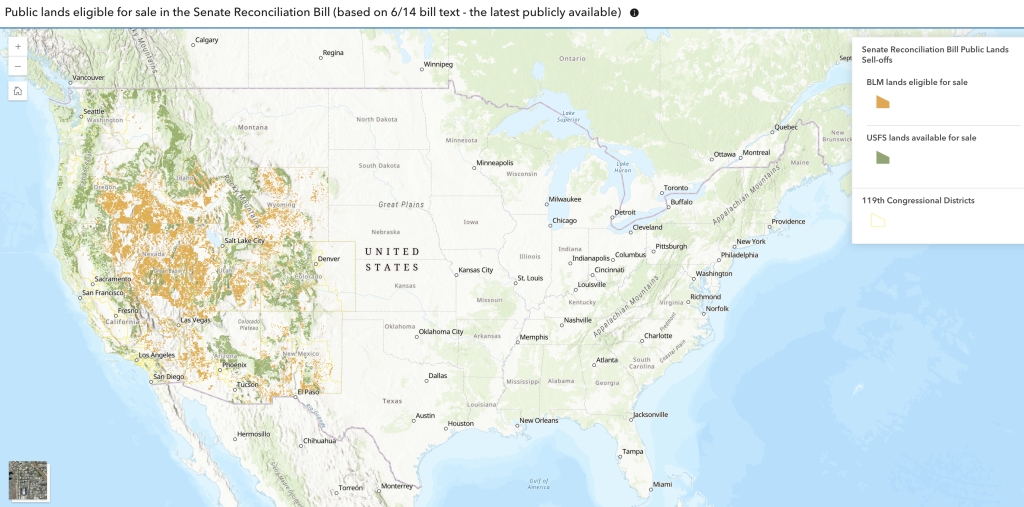
Staffers at The Wilderness Society saw this and decided to map what a 10-mile radius would look like—an effort that was in progress last May when a more immediate problem emerged. As part of a budget reconciliation bill under consideration in the U.S. Senate, Lee and his allies were backing a proposal to sell off as much as 3.3 million acres of BLM and Forest Service land for development, which included using BLM lands near urban areas to build housing.
The Wilderness Society shifted its attention to this, creating an that went viral, helping to touch off a firestorm. In late June, Burgum traveled to Santa Fe to deliver a speech at the annual meeting of the Western Governors Association. In his remarks, according to one report, he “referred to federal offshore and land holdings as ‘the largest balance sheet in the world.’”
Outside the conference venue, 2,000 people showed up to protest; similar demonstrations occurred elsewhere in the U.S. In addition to expected pushback from environmental groups, the reconciliation language drew flak from hook-and-bullet nonprofits like the and even from a few conservative Republican legislators, including , a Montana congressman who served as Interior Secretary during Trump’s first term.
The Wilderness Society’s map helped fuel all this: 1.87 million people clicked on it, and its reach was expanded by social media shares and coverage in more than 900 news articles. Ultimately, Senate Republicans blinked, and the sell-off language was stripped from draft legislation that was later passed as the One Big Beautiful Bill Act.
After the hubbub, what became of the housing task force? There haven’t been any recent public pronouncements on that front, but the concept certainly doesn’t appear to be dead. On April 7 of this year, Burgum and Raby were in Las Vegas for a series of events that included Nevada’s governor, Joe Lombardo, a longtime advocate for the construction of new affordable housing in the city—and for the idea of building it on repurposed federal land.
“Lombardo has repeatedly urged the federal government to release Bureau of Land Management land in the Las Vegas Valley to local governments, for use in affordable housing,” a local news report said. “In order to get land, it must be ‘nominated’ by a local government, assessed and then approved before it can be transferred and construction can begin.”
During this swing, Burgum said “multi-use” of federal lands should include “mining and grazing and timber and housing. It was meant for those things. It’s America’s balance sheet and we’ve got to get the appropriate return on it.”
Meanwhile, whoever is in charge may have just missed an April 15 deadline for releasing an annual report that’s required by the original MOU between Interior and HUD. RE:PUBLIC requested updated information about the task force from DOI, HUD, and the BLM. None of these agencies responded.
At our request, The Wilderness Society’s science team recently updated its , which includes BLM land but excludes protected areas like national parks. In the task force’s MOU, the blanket term “federal lands” is used, making it reasonable to assume that Forest Service property would also be part of the mix. That’s on the map as well. The MOU does not mention the 10-mile radius—thus far, Raby’s comments are the only source for that.
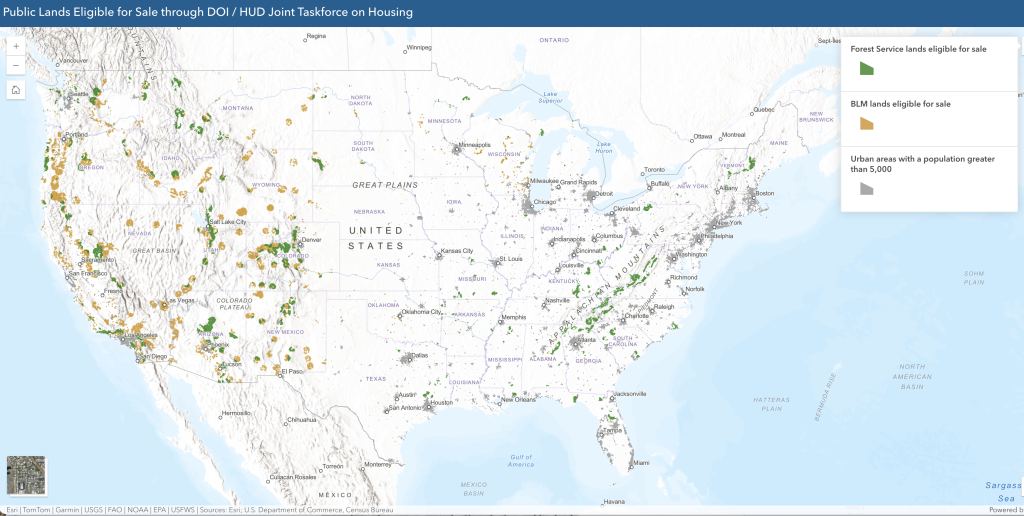
Open the map, and you’ll see why Nevada’s governor is salivating about the possibilities in Las Vegas—in every direction, large BLM parcels lie close to the city limits.
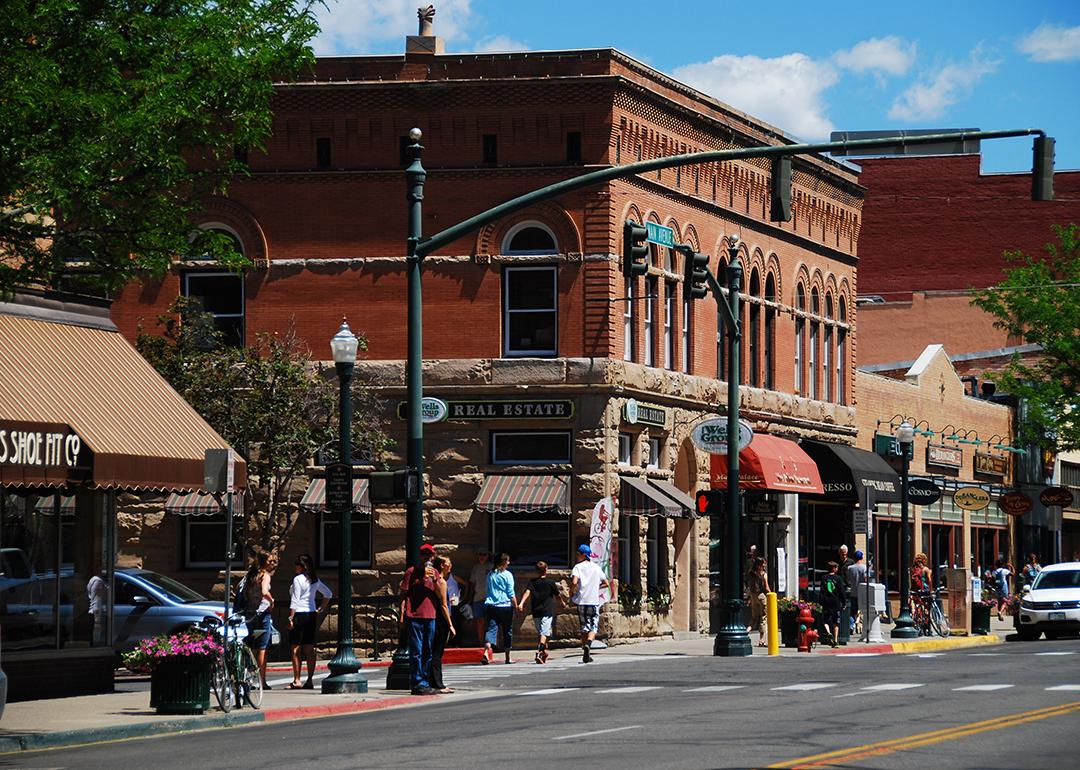
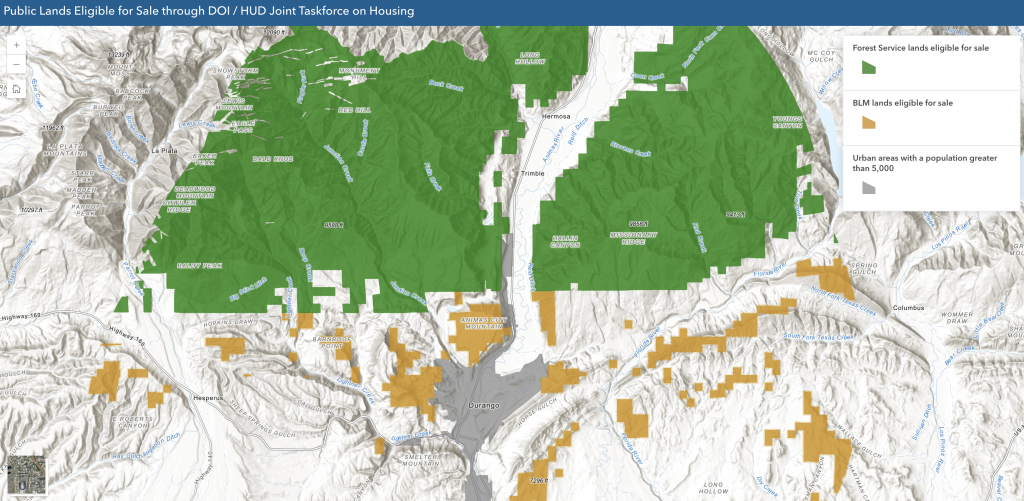
As a case study, we also chose to zoom in on Durango, Colorado, population 21,000, a typical small, outdoorsy city and the hometown of Michael Carroll, BLM campaign director for The Wilderness Society. Take a look, and you’ll see a few pieces of BLM land in the immediate vicinity, along with a huge semicircle of Forest Service land north of town.
On a map like this, these areas look like colorful abstractions, but to a local like Carroll they take in cherished stomping grounds that are a big part of what make the city special.
“When you draw that radius around this community,” he says, “it contains some of our most coveted trail systems and recreation spots—places where people take their family to go on a picnic or hike, or to take the dog out after work.” In Durango, he says, that 10-mile ring includes trail systems like Animas Mountain, Sailing Hawks, Horse Gulch, and Twin Buttes. “And that’s just within the city limits.”
Transfers of federal land in the West aren’t unheard of, but when they do happen—whether they’re for something like a water project, a new road, or some kind of housing—The Wilderness Society isn’t automatically opposed if they fill a clear public need. Such proposals are tracked and scrutinized internally by the group, which recently endorsed a bill called the Crystal Reservoir Conveyance Act.
This legislation was co-sponsored by Representative Jeff Hurd, a Colorado Republican, and Senator Michael Bennet, a Democrat. The goal is to transfer, at no cost, 45 acres of Forest Service land that’s home to a reservoir near the alpine town of Ouray. The plan is for the city to take over, refurbishing the reservoir to boost the local water supply.
Carroll, ticking off things The Wilderness Society thinks this legislation does right, says the bill requires local officials to maintain the land as public open space, prohibits new development or commercial use, and includes a “reversionary clause” that could give ownership back to the federal government if the city “fails to comply with these conditions.”
The common denominator here, he says, is following the law, working with local communities and making any land transfer proposals transparent and clear while building in safeguards that have a clear public benefit.
As a bottom line, Carroll points to a shared principles endorsed by 75 national, state, and local public lands organizations during the federal budget reconciliation fight last year. The document argues that “public land conveyances must be rare, transparent, accountable, and rooted in place-based needs that serve a compelling public interest.” Unfortunately, as Carroll knows, not all legislators or federal managers share these ideals.
One example is playing out right now in Oregon, where Republican Congressman Cliff Bentz introduced a bill that would transfer 500 acres of Mount Hood National Forest to The Dalles, a city of 16,000 on the Columbia River. The stated purpose is to allow the city to expand a reservoir that’s crucial to providing enough water for future urban growth. In January, Oregon Public Radio took a deeper look and made a convincing case that the real motive is to provide water for .
“The notion that this water is somehow for drinking water for residents, it’s just a fallacy,” John DeVoe, senior advisor at WaterWatch of Oregon, told OPR. “Obviously, the great driver of demand for water in The Dalles is Google.”
The bill is currently under review by the Senate Committee on Energy and Natural Resources.
In Texas, the U.S. Fish and Wildlife Service has proposed doing a land swap with SpaceX—the commercial space transport company founded in 2002 by Elon Musk—that would have adverse impact on the Lower Rio Grande Valley National Wildlife Refuge, a series of habitat tracts along the final 150 miles of the Rio Grande River.
According to Defenders of Wildlife, which opposes the swap, the refuge is home “to at least 18 threatened and endangered species,” including “all five species of sea turtle found in the Gulf of Mexico.”
The proposed exchange involves giving 712 acres of refuge land to SpaceX in exchange for a smaller amount of land: 692 acres, some of which would be given to a different national refuge nearby, Laguna Atascosa. According to the government’s Draft Environmental Assessment, the land taken from the Lower Rio Grande Valley refuge would be used for “residential, commercial, industrial, and infrastructure purposes.” That is: construction.
Nathan Marcy, senior federal lands policy analyst for Defenders of Wildlife, points out that land exchanges are allowed under the law that created the national refuge system: the National Wildlife Refuge System Administration Act, which uses the phrase “suitable for disposition” but doesn’t define it. In Defenders’ view, it’s not at all suitable to trade away land vital to the health of this refuge, and they contend that this swap ignores that responsibility.
“The refuge is strung out along the river—it’s a long corridor,” Marcy says. “The primary management goal of the refuge is to protect and restore habitat. This 712 acres would cut a big chunk out of that corridor, severing it permanently.”
A public comment period on this exchange just ended. If it’s approved by Fish and Wildlife, Defenders has the option of pursuing litigation.
Finally, in Jackson, Wyoming, a local group called the Jackson Hole Community Housing Trust is hoping to build 36 rental units on a 3.15-acre parcel that’s currently part of the Bridger-Teton National Forest. This project—which has no connection to the HUD-DOI task force—is aimed at providing affordable rentals to a mix of U.S. Forest Service staff and private-sector employees who live in Teton County.
According to a report in a public interest nonprofit, the proposal has drawn both local support and opposition. One argument against it is that a project like this should be designed only to include federal employees as renters.
In the summer of 2025, The Wilderness Society submitted Freedom of Information Act requests to learn more about the Joint Task Force on Federal Land for Housing. To obtain even a partial release of records, its lawyers had to file litigation against the DOI, HUD, and the BLM earlier this year. The documents released so far, Carroll says, show little sign of engagement with “local leaders or community groups” as required by the MOU.
The documents do show, as reports, “that President Donald Trump’s Interior Department shared research with the Senate Energy and Natural Resources Committee, which Lee chairs, and helped craft talking points that Lee used to pitch his controversial proposal.”
They also reflect interest in building homes in Las Vegas. During a meeting held there last May, a Florida-based manufactured-home builder called PLAD—which stands for Personalized Luxury Adaptable Dwellings—was on hand as a possible vendor.
While advocates wait to see if the task force comes back to life, Carroll and others are watching and waiting—among other things, for the release of more than 1,200 pages of records still in the hands of the DOI.
“Any administrative or legislative proposal for the use or disposal of public lands for affordable housing needs to have requirements that the land never fuels speculative development,” he says. “Unfortunately, the administration seems to want to draw circles around cities and towns and put a for sale sign on all the federal lands inside it. Blunt approaches like this could cost communities their favorite trails and open spaces—and more than likely won’t address the communities’ affordable housing needs.”
contributed interactive mapping to this story.
was produced by and reviewed and distributed by Â鶹ԭ´´.