What 37 election experts say could disrupt the 2026 elections
There are always unanswered questions heading into any election. But usually those questions are more along the lines of 鈥渨ho鈥檚 going to win?鈥� and less 鈥渨ill the federal government interfere with the election?鈥�
But here in 2026, President Donald Trump鈥檚 broadsides against the legitimacy of U.S. elections and efforts to overhaul election laws have generated lots of uncertainty 鈥� 鈥� about whether this will be a normal election year. Election officials and voters alike are left to wonder whether there will be new requirements for voters, physical interventions at the polls, or attempts to overturn results after the fact.
Despite seemingly endless speculation, no one knows for sure how likely any of these things is. But to get the most well-informed assessments, it helps to turn to the people who spend the most time thinking about elections.
asked 37 experts in the field of election administration 鈥� academics, lawyers, former election officials, etc. 鈥� to answer 26 questions about the likelihood of various scenarios coming to pass in the 2026 midterms.
Their answers reflect a general sense of cautious optimism about the most dire scenarios 鈥� such as an election getting overturned 鈥� and skepticism that the federal government will successfully change voting rules. But they also still believe the election will face serious challenges, including federal agents potentially showing up at polling places.
About this survey
For the data in this article, Votebeat surveyed 37 election experts between Feb. 11 and March 11, 2026. This is not a scientific poll; respondents were disproportionately white, male, and moderate or liberal. However, for most questions, there were in how people responded.
Election experts say new federal laws are unlikely, but split on state laws and court intervention
Since retaking office in 2025, Trump has pushed aggressively for the federal government to set more rules around how elections are run, that would require registering voters to and issuing . (The first executive order has largely been , though the administration has appealed. The second is currently , and the conventional wisdom is that it will be halted as well.)
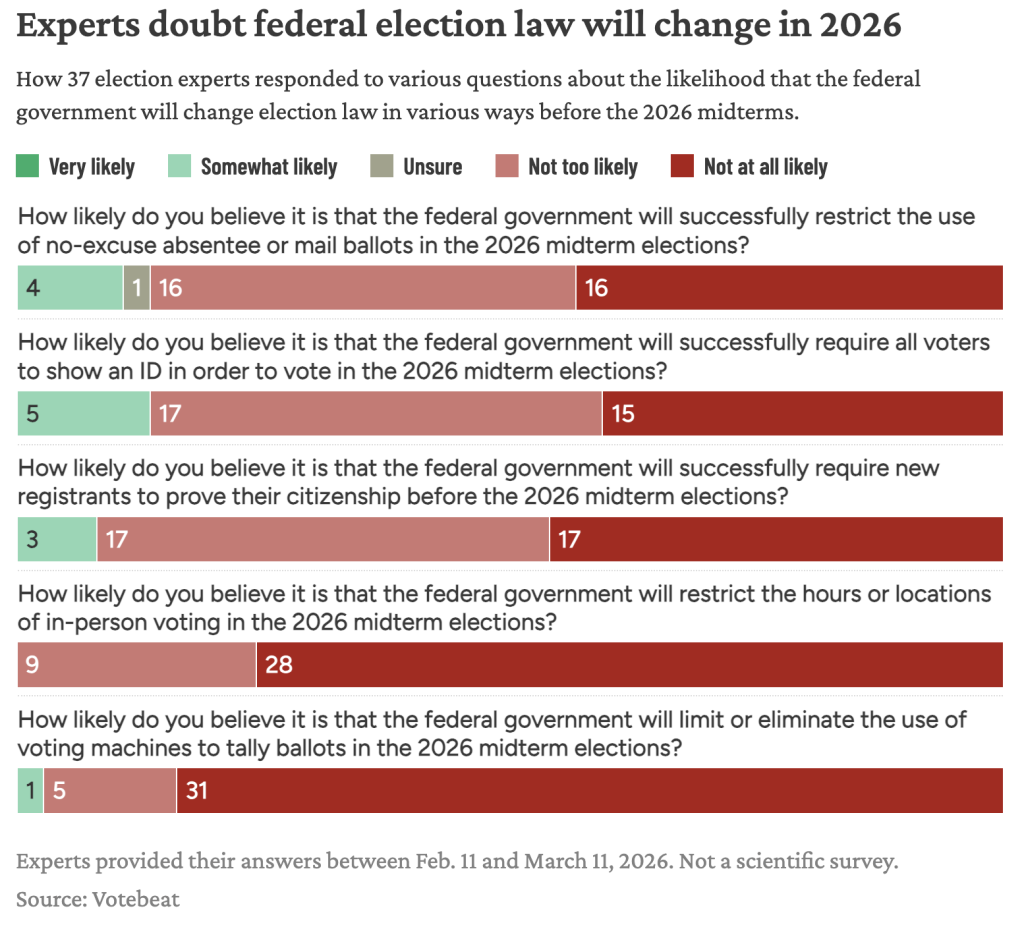
However, experts were skeptical that these measures would ever take effect. Thirty-four of the 37 respondents said it was unlikely that the federal government would successfully require new registrants to prove their citizenship for the midterms, and 32 said it was unlikely that the federal government would successfully require all voters to show an ID or restrict the use of no-excuse absentee or mail ballots. (They provided their answers before Trump issued his second executive order, which sought to .)
Likewise, virtually all respondents thought it was unlikely that the federal government would restrict the hours or locations of in-person voting or limit or eliminate the use of voting machines to tally ballots in the midterms.
However, experts were more open to the possibility that some of these policies could . Although none thought it was likely that a significant number of states would limit or eliminate the use of voting machines, about a quarter of respondents thought it was at least somewhat likely that a significant number of states would restrict the use of no-excuse absentee or mail ballots in the midterms. About one-third thought it was at least somewhat likely that a significant number of states would strengthen their voter ID requirements or restrict the hours or locations of in-person voting.
Even more respondents, 15 of the 37, thought it was at least somewhat likely that a significant number of states would pass proof-of-citizenship requirements before the election 鈥� perhaps unsurprisingly, given that such laws were working their way through several state legislatures at the time. Those laws have since passed in , , , and , although Florida鈥檚 does not take effect until 2027 and Mississippi鈥檚 is limited in scope.
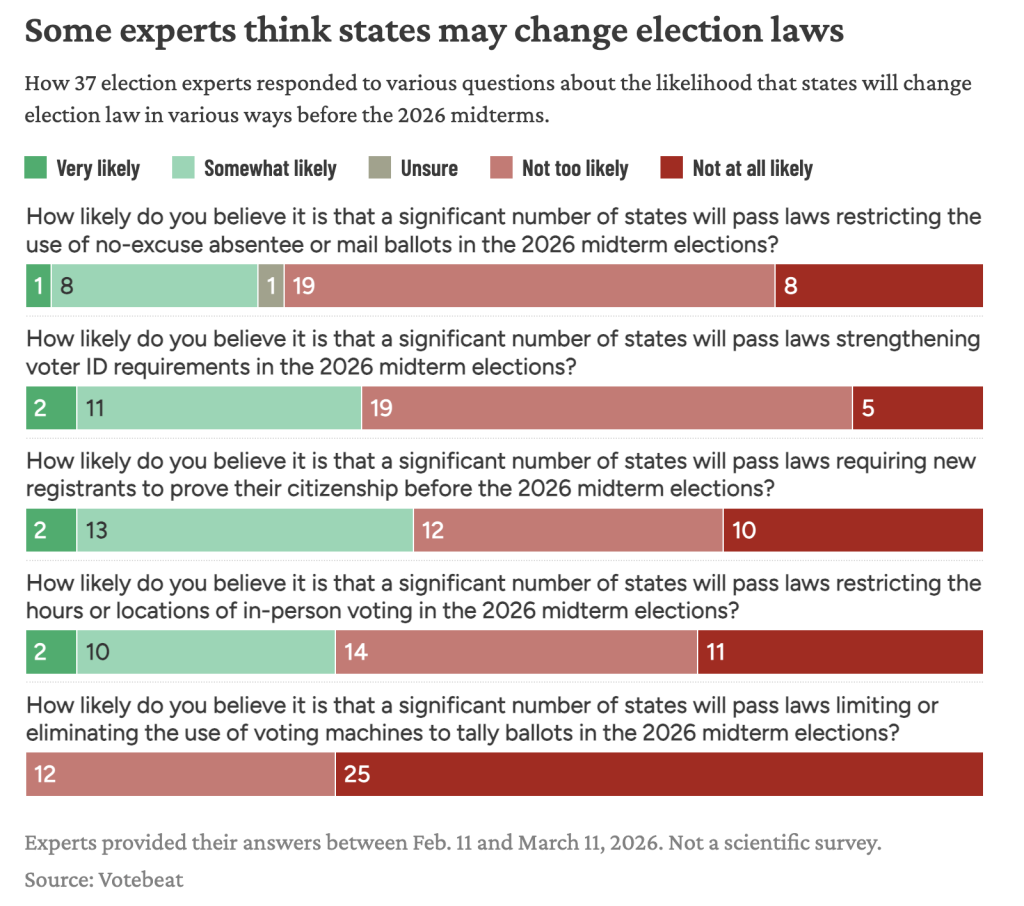
Overall, though, most experts didn鈥檛 expect states to significantly change their election laws this year. Derek Muller, an election law professor at the University of Notre Dame, pointed out that many states have part-time legislatures that won鈥檛 be in session between now and the election. 鈥淚 expect new legislation in the months ahead that might affect the 2026 election to be negligible,鈥� Muller said.
If there are going to be major election-law changes before the midterms, experts expect them to come from the third branch of government: the judiciary. Seventeen experts said it was at least somewhat likely that pre-election court rulings would significantly alter election rules shortly before the midterms, although 19 still said that was unlikely.
In follow-up interviews, those who thought this was likely said that they were keeping an eye both on currently pending cases 鈥� such as a that could require all mail ballots to arrive by Election Day 鈥� and those that have not yet been filed. That said, a Supreme Court ruling earlier this year will to bring any cases challenging election rules well before the election, making last-minute rule changes less likely.
Experts expect federal agents to disrupt the 2026 election
For many election officials and voting advocates, the nightmare scenario for the 2026 midterms is if federal agents, such as U.S. Immigration and Customs Enforcement, attempt to disrupt voting or the counting of ballots. It鈥檚 already illegal for , and the Trump administration has repeatedly said that to polling places this year. However, new Secretary of Homeland Security Markwayne Mullin has to absolutely , and a majority of the experts surveyed expected something like this to happen.
Twenty-seven of the 37 respondents said it was at least somewhat likely that the federal government would deploy some form of military or law enforcement at or near polling places in the midterms. A slight majority said it was likely that Trump would ask the National Guard or federal agents to seize voting equipment during the election, and over three-quarters said it was likely that Trump would ask them to seize voting equipment after the election. (It鈥檚 worth noting that respondents gave these answers just a few weeks after the , and Trump said that he to seize voting machines after the 2020 election.)
Multiple respondents told Votebeat that the seizure of voting equipment was more likely after the election because the election results will be known at that time. 鈥淏efore the election, no one will know where seizing equipment or ballots could shift pivotal races,鈥� said Christopher Mann, the research director at the Center for Election Innovation and Research. 鈥淎fter the election, a bad actor will have a better picture of where seizing voting equipment or ballots can shift the overall outcome.鈥�
Twenty-eight experts said it was at least somewhat likely that there would be physical threats to voters or polling places in the midterms, including 11 who said it was very likely. (They were perhaps recalling 2024, when forced some polling places to close temporarily, though election officials were able to minimize disruptions to voting.) However, experts were divided on whether these threats would deter people from voting. Twenty-one experts said it was unlikely that a significant number of voters would decide not to vote because of threats or physical intimidation, while 16 said that was likely.
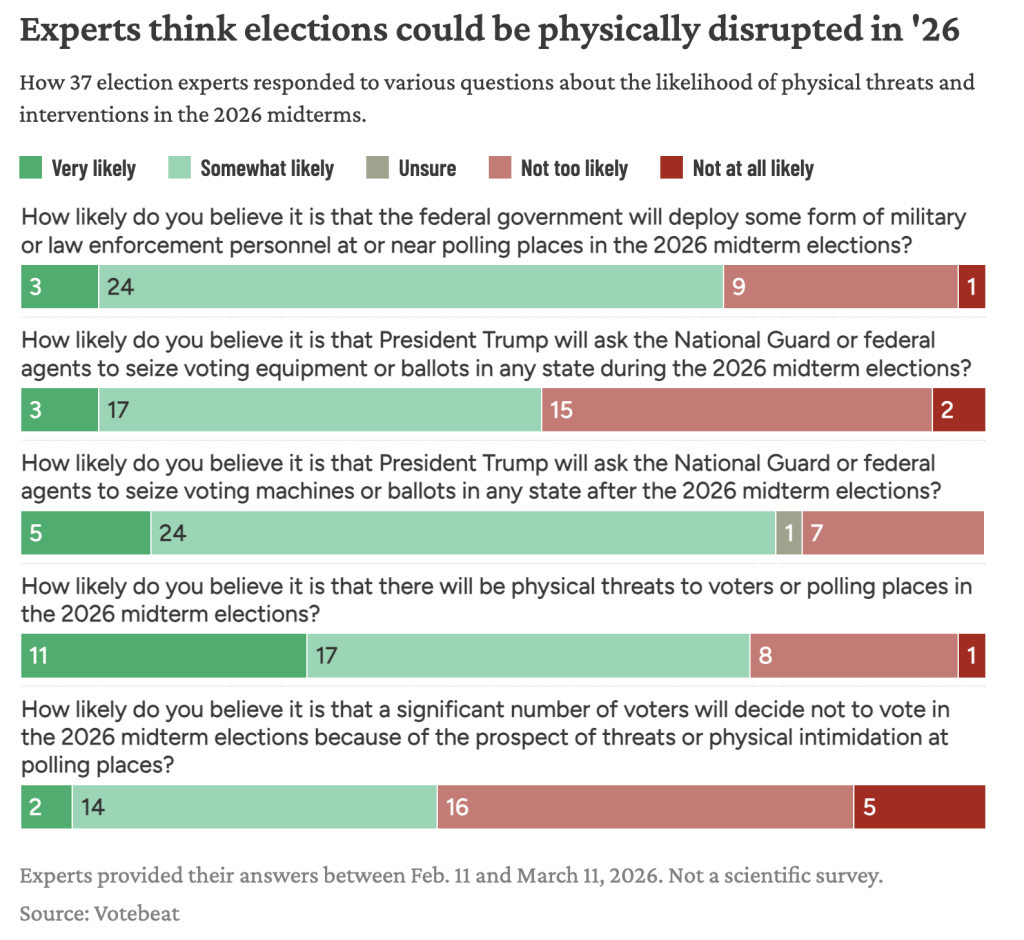
Notably, experts were not very confident about their predictions about armed intervention in the midterms. Some also pointed out that, even if it鈥檚 likely that Trump might order federal agents to interfere in the election, that doesn鈥檛 mean they will succeed. 鈥淓lection officials, courts, and other state and local officials are going to stop any attempt to seize voting equipment or ballots,鈥� Mann predicted.
And some experts emphasized that even if there are incidents at specific polling places, they expect the election overall to run smoothly. 鈥淚鈥檓 an optimist, which probably led to many of my answers,鈥� admitted Jeff Greenburg, a retired election official in Pennsylvania and a senior adviser at the Committee of Seventy, a Philadelphia-based government watchdog group. But Greenburg said he doesn鈥檛 expect that physical threats to voting 鈥渨ill significantly impact elections nationwide. I have faith and trust in our election officials, as well as the rule of law, and believe in the end every vote cast will be counted.鈥�
Losers may claim fraud, but it鈥檚 unlikely an election gets overturned
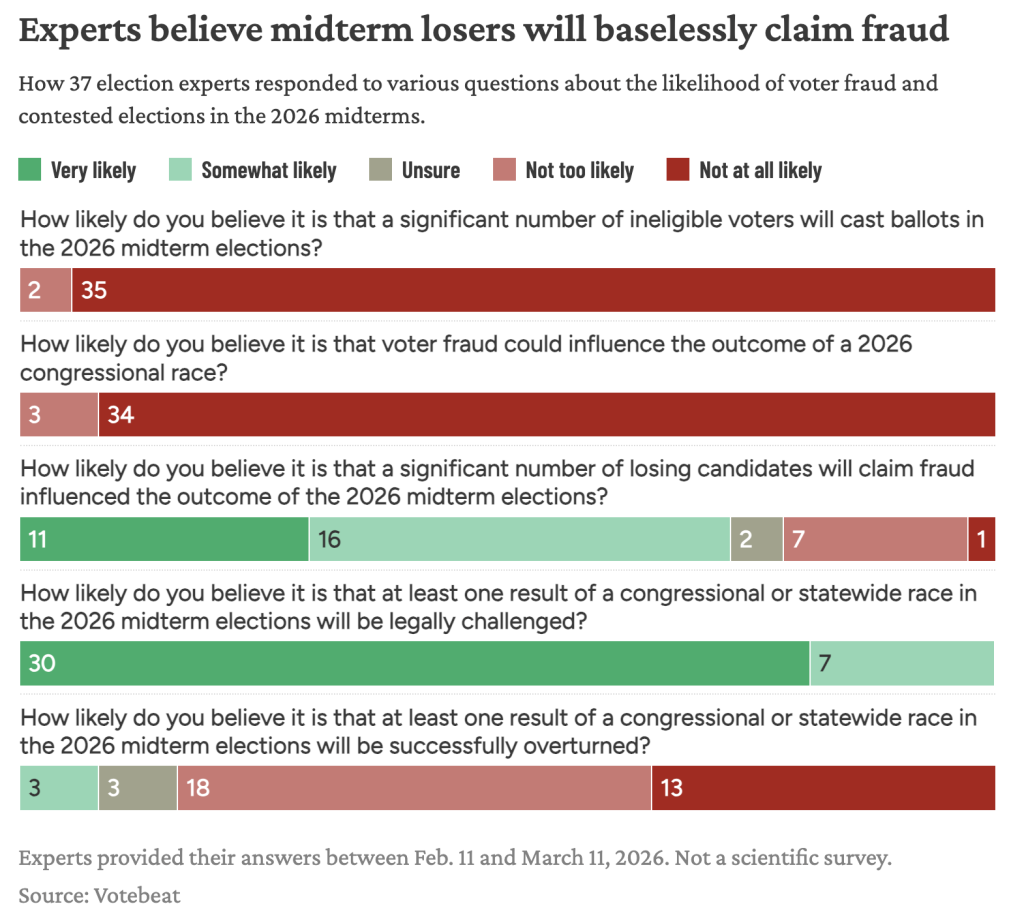
Election experts of all stripes are confident that U.S. elections are secure. All 37 respondents said it was unlikely that a significant number of ineligible voters would cast ballots in the midterms, including 35 who said it was not at all likely. Experts also unanimously said that it was unlikely that voter fraud would influence the outcome of a 2026 congressional race.
However, that isn鈥檛 expected to stop candidates from questioning the election results. Almost three-quarters of experts thought it was at least somewhat likely that a significant number of losing candidates would claim fraud influenced the outcome of the election. All 37 thought it was likely that at least one congressional or statewide election would be legally challenged, with 30 calling it very likely.
At the same time, though, most experts don鈥檛 expect those challenges to succeed. Thirty-one of the 37 respondents thought it was unlikely that any congressional or statewide elections would be successfully overturned.
was produced by and reviewed and distributed by 麻豆原创.