What Americans think about election policy and how the 2026 elections will go
What Americans think about election policy and how the 2026 elections will go
Earlier this year, what worried them about the administration of the 2026 midterms. This article shares the results for a closer look at how the American people are feeling.
Several polls in recent months have asked about people’s confidence in the election, the likelihood of voter fraud, and how — if at all — election laws should be changed. Their responses defy easy categorization: Many are concerned about fraud and support efforts to weed it out, but they’re also worried about voter disenfranchisement and oppose federal intervention in elections.
Polls: Many Americans are concerned about voter fraud
With President Donald Trump continuing to spread fear about widespread voter fraud in the midterms — despite his claims about past elections being repeatedly debunked — about half of Americans say they have concerns along these lines. According to an conducted April 15-20, 46% of American adults agreed with the statement that noncitizens cast a large number of fraudulent ballots in U.S. elections, and 50% were very or somewhat concerned about ineligible voters casting a ballot in the midterms.
Trump’s invectives against mail voting have also trickled down to the general public: The same survey found that 53% of adults were concerned about fraudulent mail-in or absentee ballots in the midterms.
More generally, a conducted March 2-4 found that 50% of adults thought it was likely that there would be voter fraud in the November elections. By contrast, none of the experts in Votebeat’s informal survey thought it was likely that a significant number of ineligible voters would cast ballots in 2026. have that noncitizen voting and voter fraud by mail are .
It’s important to look at polls in the aggregate, and not every survey agrees that such a large percentage of Americans have been convinced by Trump’s claims. In a conducted March 16-19, only 23% of adults said they thought noncitizens vote “a lot” in federal elections, although an additional 27% said they do so “sometimes.” And just 32% thought voter fraud and irregularities were generally widespread in U.S. elections; 57% thought they occurred only in a few isolated incidents, and only 11% said there was no voter fraud or irregularities whatsoever.
Still, 38% of YouGov/CBS News’ respondents thought “a lot” of fraud takes place when ballots are cast by mail, compared to just 13% who said the same of ballots cast in person, and 42% said ineligible voters casting ballots was a “major problem” — not quite half, but a meaningful minority.
Unsurprisingly, the slice of the populace that is most likely to fret about fraud is Republicans. For example, 54% of Republicans thought there were widespread fraud and irregularities in U.S. elections versus just 14% of Democrats and 28% of independents. And 69% of Republicans said that ineligible voters were a major problem, compared with 20% of Democrats and 39% of independents.
Americans are also worried about voter access, federal troops, and attempts to overturn election results
Fraud isn’t the only concern that Americans have about elections, though. In fact, all three polls found that more people are worried about disenfranchisement than fraud. In the Ipsos/Reuters poll, 57% said they were very or somewhat concerned about eligible voters being prevented from voting, and 44% of respondents to the YouGov/CBS News poll identified that as a major problem. And according to Marist, 58% of adults think it’s likely that many people will show up to vote in 2026 and be told they’re not eligible.
When it comes to the tradeoff between voting access and security, Americans are slightly more likely to prioritize access. When Marist asked respondents what concerned them more, 59% said “making sure that everyone who wants to vote can do so,” while 41% said “making sure that no one votes who is not eligible.”
That also comes across in Americans’ opposition to stationing federal agents at voting locations. According to Ipsos/Reuters, people disagree with the idea that federal law enforcement should be present at polling places, 55% to 40%, and they disagree with sending National Guard troops there by an even wider margin: 67% to 28%. However, in the Marist poll, only 54% of adults opposed having the National Guard at polling places, while 46% supported it. The difference might be explained by the fact that Marist specified that they would be there “to monitor November’s election” — a reminder that how pollsters word their surveys matters.
What really keeps Americans up at night, though, is what could happen after votes are cast. In the YouGov/CBS News poll, 47% of adults said “votes not being counted properly” is a major problem with U.S. elections, and 55% said “attempts to overturn official election results” are. Similarly, 69% of Ipsos/Reuters’ respondents said they were very or somewhat concerned about attempts to overturn official election results — by far the highest share of any scenario posed to them.
Americans have mixed views of Trump’s election agenda
So people are plenty worried about how the midterms will go — but what, if anything, do they think should be done about it? Well, the polls found that Americans have complicated, even contradictory, views on that.
First — as Trump has — Americans strongly support many of the Republicans’ plans to tighten election rules. About 80% of adults support requiring voters to show ID, according to both YouGov/CBS News (which asked specifically about photo IDs) and Ipsos/Reuters (which just asked about “official ID”). And per YouGov/CBS News, 66% of adults favor requiring people to show proof of citizenship in order to register to vote. Respondents said, 43% to 29%, that such a requirement would do more to prevent illegal voting by noncitizens than to prevent legal voting by citizens (28% said it would do both things equally).
There is, of course, pending federal legislation to implement a proof-of-citizenship requirement, but interestingly, the YouGov/CBS News poll found that people narrowly oppose one of those bills, the , 31% to 28%. However, the important number there is the 41% who weren’t sure where they stood on it — probably a symptom of the fact that many Americans aren’t closely following the debate over the bill in Washington. Indeed, 36% of adults told YouGov/CBS News that they don’t even know what’s in it!
On the other hand, Americans clearly aren’t on board with Trump’s movement to end mail voting. According to YouGov/CBS News, 49% of adults believed that mail voting should be available to all voters who want it, while 39% thought it should only be allowed for voters who can’t vote in person. Only 12% thought it should never be permitted.
The same poll also found Americans are skeptical of the to . Only 41% of respondents thought there should be more federal oversight of elections than there is now. An identical 41% thought the current level of oversight was sufficient, and 18% thought there should be even less than there is now.
Similarly, when YouGov/CBS News asked who should have the final say in how states administer their elections, only 29% said the federal government. A whopping 71% said it should be up to the individual states.
Americans trust local election officials
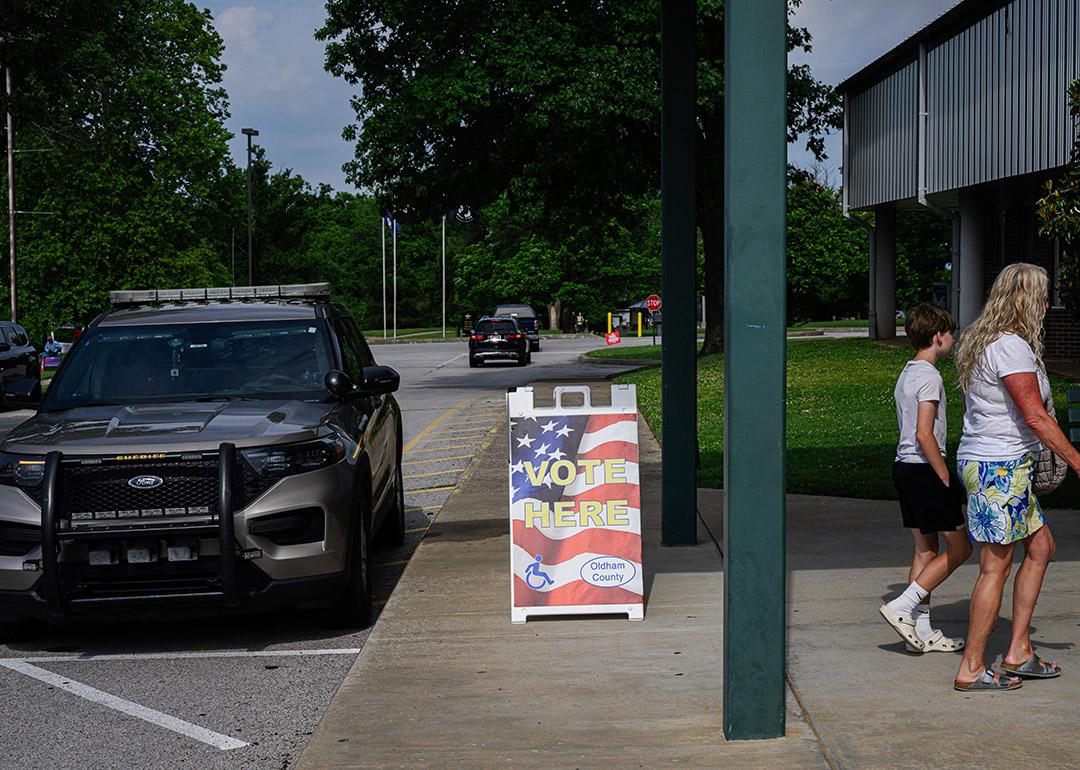
The public’s preference for local election administration reflects a broader truth: For all their anxieties on a national level, Americans still largely feel good about how the midterms will be run in their neck of the woods.
In the Marist poll, 66% of adults said they were confident that their state or local government would run a fair and accurate election this November, although that was slightly lower than the share who thought that ahead of the 2020, 2022, or 2024 elections. And per YouGov/CBS News, 35% of adults have “a lot” of confidence in their local election administrators, 39% have “some,” and only 26% have “not much” or “none at all.”
Finally, about 70% of respondents to the YouGov/CBS News and Ipsos/Reuters polls said they were confident that their own vote would be counted correctly. And Marist found that 63% had either “a great deal” or “quite a lot” of confidence that ballots cast in the election would be counted accurately.
Notably, these questions were the only ones in this article without a significant partisan split: For example, 68% of Democrats had confidence that 2026 ballots would be counted accurately, and 67% of Republicans did.
Overall, Americans’ views on election administration can seem to be all over the map. They’re worried about elections being overturned, but also think vote-counting will be accurate. They take fraud seriously and support election-security measures, but they’re concerned that voters will be disenfranchised.
It doesn’t necessarily make for a cohesive narrative, but it’s possible to reconcile all the data above: It’s not unreasonable to want both fraud-free elections and full voter access; to support federal laws but feel they should be implemented on the state level; and to worry about worst-case scenarios but acknowledge they are unlikely to happen. The partisan debates over voting that people have grown accustomed to don’t leave a lot of room for nuance, but arguments made by politicians and activists are often merely archetypes; Americans’ actual beliefs are considerably more complex.
was produced by and reviewed and distributed by Â鶹ԭ´´.