A federal program helps families eat healthy meals. Trump’s new legislation cuts it.
A federal program helps families eat healthy meals. Trump’s new legislation cuts it.
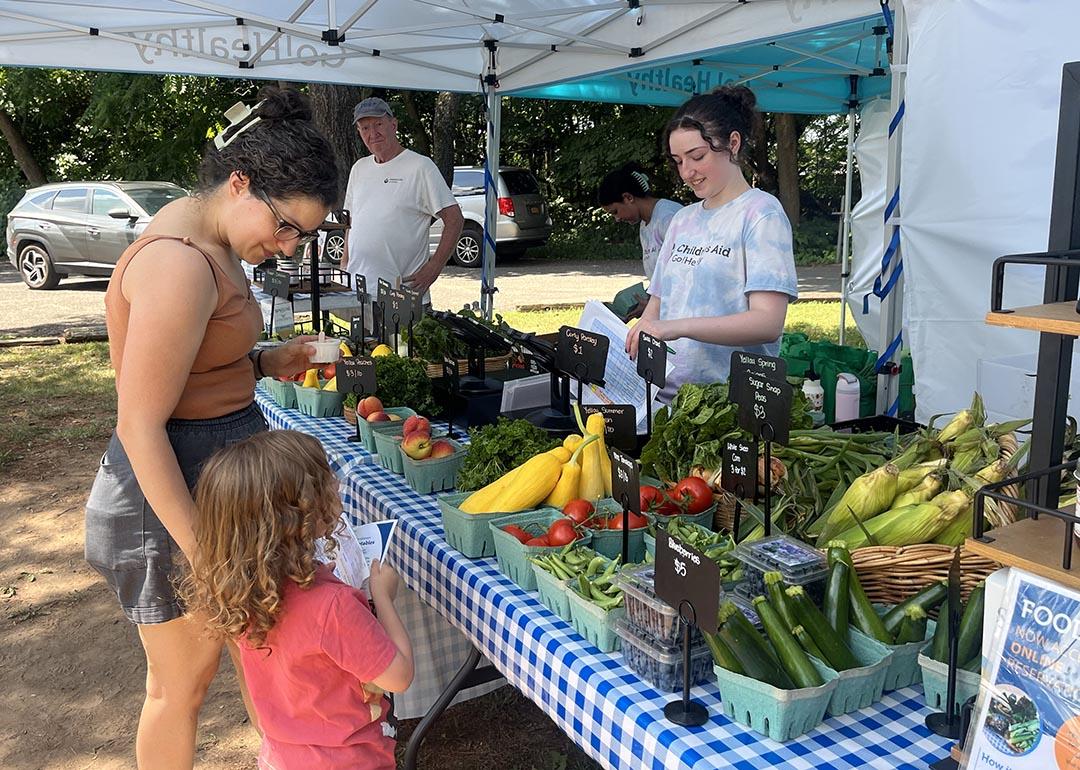
On a sweltering afternoon this week, Ana Garcia, 41, and her three-year-old son, Elliott, arrived at the Goodhue Community Center on Staten Island to pick up their weekly haul of fresh, affordable produce.
Garcia tasted a sample of tabbouleh salad. She and her son surveyed a spread of leafy greens, zucchini, summer squash, and peaches. For eight years, her family has returned regularly to buy a box of locally sourced produce. This week’s box — priced at $14, or $7 for those with Supplemental Nutrition Assistance Program, or SNAP, benefits — included a bounty of fresh fruit and vegetables, plus a recipe for tabbouleh.
“It’s awesome,” Garcia said. “We love coming here.”
But the Food Box program, administered by the nonprofit Children’s Aid, may not exist much longer, reports. President Donald Trump’s “One Big Beautiful Bill” — passed by Congress and signed by Trump last week — eliminated funding for the Supplemental Nutrition Assistance Program Education, or SNAP-Ed, and made other changes to SNAP. SNAP-Ed, which funds nutrition education and anti-obesity initiatives nationwide, is set to expire on Sept. 30.
That will mean the disappearance of programs that help people on a limited budget eat healthier and shop smarter, teach children and families how to cook meals from scratch, and promote physically active lifestyles. Those efforts seem to align with the Trump administration’s Make America Healthy Again, or MAHA, initiative, but will be impacted nonetheless.
Advocates are bracing for how the legislation will affect childhood hunger across the city and state. Changes to SNAP, including new eligibility rules, could result in . In all, New York state is facing up to $1.4 billion in annual SNAP cuts and cost shifts, with the state expected to start covering $1.2 billion for the program by October 2027.
“Not just in New York, but nationwide, we will see increases in child hunger,” said Dr. Jennifer Cadenhead, a research assistant professor at Columbia’s Teachers College, who focuses on diet, food quality, and food insecurity issues. “That really makes me sad.”
While SNAP cuts might , New York City’s universal breakfast and lunch program is safe because the city’s high poverty rate will continue to qualify the whole school system for the program. But individual families will likely be hit hard, which could in turn lead to and .
On Staten Island, Garcia said that the end of the Food Box program would mean less fresh produce in her family’s diet — a loss for her two children.
“I want my kids to have all the vegetables,” she said.
We're on a need-to-know basis.
Every weekday morning, Chalkbeat New York is bringing thousands of subscribers the news on public schools and education policy that they need to start their day. Sign up for our free newsletter to join them.
A roughly with a 30-year history, SNAP-Ed is among the U.S. Department of Agriculture’s largest nutrition education programs. In a 2024 from the Journal of Nutrition Education and Behavior, researchers described it as a “critical pillar in the nation’s public health infrastructure.” Still, it’s a fraction of SNAP’s $99.8 billion in total spending in fiscal year 2024.
By offering evidence-based nutrition and food education, SNAP-Ed pays dividends for families’ long-term health, said Cadenhead, of Teachers College.
“A lot of times, a doctor will say, ‘You need to eat better,’ but people don’t know how,” she said. “They don’t know how to prepare a balanced meal. They may not have time. They don’t understand what they need to do, they can get overwhelmed in the grocery store.”
Funded with $29 million in federal dollars, New York’s SNAP-Ed programs reached over 2.2 million individuals across the state last fiscal year, through efforts like . That program educates preschoolers on how their food is grown and encourages their caregivers to prepare and serve local produce to their families.
Darren O’Sullivan, a spokesperson for the state’s Office of Temporary and Disability Assistance, said in a statement that the federal legislation eliminating SNAP-Ed “increases the risk that New Yorkers in need will experience food insecurity, health issues, and economic hardship.”
Through the $1 million grant Children’s Aid gets through SNAP-Ed, the organization operates Food Box sites throughout the city, as well as programs in schools. Currently, the organization is running youth nutrition workshops and cooking demonstrations at Summer Rising sites, the city’s free summer school program.
“We hear from parents that their kids are coming home and asking, ‘Can we make this recipe at home?’” said Taisy Conk, director of food and nutrition programs at Children’s Aid. “This is opening up their palettes and their minds and getting them excited about it. It really makes an impact on children’s health.”
Through SNAP-Ed, Children’s Aid brought nutrition education to 20 sites, including 11 schools last year. The organization analyzed its programs’ impacts for the year before, and found that across its 176 workshops that reached nearly 430 kids, young people improved their vegetable consumption by 35%, with more than 60% reporting eating at least two fruits a day at the end of the course.
Conk said she worries that changes to SNAP will have far-reaching effects, with people assuming they’re no longer eligible or struggling with new requirements. She said Children’s Aid is urging the city and state to explore some bridge funding to keep the programs going and is looking to philanthropy to help plug the gaps.
Families brace for reductions in fresh produce
On Staten Island, the Food Box stand was open during dismissal for a summer camp at the Goodhue Community Center. Some families stopped by to learn about the program or buy armfuls of corn.
“It’s been great to have affordable produce,” said Tara Messenger, 50, as she and her nine-year-old daughter collected their Food Box.
Without the Food Box program, Messenger, an art teacher, said she’d have to rely more on her local grocery store, and they’d likely eat more processed food.
“It wouldn’t be as fresh, as local, as affordable,” she said. “I probably wouldn’t have as many vegetables and fruits in our diet.”
Sarah Kabalkin, 46, a local culinary educator, said she worried that cuts to SNAP would have a “devastating” impact on her community, with more residents going hungry.
Losing the Food Box program would affect her family, she said. Without their weekly boxes of fresh produce, Kabalkin said she’d have to find a way to grow more in her community garden plots.
“I can’t produce this kind of variety,” she said. “So it will limit what we’re eating at home.”
was produced by and and reviewed and distributed by Â鶹ԭ´´.