Intel faces the unusual challenge of trying to influence one of its owners: the federal government
As the U.S. government obtains a in Intel, the American computer chip manufacturer finds itself in the awkward position of attempting to influence Trump administration officials who now hold some sway over the company through its stock holdings.
But as Intel executives navigate the new business arrangement, they have several political and policy tools at their disposal. And despite recent , the company has significant financial resources to bring to bear.
highlights four key ways Intel can still influence its newest big-time shareholder.
Lobbying
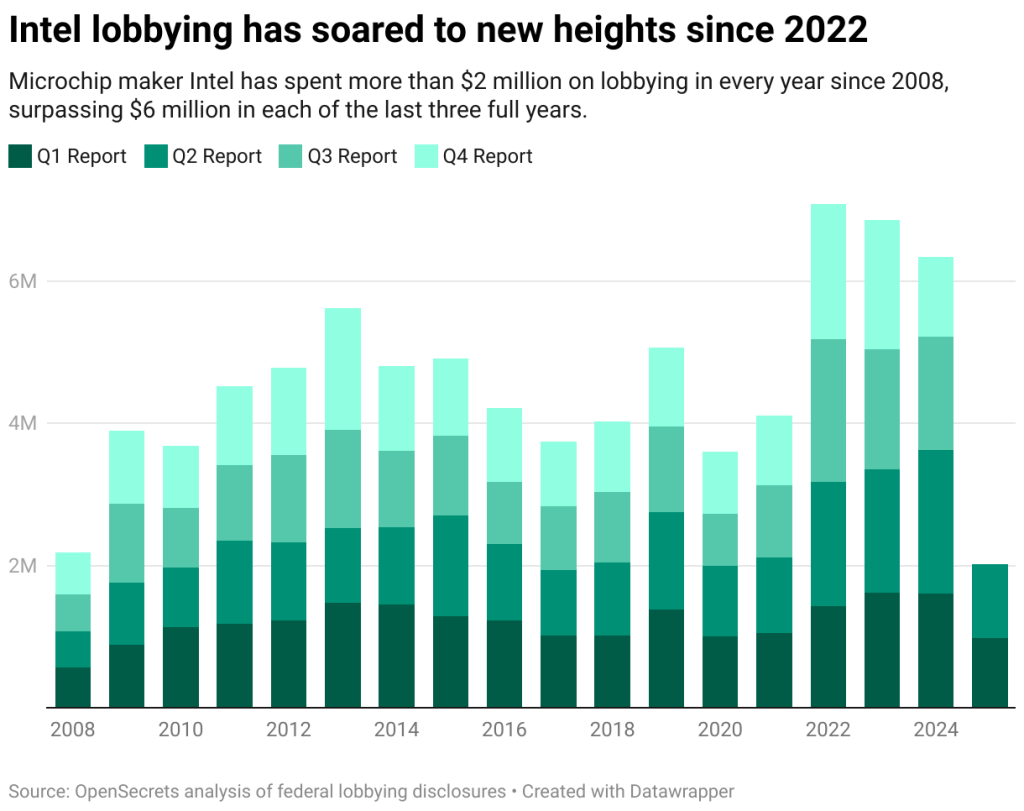
Intel has spent at least $2 million every year for the past 15 years on federal lobbying efforts, which ranks it among a small set of companies that have consistently spent so much for such a long period of time.
Of late, Intel has been spending more on lobbying than ever, topping the $6 million mark in each of the past three full years, according to an .
During , only a handful of other electronics manufacturing and equipment industry companies 鈥� Oracle, Microsoft, Apple, Qualcomm, Samsung and Dell Technologies 鈥� spent more.
But while still on pace to exceed the $4 million mark in 2025 鈥� the pace of Intel鈥檚 lobbying spending has slowed during the , federal records indicate.
So far this year, have represented Intel. Several are in-house Intel lobbyists, while the majority hail from any of several for-hire firms, including Alcalde & Fay, Bose Public Affairs Group, FS Vector, H&M Strategies, Klein/Johnson Group and the S-3 Group. Most have prior experience serving in government.
Together, Intel鈥檚 lobbyists have in Washington, D.C., having lobbied the Executive Office of the President, Congress, the Department of Commerce, the Department of Defense, the Department of the Treasury and the Department of State, among other agencies.
Likewise, the specific and on which Intel has lobbied this year are numerous and diverse. Among them: patent policies, the CHIPS and Science Act, semiconductor security, artificial intelligence, federal research incentives, tax credits, climate change policy, 鈥渟upply chain resiliency鈥� and 鈥渋ssues related to high-skilled immigration.鈥�
Political action committee
Intel has, this century, maintained an active political action committee, which typically spends somewhere in the high six-figure or low seven-figure range each election cycle, an OpenSecrets indicates.
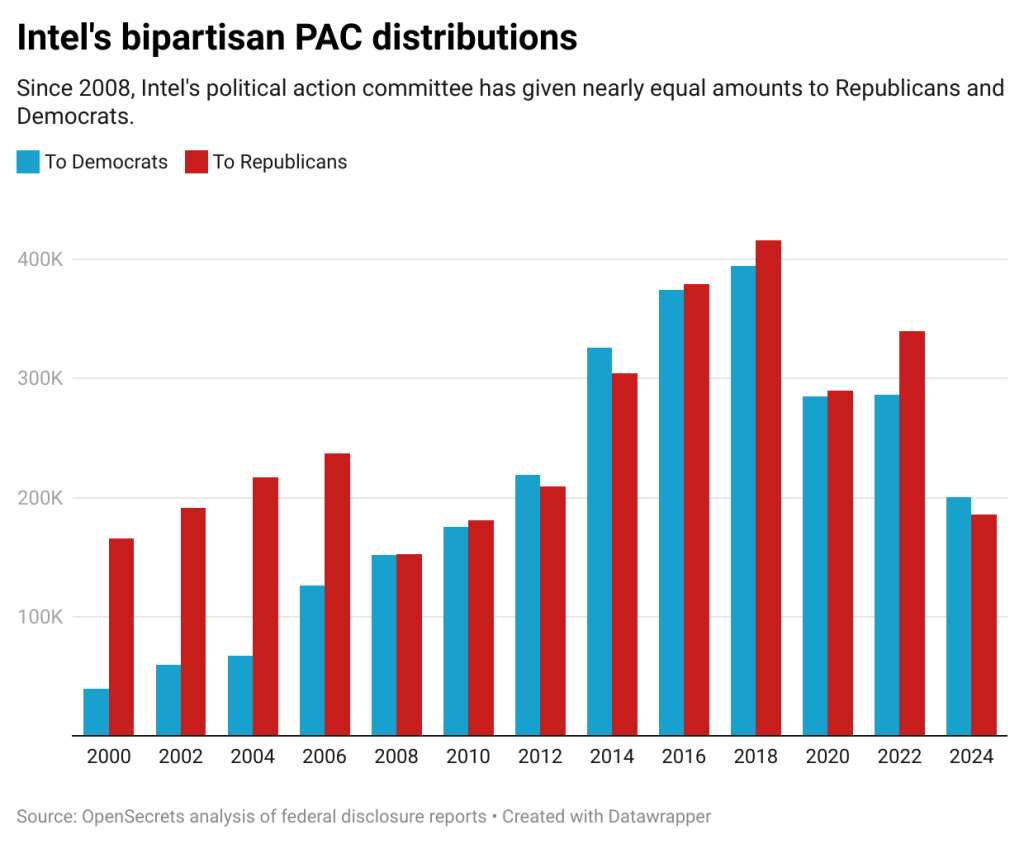
Intel鈥檚 PAC is decidedly bipartisan, too, giving Democratic and Republican candidates almost equal amounts during the past nine two-year election cycles.
During the 2024 election cycle, the company鈥檚 PAC overall.
Of that, it donated to the Democratic Congressional Campaign Committee, the Democratic Senatorial Campaign Committee, the National Republican Congressional Committee and the National Republican Senatorial Committee.
As for , Intel鈥檚 PAC gave $200,500 to Democratic committees and $186,000 to Republican committees.
Reps. Troy Balderson (R-Ohio), Katherine Clark (D-Mass.), Zoe Lofgren (D-Calif.) and former House Speaker Kevin McCarthy (R-Calif.), who鈥檚 since left Congress, each received the maximum PAC contribution of $10,000 toward their primary and general elections, by OpenSecrets indicate.
Others receiving high four-figure amounts include: House Minority Leader Hakeem Jeffries (D-N.Y.), Rep. Pete Aguilar (D-Calif.) and Rep. Frank Lucas (R-Okla.).
As is the case with all federal-level corporate PACs, Intel鈥檚 PAC is not funded by corporate treasury money, but rather the of individual employees 鈥� usually, corporate executives.
Executives鈥� contributions
Beyond a corporate PAC, individual corporate executives and other employees may directly contribute money to political campaigns and causes.
Intel is no exception, with thousands of employees together making tens of thousands of over the years.
During the 2024 election cycle, , who has since left Intel, according to his LinkedIn resume, contributed $41,300 to the Democratic National Committee 鈥� the of any Intel employee from that time period.
Other Intel employees made sizable contributions in 2023 and 2024 to the campaigns of Republican presidential candidate Donald Trump, Democratic presidential candidate Kamala Harris, then-Sen. Sherrod Brown (D-Ohio), and Reps. Mike Johnson (R-La.), Andy Ogles (R-Tenn.) and Ro Khanna (D-Calif.).
Former Vice President Mike Pence鈥檚 short-lived presidential campaign received a contribution from an Intel employee, as did the Democratic-turned-independent presidential campaign of Robert F. Kennedy Jr., who now serves as Trump鈥檚 secretary of health and human services.
Personal investments
The U.S. government isn鈥檛 alone among political entities with a financial stake in Intel.
Several members of Congress have personal investments in Intel, congressional financial disclosures indicate.
In July, Rep. Tim Moore (R-N.C.) between $15,001 and $50,000 of Intel stock.
Rep. Rob Bresnahan (R-Pa.) modest Intel stock purchases and sales throughout the year.
Reps. (R-Ga.), (D-Calif.), (D-Pa.), (R-Ind.), (D-La.), (R-Texas), (R-Ark.) and have all reported Intel stock trades during 2025.
Intel acknowledged an inquiry from OpenSecrets but did not otherwise respond to questions.
was produced by and reviewed and distributed by 麻豆原创.