The most influential Supreme Court cases of the past term
Explaining the most influential Supreme Court cases of the past term
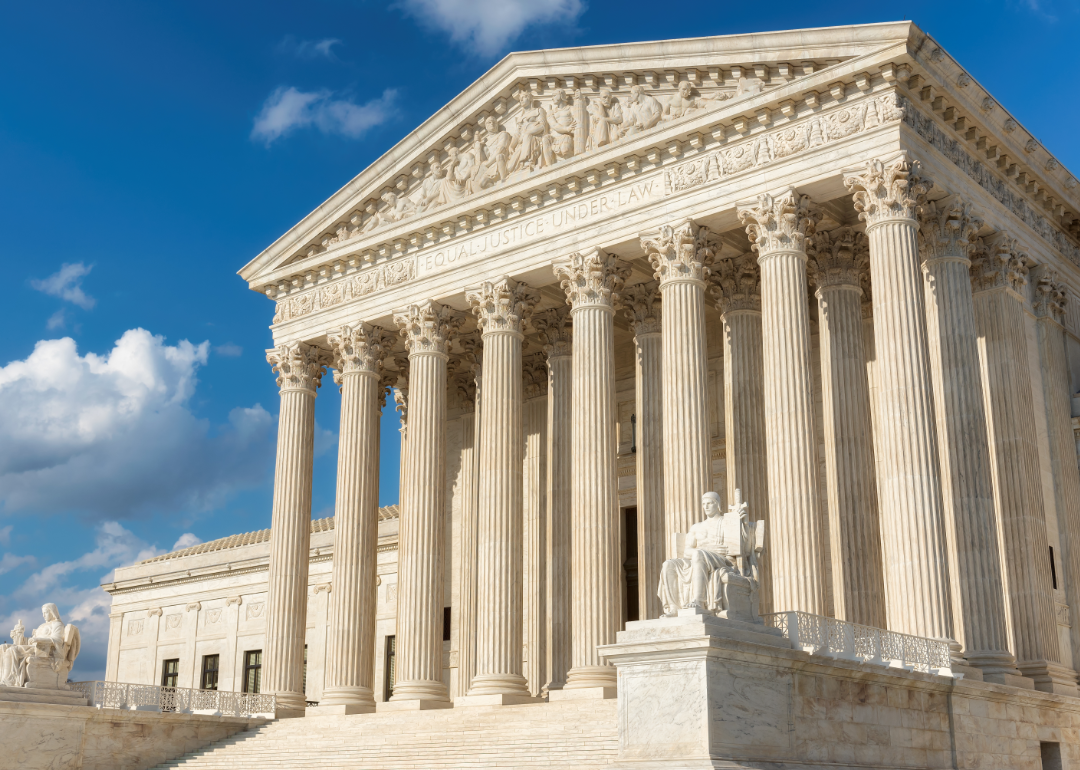
When the Supreme Court of the United States decides to hear a case, that case is inherently important. Many decisions, though, that the highest court in the land handed down in its most recent term are not only important, but consequential. They change the way corporations do business, alter the relationship between police and the communities they serve, determine the fate of thousands of immigrants, or impact the lives of everyday Americans.
, which ran for eight months between November 2017 and June 2018, witnessed dramatic and highly anticipated rulings on subjects like gay rights, religious freedom, police excess, immigration, abortion, free speech, elections, human rights, and workers' rights. Many were hotly contested 5-4 rulings handed down by a bitterly divided court. Some were unanimous rulings while others paired reliably conservative and liberal justices as unlikely bedfellows, in both majority and dissenting opinions.
The Supreme Court has the ultimate say in the Constitutionality of American laws and serves as the final forum of appeal in both criminal and civil cases. Of the dozens of decisions the High Court handed down during its past term, the following 25 were especially dramatic, surprising, far reaching, or consequential.
ALSO:
Trump v. Hawaii
Decided on June 26, 2018, resulted in a 5-4 split along ideological lines. The more conservative members of the Supreme Court upheld a central component of the Trump administration's controversial immigration policy: a to the U.S. by people from several Muslim-majority countries. The ruling also validated the administration's claim that the executive branch has wide authority to establish such broad policies.
Murphy v. NCAA
On May 14, 2018, Justice Elena Kagan broke from the court's liberal bloc to join a 6-3 majority that struck down a federal law that banned most states from legalizing sports betting. The decision determined that a 1992 prohibition , which prevents the federal government from compelling the states to enforce federal law.
Minnesota Voters Alliance v. Mansky
On June 14, 2018, two of the High Court's more liberal justices, Ruth Bader Ginsburg and Elena Kagan, joined the court's conservative bloc for a 7-2 decision that overturned a total ban on political attire and messages at polling places. In , the court that the rule was too broad, too vague, and infringed on limited free speech.
South Dakota v. Wayfair
The 5-4 decisions saw two defections: conservative Chief Justice John Roberts joined the dissent and liberal Justice Ruth Bader Ginsburg joined the majority. In a hugely impactful decision for online shoppers and sellers alike, that states can force internet-based merchants to collect sales tax from buyers in the state, even if the company has no physical presence there.
Ohio v. American Express
was another 5-4 split on a court that was once again sharply divided. The division on the case about the nature of retail purchases occured along strict ideological lines. It was decided in favor of the company, granting American Express a huge victory. The cooperation emerged from with a court-issued validation of part of its core business model: preventing retailers from giving buyers incentives to make purchases with cheaper credit cards.
Lucia v. SEC
On June 21, 2018, justices Sonia Sotomayor and Ginsburg dissented against a 7-2 majority ruling in . The court ruled that in-house judges at the Securities and Exchange Commission had been and, in yet another ruling bolstering the power of the president, should be held more accountable to the executive branch.
Benisek v. Lamone
The case of attempted to tackle the controversial policy of partisan gerrymandering, in which one political party draws redistricting maps in a way that dilutes the vote in regions that are favorable to the other party. The on June 18 was underwhelming. It dealt solely with the actions of the appeals court, not the merits of the case, leaving the generationally unsolved question of gerrymandering open for another day and future debate.
Gill v. Whitford
On the same day as The Benisek v. Lamone gerrymandering ruling鈥擩une 18鈥攖he court ruled on , another case testing the legitimacy of partisan gerrymandering, this time regarding maps drawn by Republicans in Wisconsin. The the case back to the district court, missing its second opportunity in one day to finally tie up the political loose ends of gerrymandering in American elections.
Abbott v. Perez
For the Supreme Court in its most recent term, the third time turned out to be the charm for partisan and racial gerrymandering鈥攁nd that charm came in the form of the June 25 ruling. In one of the year's most , the court, split 5-4 along ideological lines, overturned a Texas district court's ruling that said the state's redistricting maps were racially discriminatory both in intent and outcome, and therefore invalid. The Supreme Court's conservative majority ruled that by not presuming that the state acted in good faith, the district court unfairly shifted the burden of proof to the state.
Epic Systems v. Lewis
Detractors of the ruling in worry the new precedent will weaken what they claim are already dwindling . The decision, which was handed down in a 5-4 split along ideological lines, paved the way for employers to legally forbid their employees from joining together in shared legal claims about conditions in the workplace. Instead, employers can now force workers into individual arbitration, which is much less advantageous for the employee.
Sessions v. Dimaya
Like so many consequential rulings during the term, was a split 5-4 decision鈥攂ut in this case, conservative Justice Neil Gorsuch joined the court's liberal minority to tip the scales. The majority ruled in favor of a legal immigrant who was set to be deported after pleading guilty to the burglary of an unoccupied home, which authorities labeled a "crime of violence"鈥攖he kind of crime that results in deportation under the Immigration and Nationality Act. that the law was too vague and violated the Due Process clause of the Fifth Amendment.
Animal Science Products v. Hebei Welcome
In an era where punitive tariffs and simmering trade tensions dominate the news, the ruling loomed particularly large. In response to an American business' antitrust case against a Chinese supplier, which was thrown out in deference to Chinese law, the Supreme Court handed down a unanimous decision. The court came to the conclusion that federal judges must carefully consider, but aren't bound by, a foreign government's position in such a case.
Jesner v. Arab Bank
In , the court ruled that foreign companies can't be sued in U.S. courts for alleged complicity in human rights violations that occurred in other countries. In one of many 5-4 party-line decisions, the court's conservative majority held that the Alien Tort Statute against corporate defendants. This ruling has major implications in both the business world and the arena of global human rights.
Byrd v. United States
Few cases decided by the court in the past term impact daily life more than . In a relatively rare unanimous decision, that the police were wrong to search a rental car without consent during a traffic stop. The check of Byrd鈥檚 license and rental agreement revealed that he wasn鈥檛 listed by the rental company as an authorized driver, was using an alias, and had an outstanding warrant in New Jersey. As the officers weren鈥檛 able to contact authorities in New Jersey to seek confirmation that no extradition was required, they searched the rental car finding drugs and a body armour. Nevertheless, the court determined that someone in lawful possession of a rental car has a reasonable expectation of privacy, even when that person is not technically supposed to be driving.
Class v. United States
was a 6-3 decision that saw conservative justices Neil Gorsuch and Chief Justice John Roberts join the court's liberal wing in bolstering the rights of defendants. The court ruled in favor of a confessed criminal whose attempt to appeal his conviction was denied because he had plead guilty. The that a guilty plea in and of itself does not waive the defendant's right to challenge the constitutionality of his conviction.
Jennings v. Rodriguez
In , another controversial immigration-related decision widely hailed as a victory for conservatives, the court ruled in that immigrants are not entitled to periodic bond hearings while in detention fighting deportation. The Supreme Court, whose ruling overturned the 9th Circuit Court of Appeals, whose lawyers argued that the law does not permit such long-term detentions.
Carpenter v. United States
In yet another bitter 5-4 decision, the court ruled in that the to get a warrant to search a suspect's so-called "cell site" evidence. This comprises all information gleaned by seizing and searching a person's cell phone records, including the movement and location of the person's phone. Chief Justice John Roberts broke from the court's conservative wing to join the majority and tip the balance in favor of limiting police powers.
Janus v. AFSCME
In yet another 5-4 split along ideological lines, the court ruled in that state to force non-consenting public-sector employees to pay union fees to cover the costs of collective bargaining. This was a historic blow to unions, as the precedent the court overturned dated back more than 40 years to 1977.
McCoy v. Louisiana
In , the court weighed in on the controversial and timely topic of the death penalty. In a 6-3 ruling, that the 6th Amendment guarantees the right of a criminal defendant to steer his own defense and maintain his innocence. The court overturned the lower courts that upheld the conviction of a murder defendant in a death penalty case where the defendant's attorney conceded guilt against the wishes of his client.
Husted v. A. Philip Randolph Institute
When the state of Ohio's Republican leadership aggressively purged large numbers of infrequent voters from its rolls, various civil rights groups filed suit saying the move violated the National Voter Registration Act of 1993 and the Help America Vote Act of 2002. The case was , and in yet another bitter 5-4 ruling with massive political implications, the court's conservative bloc formed a majority and ruled that Ohio's roll purges were, in fact, constitutional.
Collins v. Virginia
In a time when police are under unprecedented scrutiny, the case holds especially significant meaning. With Justice Samuel Alito holding out as the sole dissenter, the who claimed that police violated his Fourth Amendment rights by searching his home's curtilage, or the area immediately surrounding his house, without a warrant. Police were looking for a stolen unique-looking motorcycle whose rider had committed traffic law violations and then evaded officers. They tracked it down to a local house where an officer lifted up a tarp partially covering what he believed to be the bike in question. On discovery that it was indeed the stolen motorcycle, he arrested the alleged driver at the home. The lifting of the tarp, the court ruled, constituted an illegal search.
Digital Realty Trust v. Somers
The case of once again in a unanimous decision. In this case, which was especially relevant considering the recent slew of highly public whistleblower reports, the court ruled against an employee who was fired after reporting alleged corporate malfeasance. The logic of the justices was that the Dodd-Frank Act only affords anti-retaliation protection to people who fit the act's narrow description of a whistleblower.
Kisela v. Hughes
The emotional subject of police excess has spawned protests from the streets of Washington, D.C. to NFL stadiums across the country. was a major ruling on this sensitive and timely subject. that a police officer who shot a woman brandishing a knife was protected by qualified immunity. This legal doctrine shields police officers鈥攅ven if they misinterpret the law or violate someone's rights鈥攑rovided they didn't clearly and knowingly break the law under circumstances where a "reasonable person" could have made the same mistake.
National Institute of Family and Life v. Becerra
Few topics are more politically charged than abortion, and the country's polarization on the topic was reflected in the highly contested 5-4 decision the Supreme Court handed down in the case of . The court's conservative majority sided with a group of pro-life religious organizations that challenged the California Reproductive Freedom, Accountability, Comprehensive Care, and Transparency Act. that the organization's First Amendment rights were violated by the law, which required licensed clinics to tell patients about free and low-cost family planning services, including abortion and birth control, while requiring unlicensed clinics to inform their patients about their licensure status.
Masterpiece Cakeshop v. Colorado Civil Rights Commission
Few cases during the court's most recent term captured the attention of the country like . In a 7-2 ruling, the that a cake shop owner's refusal on religious grounds to provide a cake for a gay wedding did not violate the rights of the gay couple that was denied service. Requiring the owner to bake the cake, on the other hand, would have violated his rights under the Free Exercise clause of the First Amendment. Despite the attention given to the Masterpiece decision, it鈥攍ike so many other rulings by the court's conservative wing鈥攚as narrow in its scope.