Rural Americans struggle to afford heat as winter intensifies
Rural Americans struggle to afford heat as winter intensifies
Each year, an U.S. utility customers have trouble affording their monthly heat and electricity bills. Now, as the cost of energy climbs, experts say more people are at risk of energy insecurity and poverty, defined by the struggle or inability to keep up with electric, heating, and cooling bills. Rural utility customers face unique challenges around access to fuel and affordability programs, and they often live in older, less energy-efficient homes than their urban and suburban counterparts.
“Energy poverty can disproportionately affect people in poverty in rural areas,” Maria Castillo, a senior associate on the electricity team at energy think tank RMI, told . Castillo leads the organization’s energy poverty work.
During the recent federal government shutdown, lasting from Oct. 1 to Nov. 12, 2025, that $3.6 billion in Department of Health and Human Services (HHS) assistance funding under the Low Income Home Energy Assistance Program (LIHEAP) could be delayed. Though many states prevent low-income customers from having their heat turned off through policies called , Castillo said , like percentage-of-income payment plans, utility debt management programs, and low-income energy efficiency programs, are necessary to move customers out of energy poverty.
Now that the government has reopened, the $3.6 billion in funding for LIHEAP will resume distribution, though .
Adam Hall is a utility customer in Knott County, Kentucky. Since 2020, Hall said his gas bill has increased from about $80 per month to $300 per month. In 2022, the hit Hall’s family hard, knocking their home off its foundation and impacting their energy efficiency.
“The flood destroyed everything,” Hall said. “It’s just been one thing after another after another.”
Every three months, Hall goes to the Leslie, Knott, Letcher, Perry Community Action Council (LKLP) for assistance paying his utility bills. The nonprofit serves four rural counties in Eastern Kentucky and receives some funding from LIHEAP to distribute among community members. Still, Hall said there are community members who need the help but don’t have the necessary paperwork to get the assistance, often because they rent their homes.
“There’s still some people who don’t get a chance to take advantage of it because their utility bill is not in their name, so they can’t apply for it,” Hall said. “You’re stuck with a rent payment plus a utility payment. …You fear they overlook that a little bit.”
Nationwide, LIHEAP assistance only reaches about 17% of households that qualify for the benefits, according to a 2024 . Katrina Metzler is the executive director for the National Energy and Utility Affordability Coalition. She said that rural communities can have a more difficult time accessing LIHEAP benefits than urban communities, where resources tend to be centralized.
“Every time you put an obstacle up in front of a family, and living in a rural area is one of them, it makes it more difficult,” Metzler said. “If they’re having trouble affording their utility bills, can they also afford gasoline to get in the car and drive however many miles it might be in order to reach the office where assistance is available and complete the application?”
SaverLife, a national nonprofit that helps low- to moderate-income Americans develop saving habits, conducts about energy affordability. Over the last year, President and CEO Leigh Phillips said 80% of 1,300 recently surveyed members reported a significant increase in their energy bills.
“The burden is significantly higher for rural members, so 85% of rural members said it was somewhat or very difficult to pay their energy bills, which is a lot higher than non-rural members, where 65% said it was somewhat or very difficult to pay,” Phillips said.
A Growing Energy Pie
LIHEAP was established by Congress in 1981, combining a series of winter fuel and weatherization programs that the federal government had funded during the OPEC Oil Embargo in the 1970s. As LIHEAP has expanded across all 50 states, it has also begun extending funding to states for cooling-related utility bills. But Castillo said the need for energy assistance is growing faster than what LIHEAP can provide.
“The LIHEAP formula from the seventies disproportionately [gave] cold weather states more funding,” Castillo said. “That’s part of the issue now with climate change, and there being extreme weather on both ends, is basically it’s outdated because it was seen as a cold-weather policy.”
Now, rising electricity prices are compounding the problem, said Carina Rosenbach, an expert on regulatory strategies to improve customer affordability at RMI. Residential electricity costs have increased by almost 30% since 2021, while residential gas costs have increased by 40% since 2019, per an April 2025 from PowerLines, an advocacy group focused on utility regulations. As of July 2025, $29 billion in utility rate increases had been requested and approved across the U.S. for the first half of 2025, doubling the figures from the same period in 2024, according to .
Those rate increases are passed on to utility customers across the country. This year, ratepayers are continuing to see their monthly bills increase as a result of demand growth and increased spending on the grid, as well as more frequent and extreme weather events that damage infrastructure. Those costs—whether for repairing the grid or modernizing it to handle new technology like AI—have played a part in driving up household utility debt. In the South and Appalachia, rates of severe utility debt were nearly twice as high as of June 2025, per an from Protect Borrowers and the Century Foundation economic think tank. Those regions tend to have harsher utility debt , which can strain households already struggling to make ends meet.
“Think about it like a pie, the pie being the costs on the system,” Rosenbach said. “The larger the pie, the more that all customers have to pay.”
Right now, the size of the pie is growing, which means energy is becoming more expensive for everyone. That leads to affordability challenges, Rosenbach said. In rural areas, those challenges are often exacerbated by older homes that are less able to insulate against and cold, which are also more likely to be single-family units than in urban areas.
With winter approaching, home heating costs are expected to outpace inflation, according to a September 2025 published by the National Energy Assistance Directors Association (NEADA). The group projects that nationally, home heating costs will increase by 7.6% across all fuel types this winter, with the highest regional increase occurring in the South, where home fuel costs are expected to increase by 15%, driven by a 21% increase in electricity costs between this winter and last winter. In the Midwest, the cost of natural gas is up 16% from where it was last year, NEADA found.
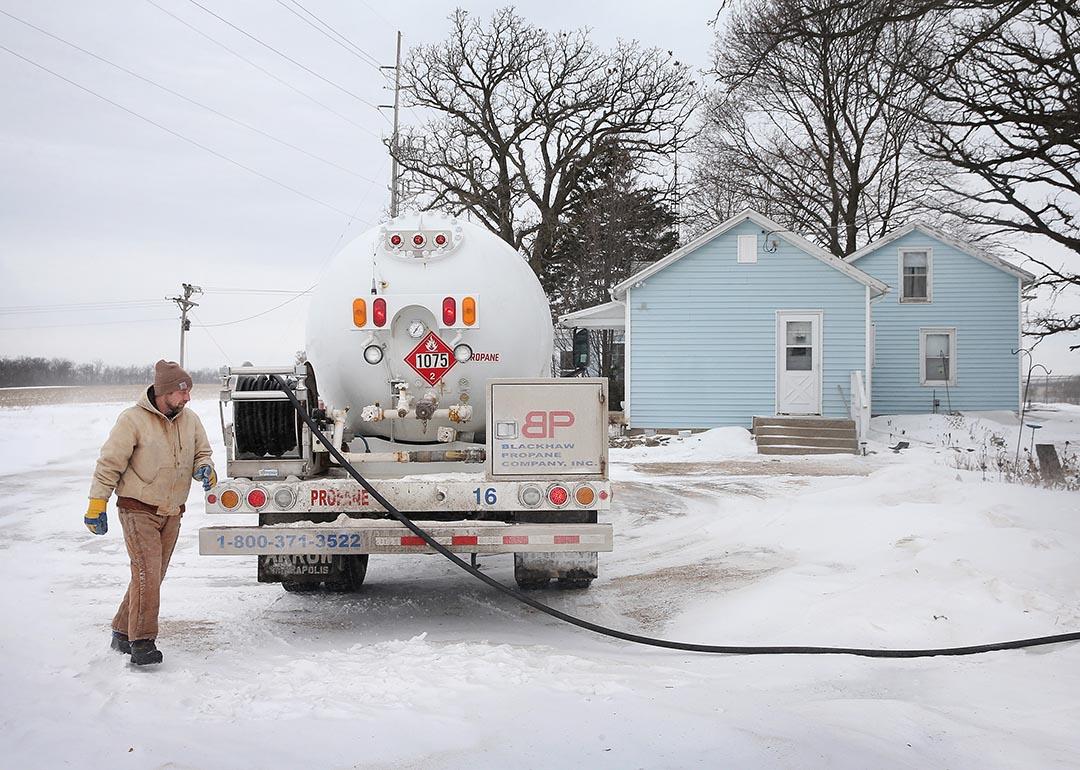
Increases in the costs of propane and natural gas can take a toll on rural families, since many rely on fuel deliveries where gas pipelines and electric heat aren’t available, Metzler said.
“When your tank is low, it’s not a monthly bill that’s predictable in the same way that electric and gas [pipelines] might be,” Metzler said. “You’re required to fill to a certain point in order to get your heat turned back on. That can be $800 for a family all at once, and if you’re already struggling to make ends meet, that’s a significant burden.”
LIHEAP’s funding as a government means it’s flexible to meet the needs of families who struggle to pay for fuel deliveries. Yet the number of utility customers who qualify for help based on state income eligibility levels exceeds the funding for the program. In states like Alabama, Mississippi, and Montana, which have among the highest percentages of rural population, LIHEAP only reaches about 15% or less of income-eligible households, per .
“Who we understand as experiencing energy poverty is unfortunately expanding because of the affordability pressures brought on by rising prices and the volatility of gas prices,” Castillo said.
was produced by and reviewed and distributed by Â鶹ԭ´´.