The Supreme Court is more interested in Second Amendment cases than ever before
The Supreme Court is more interested in Second Amendment cases than ever before
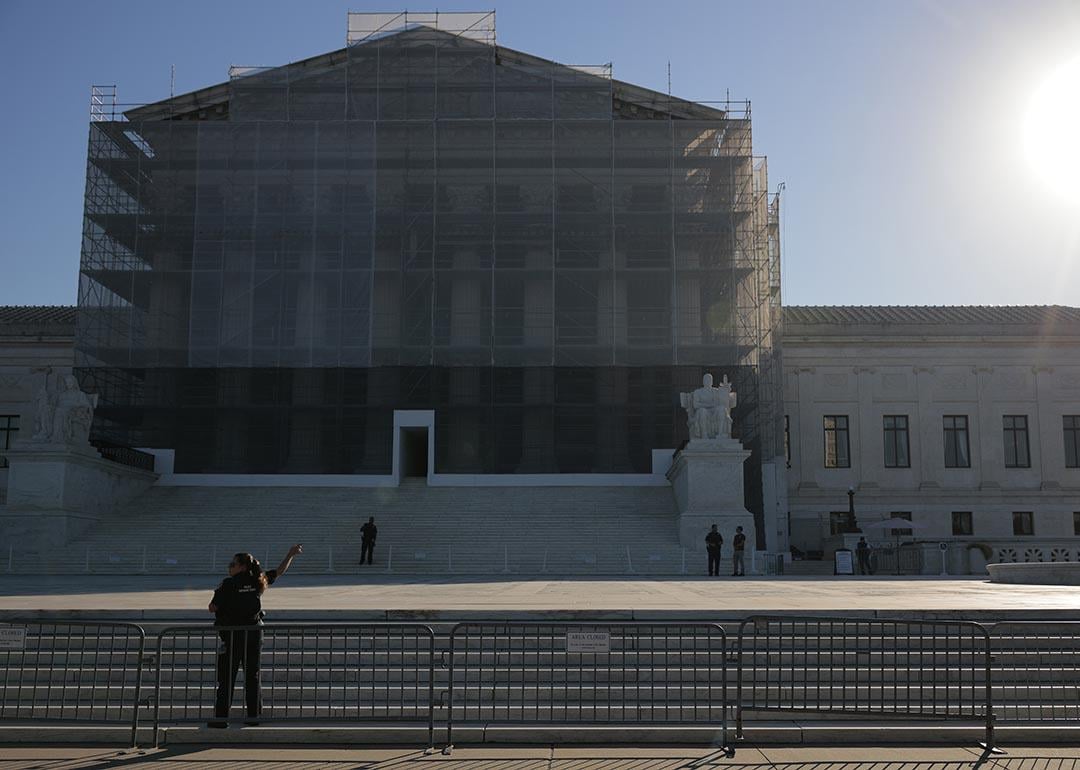
With the Supreme Court back in session, the justices are preparing to weigh two Second Amendment challenges. One will look at whether it is constitutional to restrict people from carrying firearms on private property, and the other concerns drug use and gun rights.
For a court that’s taken less than a dozen Second Amendment challenges in its 230-year history, two in one year is unprecedented. “This is a real indication that we have a court that’s more willing to and more interested in taking these cases,” said Andrew Willinger, the executive director of the Center for Firearms Law at Duke University.
The caseload is also a sign that the dust hasn’t settled three years after the Supreme Court decided New York State Rifle & Pistol Association v. Bruen. The landmark ruling, issued in June 2022, modern gun laws to align with historical firearm regulations to be constitutional. Bruen threw the landscape of firearms law into flux, and lower courts have since ruled on nearly 3,000 challenges to gun restrictions — a record number, according to The Trace’s Bruen database, which is to the public.
The two gun cases before the Supreme Court are part of that post-Bruen wave, and the court is expected to hear oral arguments in the next several months. Below, breaks down the cases and explains their implications.
Carrying guns on private property
The Supreme Court will decide whether states can ban people from carrying guns at businesses, restaurants, and other private property unless the property owner gives express permission.
The case, Wolford v. Lopez, centers on a Hawai‘i law that bans gun owners with concealed carry licenses from bringing their firearms onto most private property that’s open to the public. A few Democratic-led states have passed similar laws to discourage people from toting weapons after Bruen recognized a right to carry guns in public.
If the Supreme Court decides the laws are unconstitutional, business owners in those states could wind up having to tell customers if they don’t want guns on their property. “The default that the government sets does matter a lot because unless you, as a private property owner, feel really strongly one way or another, you’re probably not likely to do anything,” Willinger said. “There’s a ton of commercial private property out there, so that could have a very big effect.”
Gun rights groups appealed to the Supreme Court in 2025 after a 9th Circuit Court of Appeals upheld Hawai‘i’s law. But similar restrictions have been blocked by other appeals courts, including the 2nd Circuit Court of Appeals, which struck down a nearly identical New York law last year.
The impact of the Supreme Court’s decision may be limited, as most states still do the opposite of Hawai‘i and generally allow guns on most private property unless the property owner prohibits them. The Trump administration had urged the court to take the case, arguing that Hawai‘i’s law violates the Bruen’s history-and-tradition test.
The justices have indicated that they will not be using Wolford to clarify whether laws from later in American history — around the time of Reconstruction — can be used alone to justify modern gun laws under Bruen, or if judges have to find analogs from the Founding Era. As The Trace , gun rights groups have capitalized on the confusion over that question to overturn gun laws around the country.
Drug use and gun rights
The second Supreme Court case will examine whether people who use drugs should legally be allowed to have guns. For more than 50 years, federal law has banned anyone who is an “unlawful user of or addicted to any controlled substance” from possessing firearms. United States v. Hemani, a case out of Texas, asks whether that law is constitutional — and when.
The Trump administration urged the justices to take the case after the conservative 5th Circuit Court of Appeals found that the ban is constitutional only when the government can show that a defendant was actively using or under the influence of drugs when they possessed firearms, as opposed to using drugs habitually but maybe not at the time of their arrest. Eric Ruben, a professor at Southern Methodist University Dedman School of Law, said allowing the 5th Circuit ruling to stand would have far-reaching consequences. “Most of the prosecutions aren’t arising in the context of somebody who’s caught with a firearm while high,” he said.
Since Bruen, lower courts have disagreed over whether people who use drugs — particularly marijuana — can constitutionally possess guns. But experts say Hemani may not be the best vessel to answer that question, as the Texas defendant was arrested with not only marijuana but also cocaine, and he allegedly abused and sold prescription drugs, according to court documents. The Trump administration also the defendant of having links to an Iranian terrorist group. “In this particular case, the facts are kind of unique and, you might say, egregious,” Willinger said.
That could be a signal that the court took the case with an eye toward upholding the ban, but may not want to answer whether casual or even habitual marijuana use bars otherwise law-abiding people from possessing guns. “They had the opportunity to take other cases that squarely presented that issue, and they chose to take this case specifically,” Willinger said. “That leads me to think that this could be a pretty narrow decision in the end.”
Hemani will also test whether the Trump administration’s renewed can shield gun regulations from being struck down under Bruen. The process — which was technically on the books but disused for decades — lets people barred from owning guns because of drug use, a conviction, or another disqualifier request to have their gun rights reinstated. The administration has said the process could blunt Bruen-based challenges to gun laws. In its recent Supreme Court petition, the administration cited the process’s availability to argue that the drug use ban can be temporary and is therefore consistent with the nation’s historical tradition of gun regulation.
What’s to come
The justices have several petitions asking them to take up cases about state bans on assault weapons, restrictions on the capacity of ammunition magazines, and minimum age requirements for guns. Other petitions over similar laws remain pending, but experts say the court is unlikely to accept them. “I wouldn’t be surprised if one of those cases goes up in the near term, but two Second Amendment opinions would already be more Second Amendment opinions in a single term than we’ve seen in our lifetimes,” Ruben said.
The justices should release their decision in Wolford and Hemani by early July.
was produced by and reviewed and distributed by Â鶹ԭ´´.