Why a trans teen fled his Texas home to find safety: 'Daily danger zone'
Why a trans teen fled his Texas home to find safety: ‘Daily danger zone’
Fifteen-year-old Dylan is in Minnesota, in his aunt’s basement, where he and his mom Sara now live, when he meets with a reporter from and . Dylan and his mom, whose names have been changed for privacy and safety, fled their home in Texas shortly after President Donald Trump’s inauguration, as his on trans people turned an already unfriendly state into something even more terrifying.
Dylan has blue hair and glasses. He’s wearing a colorful striped cardigan that he hand-crocheted and is also knitting a vest while talking. He has a lot of downtime these days. He’s a gifted student who got stuck doing ninth grade online. “It’s boring overall,” he says. “It just sucks.” He says he doesn’t have any friends. Sara works during the day, and his supportive dad and big sister are back in Texas. Besides working with yarn, he passes the time cooking, reading mostly fantasy books, watching TV, and taking care of his and his aunt’s dogs, Max and Biscuit.
Around age 12, Dylan experienced intense gender dysphoria triggered by puberty. Getting his period in particular would make him experience suicidal ideation, and he attempted suicide once. “Those times were torture for both he and I,” his mom says. He also got harassed after coming out as trans in middle school. It got so bad that Sara quit her job and pulled Dylan out of school.
Around the time he came out as trans in 2023, Texas gender-affirming care for minors. Dylan and his family knew they’d have to to get him the care that would “give him some peace and let him be a kid,” Sara says.
Human Rights Watch on the crisis caused by state-level bans on gender-affirming care for minors, which first appeared in 2021 and now exist in half of U.S. states. Out of 14 interviews with transgender youth and 16 interviews with families of transgender youth, they documented seven instances of suicidal ideation and suicide attempts, some directly linked to legislative bans. Doctors who provide are being targeted and harassed, according to the report, similar to what providers have experienced.
States are using digital medical records to surveil people, the report shows, even those who get care out of state. Some parents of trans kids are afraid to take them to the regular doctor, lest their trans identities be discovered and reported. And on June 18, the six conservative justices on the Supreme Court affirmed that the bans that cause all this are legal when they upheld Tennessee’s decision to not recognize gender-affirming care as constitutional in the case , paving the way for further restrictions or even a national ban. And as youth across the country , these restrictions and this cultural climate may come even more sharply into focus, from anti-trans laws to bullying and harassment from peers.
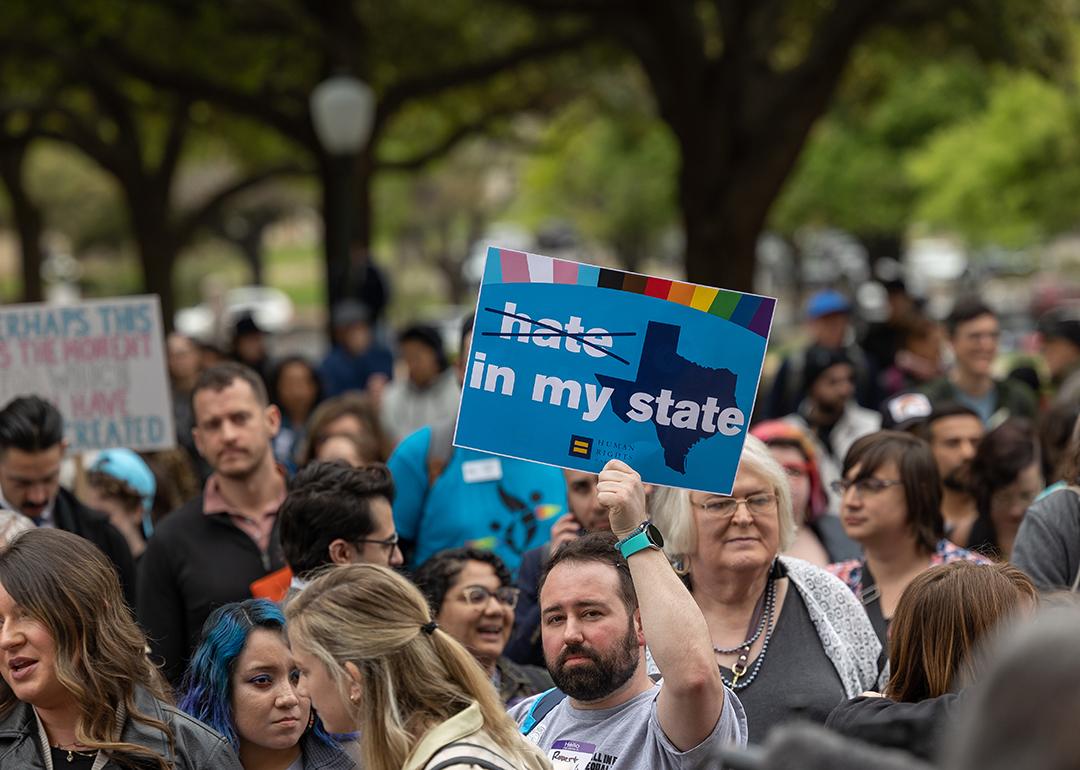
In Texas, things are especially scary. The Human Rights Watch report calls Texas “an extreme example,” because in 2022 Gov. Greg Abbott that helping kids get gender-affirming care could qualify as a form of child abuse. That put their family, says Sara, in a “daily danger zone.” Anyone who clocked Dylan — at Walmart, at the dentist — could, in theory, call the authorities and get him taken away and put in foster care.
“You can be charged with felony child abuse, which is prison,” says Sara. “I’m not built for that. I’m not going to prison. My child will not survive. Can you imagine that your child would then blame themselves for his mother and father being imprisoned? That’s a death sentence for all of us.” There has been of the Briggles, who have been activists in support of their transgender son for over a decade.
Yasemin Smallens, the author of the Human Rights Watch report mentioned above, says, “For a country [that] likes to pride itself on its human rights record, this stands in contrast to the right to health, rights of the child, and personal autonomy.”
This is all happening even though gender affirming care for minors is supported by s in the United States. In fact, the state of Utah, when it passed its moratorium on gender-affirming care, commissioned an for the safety and efficacy of such treatment. Their 1000-page report, released in May 2025, concluded that hormones and puberty blockers are “safe” and “effective” with a very low rate of regret: “The consensus of the evidence supports that the treatments are effective in terms of mental health, psychosocial outcomes, and the induction of body changes consistent with the affirmed gender in pediatric [gender dysphoria] patients.”
Since Sara and Dylan had family in Minnesota, they started making the 34-hour round trip drive north to see a doctor there every few months. (They usually picked Starbucks as the safest place to use the bathroom). The trips were a financial stretch for their family, living on one income from Dylan’s dad’s job at a railroad. “It’s very expensive,” says Sara. “You’re talking about $500 for a puberty blocker,” plus money for labs, co-pays, and more. The family got small charity grants to help pay for the gas, the doctors, food on the road, and medication.
There are many teens who can’t afford or access this care at all, especially if it involves travel. The says 38% of transgender girls and women, 39% of transgender boys and men, and 35% of nonbinary youth have experienced homelessness or housing instability. Many LGBTQ youth experience homelessness because their families reject them.
Katie Hays is the pastor of Galileo, an LGBTQ+ affirming church that has supported Sara and Dylan’s family through a project called (NTTN). They also support a group called Elevate North Texas that finds emergency housing for youth who need it. And, the church hosts an LGBTQ+ community center where youth, including some who are couch-surfing or living temporarily in hotels, come for things like clothing swaps, game nights, and queer-affirming haircuts.
But, Hays says, the church can’t be liable for helping a teen get care if their parents or guardians don’t sign off. And the NTTN’s $1,000 travel grants, like the one Dylan’s family received a few times, won’t meet the need for families who are truly living on the edge. “We’re leaving out a lot of people, and that’s a serious consideration,” says Hays.
The political climate was already bad for trans kids in red states. Trump’s election in 2024 made things worse. According to Smallens, for the people she interviewed for the report, “The level of fear rose as the election season went on — and after the inauguration, exponentially. People were feeling like there was no one left at any tier of government having their backs, respecting their rights.”
That’s exactly how it felt for Sara and Dylan. “With Trump being the one who calls the shots, that will just make Texas a way more dangerous place to be,” Dylan says.
“I was knocked on my ass from about November until January,” says Sara, who grew afraid to take Dylan out in public.
The silver lining, for Sara, was that more people took the threat seriously. “People who don’t live with a trans kid, they think you’re overreacting. You’re being hyperbolic.” With Trump’s inauguration and the series of anti-trans executive orders he signed, that changed. Her sister-in-law called and told them, “get your ass up here right now.”
In January, the North Texas TRANSportation Network started offering $3,000 grants for permanent relocation, a step up from their existing travel grants. Hays, the pastor, says, “It’s so sad. There are a number of people making plans to move. They have come to me tearfully to say: It’s not safe for my kid or me, and I can’t keep living at this level of alert all the time. And it breaks my heart.”
Sara and Dylan headed north. “We drove over the Red River Valley, which is the border between Texas and Oklahoma,” says Sara. “And we were giving middle fingers out the window, and playing Taylor Swift, ‘We Are Never Ever Getting Back Together,’ screaming at the top of our lungs, and that’s kind of how I feel about it, you know.” While he says it’s hard in some ways to leave the only home he’s ever known, Dylan compares Texas to “an abusive ex.”
Dylan is excited about going to 10th grade in person in the fall and being around people again. They all hope the family will be reunited within a year, although that depends on dad finding a new job up north, which is a big “if.” To help finance the move and living in two households, Sara and her husband had to sell their house, which they had purchased before the COVID-19 pandemic after saving up for nearly two decades. And Minneapolis is generally more expensive than north Texas.
In the midst of all the difficulties, being able to consistently get the medical care he needs has been a huge bright spot for Dylan. He’s about to celebrate his first anniversary on testosterone. “I’ve been noticing a lot of changes. And it makes me super happy. It’s something that I’ve always dreamed of.”
Co-published by and .
was produced by and and reviewed and distributed by Â鶹ԭ´´.