
ADHD in women: Why it's hard to detect and how to treat it
Women have so much to think about these days, having to ping-pong from one item to the next across multiple to-do lists, that it can be challenging to think clearly and give full attention to anything. And while there’s no end to time-tracking apps and focus journals, what are you supposed to do if they have never really helped?
If you’ve nervously asked yourself, “Do I have ADHD?” you’re in a very big club of women who struggle to stay focused, meet deadlines, or patiently wait in line. shares what you need to know about this sometimes counterintuitive condition, and whether it might be time to see a therapist about your symptoms.
Half of people with ADHD were diagnosed as adults
According to a recent study from the CDC, had an official ADHD diagnosis in 2023. Half of those people were diagnosed in adulthood, and fewer women had been diagnosed compared to men.
Between 2020 and 2022, the number of adult women (ages 23-49) diagnosed with attention-deficit/hyperactivity disorder (ADHD) .
If you are diagnosed with ADHD as an adult, it doesn’t mean that you developed it later in life. It’s likely that you’ve always had symptoms that were overlooked. Maybe because they were mild, or maybe because you unconsciously developed strategies to compensate for them (more on that below).
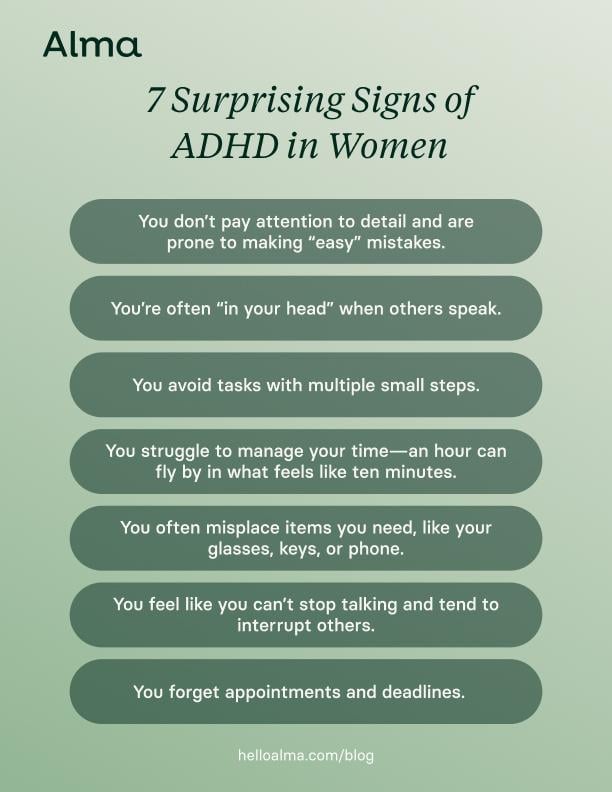
ADHD symptoms in women
There’s a lot that experts still don’t understand about ADHD, but what is clear is that it affects the structure of your brain as well as your brain chemistry. That can lead to three different groups of symptoms: hyperactive symptoms, inattentive symptoms, and a combination of the two.
Most people are familiar with the hyperactive/impulsive type of ADHD. Classic signs of hyperactive ADHD include:
- Fidgeting
- Always being “on the go”
- Finding it hard to sit quietly or wait in line
- Excessive talking
- Interrupting others
Less attention is given to the inattentive type of ADHD. In fact, its common symptoms are often explained away as personality traits, like being “scatterbrained,” “overwhelmed,” or “spacey.”
If you have inattentive ADHD, you might notice these symptoms:
- You don’t pay close attention to detail and often make “easy” mistakes.
- You struggle to manage your time.
- You miss deadlines.
- You tend to be “in your head,” even when others are talking to you.
- You dislike or avoid tasks that have a lot of steps or require sustained focus, like filling out complex forms.
- You often misplace items you need, like your keys, glasses, or phone.
- You forget important tasks like appointments, paying bills on time, and returning texts and phone calls.
You can also have “combined” ADHD, which includes symptoms of both inattentive and hyperactive types.
While the root causes of ADHD are still being studied, genetics play a key role. If one of your parents has ADHD, you’re more likely to have it, too.
How ADHD in women is diagnosed
On a particularly hectic day, you might feel like you have ADHD, but a diagnosis is based on more than the symptoms you have right now.
To be officially diagnosed with ADHD as an adult:
- Your symptoms must have started in childhood (before age 12).
- You must have five or more symptoms for at least six months.
- Two or more parts of your life (for instance, work and home) are affected.
- Your symptoms make it hard for you to function.
You can’t diagnose yourself with ADHD. You’ll need to be evaluated by a trained professional, like a licensed therapist, counselor, or psychiatrist.
How ADHD affects girls and women
In childhood, girls are less likely to be diagnosed with ADHD, and, on average, four years later than boys. One of 85,000 people put the average age of ADHD diagnosis for women at 23 years, compared to 19 years for men.
How can this neurodevelopmental disorder go so long without being detected? According , there are a few reasons.
You may internalize your symptoms
For starters, “women are more likely to have the inattentive version of ADHD, which can sometimes be confused with anxiety, forgetfulness, and disorganization,” says a double board-certified psychiatrist in Menlo Park, California.
Even the hyperactive type of ADHD may manifest differently in girls than boys. Instead of physical restlessness, they’re more likely to quietly internalize their symptoms. That can show up as being “over-sensitive,” finding it hard to regulate emotions, and struggling to stay on task or one train of thought.
But because they’re often not loud or disruptive to others, early ADHD signs in girls are easily missed, or dismissed, by parents, teachers, and doctors.
You may find ways to hide your symptoms
Without a diagnosis, it’s common for girls with ADHD to put strategies in place to “mask” how their brains naturally work and help them fit in. These strategies may sound familiar to many of us: rigid scheduling to stay on top of things, overachieving, perfectionism, and even people-pleasing.
While these coping methods may work well, times of transition often highlight their limits.
For instance, Dimitriu usually sees a spike in ADHD issues between high school or college graduation and entering the work force. “There’s more responsibility to stay on top of work demands and deadlines,” he says. “Usually in people’s late teens and 20s, responsibilities increase and there’s less external guidance as to what to do and when.”
Your symptoms can be mistaken for ‘female’ issues or mental health conditions
suggests that ADHD interferes with the brain’s ability to process dopamine, a key “feel-good” chemical that’s already in short supply at times when the female hormone, estrogen, naturally dips. This means that hormonal shifts which happen during periods, pregnancy, breastfeeding, and menopause can exacerbate ADHD symptoms, but the timing makes it easy to only blame your lack of focus on hormones.
also show that women with ADHD are more likely to have other mental health issues like depression, anxiety, and substance abuse disorders. Some of those symptoms overlap with signs of ADHD, too.
Screens are definitely making things worse
While our dependence on screens isn’t a cause of ADHD, it certainly doesn’t help. “Since smartphones entered our lives in 2007, as a society we’ve all been more distracted,” says Dimitriu.
“More inboxes, messages, feeds, and notifications have been distracting to all, but people with ADHD tendencies may have suffered more than others. The shiny toy, the tasty candy, the slot machine of fun facts and pictures is now in your pocket, ready to play. Can you stay on task with that temptation?”
What to do if you think you have ADHD
The diagnostic criteria for ADHD are restrictive and can leave you wondering how to explain your symptoms—and what to do next—if you don’t check all the boxes.
The first thing to know: You don’t need an ADHD diagnosis to get support from a therapist for your symptoms. In fact, talking to a therapist is the best way to determine if you need an ADHD assessment and to start learning strategies to feel better and get more done in a more comfortable way, without or without ADHD.
In the meantime, there are other steps you can take.
Check in on your self-care
“Take care of your basic human needs,” says Dimitriu. “Make sure you’re getting enough sleep, enough physical activity, and eating a healthy diet.”
Sleep deprivation can mimic or intensify ADHD symptoms. So can sitting too long in front of your computer. And while nutritional research is ongoing, experts generally recommend a diet that emphasizes fruits and vegetables, lean protein, and whole grains, while trying to limit high-sugar foods and unhealthy saturated fats.
Support yourself with structure
Next, build a framework for your day, including writing down specific goals to reach and for each task. “ADHD symptoms benefit from structure,” says Dimitriu. “Discipline goes a long way, and is often most challenging for people with ADHD.”
If your symptoms persist or affect more than one part of your life, talking to a therapist is your best strategy. “Medications can help too, but ideally, all the other beneficial behaviors and strategies are tried first,” says Dimitriu.
Therapy can help you get answers—and feel more in control
“Whether you have ADHD or not, sometimes there are just too many demands. This is stress,” says Dimitriu. “Stress is really having too much to do, sometimes beyond what might be comfortably possible for you. Anxiety is all the feelings and emotions on top of the actual stress.”
was produced by and reviewed and distributed by Â鶹ԭ´´.