
How to choose the best cold and flu medicine for your symptoms
If you find yourself feeling feverish and coming down with a cough, congestion, or a runny nose, you might reach for a quick, over-the-counter (OTC) fix. But with so many products to choose from in the cold and flu aisle, it鈥檚 easy to feel overwhelmed.
OTC won鈥檛 cure an infection. But they can help make symptoms more manageable. , a platform for medication savings, explains how to determine which OTC medicines are the best for colds and flus.
Key takeaways:
- There are many OTC cold and flu medicines available. Many ingredients can be found on their own and used in combination products for multisymptom relief.
- Acetaminophen (Tylenol), dextromethorphan (Delsym), and phenylephrine (Sudafed PE) are commonly found in combination cold and flu products. These ingredients target symptoms such as fever, cough, and congestion. However, phenylephrine may not actually be effective for a stuffy nose.
- Checking product ingredients before making the purchase can help avoid doubling up on medications and treating nonexistent symptoms.
- The best OTC cold and flu medicine can depend on symptoms, age, and health conditions. A pharmacist can help with navigating options.
What are the best OTC cold and flu medicines?
The best OTC cold and flu medicine is one that targets specific symptoms. And it shouldn鈥檛 interfere with other medications or health conditions.
Marketing aside, there are just a handful of found in cold and flu medicines. But which ones are best for which symptoms? Common symptoms are broken down in the table and subsequent sections below.
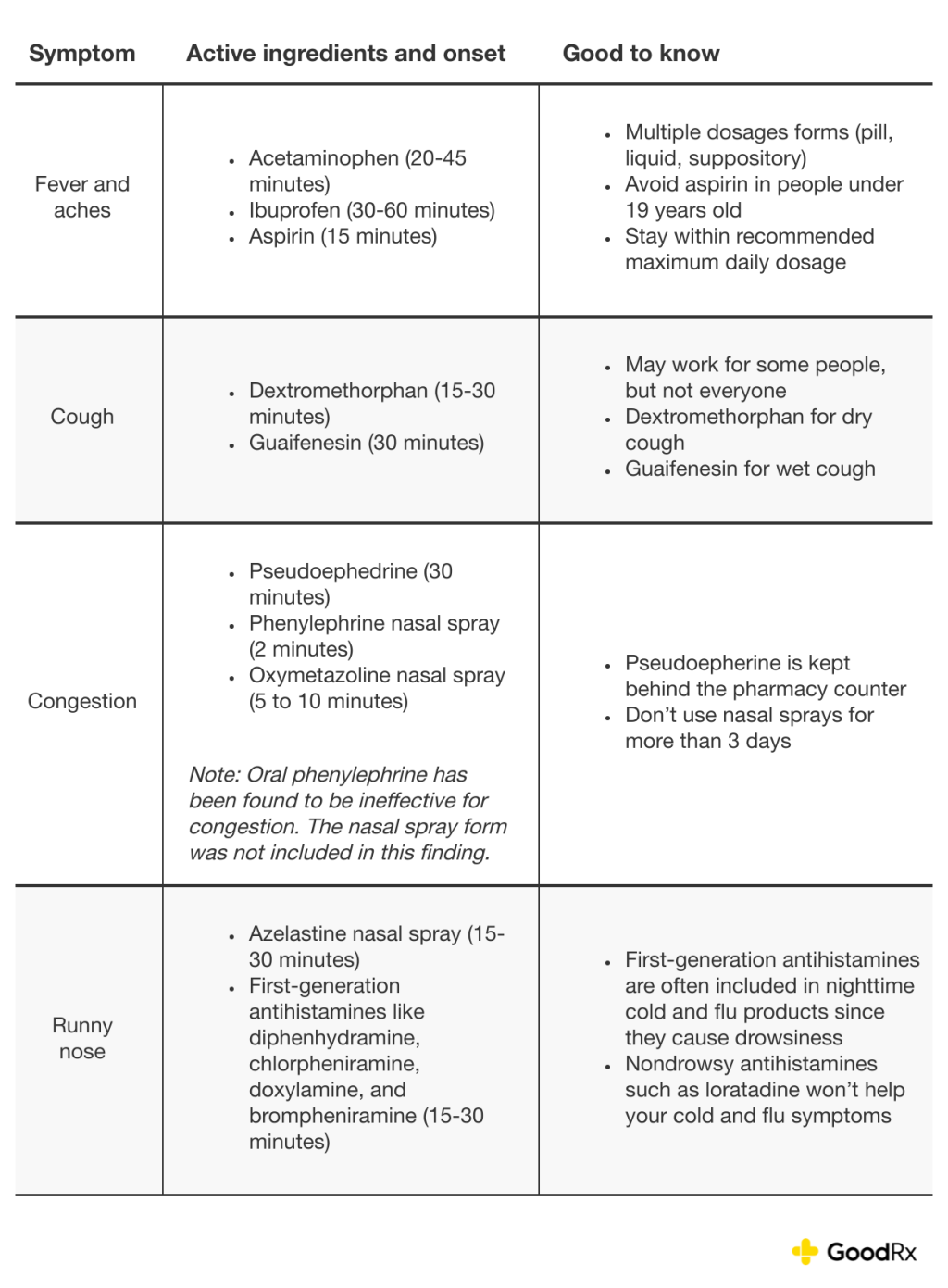
Fever and aches
There are two OTC options to help bring down a fever: (Tylenol) or nonsteroidal anti-inflammatory drugs (), such as (Motrin, Advil). Both can provide relief for headaches and achy muscles, too.
is also an NSAID option, but it should be under age 19. That鈥檚 because it鈥檚 linked to a dangerous condition called Reye鈥檚 syndrome.
These medications are available on their own for fever and minor aches. They can also be found in a variety of combination products for multisymptom relief. and instructions for children based on their . Multiple dosage forms are available for each medication, including capsules and tablets, liquids, and .
Acetaminophen takes about to kick in, depending on the product. Ibuprofen can take about , with the liquid-filled gel capsules working the fastest. There is also the option to alternate products. This means if acetaminophen doesn鈥檛 provide relief, for example, can be taken a few hours later. Aspirin takes about to start working.
Keep in mind that taking can result in . If taking a few different products for your symptoms, check to make sure not to double up. The same is true with NSAIDs like ibuprofen, which can cause and stomach ulcers .
Tylenol and NSAIDs aren鈥檛 safe for everyone. Those who take medications or have other health conditions should check with a healthcare professional first.
Cough
(Delsym) and (Mucinex) are common go-to . There that they work, but some people find relief from taking them.
Dextromethorphan is a cough suppressant. It鈥檚 thought to work by blocking cough reflexes. This may be helpful for a dry, hacking cough that doesn鈥檛 produce mucus. Dextromethorphan usually starts working of taking it.
Guaifenesin is an expectorant. It鈥檚 supposed to loosen up and thin the mucus in the airways of those with a wet cough. This can help make coughing up the mucus easier. But can have a similar effect. Guaifenesin can start kicking in .
Both dextromethorphan and guaifenesin are available on their own and in combination products. Sometimes they can be found together, as with .
Keep in mind that OTC cough medications can have in young children . So, it鈥檚 best to check with their pediatrician about your options. Medication-free alternatives, such as (after ) or a cool-mist , may be a good place to start.
Sinus congestion
There are a few options for a stuffy nose. First, consider nonprescription oral and nasal decongestants.
- Oral options: (Sudafed) and (Sudafed PE)
- Nasal options: (Afrin) and phenylephrine ()
Decongestant nasal sprays typically kick in the fastest 鈥� within 2 to 10 minutes. But they shouldn鈥檛 be used for because symptoms could come back worse and be tougher to treat.
Pseudoephedrine of the two oral options. It typically starts working . But it is kept . It can also cause sleeping problems if . Oral phenylephrine is commonly found in combination products, but it has been . So even though it鈥檚 still on pharmacy shelves, it may not help symptoms.
Keep in mind that decongestants can make certain health conditions, such as , worse. Check with a healthcare professional before taking one.
Runny nose
may be helpful for for those who have a runny nose. One option is (Astepro Allergy), an OTC antihistamine nasal spray that starts working within 15 to 30 minutes. Azelastine may help if the congestion is caused by allergies.
Older oral antihistamines, such as (Benadryl) and (Unisom), may and start working in a similar . But they can cause , such as drowsiness and dry mouth. , such as loratadine (Claritin), won鈥檛 help symptoms.
Certain oral antihistamines for older adults. Some of these medications can have risks in young children, too. Check with a healthcare professional before taking one.
Which cold and flu medicines are best for nighttime?
When , the last thing anyone wants is something that will keep them awake. But certain ingredients in cold and flu medicines may do just that.
As a general rule, avoid taking daytime cold and flu medications at night. They may include ingredients that are stimulating and can . Examples include decongestants such as pseudoephedrine and phenylephrine.
鈥淣ighttime鈥� products, on the other hand, may contain ingredients that . For those who are having difficulty sleeping, this can be a welcome side effect. Examples include antihistamines such as diphenhydramine and doxylamine. Dextromethorphan can also . Keep in mind that some products contain alcohol, which may not be ideal for certain people.
Pharmacists can be a good resource for those who are unsure of when to take a specific product.
Tips for picking the best cold and flu medication
So far, this story has covered some of the basics to help navigate the best OTC cold and flu medicine options. But there are a few more things to know before making a purchase.
1. Many OTC cold and flu medications have the same or similar ingredients
As mentioned earlier, there are just a handful of ingredients found in OTC cold and flu medications. This may be surprising given how many different products are found on pharmacy shelves. What鈥檚 more, many products are the same or very similar to each other.
For example, contains the exact same active ingredients as . If someone is judging the product on the label alone, they might pick one over the other based on how it鈥檚 named. Taking different products with the same ingredient could result in the person taking too much of that particular medication.
When selecting a product, try to pay less attention to the marketing. Look at the instead. It鈥檒l list the active ingredients, amounts, and symptoms the product is intended to treat. This can help avoid duplicating ingredients. And the shopper may even find a better deal for the same combination of medications.
2. Generics and store brands can help save money
names like dextromethorphan and diphenhydramine aren鈥檛 always commonly known. People may be more familiar with their branded products 鈥� Delsym and Benadryl. But when people buy the brand, they鈥檙e really just paying for the name.
Generics work just as well as their brand-name counterparts. Store-brand (also called private-label) versions are also a great option. And they can save some money, too.
For those who are not familiar with the generic names, ask a pharmacist. They can help select the right product to meet needs.
3. People may be taking more medication than necessary
It鈥檚 best to avoid throwing the kitchen sink at . Especially with OTC combination products, people may end up taking more medication than they actually need.
For example, people may keep a combination product like on hand for when they get sick. It contains acetaminophen, as well as medications for cough and a runny nose. But if someone doesn鈥檛 have a fever or aches, they鈥檒l end up taking acetaminophen 鈥� even though they don鈥檛 need it.
Combination products can be convenient. But taking unnecessary medications can increase the risk of side effects, , and more. Be sure to check product ingredients first.
4. Know when to consult with a doctor about cold and flu medicine
It鈥檚 also important to know when to skip OTC cold and flu medicines altogether. In some cases, people are better off speaking to their primary care provider or another healthcare professional. A prescription may be needed for cold and flu medications. Or more targeted treatments, such as , that aren鈥檛 available OTC, may be necessary.
People should talk to a healthcare professional about their symptoms if:
- 罢丑别测鈥檙别 and think they have the flu.
- They have a chronic health condition, such as diabetes, high blood pressure, or asthma.
- 罢丑别测鈥檙别 .
- The person who鈥檚 sick is an or a under age 5.
- They have a .
- They take that weaken the immune system, such as prednisone.
- They鈥檝e been taking OTC cold and flu medicines for one week and don鈥檛 feel any better.
- Their symptoms initially improve and then worsen again.
- They have , such as a fever of 103 degrees Fahrenheit or higher.
Frequently asked questions
Which cold and flu medicines should people avoid taking together?
Cold and flu medicines that contain the same ingredients or ingredients that belong to the same drug class together shouldn鈥檛 be combined. For example, diphenhydramine and chlorpheniramine shouldn鈥檛 be taken together since they鈥檙e . This is also the case for taking multiple NSAIDs, such as ibuprofen and naproxen (Aleve, Naprosyn).
Which cold medications work the fastest?
Which cold medications work the fastest depends on which symptoms are being treated. For congestion, decongestant nasal sprays . For a fever, there between acetaminophen, ibuprofen, and aspirin. And for a runny nose, nasal spray antihistamines, such as azelastine, usually than oral antihistamines.
The bottom line
When dealing with cold and flu symptoms, over-the-counter (OTC) remedies may help provide some relief. Fever reducers, cough suppressants, and decongestants are common options to consider. They can be found on their own and in combination products.
Check a product鈥檚 ingredients before purchasing, since it鈥檚 best to avoid taking unnecessary medications. Also consider generics and store brands over brand-name products to help save money. Pharmacists can help navigate these options.
was produced by and reviewed and distributed by 麻豆原创.