How connecting with nature helps Black women have healthier pregnancies
How connecting with nature helps Black women have healthier pregnancies
At the start of her pregnancy with her now 10-month-old daughter, Marica Lowe was consumed by fear. She was so worried for her safety and that of her unborn baby that she holed up in her bedroom most days. She even skipped Mardi Gras, the vibrant but notoriously crowded festival that is normally the highlight of her year.
But as spring began, and the streets filled with flowering trees, Lowe reconnected with what had lured her to move to New Orleans from her hometown of New York City two years earlier: nature.
“The first time I visited New Orleans, I went on a walk, and I saw limes growing on the tree,” Lowe said. “Fruit doesn’t grow on trees in New York, so that really drew me here.”
She organized a community “sensory walk” through Couturie Forest, a 60-acre nature preserve. The aim was for participants to take in the beauty of the natural environment by listening to birdsong, smelling fragrant plants, touching tree bark, and grounding themselves in the earth.
As reports, it was the second trimester of her pregnancy, and something unexpected happened. As she led the group through the forest, she experienced a profound mental shift, feeling peaceful and centered.
“I felt connected to nature. I felt protected. I felt more excited. I felt connected to my baby,” recalled Lowe, 39, who is now the wellness director at Dream House Lounge in New Orleans, a nonprofit organization committed to expanding access to mental and spiritual wellness services. “It just was life-giving.”
Research increasingly shows that women who participate in nature-based activities have — information that is especially critical for Black women, who nationwide have a maternal mortality rate that is more than three times the rate for white women, according to the . In New York City, the disparity is even greater: Black women face a of dying from pregnancy-related complications than white women — and shows that more than 80% of these deaths are preventable.
For Black women, though, getting out into nature can be a challenge. Decades of discriminatory housing policies and disinvestment have resulted in many Black women living in communities with limited access to parks and green spaces, walkable streets, vegetation, or shade trees. These inequalities don’t just degrade the quality of life in these neighborhoods, they contribute to that disproportionately affect Black women of childbearing age.
In response, health advocacy groups and community-focused birth workers are creating opportunities for Black women to connect with nature, recognizing it as a vital tool in maternal health and wellness.
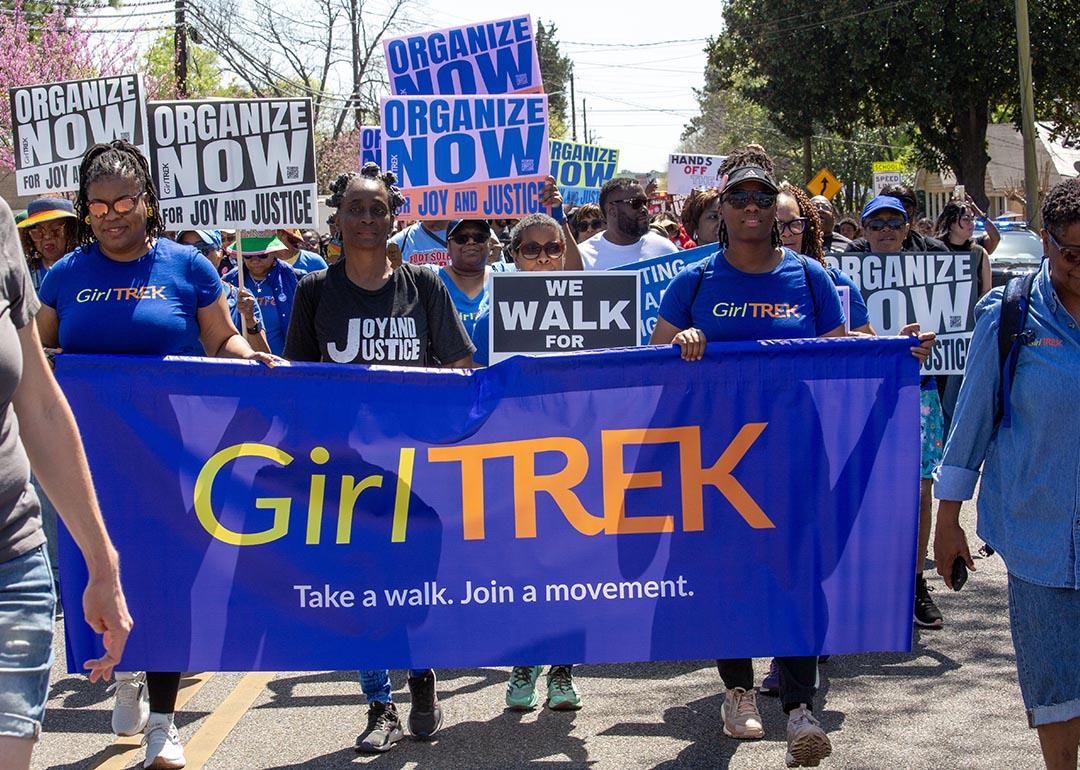
“When a Black pregnant woman walks through a park or sits under a tree, she’s not just relaxing — she’s reclaiming a piece of her health and her power,” said Keturah Queen, recruitment specialist at , a national health justice movement that aims to combat systemic racism and extend Black people’s lives through nature walks for women. “Nature gives us a chance to reset.”
Research shows link between green space and maternal health
Queen, 40, joined GirlTREK in 2016, when her first child turned 1. Hoping to lose weight and connect with like-minded women, she began walking regularly and along the way, cultivated a deep love for nature.
“When I got involved with GirlTREK, I started to plan nature walks,” Queen said. “And then I found myself being at such a place of calm, feeling stress-free and just loving to be under the skies, or just in the grass, barefoot walking — different things that brought me joy.”
A 2023 study led by a multidisciplinary team of researchers from the , among other institutions, found a measurable link between green space and maternal mental health. Analyzing more than 415,000 singleton births in Southern California, researchers found that for every 10% increase in visible street-level greenery, the risk of postpartum depression dropped by more than 4%.
One in eight women who have recently given birth experience symptoms of postpartum depression, according to the , and . Without treatment, the condition can affect a mother’s well-being, her ability to care for her baby, and even the child’s development, including sleep, feeding, and behavior.
The health impacts of green space also extend to physical complications during pregnancy. Pregnant women residing in urban areas with sparse tree coverage face more than twice the risk of such as preeclampsia, a study by the found.
Preeclampsia — a condition that typically develops after 20 weeks of pregnancy involves high blood pressure and can lead to organ damage — affects about , and than white women to develop it.
The same study found that those living within 100 meters of areas with less than 10% tree canopy had more than twice the odds of developing complications related to hypertension — especially non-Hispanic Black women — compared to those living near green spaces with more than 30% tree cover.
Black neighborhoods across the country have steadily lost trees over the years — a trend driven by environmental neglect, which closely ties to the legacy of housing discrimination.
“People who are Black, people who have historically been marginalized, live in neighborhoods that continue to experience disinvestment and dispossession,” said Dr. Max Jordan Nguemeni, an assistant professor in general internal medicine and health services research at the David Geffen School of Medicine at the University of California, Los Angeles.
In his latest research, Nguemeni is examining whether there is a direct link between tree canopy coverage and health outcomes before and after pregnancy in underserved Black neighborhoods. He and his team began by analyzing data from a tree-planting initiative in Philadelphia, where some predominantly Black neighborhoods received new trees and others with similar demographics did not.
Nguemeni’s study aims to determine whether differences in green space impacted not just the broader Black community, but Black pregnant women in particular.
This focus on environmental factors and the effects of these disparities resonates deeply with Michele Akosua Chin-On, a New York City doula, private duty nurse, and co-founder of . She has witnessed firsthand how environmental and systemic stress affects Black mothers — from elevated cortisol and blood pressure to lower vitamin D levels linked to depression and higher-risk pregnancies.
“These inequalities are like a visceral pain,” she said. “It’s proof that Black women are not heard, taken care of and seen. If you nurture a mother, you nurture a nation.”
GirlTREK recruiting for Harlem walking group
Chin-On is committed to helping Black women reconnect with nature throughout their motherhood journey — a message she often shares with the women she supports, including 26-year-old Amanah Brookins, whom she encourages to spend time outdoors, especially during her postnatal recovery period.
“When you walk out in nature, and you’re touching Mother Earth, and you’re looking up, you see that you’re part of the moon, you’re part of the sunshine, you’re part of life,” Chin-On said. “When you see flowers actually reproducing these beautiful buds, that’s symbolic. You’re one with the universe and one with motherhood.”
Brookins, along with her husband and firstborn, used to live in Jamaica. Her home there was surrounded by a river, a garden, and a plethora of trees.
“Getting that fresh air and that sun on your skin not just prepared my body physically, but just lifted my mood,” she said.
But in September 2024, early in her pregnancy with her second child, Brookins moved back to New Jersey and began working 11-hour shifts at a call center in Essex County.
“By the time you get out of work, it’s already dark outside. You haven’t spent any time in the sun,” Brookins said. “You’re just behind a desk all day, and it’s not only just the physical aspects of having pains throughout the day, like your feet swelling up, but just mentally and emotionally, it’s taxing.”
Determined to maximize her income before her baby’s arrival, Brookins delayed starting maternity leave until less than two weeks before giving birth — a difficult choice, as the long indoor hours had become a source of increased loneliness and stress.
As GirlTREK, founded in 2010, expands, Queen is recruiting for a new Harlem walking group specifically for Black mothers, who she said because of pressures and responsibilities are vulnerable to “the three deadly I’s: isolation, inactivity, and injustice.”
“We find that women who are in isolation, their health is failing more, because they feel like they’re doing it by themselves,” she said. “They’re overwhelmed, they’re stressed out, and some of them don’t have an outlet.”
Walking with a “sister friend” alleviates stress, boosts social skills, and motivates women to have a set structure, as well as an accountability partner — fostering trust and deepening their connection with nature, Queen said.
“How many times do we just not feel like it? But if you have someone who’s encouraging you, pulling you along, that’s just life-saving within itself.”
Queen, Lowe, and Brookins — alongside organizations like and — emphasize that the movement to connect Black pregnant women with nature must go beyond individual healing. They are demanding urgent policy changes that confront the environmental consequences of structural racism. They call for halting development in urban green spaces and investing in community gardens, parks, and walkable areas that support Black families’ health and well-being.
Lowe’s advocacy for environmental justice was strengthened by negative medical experiences she had during her pregnancy. Her doctor kept warning her about potential complications as a Black woman, statements that felt impersonal and disconnected.
“The doctor kept telling me these things that were statistics around my age, around like just being Black and the things that could happen, all these risk factors,” Lowe said. “And in the last conversation I had with the doctor, I was just like, ‘Are you talking about me, or are you talking about the statistics? Because I’m in great health.’”
Nature became her remedy, a break from the unjust but common realities Black women across the United States face within the health care system. During checkups and even in labor, Lowe’s heart rate never spiked — something she attributes to the calming effects of her connection to nature.
“It helped to regulate both me and my baby,” she said.
This story was produced in partnership with the Health & Science Reporting Program at the .
was produced by and reviewed and distributed by Â鶹ԭ´´.