How states are helping residents with independent living disabilities
This story originally appeared on Foothold Technology and was produced and distributed in partnership with 麻豆原创 Studio.
How states are helping residents with independent living disabilities
It's not just the very old鈥攆or a growing number of American adults, completing basic errands can be anything but a simple daily task.
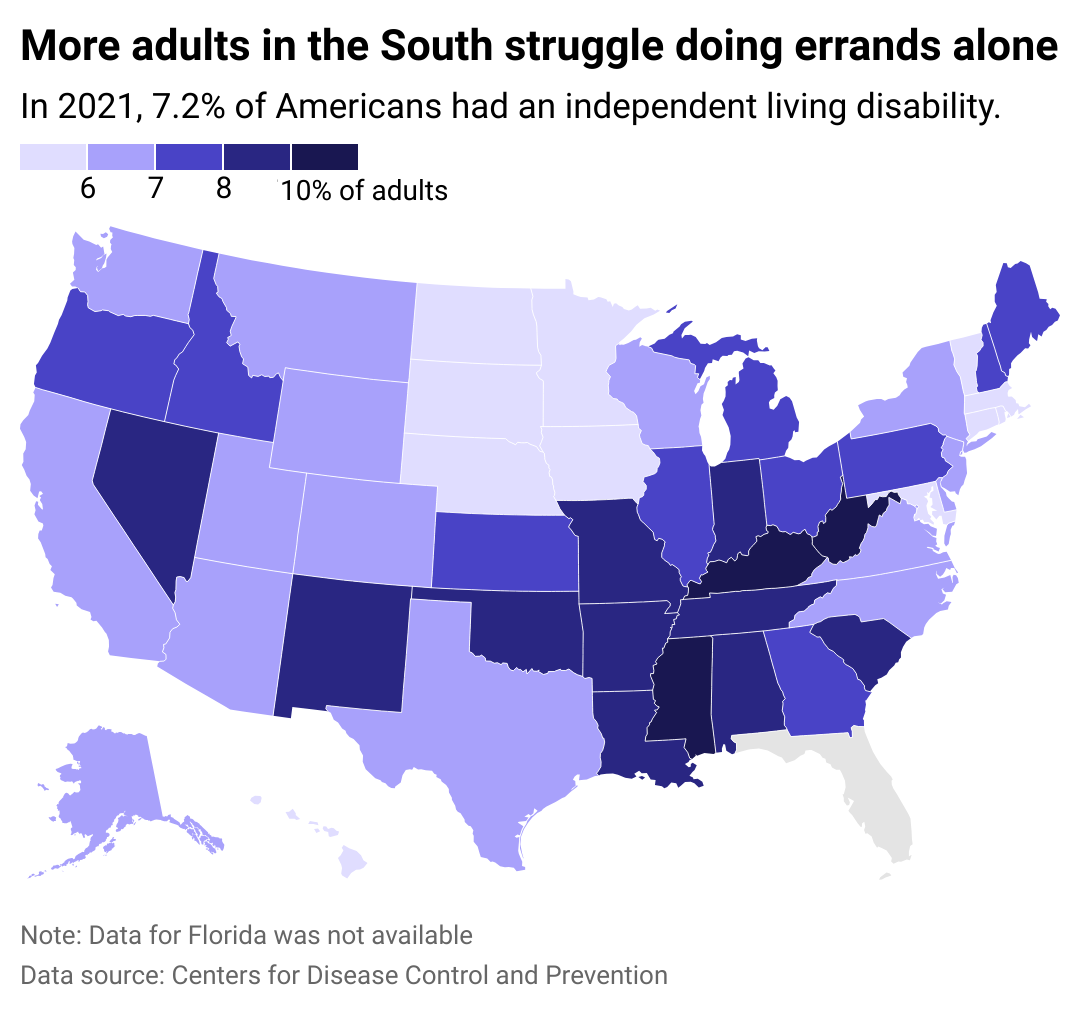
More and more Americans report difficulty doing errands alone, , or doing other daily tasks necessary to live. According to the Centers for Disease Control and Prevention, as of 2021, have what's considered an independent living disability. The CDC includes people in this group if they self-report having that prevents them from doing errands alone.
Each state can play an essential part in closing the gap. examined data to determine which states had the most residents with independent living disabilities in 2021 and how that number has changed since 2016, and explored several ways states are helping this population live more independently.
There is federal help available for some of these efforts. In September, the Education Department announced nearly to help individuals with disabilities transition to life after high school. The funding is part of a patchwork of programs offered at the state level across the United States.
States with the most residents with independent living disabilities
Many states are working to help their residents with disabilities gain more control over their health care, employment, community participation, and other aspects of their daily lives.
California's Independent Living Programs focus on in people with disabilities to offer them more independence. Short-term and long-term assistance is available depending on people's needs.
In Texas, some local school districts are partnering with nearby universities to allow young adults with disabilities to , aiming to improve their employment prospects as they transition out of high school. In addition to skills training to enhance their employability, they also engage in peer-to-peer recreation.
A Wisconsin funded by the American Rescue Plan Act disperses funds for residents to improve their ability to live long-term in their homes. Recipients can use the money toward , including specialized medical equipment, moving services, home modifications, financial management, or personal emergency response systems.
The varying ways states have decided to approach these challenges show how independence can have drastically different meanings for each person, depending on their unique circumstances.
Read on to see which states had the most significant increase in residents with independent living disabilities from 2016 to 2021.
#10. Idaho
- Share of adults with independent living disabilities: 7% (up 1.2 percentage points from 2016)
#9. West Virginia
- Share of adults with independent living disabilities: 11.4% (up 1.5 percentage points from 2016)
#8. Ohio
- Share of adults with independent living disabilities: 7.9% (up 1.6 percentage points from 2016)
#7. Virginia
- Share of adults with independent living disabilities: 6.7% (up 1.7 percentage points from 2016)
#6. Indiana
- Share of adults with independent living disabilities: 8.2% (up 1.8 percentage points from 2016)
#5. Utah
- Share of adults with independent living disabilities: 6.5% (up 1.8 percentage points from 2016)
#4. Kansas
- Share of adults with independent living disabilities: 7.1% (up 1.8 percentage points from 2016)
#3. Illinois
- Share of adults with independent living disabilities: 7.4% (up 1.9 percentage points from 2016)
#2. Alaska
- Share of adults with independent living disabilities: 6.3% (up 2 percentage points from 2016)
#1. Wisconsin
- Share of adults with independent living disabilities: 6.5% (up 2.2 percentage points from 2016)
Story editing by Jeff Inglis and Ashleigh Graf. Copy editing by Kristen Wegrzyn.