A Muslim youth center in Brooklyn is helping teens connect mental health to faith
Jana, a public affairs student at Baruch College, was raised in a devout Muslim family but had stopped coming to the mosque in high school.
Her family frequented the Muslim American Society Youth Center in Bensonhurst, Brooklyn throughout her childhood. She recalls fond memories of running around the center’s prayer area at eight years old. It was like a second home. But by high school, she found herself retreating from the space. She was struggling with mental illness and feeling distanced from her religious upbringing.
“I’ve always dealt with issues of depression, anxiety, self-harm, the works,” said Jana, now 20, who began cutting herself at around 12 years old. Her last name is being withheld to protect the privacy of sensitive health information. “And in immigrant households, typically they don’t believe in [treating] mental health, or they’d rather you pray about it instead of going to therapy. They say ‘why speak to someone when you can speak to God?’”
In July 2022, while visiting the center with her mother, Jana came across a pop-up event hosted by the center’s Social Services Department. Tables were stationed in the center’s lobby with resources for self-care and mental health support. It jumpstarted a change in her life.
At her mother’s suggestion, she signed up for a referral and was paired with a therapist. She was later diagnosed with bipolar disorder, and the services she found were the catalyst for how she manages her mental health today. It has been over two and a half years since she’s harmed herself, she said, she has a better grasp on her manic episodes and impulsiveness, and feels more connected to her faith than ever.
Jana now leads mental wellness programming under the very Social Services Department that connected her with crucial mental health resources. Her story is not uncommon and reflects an ever-present need for culturally competent mental health support, reports.
Muslim Americans face barriers to care
Across New York and the United States, for mental distress, often worsened by stigma, generational gaps, and limited access to culturally aligned care.
These challenges are compounded by broader societal issues, including lingering effects of executive order from President Donald Trump in 2017 and increased scrutiny of Muslim Americans in the wake of . Many Muslims, like Jana, come from families where , seen less as a medical condition and more as a test of faith.
Recent research shows Muslim Americans experience rates of anxiety, depression, and mood disorders similar to the general population, but they face unique barriers in accessing care. A found that about 15% of Muslim Americans had a lifetime mood disorder, and 10% had a lifetime anxiety disorder, rates comparable to other groups. Yet fewer sought help, with pointing to stigma, experiences of discrimination, and mistrust of a mental health system seen as lacking cultural and religious competence.
“The problem with Muslims in America is that we are often dehumanized,” said Ayah Issa, a licensed clinical social worker and trauma therapist based in Astoria, Queens. “You start to create stories about them based on what you were taught in this white-centric country, rather than letting that story come from the person in front of you.”
Nationally, nearly half of U.S. religious congregations offer some form of mental health programming — up from 23% in 2012, according to research from Duke University’s National Congregations Study. In New York, local efforts have followed suit, with the state’s Office of Mental Health partnering with faith leaders to develop faith-based initiatives and city-based nonprofits increasing behavioral health offerings tailored to immigrant and religious communities. These broader shifts toward faith-based mental health support mirror what’s happening at the MAS Youth Center.
The center formalized its Social Services Department in October 2020, initially launching as a virtual response to the mental health fallout of COVID-19. It was founded with the main goal of psychoeducation, sharing information and connecting community members with mental health resources. In the earliest days, the department operated online, offering virtual office hours, now done in-person on Saturdays, and a digital therapy referral system.
Upon transitioning to in-person programming, they faced struggles, including staffing the department with enough committed volunteers, overcoming widespread stigma around mental health, and targeting core MAS community members.
“[It] made it difficult for people to come to our events. We had people who were interested in mental health, but it was very slow. And the people we were getting at our events weren’t the people at the MAS Youth Center,” said Roua Eltayeib, one of the department’s co-directors.
In response, the department shifted to meet the community where it was, organizing pop-up tables outside of halaqahs (religious study circles) and other center events. The first major in-person programming, including grief circles and Mental Health Mondays, began to break down barriers and draw broader participation, especially after a widely attended grief circle in 2021 in response to the loss of a young beloved community member to substance use. Over time, this outreach helped the department become not just a referral hub, but a trusted fixture in the center’s landscape.
“Trust is built through presence,” said Somer Saleh, the other department co-director. “We make it a point to show up regularly in spaces where young people already are, at prayer, and all of their events, whether it’s a regular Friday [gathering] or an annual revival.”
The Social Services Department is facilitated by a team of seven, and both co-directors, Saleh and Eltayeib, are licensed marriage and family therapists. The department runs programming in four broad areas: mental wellness, family wellness, preventative advocacy (focused on issues of domestic violence and substance use), and special needs.
Youth Center works to connect personal growth to faith
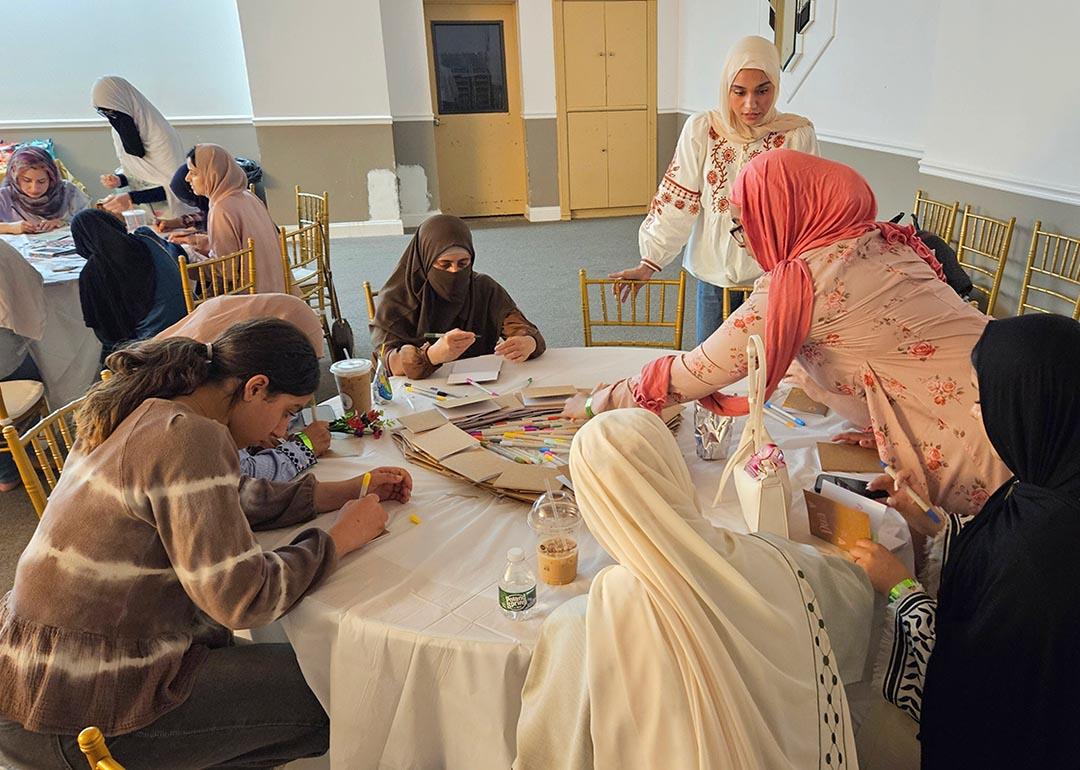
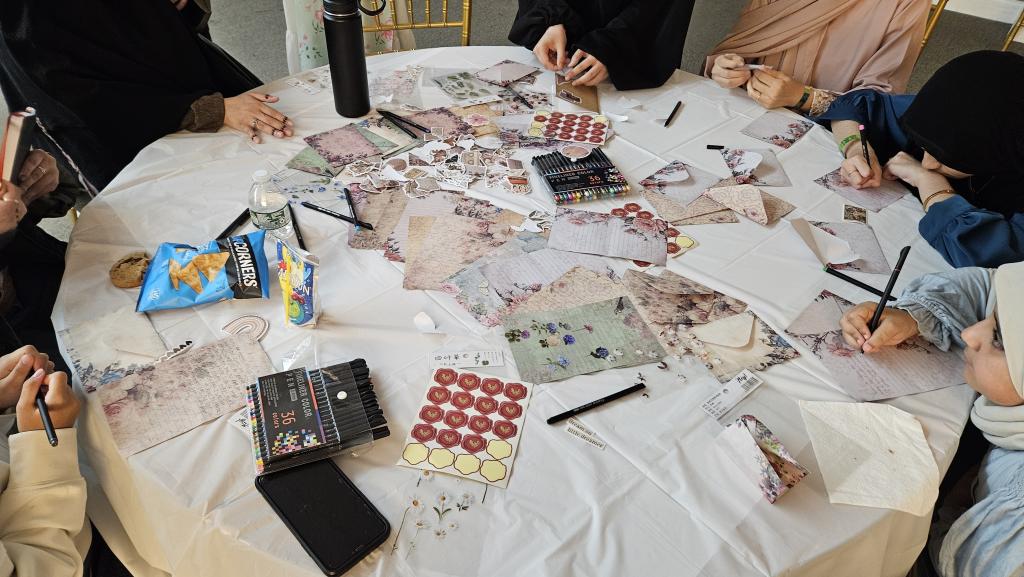
An important factor in departmental planning is the Islamic concept of tarbiyyah, or spiritual development, emphasizing personal growth in connection to faith. An illustration of this can be seen at the Sisters Self-Care Night, a recurring event that combines creative activities with intentional conversations grounded in Islamic teachings.
At the July gathering, women and girls of all ages sat at round tables and bonded over conversation as they painted, made floral arrangements, got henna tattoos, and wrote du’aa (prayer) journals and letters to themselves. These activities were then momentarily paused for a communal prayer break, followed by a halaqah, where everyone gathered to reflect on a brief talk by Saleh about the religious importance of rest.
“Slowing down is not a luxury. It is actually a part of our deen [religion],” she said, describing rest as an “act of worship” and referencing the Islamic teaching that “our bodies have a right over us.”
Amina Barnes, an educator in early intervention who lives in Bedford Stuyvesant, Brooklyn, is one of many attendees finding community and a sense of spiritual grounding at the MAS Youth Center.
“I loved the self-care night,” she said. “The brief talk on rest as worship really stayed with me. It affirmed something I already knew in my spirit, but hearing it out loud in that setting made me feel truly seen.”
As a single mother of three sons, each with different neurodivergent needs — Asperger’s syndrome, autism, and ADHD — Barnes said the center and its environment were what she had been praying for, describing the space as “emotionally aware and religiously sound.”
The impact of this sense of belonging is echoed in research. A from the National Alliance on Mental Illness highlights community connection as a protective factor against mental illness and aid in reducing stigma. show that mosque-based programs can build trust, improve access to culturally competent care, and normalize help-seeking.
“When we talk about breaking the stigma, that looks like creating a community. People need to be able to connect, to hug each other, make plans with each other, celebrate each other. Those are the things that are incredibly important in helping manage and navigate mental health gaps,” Issa said.
For Jana, that community has not only been a source of healing but also a place to give back.
“When you walk into a masjid [mosque], you’re not expecting to see a Social Services Department. It’s so interesting and honestly groundbreaking,” she said. “I was attracted to it because I wanted to be a part of it.”
This story was produced in partnership with the Health & Science Reporting Program at the .
was produced by and reviewed and distributed by Â鶹ԭ´´.