This state's kindergarten vaccination rates decline as more parents claim exemptions
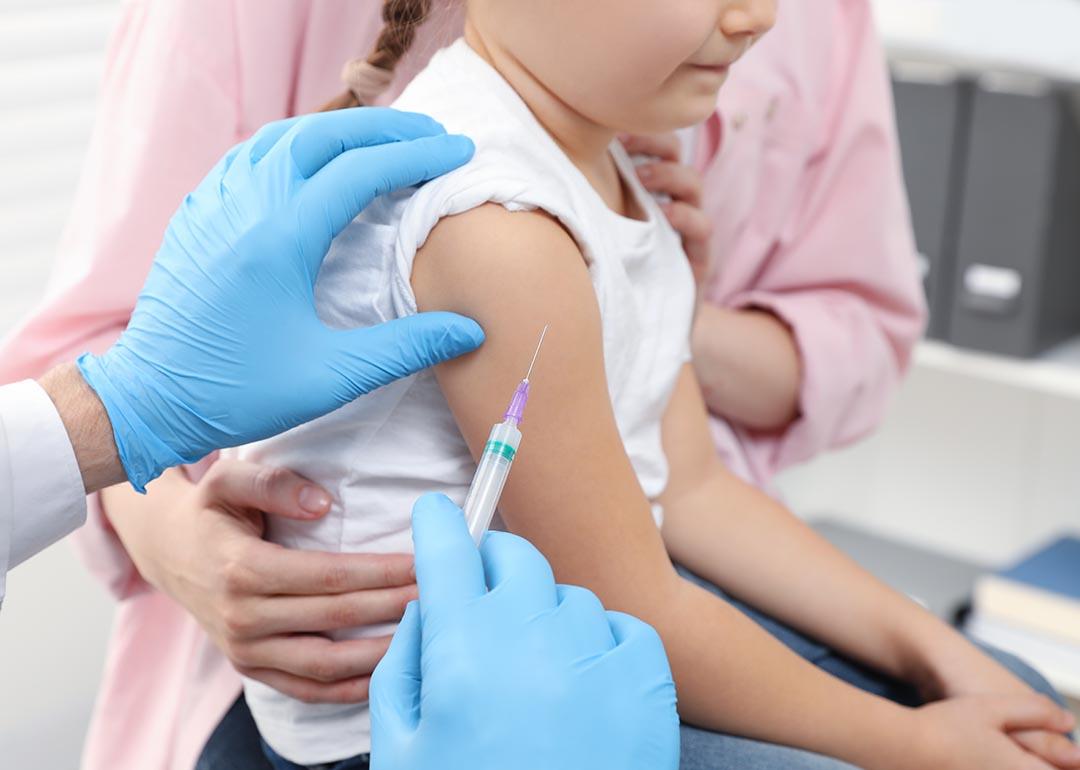
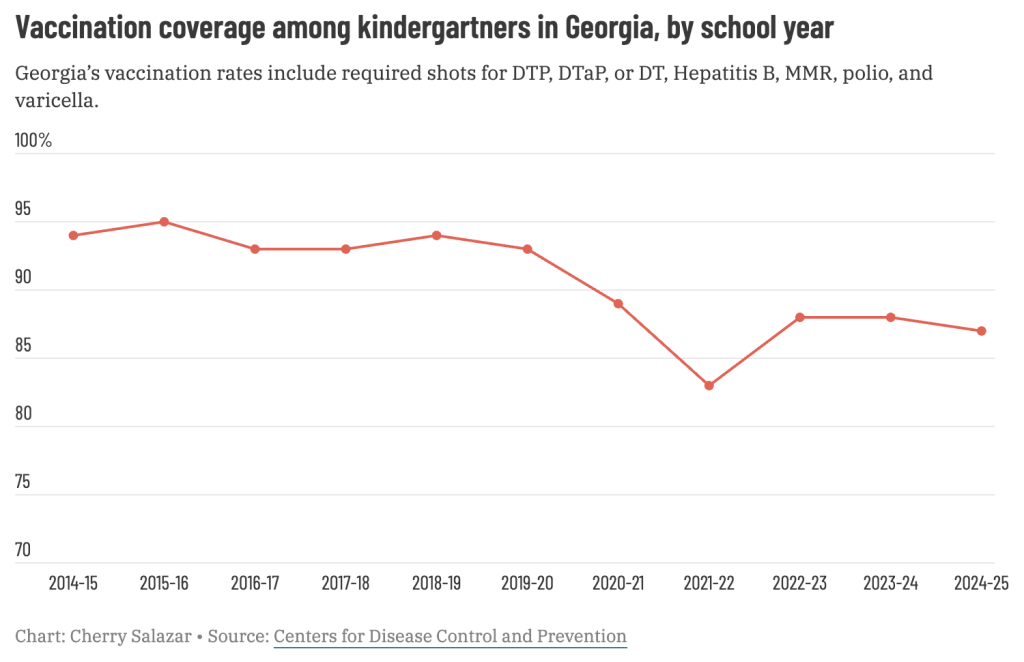
New childhood vaccination data from the U.S. Centers for Disease Control and Prevention show that Georgia vaccination rates are decreasing, with 86.8% of the state’s children fully up-to-date on their required vaccines when they entered kindergarten last year.
The state’s exemption rate is also on the rise, at 4.8%, with most granted for religious rather than medical reasons. But that’s not the whole story. Some public health experts say the remainder of unvaccinated children likely includes some who weren’t able to access the shots, reports. It’s hard to know for sure because data released by the state Department of Public Health is limited.
The falling vaccination rates raise concerns as children return to school this week, and the United States sees the highest number of measles cases since the early 1990s, according to . Georgia has reported this year, all in unvaccinated people. Those cases were contained to members of two families.
According to CDC data released last week, Georgia has the lowest rate for the measles, mumps, and rubella vaccine uptake among Southern states, trailing behind Alabama, where the rate for MMR is 95.2%, and Mississippi, where it is 97.6%.
It’s a matter of time before the state faces a serious measles outbreak, said Scott Thorpe, a former public health official in South Carolina and Georgia who serves as executive director of the Southern Alliance for Public Health Leadership.
“What these numbers mean is that we have a growing vulnerability to disease outbreaks,” said Jodie Guest, a professor of epidemiology at Emory University. “Georgians should be very concerned that our kids are not going to be as well protected.”
Exemptions increase amid ‘swirling’ misinformation
Georgia has one of the highest vaccine exemption rates in the South, at 4.8%, or about 5,535 kindergartners. That’s second to only Florida at 5.1% and far higher than neighboring Alabama at 2.3%.
Most exemptions for last year’s entering kindergarten class — 4.7% — were for religious and not medical reasons, which made up just 0.1%.
Under Georgia law, if parents want to claim a religious exemption, they must file an affidavit with the child’s school or child care facility affirming that “vaccination is contrary to my religious beliefs, and that my objections to vaccination are not based solely on grounds of personal philosophy or inconvenience.”
Guest attributed the falling vaccine and rising exemption rates to “swirling inaccurate information” about the safety and efficacy of vaccines.
“We are still in our state not doing a great job of addressing the inaccurate information that is out there about vaccines,” she said. That’s been fueled by top health leaders questioning the efficacy of vaccines, Guest said, referring to U.S. Health and Human Services Secretary Robert F. Kennedy Jr., who has opposed vaccines.
Kennedy of the CDC’s Advisory Committee on Immunization Practices, which develops recommendations for childhood and adult vaccines, and replaced them with people whose expertise has been questioned by groups including the . Several professional medical societies, including the American Academy of Pediatrics, the HHS over changes to vaccine policy.
“Sometimes it’s a lack of accurate information that’s easy for parents to understand and digest, or a relationship with a trusted health care provider to communicate that information,” said Melissa Haberlen DeWolf, research and policy director at Voices for Georgia’s Children, a nonprofit advocacy group.
There’s also about the harms of deadly childhood diseases that have been eliminated in the United States.
“People tend to forget that the reason we haven’t seen many of these illnesses is because of widespread vaccination,” DeWolf said. “Diseases like polio have been eradicated in the U.S. thanks to decades of successful vaccination efforts, and we cannot take that progress for granted.”
Access to health care plays a role in vaccination rates
Exemptions aren’t the only reason children may lack immunization, Thorpe said. Some Georgia families face barriers to accessing the shots.
“I don’t think that’s being driven exclusively by ideology or personal beliefs or religious beliefs. A lot of what’s driving that is kids struggling with access to health care, and their families struggling with access to health care,” Thorpe said.
“If you’re a mom or a dad dealing with living in an , you just know that getting your kid vaccinated is just not going to be priority number one,” Thorpe said. “You’ve got a lot of other things in your life that make it hard to get your kid vaccinated.”
Many health department clinics and doctor’s offices have limited hours that make it tough for working parents — especially those without reliable transportation — to get their children to appointments, Thorpe said.
The federal Vaccines for Children program provides free vaccines to un- and under-insured children. But not all pediatricians are registered with the program, Thorpe said.
Chattahoochee County, near Columbus, had the lowest MMR vaccination rate for children between 19 and 35 months in Georgia, at 66.1%, according to the available from the state DPH, from the third quarter of 2023. (Children get two MMR vaccines, between 12 and 15 months of age and between ages four and six years.)
According to state data, Chattahoochee County has one provider enrolled in Vaccines for Children, Thorpe said.
“The counties with some of the lower vaccination rates also have access issues,” Thorpe said. “It’s not the only issue — but it’s certainly one …. There are 23 other counties in Georgia in the same boat.”
His organization plans to work in South DeKalb County to learn where the gaps are and try to increase access, he said.
“We know from data from a that vaccine coverage is lower among uninsured children, and uninsured children are more likely to live below poverty level, have no health care visits in previous 12 months, and be less likely to receive follow-up doses of multidose vaccines,” if they got the first dose, Guest said. “Access is always an issue.”
Georgia releases limited data on child vaccination
Thorpe and others said more granular data from the state about the number and location of unvaccinated children would help better target areas of need. “The data we have in Georgia (beyond that headline statewide number) is pretty limited,” he said.
The new CDC data is based on states’ self-reports, and Georgia doesn’t follow the same methods as many others, reporting only whether entering kindergarteners are fully compliant with all vaccines, instead of vaccine-specific data. For example, a child missing one shot would be categorized as unvaccinated.
For this reason, Georgia’s vaccination rate for the MMR, polio, DTAP (diphtheria, tetanus and pertussis), chicken pox, and Hepatitis B are all listed as 86.8%, down from 88.4% for the prior year. A decade ago, the rate was 94% in Georgia, according to the CDC.
The state DPH has posted online only immunization reports by county for children ages 19 to 35 months, not for older children like those entering kindergarten. Those reports have not been updated since the third quarter of 2023.
The state is in the process of updating the information, DPH spokesperson Nancy Nydam Shirek said. It collects detailed vaccination information via its online Georgia Registry of Immunization Transactions and Services.
“The data hasn’t been posted online yet because epidemiologists were improving the data cleaning process, adding geocoding, and changing how coverage by insurance was calculated,” Nydam Shirek said. “They are finalizing their review of the reports and will prioritize publishing them online once they receive final review and approval from leadership.”
Nydam Shirek provided Healthbeat with a report on vaccination rates for young children for the entire state, but not each county, as of June 30, 2025. It shows that 87.2% of children ages 19 to 35 months in the second quarter of 2025 had received the MMR vaccine.
In comparison, neighboring states and post data about kindergarten vaccinations at the school level.
Detailed, local-level data is important because “vaccination behavior and vaccine exemption behavior is a very socially and spatially clustered behavior,” Alison Buttenheim, a professor at the University of Pennsylvania’s nursing school said during a June media briefing. “We tend to see it in clumps.”
was produced by and reviewed and distributed by Â鶹ԭ´´.